
What’s Observed on January 25
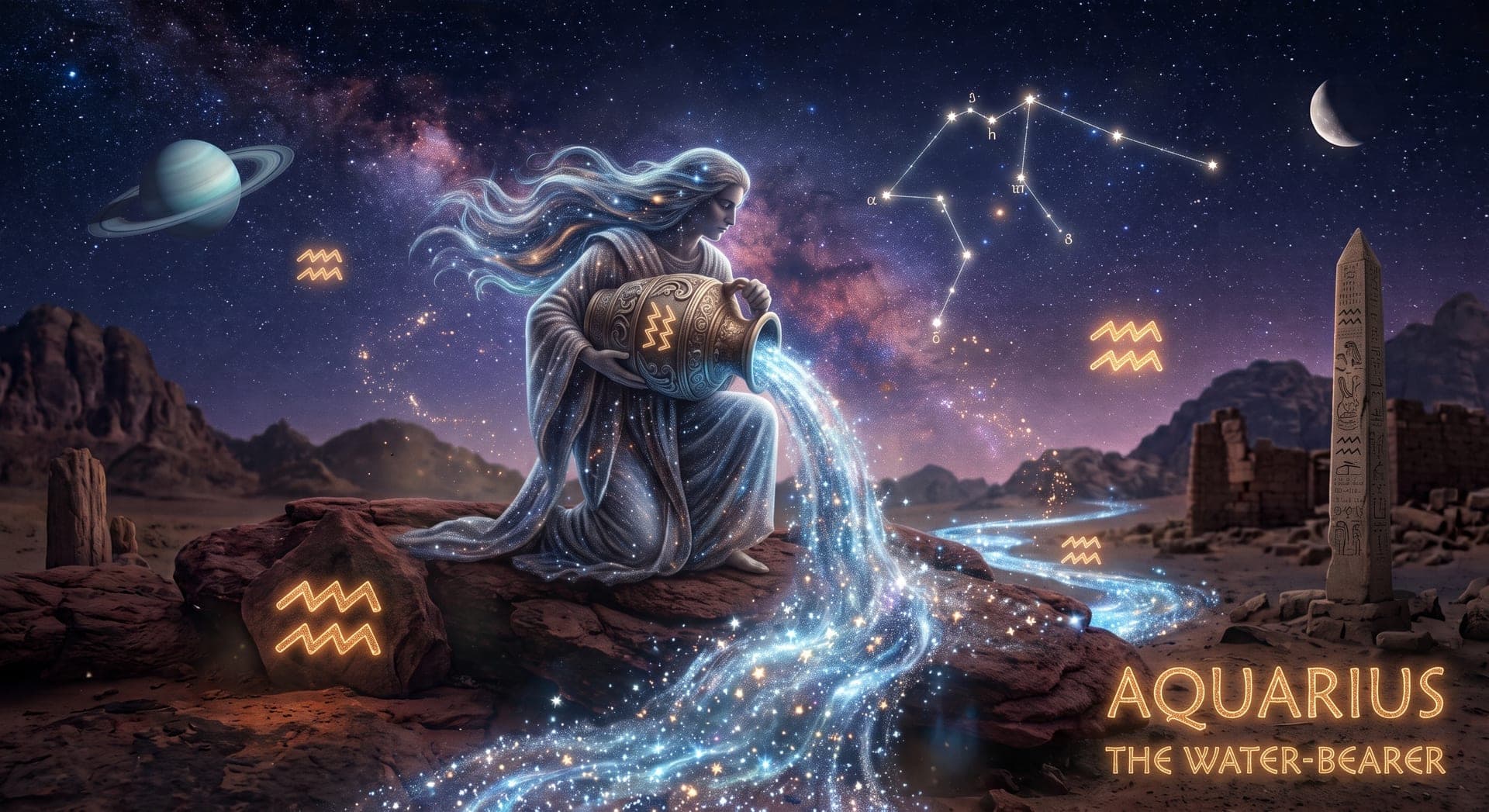
Born on January 25: Aquarius ♒
Aquarius, the eleventh sign of the zodiac, spans January 20 to February 18 and is symbolized by the water bearer, an image of someone pouring out knowledge and life-giving ideas to the world, despite Aquarius actually being an air sign rather than a water sign. Traditionally ruled by disciplined Saturn and, in modern astrology, by unpredictable Uranus, the planet of innovation and rebellion, Aquarius carries a distinctive blend of structure and originality. People born under this sign are often described as independent thinkers, forward-looking, and drawn to humanitarian causes, valuing the collective good over convention. As a Fixed sign, Aquarius can be famously stubborn once its mind is made up, even while championing change for everyone else. Intellectually curious and sometimes emotionally guarded, Aquarians tend to value friendship and community deeply, often serving as the visionary of their social circle, more comfortable debating ideas than discussing feelings.
Personality Traits
Strengths
- Original and forward-thinking
- Strong sense of fairness and justice
- Independent and self-sufficient
- Loyal to friends and causes alike
- Sees the bigger picture others miss
Weaknesses
- Can run from emotional expression
- Uncompromising once a position is fixed
- Prone to aloofness or detachment
- Sometimes contrarian just to stand apart
- Can prioritize ideas over people's feelings
Compatible Signs
Fun Facts
- Despite its watery name and imagery, Aquarius is classified as an air sign, grouped with Gemini and Libra as a sign of thought and communication rather than emotion.
- Aquarius has two ruling planets: Saturn in classical astrology, and Uranus, discovered in 1781, in the modern system most Western astrologers use today.
- The water bearer symbol traces back to Ganymede in Greek mythology, a cupbearer to the gods said to pour out a life-giving stream from the heavens.
- Notable Aquarians include Oprah Winfrey, Abraham Lincoln, Charles Darwin, Thomas Edison, and Bob Marley.
- Aquarius is one of the rarer signs to be represented by a person rather than an animal or object, alongside Gemini, Virgo, and Sagittarius's centaur half.
Born on January 25
- 1759
Robert Burns
Scottish poet and songwriter celebrated for works like "Auld Lang Syne" and "Tam o' Shanter", regarded as the national poet of Scotland
- 1796
William MacGillivray
Scottish ornithologist and naturalist known for his detailed studies of British birds
- 1841
John Fisher, 1st Baron Fisher
English admiral who modernized the Royal Navy and championed the Dreadnought battleship
- 1874
W. Somerset Maugham
British playwright and novelist
- 1882
Virginia Woolf
English novelist and essayist known for modernist works like Mrs Dalloway and To the Lighthouse
- 1915
Ewan MacColl
English folk singer-songwriter known for "Dirty Old Town" and "The First Time Ever I Saw Your Face"
- 1927
Antonio Carlos Jobim
Brazilian composer, a founder of the bossa nova genre
- 1933
Corazon Aquino
11th President of the Philippines
- 1949
Paul Nurse
English geneticist and Nobel laureate known for his research into cell cycle regulation
- 1951
Steve Prefontaine
Celebrated American long-distance runner
- 1978
Volodymyr Zelenskyy
President of Ukraine and former actor and comedian
- 1981
Alicia Keys
Grammy-winning American singer-songwriter and pianist

On This Day in History
- 750
Abbasid forces defeat the Umayyad Caliphate at the Battle of the Zab, ending Umayyad rule and beginning the Abbasid Caliphate.
The Abbasid victory at the Zab river, aided by superior tactics and disillusionment among Umayyad troops, ended the Umayyad dynasty's near century-long rule over the Islamic caliphate. The Abbasids soon moved the caliphate's capital to the newly founded city of Baghdad, ushering in an era often remembered as the Islamic Golden Age of science, philosophy, and culture.
- 1327
Edward III ascends the throne of England at age fourteen after his father is forced to abdicate.
Edward III's father, Edward II, had been forced to abdicate amid political turmoil and was likely murdered in captivity shortly afterward. The young king initially ruled under the regency of his mother, Isabella, and her lover Roger Mortimer, before seizing personal control at 17 and going on to launch the Hundred Years' War with France.
- 1327
Edward III ascends the English throne at the age of fourteen.
Edward III took the crown after his father, Edward II, was forced to abdicate amid a rebellion led by Queen Isabella and Roger Mortimer, who initially ruled as regents. Edward asserted personal control in 1330 by overthrowing Mortimer, and went on to reign for fifty years, launching the Hundred Years' War with France and reshaping English kingship and chivalric culture through institutions like the Order of the Garter.
- 1533
King Henry VIII of England secretly marries his second wife, Anne Boleyn.
Henry VIII's secret marriage to Anne Boleyn, conducted before his first marriage to Catherine of Aragon had been formally annulled, was a decisive step in his break from the Catholic Church, since the pope refused to grant the annulment. The resulting split led to the establishment of the Church of England, with Henry as its head, one of the most consequential religious ruptures in English history.
- 1533
Henry VIII secretly marries Anne Boleyn in London.
The marriage took place before Henry's union with Catherine of Aragon had been formally annulled, which followed in May that year. Anne was already pregnant with the child who would become Elizabeth I. The Pope's refusal to sanction the annulment pushed Henry toward breaking with Rome, culminating in the 1534 Act of Supremacy that made him head of the Church of England.
- 1585
Walter Raleigh is knighted, and the newly explored North American territory is renamed "Virginia".
Queen Elizabeth I knighted Raleigh for his role in organizing expeditions to explore and colonize North America, naming the region Virginia in her own honor as the unmarried "Virgin Queen." Raleigh went on to sponsor the ill-fated Roanoke colony, one of England's earliest attempts to establish a permanent settlement in the New World.
- 1791
The British Parliament passes the Constitutional Act, splitting the Province of Quebec into Upper and Lower Canada.
The act created Upper Canada, predominantly English-speaking and later Ontario, and Lower Canada, predominantly French-speaking and later Quebec, each with its own elected legislative assembly. It was Britain's attempt to balance the demands of Loyalist settlers who had fled the American Revolution with the existing French Canadian population, and it laid early groundwork for representative government in British North America.
- 1792
The London Corresponding Society, one of Britain's first working-class political reform organizations, is founded.
Founded by shoemaker Thomas Hardy, the society campaigned for parliamentary reform, including universal male suffrage, and was notable for admitting members regardless of social class at a time when reformist politics was largely the preserve of the wealthy. Inspired partly by the French Revolution, it was viewed with suspicion by the government and eventually suppressed under sedition and treason laws later in the decade.
- 1858
Mendelssohn's Wedding March is played at the marriage of Princess Victoria, the Princess Royal, in London.
Queen Victoria's eldest daughter married Crown Prince Frederick of Prussia at the Chapel Royal, St James's Palace. The ceremony's use of Felix Mendelssohn's processional, composed decades earlier as incidental music for A Midsummer Night's Dream, helped popularize the piece as a standard wedding recessional across Britain and, eventually, much of the English-speaking world.
- 1917
The British ocean liner SS Laurentic sinks after striking German mines off the coast of Ireland.
Requisitioned as an armed merchant cruiser during the First World War, the Laurentic struck mines laid by a German U-boat off County Donegal, sinking quickly in freezing waters with the loss of over 350 lives. The ship was carrying a substantial shipment of gold bullion, which became the subject of one of the most famous salvage operations of the twentieth century.
- 1924
The first Winter Olympic Games open in Chamonix, France.
The inaugural Winter Games in the French Alpine town of Chamonix featured events like figure skating, ice hockey, and bobsled, though it wasn't officially designated the "first Winter Olympics" until after the fact, since it was initially held as an International Winter Sports Week. Its success led the International Olympic Committee to establish separate, recurring Winter Games from then on.
- 1924
The first Winter Olympics opens in Chamonix, France.
Originally billed as an "International Winter Sports Week," the Chamonix games were later retroactively recognized by the International Olympic Committee as the first Winter Olympics. They featured events including figure skating, ice hockey, bobsleigh, and Nordic skiing, and established the pattern for the Winter Games that has continued, with occasional changes to scheduling, ever since.
- 1942
Thailand declares war on the United States and the United Kingdom.
Following Japan's invasion and occupation of Thai territory the previous December, the Thai government under Plaek Phibunsongkhram aligned itself with Japan and formally declared war on the Western Allies. Britain subsequently found itself fighting Japanese-aligned forces across Southeast Asia, including the defense of Malaya and Burma, as the wider Pacific War intensified in the months that followed.
- 1945
The Battle of the Bulge, the last major German offensive on the Western Front, ends in Allied victory.
German forces launched their last major offensive of World War II through the densely forested Ardennes region, aiming to split Allied lines and retake the port of Antwerp. American forces, notably at the besieged town of Bastogne, held out against fierce winter fighting and heavy casualties, and the battle's failure critically depleted Germany's remaining reserves ahead of the final Allied push into Germany.
- 1964
Blue Ribbon Sports, later renamed Nike, is founded by University of Oregon athletes.
Phil Knight and his former college track coach Bill Bowerman founded the company to import and sell Japanese running shoes, initially selling them out of the back of a car at track meets. The company was renamed Nike in 1971 after the Greek goddess of victory and grew into one of the largest and most influential athletic apparel companies in the world.
- 1971
Charles Manson and four members of his "Family" are found guilty of the 1969 Tate–LaBianca murders.
Manson, who never personally committed the murders himself, was convicted of orchestrating them through his cult-like "Family" of followers, who killed actress Sharon Tate and several others in a plot he believed would ignite a race war. The sensational trial captivated national attention and made Manson one of the most notorious criminal figures in American history.
- 1995
Russia nearly launches a nuclear counterattack after mistaking a Norwegian scientific rocket for an incoming missile.
A Norwegian scientific rocket, launched to study the aurora borealis, closely resembled the flight profile of a U.S. submarine-launched ballistic missile, triggering Russia's nuclear alert system and reportedly reaching President Boris Yeltsin, who had the launch codes ready before the rocket was identified as harmless. The incident remains one of the closest known calls to accidental nuclear war since the Cuban Missile Crisis.
- 2011
Mass demonstrations in Cairo mark the start of the Egyptian revolution.
Mass protests erupted across Egypt against President Hosni Mubarak's nearly 30-year authoritarian rule, driven by grievances over corruption, unemployment, and police brutality, inspired partly by Tunisia's recent uprising. Sustained demonstrations centered on Cairo's Tahrir Square continued for over two weeks and ultimately forced Mubarak to resign, part of the broader wave of uprisings known as the Arab Spring.
- 2011
The first wave of the Egyptian revolution begins with mass protests across the country.
Protests erupted in Cairo, Alexandria, and other cities on what was Egypt's National Police Day, part of the wider Arab Spring movement sweeping the region. Demonstrators demanded the resignation of President Hosni Mubarak, citing police brutality, corruption, and economic hardship. The eighteen-day uprising ultimately forced Mubarak from power on 11 February 2011, ending nearly three decades of rule.
- 2019
A mining dam collapses in Brumadinho, Brazil, killing 270 people.
A dam holding mining waste from an iron ore operation collapsed suddenly, unleashing a massive wave of toxic mud that buried nearby company buildings and a cafeteria full of workers during their lunch break. The disaster, one of Brazil's worst industrial accidents, led to criminal charges against mining company executives and prompted stricter regulation of similar dams nationwide.