
What’s Observed on January 19
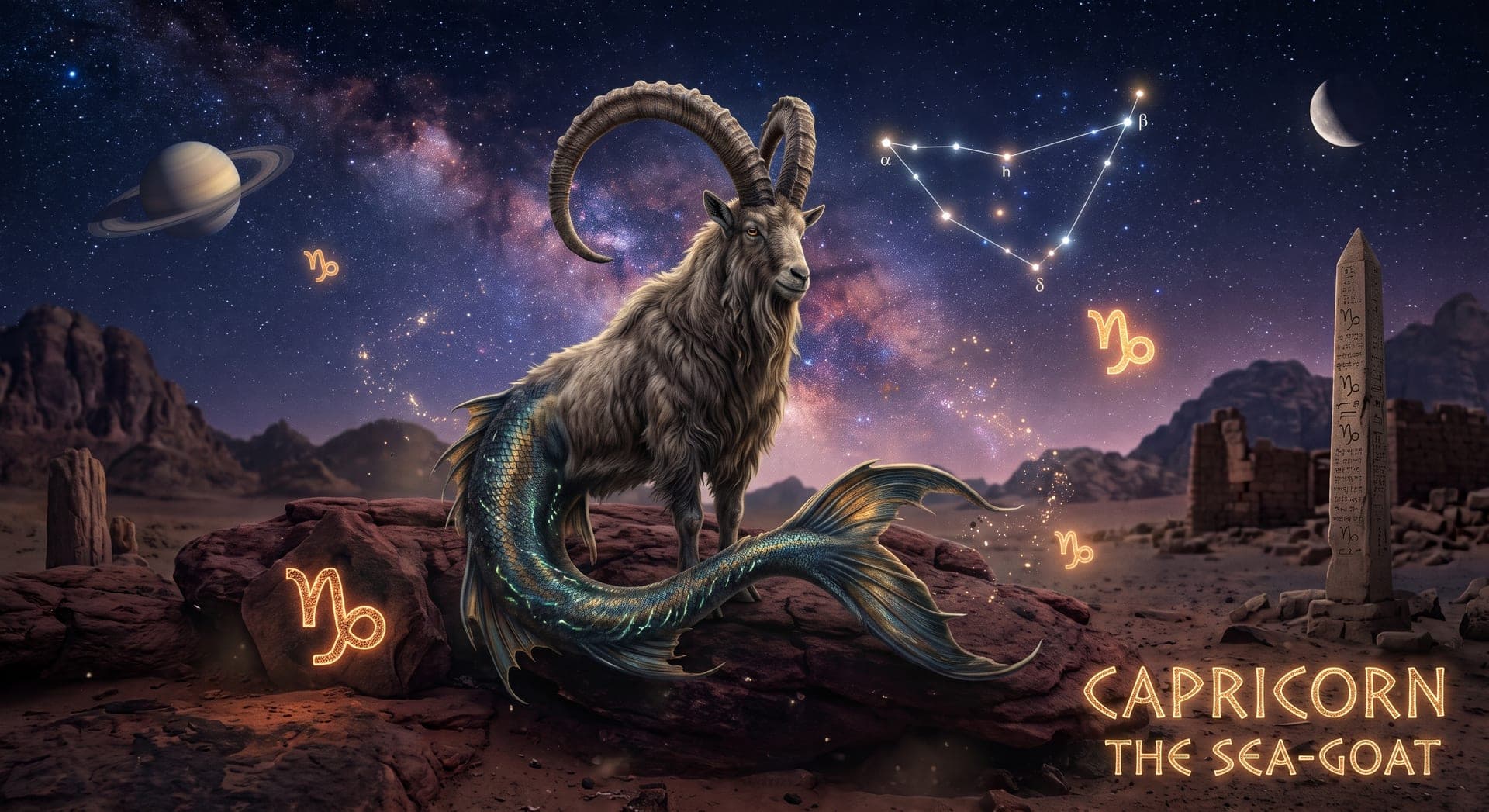
Born on January 19: Capricorn ♑
Capricorn, the tenth sign of the zodiac, spans December 22 to January 19 and is represented by the sea-goat, a mythical creature with the body of a goat and the tail of a fish, symbolizing an ability to navigate both the practical, earthly world and deeper emotional currents. Ruled by Saturn, the planet of discipline and time, Capricorns are often characterized as ambitious, patient, and deeply committed to long-term goals, willing to put in steady effort where others give up. As an Earth sign, Capricorn is grounded and practical, valuing tangible results and responsibility over impulsiveness. People born under this sign are frequently drawn to leadership and other structured pursuits where their organizational skills and work ethic can shine. Beneath a reserved, businesslike exterior, Capricorns are often said to carry a dry, understated sense of humor and a loyal, protective nature toward the people closest to them.
Personality Traits
Strengths
- Disciplined and self-controlled
- Responsible and dependable
- Excellent long-term planner
- Hardworking and persistent
- Good sense of humor once comfortable
Weaknesses
- Can be a know-it-all
- Unforgiving of mistakes, including their own
- Prone to pessimism
- Condescending toward those who don't work as hard
- Stubbornly resistant to changing plans
Compatible Signs
Fun Facts
- Capricorn's symbol, the sea-goat, comes from the Greek myth of Pan, who transformed his lower half into a fish tail to escape the monster Typhon while diving into the Nile.
- Saturn, Capricorn's ruling planet, was the Roman god of time, harvest, and generational structure, echoing the sign's association with patience and long-term thinking.
- Capricorn is one of only two zodiac signs represented by a hybrid creature, the other being Sagittarius, the centaur.
- Notable Capricorns include Michelle Obama, Martin Luther King Jr., Dolly Parton, LeBron James, and Isaac Newton.
- In traditional astrology, the winter solstice, the shortest day of the year, falls right at the start of Capricorn season in the Northern Hemisphere.
Born on January 19
- 1736
James Watt
Scottish engineer whose improvements to the steam engine were central to powering the Industrial Revolution.
- 1807
Robert E. Lee
Confederate general during the American Civil War
- 1809
Edgar Allan Poe
American writer known for pioneering gothic and detective fiction
- 1813
Henry Bessemer
English engineer and inventor of the Bessemer process, which made mass production of steel commercially viable.
- 1839
Paul Cezanne
French Post-Impressionist painter who influenced modern art
- 1848
Matthew Webb
English swimmer who became the first person to swim across the English Channel unaided.
- 1878
Herbert Chapman
English football player and manager whose tactical innovations at Arsenal helped shape the modern game.
- 1930
Tippi Hedren
American actress and animal rights advocate
- 1942
Michael Crawford
English actor and singer best known for creating the title role in the musical The Phantom of the Opera and for the sitcom Some Mothers Do 'Ave 'Em.
- 1943
Janis Joplin
Iconic rock singer of the 1960s
- 1946
Dolly Parton
American country music singer-songwriter and actress
- 1946
Julian Barnes
English novelist known for works including Flaubert's Parrot and the Booker Prize-winning The Sense of an Ending.
- 1949
Robert Palmer
English singer known for hits including Addicted to Love and his sharp, soul-influenced style.
- 1966
Stefan Edberg
Swedish tennis champion

On This Day in History
- 1419
Rouen surrenders to King Henry V of England, completing his conquest of Normandy.
Henry V's forces captured Rouen after a grueling six-month siege that starved the city's population, completing his conquest of the duchy of Normandy during the Hundred Years' War. The victory strengthened Henry's negotiating position, eventually leading to the Treaty of Troyes, which recognized him as heir to the French throne itself.
- 1419
The city of Rouen surrenders to King Henry V of England after a prolonged siege.
After a six-month blockade that starved the Norman capital into submission during the Hundred Years' War, Rouen's defenders capitulated to Henry V's besieging army. The fall of the city completed the English conquest of Normandy and strengthened Henry's position in negotiations that would soon see him recognised as heir to the French throne.
- 1764
Radical politician John Wilkes is expelled from the British House of Commons.
Already convicted of seditious libel for criticising King George III in his newspaper, and separately for an obscene publication, Wilkes was expelled from Parliament and later declared an outlaw after fleeing to France. His repeated re-election by Middlesex voters despite the ban turned him into a popular champion of press freedom and electoral rights, fuelling reform movements for decades.
- 1795
The Batavian Republic is proclaimed in the Netherlands, replacing the Dutch Republic.
French revolutionary forces, aided by a rare freeze that let cavalry cross the normally impassable Zuiderzee, invaded the Netherlands and helped Dutch revolutionaries overthrow the ruling House of Orange. The new Batavian Republic, modeled on revolutionary France, functioned largely as a French client state until Napoleon later replaced it with a kingdom under his brother Louis.
- 1817
An army led by General José de San Martín crosses the Andes from Argentina to liberate Chile from Spanish rule.
San Martín's army crossed multiple treacherous Andean mountain passes at extreme altitude, a logistical feat historians still marvel at, to surprise Spanish royalist forces in Chile. The campaign led to Chilean independence and set the stage for San Martín's later campaign into Peru, making him one of South America's most celebrated independence leaders alongside Simón Bolívar.
- 1839
The British East India Company seizes the port of Aden on the southern coast of Arabia.
A landing party stormed the strategically positioned port after its ruler refused to compensate the Company for a shipwreck plundered by local tribesmen. Aden's capture gave Britain a coaling station and naval base guarding the route to India, and the territory remained under British control for well over a century, long outlasting the Company itself.
- 1899
Britain and Egypt agree to jointly govern Sudan as the Anglo-Egyptian Condominium.
The agreement formalised British control over Sudan following the reconquest completed the previous year, establishing nominal joint rule with Egypt while real authority rested with a British governor-general. The arrangement lasted until Sudanese independence in 1956, and shaped the region's borders and administration throughout the colonial period.
- 1901
Queen Victoria is stricken with paralysis; she dies three days later after a 63-year reign.
Victoria's final illness came after a reign of 63 years, the longest of any British monarch up to that time, during which the British Empire expanded to cover roughly a quarter of the globe. Her death marked the symbolic end of the Victorian era and the ascension of her son, Edward VII, ushering in a new century and a shifting European political landscape.
- 1901
Queen Victoria is stricken with paralysis, three days before her death.
After more than sixty-three years on the throne, the elderly queen suffered a debilitating stroke at Osborne House on the Isle of Wight. Her condition rapidly worsened and she died on 22 January, ending the longest reign in British history to that point and bringing her son Edward VII to the throne, closing the Victorian era.
- 1915
German zeppelins bomb the English towns of Great Yarmouth and King's Lynn in the first aerial raid on Britain.
Two Zeppelin airships crossed the North Sea and dropped bombs on the Norfolk coastal towns, killing four civilians and causing panic far from the front lines of the First World War. The raid marked the beginning of a sustained German air campaign against British cities and forced Britain to develop home air defences for the first time.
- 1917
An explosion at a munitions factory in Silvertown, London, kills 73 people.
A fire ignited around 50 tonnes of stored TNT at the Brunner Mond chemical works in East London, producing a blast heard across much of southern England and destroying hundreds of nearby homes. The disaster, among the worst on the British home front during the First World War, prompted stricter regulation of munitions production near residential areas.
- 1920
The U.S. Senate votes against joining the League of Nations.
Despite President Wilson's leading role in proposing the League of Nations, the Senate rejected U.S. membership, largely over concerns that the League's collective security provisions could drag America into future foreign wars without direct congressional approval. The absence of the United States significantly weakened the League's effectiveness throughout the interwar period.
- 1941
The Royal Navy destroyer HMS Greyhound sinks the Italian submarine Neghelli in the Mediterranean.
Operating as part of Britain's naval campaign to control Mediterranean shipping lanes during the Second World War, Greyhound detected and depth-charged the Italian submarine, sending it to the bottom with the loss of its crew. The action was one of many small but steady naval victories that gradually eroded Italy's undersea fleet during the early years of the war.
- 1945
Soviet forces liberate the Łódź Ghetto, where fewer than 900 of its 200,000 original inhabitants had survived.
Soviet troops entering the Łódź Ghetto found only a small fraction of its original population still alive, most having died from disease and starvation or been deported to extermination camps, chiefly Chełmno and Auschwitz, during the preceding years. It was one of the last major ghettos to be liberated, having survived far longer than most others under Nazi occupation.
- 1966
Indira Gandhi becomes India's first female Prime Minister.
Gandhi, daughter of India's first prime minister Jawaharlal Nehru, was elected leader of the Indian National Congress party and became prime minister following Lal Bahadur Shastri's sudden death. She went on to dominate Indian politics for nearly two decades, including a controversial period of emergency rule, before her assassination by her own bodyguards in 1984.
- 1969
Czech student Jan Palach dies from injuries sustained during a self-immolation protest against Soviet occupation.
Palach set himself on fire in Prague's Wenceslas Square three days earlier, in protest against the Soviet-led invasion that had crushed the Prague Spring reforms months before. His death made him a lasting symbol of resistance to Communist rule in Czechoslovakia, and his funeral drew huge crowds despite government efforts to suppress public mourning.
- 1981
The United States and Iran sign an agreement to release 52 American hostages held for 444 days.
The Algiers Accords, signed just minutes before Ronald Reagan's presidential inauguration, resolved the Iran hostage crisis that had begun when Iranian students stormed the U.S. embassy in Tehran in 1979. The agreement secured the hostages' release after 444 days in captivity in exchange for unfreezing billions of dollars in Iranian assets held by the United States.
- 1995
A Bristow Helicopters flight is struck by lightning off the British coast, forcing an emergency ditching.
The Super Puma helicopter, operated by the British firm Bristow Helicopters on a North Sea oil support run, lost power after the lightning strike and came down in the water. All eighteen people aboard were rescued, and the incident led to a review of lightning protection standards for offshore helicopter operations, a vital lifeline for Britain's oil and gas industry.
- 2007
Turkish-Armenian journalist Hrant Dink is assassinated outside his newspaper's office in Istanbul.
Dink, editor of a bilingual Armenian-Turkish newspaper, had faced repeated prosecution and threats for his writing on the Armenian genocide and Turkish-Armenian relations before being shot by a Turkish nationalist teenager. His assassination sparked massive public mourning and protests in Turkey and drew international attention to issues of press freedom and minority rights in the country.
- 2024
Japan's SLIM probe lands on the Moon, making Japan the fifth country to achieve a soft lunar landing.
SLIM, nicknamed the "Moon Sniper" for its unprecedented pinpoint landing accuracy, touched down despite one of its two main engines failing shortly before landing, leaving the craft tilted on the lunar surface. Japan became only the fifth nation to achieve a soft lunar landing, joining the Soviet Union, the United States, China, and India in an increasingly competitive new era of lunar exploration.