
What’s Observed on January 18
Born on January 18: Capricorn ♑
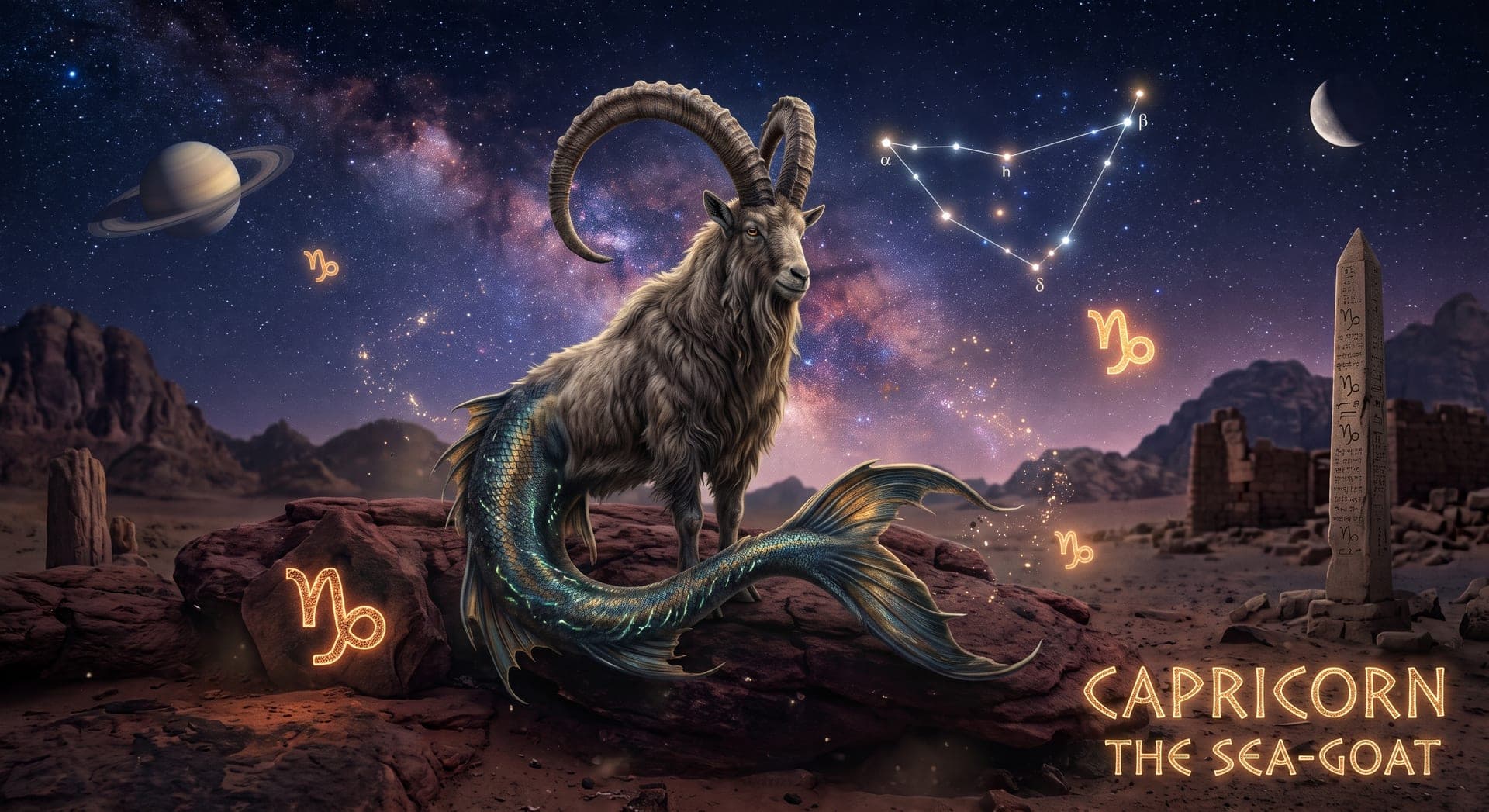
Capricorn, the tenth sign of the zodiac, spans December 22 to January 19 and is represented by the sea-goat, a mythical creature with the body of a goat and the tail of a fish, symbolizing an ability to navigate both the practical, earthly world and deeper emotional currents. Ruled by Saturn, the planet of discipline and time, Capricorns are often characterized as ambitious, patient, and deeply committed to long-term goals, willing to put in steady effort where others give up. As an Earth sign, Capricorn is grounded and practical, valuing tangible results and responsibility over impulsiveness. People born under this sign are frequently drawn to leadership and other structured pursuits where their organizational skills and work ethic can shine. Beneath a reserved, businesslike exterior, Capricorns are often said to carry a dry, understated sense of humor and a loyal, protective nature toward the people closest to them.
Personality Traits
Strengths
- Disciplined and self-controlled
- Responsible and dependable
- Excellent long-term planner
- Hardworking and persistent
- Good sense of humor once comfortable
Weaknesses
- Can be a know-it-all
- Unforgiving of mistakes, including their own
- Prone to pessimism
- Condescending toward those who don't work as hard
- Stubbornly resistant to changing plans
Compatible Signs
Fun Facts
- Capricorn's symbol, the sea-goat, comes from the Greek myth of Pan, who transformed his lower half into a fish tail to escape the monster Typhon while diving into the Nile.
- Saturn, Capricorn's ruling planet, was the Roman god of time, harvest, and generational structure, echoing the sign's association with patience and long-term thinking.
- Capricorn is one of only two zodiac signs represented by a hybrid creature, the other being Sagittarius, the centaur.
- Notable Capricorns include Michelle Obama, Martin Luther King Jr., Dolly Parton, LeBron James, and Isaac Newton.
- In traditional astrology, the winter solstice, the shortest day of the year, falls right at the start of Capricorn season in the Northern Hemisphere.
Born on January 18
- 1752
John Nash
English architect who shaped much of Regency London, designing Regent Street, Regent's Park, and the Royal Pavilion at Brighton.
- 1779
Peter Mark Roget
English physician and lexicographer who compiled Roget's Thesaurus, still widely used as a reference for synonyms.
- 1882
A. A. Milne
English author and playwright best known for creating Winnie-the-Pooh.
- 1892
Oliver Hardy
American comedian, half of the duo Laurel and Hardy
- 1904
Cary Grant
English-born actor who became one of Hollywood's leading stars, known for films including North by Northwest and Bringing Up Baby.
- 1908
Jacob Bronowski
Polish-born British mathematician and broadcaster best known for presenting the BBC series "The Ascent of Man"
- 1911
Danny Kaye
American entertainer known for comedy, singing, and dancing
- 1934
Raymond Briggs
English illustrator and author renowned for the wordless picture book and animated film The Snowman.
- 1937
John Hume
Northern Irish politician and civil rights activist who co-founded the SDLP and shared the Nobel Peace Prize for his role in the Good Friday Agreement.
- 1955
Kevin Costner
American actor, director, and producer
- 1960
Mark Rylance
English actor and the first artistic director of Shakespeare's Globe theatre, later an Academy Award winner for Bridge of Spies.
- 1971
Pep Guardiola
Acclaimed football manager and former Spanish international
On This Day in History
- 1486
King Henry VII of England marries Elizabeth of York, uniting the rival houses of Lancaster and York.
The marriage of Henry Tudor to Elizabeth of York symbolically united the warring houses of Lancaster and York, ending the decades-long dynastic conflict known as the Wars of the Roses. Their union produced the Tudor dynasty, whose red-and-white rose emblem combined both families' symbols and whose descendants, including Henry VIII and Elizabeth I, would rule England for the next century.
- 1486
Henry VII marries Elizabeth of York, symbolically uniting the houses of Lancaster and York.
The marriage, held at Westminster Abbey, joined the first Tudor king with the eldest daughter of the Yorkist Edward IV, merging the two rival bloodlines whose feud had fuelled the Wars of the Roses. The union underpinned Tudor claims to legitimacy and is commonly seen as the symbolic close of the decades-long dynastic conflict between Lancaster and York.
- 1670
Welsh privateer Henry Morgan captures and burns the city of Panama.
Leading a force of buccaneers under English commission, Morgan marched across the isthmus and overwhelmed Spanish defenders before his men sacked and torched Panama City, then one of the richest ports in the Americas. The raid, carried out after peace had technically been agreed between England and Spain, embarrassed English diplomats but cemented Morgan's reputation as the era's most feared privateer.
- 1701
Frederick I crowns himself King in Prussia at Königsberg.
Frederick crowned himself "King in Prussia" in a lavish ceremony, a carefully worded title chosen because his territory was technically only a duchy within the Holy Roman Empire, not a full kingdom. The self-coronation elevated Prussia's status among European powers and laid groundwork for its later rise as a dominant military and political force that would eventually unify Germany.
- 1778
British explorer James Cook becomes the first known European to reach the Hawaiian Islands.
Cook's expedition, sailing in search of a Northwest Passage, became the first recorded European contact with the Hawaiian Islands, which he named the "Sandwich Islands" after his patron, the Earl of Sandwich. Cook was killed by Hawaiians the following year during a dispute after returning to the islands, but his voyages opened the Pacific to sustained European exploration and trade.
- 1778
British explorer James Cook becomes the first European to reach the Hawaiian Islands.
Sailing in search of a northern passage between the Pacific and Atlantic, Cook's expedition sighted and landed on Oahu and Kauai, naming the archipelago the Sandwich Islands after his patron the Earl of Sandwich. The encounter opened the islands to sustained European contact and trade, though Cook himself would be killed in a clash with islanders there just over a year later.
- 1788
The British First Fleet arrives at Botany Bay carrying more than 700 convicts to found a penal colony.
After an eight-month voyage from Portsmouth, eleven ships under Captain Arthur Phillip anchored in Botany Bay, delivering convicts, marines, and officials intended to establish Britain's first colonial settlement in Australia. Finding the bay unsuitable for a permanent base, Phillip soon explored the coastline further north, leading to the colony's establishment days later at Sydney Cove.
- 1806
Dutch governor Jan Willem Janssens surrenders the Cape Colony to British forces.
Following a British victory at the Battle of Blaauwberg days earlier, the outnumbered Dutch garrison under Janssens capitulated, handing control of the strategically vital Cape of Good Hope to Britain. The takeover secured the sea route to India for the Royal Navy and began more than a century of British rule over the Cape, later folded into the Union of South Africa.
- 1871
Wilhelm I is proclaimed German Emperor at the Palace of Versailles, marking the unification of Germany.
German princes proclaimed Wilhelm I emperor in the Hall of Mirrors at the captured French royal palace, a deliberately symbolic and humiliating location chosen just as France was losing the Franco-Prussian War. The ceremony completed the unification of the numerous German states into a single empire under Prussian leadership, reshaping the balance of power in Europe.
- 1886
The Hockey Association is founded in England, establishing the first formal rules of modern field hockey.
Representatives of several English clubs met to standardise the sport's rules, replacing the varied local customs that had governed earlier versions of the game. The new governing body's codified regulations, covering everything from stick dimensions to offside rules, became the template adopted internationally as field hockey spread through the British Empire and beyond.
- 1919
The Paris Peace Conference opens, where Allied leaders negotiate the treaties ending World War I.
Leaders of the victorious World War I Allied powers, chiefly the United States, Britain, France, and Italy, gathered in Paris to negotiate peace terms with the defeated Central Powers. The conference produced the Treaty of Versailles and several related treaties, redrew national borders across Europe and the Middle East, and established the League of Nations.
- 1919
The Paris Peace Conference opens, bringing Allied leaders together to settle the terms ending the First World War.
Delegations from the victorious Allied powers gathered outside Paris to negotiate peace terms with the defeated Central Powers. British Prime Minister David Lloyd George sat among the conference's dominant Big Four leaders, pushing for reparations and colonial settlements favourable to Britain while resisting the harshest French demands. The talks produced the Treaty of Versailles later that year.
- 1941
British and Commonwealth troops launch a counter-offensive against Italian forces in East Africa.
Advancing from Sudan and Kenya, British Empire forces began a campaign to reverse Italy's earlier conquest of British Somaliland and push into Italian East Africa. The offensive combined troops from Britain, India, and various African colonies, and over the following months succeeded in liberating Ethiopia and forcing the surrender of Italian forces in the region.
- 1943
Jewish residents of the Warsaw Ghetto stage their first armed uprising against Nazi deportations.
As Nazi forces resumed mass deportations from the Warsaw Ghetto to death camps, a group of Jewish resistance fighters, armed with smuggled weapons, fought back for the first time, forcing German troops to temporarily halt the operation. The unexpected resistance inspired and informed preparations for the larger, better-known Warsaw Ghetto Uprising that erupted three months later.
- 1945
The Red Army liberates Kraków, Poland, from German occupation.
Soviet forces liberated Kraków largely intact, unlike Warsaw, after German troops retreated rather than mount a prolonged defense of the historic city. Kraków's relatively undamaged medieval architecture and university survived the war, and the city later became an important center of Polish culture and eventually the base of Pope John Paul II's early career as archbishop.
- 1978
The European Court of Human Rights finds the United Kingdom guilty of inhumane treatment of detainees in Northern Ireland.
Ruling on a case brought by the Republic of Ireland, the Strasbourg court found that interrogation techniques used on internees during the Troubles, including sleep deprivation and hooding, amounted to inhuman and degrading treatment, though it stopped short of labelling them torture. The judgment remains a landmark case in the development of European human rights law.
- 1993
Martin Luther King Jr. Day is observed for the first time in all 50 U.S. states.
Full nationwide observance came seven years after MLK Day was first established as a federal holiday, since several states initially resisted adopting it, sometimes combining it with other holidays or observing it under different names. Arizona's prolonged refusal to recognize the holiday even led the NFL to relocate a Super Bowl away from the state, before it finally adopted the holiday in 1992.
- 1999
British Aerospace agrees to acquire the defence electronics arm of GEC, forming BAE Systems.
The deal combined British Aerospace's aircraft and weapons manufacturing with Marconi Electronic Systems, the defence division of the General Electric Company, to create one of the world's largest defence contractors. The merger consolidated Britain's aerospace and defence industry into a single dominant firm, reshaping the country's military-industrial landscape for the following decades.
- 2005
The Airbus A380, then the world's largest commercial airliner, is unveiled in Toulouse, France.
The A380, a massive double-decker aircraft capable of carrying over 500 passengers, represented Airbus's bet that airlines would prefer larger planes flying between major hub airports. Despite its engineering achievement, the aircraft struggled commercially against a shift toward smaller, more fuel-efficient long-range jets, and Airbus ended production of the A380 in 2021.
- 2012
Over 100,000 websites stage an online protest against proposed U.S. anti-piracy legislation, SOPA and PIPA.
The coordinated online protest, in which sites like Wikipedia and Reddit went dark or displayed protest messages, was organized against proposed legislation that opponents argued would enable excessive government censorship of the internet in the name of fighting piracy. The unprecedented digital mobilization generated millions of messages to lawmakers and led Congress to shelve both bills within days.