
What’s Observed on January 17
Born on January 17: Capricorn ♑
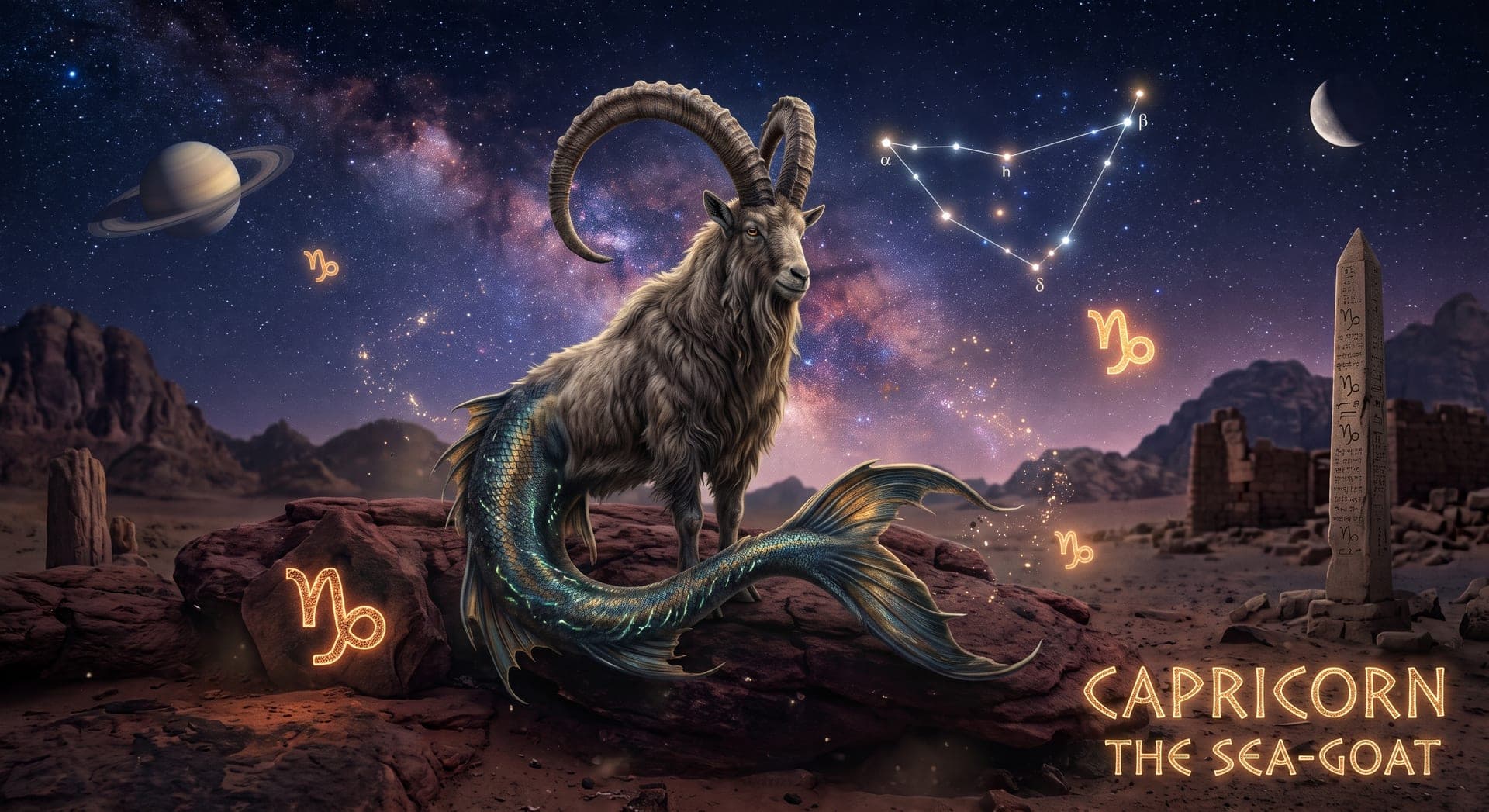
Capricorn, the tenth sign of the zodiac, spans December 22 to January 19 and is represented by the sea-goat, a mythical creature with the body of a goat and the tail of a fish, symbolizing an ability to navigate both the practical, earthly world and deeper emotional currents. Ruled by Saturn, the planet of discipline and time, Capricorns are often characterized as ambitious, patient, and deeply committed to long-term goals, willing to put in steady effort where others give up. As an Earth sign, Capricorn is grounded and practical, valuing tangible results and responsibility over impulsiveness. People born under this sign are frequently drawn to leadership and other structured pursuits where their organizational skills and work ethic can shine. Beneath a reserved, businesslike exterior, Capricorns are often said to carry a dry, understated sense of humor and a loyal, protective nature toward the people closest to them.
Personality Traits
Strengths
- Disciplined and self-controlled
- Responsible and dependable
- Excellent long-term planner
- Hardworking and persistent
- Good sense of humor once comfortable
Weaknesses
- Can be a know-it-all
- Unforgiving of mistakes, including their own
- Prone to pessimism
- Condescending toward those who don't work as hard
- Stubbornly resistant to changing plans
Compatible Signs
Fun Facts
- Capricorn's symbol, the sea-goat, comes from the Greek myth of Pan, who transformed his lower half into a fish tail to escape the monster Typhon while diving into the Nile.
- Saturn, Capricorn's ruling planet, was the Roman god of time, harvest, and generational structure, echoing the sign's association with patience and long-term thinking.
- Capricorn is one of only two zodiac signs represented by a hybrid creature, the other being Sagittarius, the centaur.
- Notable Capricorns include Michelle Obama, Martin Luther King Jr., Dolly Parton, LeBron James, and Isaac Newton.
- In traditional astrology, the winter solstice, the shortest day of the year, falls right at the start of Capricorn season in the Northern Hemisphere.
Born on January 17
- 1706
Benjamin Franklin
Founding Father, inventor, and diplomat
- 1820
Anne Bronte
English novelist and poet, youngest of the Bronte sisters, author of Agnes Grey and The Tenant of Wildfell Hall.
- 1863
David Lloyd George
Welsh-raised British statesman who served as Prime Minister from 1916 to 1922, leading the country through the final years of the First World War.
- 1883
Compton Mackenzie
English-born novelist and essayist known for comic novels such as Whisky Galore and his role in Scottish cultural life.
- 1899
Al Capone
Notorious American Prohibition-era crime boss
- 1907
Alfred Wainwright
English fellwalker and author best known for his illustrated Pictorial Guides to the Lakeland Fells.
- 1918
Keith Joseph
English lawyer and Conservative politician whose free-market ideas heavily influenced Thatcherism.
- 1926
Moira Shearer
Scottish ballerina and actress celebrated for her starring role in the film The Red Shoes.
- 1928
Vidal Sassoon
English hairdresser and businessman who revolutionised modern hairstyling with his geometric cutting techniques.
- 1942
Muhammad Ali
Legendary heavyweight boxing champion and activist
- 1957
Steve Harvey
American comedian and television host
- 1962
Jim Carrey
Canadian-American actor and comedian
- 1964
Michelle Obama
Attorney and former First Lady of the United States
- 1980
Zooey Deschanel
American actress and singer-songwriter

On This Day in History
- 1648
England's Long Parliament resolves to end negotiations with King Charles I.
Meeting amid the aftermath of the First English Civil War, the Long Parliament voted to break off all further talks with the captive king, declaring it treasonable for anyone to communicate with him about a settlement. The resolution hardened parliamentary opposition to Charles and set the political stage for his eventual trial and execution the following year.
- 1773
Captain James Cook's expedition becomes the first to cross the Antarctic Circle.
Commanding HMS Resolution during his second Pacific voyage, the British explorer James Cook led his ships south of latitude 66 degrees 33 minutes, the first vessels recorded to do so. Thick ice prevented further progress toward the still-undiscovered Antarctic mainland, but the crossing marked a milestone in Britain's long tradition of oceanic exploration and mapping of the southern seas.
- 1781
American Continental forces rout the British army at the Battle of Cowpens in South Carolina.
Brigadier General Daniel Morgan's outnumbered Continental and militia troops used a double-envelopment tactic to crush the British force led by the aggressive cavalry commander Banastre Tarleton. The decisive American victory destroyed much of Lord Cornwallis's light infantry and cavalry, weakening British operations in the South and helping pave the way toward the war's end at Yorktown.
- 1852
Britain signs the Sand River Convention, recognising the independence of the South African Republic.
Under the agreement negotiated with Boer representatives north of the Vaal River, the British government renounced any claim to sovereignty over the territory that became the Transvaal, or South African Republic. The convention marked a retreat from earlier British ambitions to control the interior of southern Africa and shaped the region's fractured political map for decades afterward.
- 1885
British forces defeat a Mahdist army at the Battle of Abu Klea in Sudan.
As part of the failed expedition to relieve General Charles Gordon at Khartoum, a British desert column formed a defensive square near the wells of Abu Klea and withstood a fierce charge by Mahdist fighters that briefly broke through the line. The costly victory allowed the column to continue its advance, though it arrived at Khartoum two days too late.
- 1893
The Kingdom of Hawaii is overthrown in a coup led by American and European businessmen.
American sugar planters and businessmen, backed by U.S. Marines landed from a nearby warship, orchestrated the overthrow of Queen Liliuokalani, ending the Hawaiian monarchy. The coup paved the way for U.S. annexation of Hawaii five years later, an act the United States formally apologized for in 1993, acknowledging it had been carried out without the consent of the Hawaiian people.
- 1912
British explorer Robert Falcon Scott reaches the South Pole, only to find that Roald Amundsen's team arrived a month earlier.
Scott's British expedition reached the South Pole only to discover a Norwegian flag left by Roald Amundsen's team, which had arrived over a month earlier using a faster route and sled dogs. Devastated, Scott and his four companions died of starvation and exposure during their return journey, their fate becoming a defining, tragic story of the heroic age of Antarctic exploration.
- 1912
Robert Falcon Scott's expedition reaches the South Pole, five weeks after Roald Amundsen.
After a gruelling trek across the Antarctic ice, the British explorer Robert Falcon Scott and four companions arrived at the pole only to find a Norwegian flag already planted there. The devastating discovery that Amundsen's team had beaten them was followed by a disastrous return journey, during which Scott and his entire party perished before reaching safety.
- 1920
Prohibition begins in the United States as the Volstead Act takes effect, banning the sale of alcohol.
The Volstead Act provided the legal enforcement mechanism for the 18th Amendment, banning the sale, manufacture, and transport of alcoholic beverages across the United States. Rather than eliminating alcohol consumption, Prohibition drove the trade underground, fueling organized crime syndicates like Al Capone's and ultimately proving so unpopular and difficult to enforce that it was repealed in 1933.
- 1920
Nationwide Prohibition takes effect in the United States, banning the sale of alcohol.
The Eighteenth Amendment's enforcement legislation, the Volstead Act, came into force at midnight, outlawing the manufacture, sale, and transport of intoxicating liquor across the country. The ban gave rise to widespread bootlegging and organized crime, and proved so unpopular and difficult to enforce that it was repealed thirteen years later by the Twenty-first Amendment.
- 1945
Soviet forces liberate Warsaw from German occupation during World War II.
The Red Army's liberation of Warsaw came after the city had been devastated by German forces the previous year in retaliation for the Warsaw Uprising, an occupation during which roughly 85 percent of the city was deliberately destroyed. Soviet troops found a largely empty, ruined capital, and Poland's postwar reconstruction and political future would soon fall under Soviet-dominated communist control.
- 1945
Soviet forces liberate Warsaw as the Vistula-Oder Offensive drives German troops back across Poland.
The rapid Red Army advance, launched days earlier, pushed deep into German-held Poland and forced the evacuation of the Auschwitz concentration camp as Nazi authorities fled the approaching front. The offensive shattered German defenses on the Eastern Front and brought Soviet forces within striking distance of Germany itself, hastening the final collapse of the Third Reich months later.
- 1946
The United Nations Security Council holds its first-ever session.
Delegates from the UN Security Council's founding members convened for the first time in London, working to establish procedures for the body tasked with maintaining international peace under the new United Nations Charter. The session set early precedents for how the council, and its five permanent veto-wielding members, would operate throughout the Cold War and beyond.
- 1961
President Dwight D. Eisenhower delivers his farewell address, famously warning of the dangers of the "military-industrial complex."
In his televised farewell address, Eisenhower, a former five-star general, surprised many by warning of the growing political influence of the defense industry and military establishment, cautioning that unchecked, it could endanger American democracy and liberties. The phrase "military-industrial complex" entered common political vocabulary and remains frequently cited in debates over defense spending.
- 1966
A B-52 bomber collides with a refueling tanker over Palomares, Spain, accidentally dropping four nuclear bombs.
During a mid-air refueling attempt gone wrong, the bomber and tanker collided, killing seven crew members and scattering wreckage, including four hydrogen bombs, near the Spanish fishing village of Palomares. Three bombs were recovered relatively quickly, but the fourth, lost in the Mediterranean Sea, took over two months of searching by a specialized submarine to locate and retrieve.
- 1991
A U.S.-led coalition launches Operation Desert Storm with airstrikes against Iraqi targets.
The coalition's opening air assault, involving thousands of sorties against Iraqi military targets, infrastructure, and command centers, marked the start of the Gulf War proper following Iraq's refusal to withdraw from Kuwait. The overwhelming display of precision-guided munitions and airpower, broadcast live on television, showcased a new era of high-tech warfare to a global audience.
- 1991
A US-led coalition launches Operation Desert Storm against Iraqi forces occupying Kuwait.
Following months of diplomatic deadlock after Iraq's invasion of Kuwait, coalition aircraft began a massive bombing campaign targeting Iraqi military infrastructure, air defenses, and command centers. The opening air assault, broadcast live around the world, marked the start of the Gulf War and preceded a ground offensive weeks later that swiftly expelled Iraqi forces from Kuwait.
- 1994
The magnitude 6.7 Northridge earthquake strikes the Los Angeles area, causing dozens of deaths and billions in damage.
The Northridge earthquake struck a densely populated area of Los Angeles in the early morning, collapsing freeway overpasses and apartment buildings and killing 57 people despite California's relatively strict seismic building codes. It remains one of the costliest natural disasters in U.S. history and prompted significant revisions to building and infrastructure retrofitting standards.
- 1995
The magnitude 6.9 Great Hanshin earthquake devastates Kobe, Japan, killing thousands.
The Great Hanshin earthquake devastated the port city of Kobe, collapsing highways, buildings, and rail lines and killing more than 6,000 people, exposing gaps in Japan's earthquake preparedness despite its reputation for strict building codes. The disaster prompted a major overhaul of Japan's emergency response systems and construction standards in the years that followed.
- 2008
British Airways Flight 38 crash-lands short of the runway at London Heathrow Airport.
The Boeing 777 arriving from Beijing lost engine power on final approach and came down just short of the runway, skidding across grass before stopping near the threshold. All 152 people aboard survived, though several suffered injuries. Investigators traced the fuel starvation to ice crystals restricting fuel flow, prompting design changes to aircraft fuel systems worldwide.