
What’s Observed on January 16
Born on January 16: Capricorn ♑
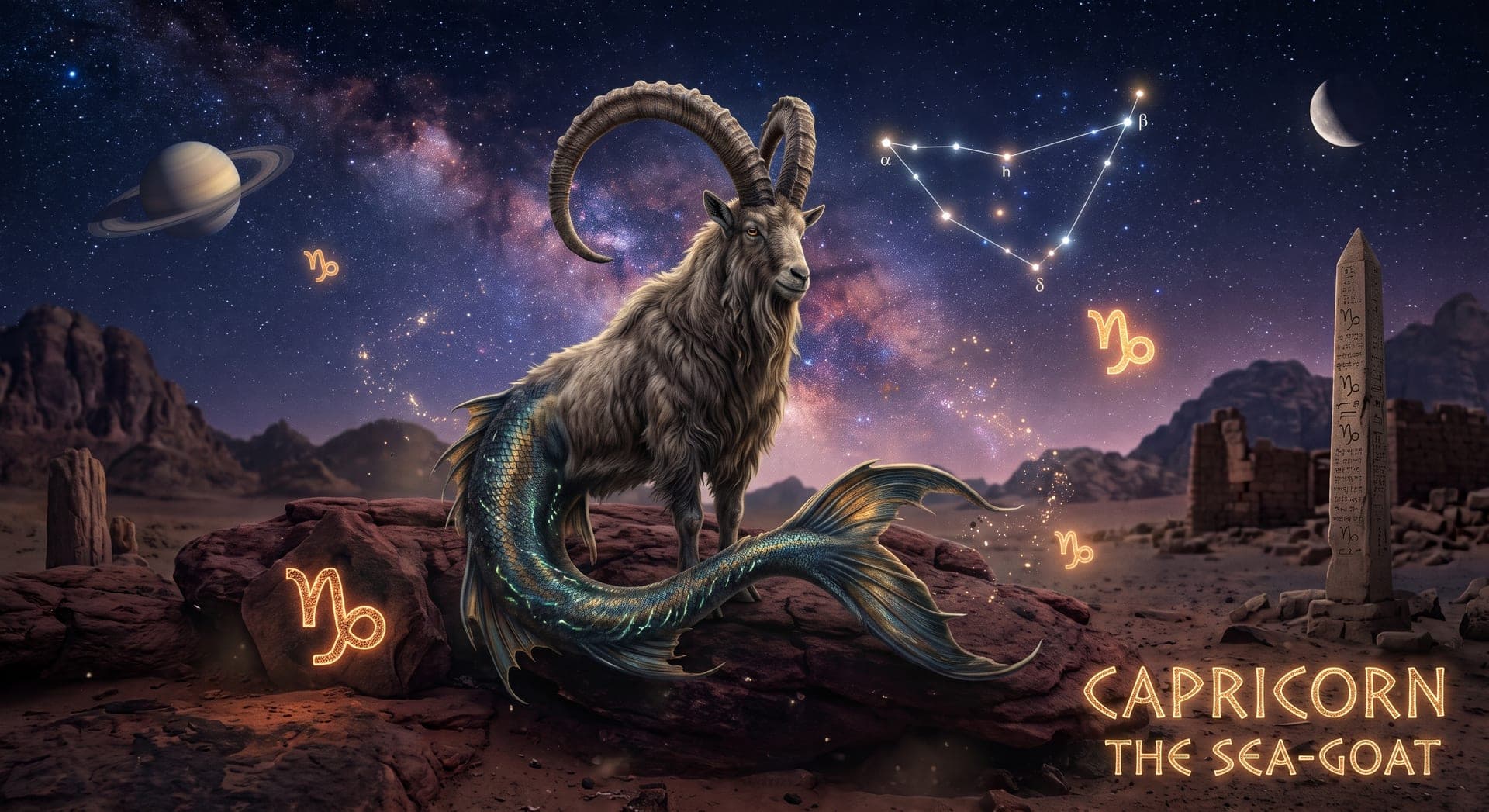
Capricorn, the tenth sign of the zodiac, spans December 22 to January 19 and is represented by the sea-goat, a mythical creature with the body of a goat and the tail of a fish, symbolizing an ability to navigate both the practical, earthly world and deeper emotional currents. Ruled by Saturn, the planet of discipline and time, Capricorns are often characterized as ambitious, patient, and deeply committed to long-term goals, willing to put in steady effort where others give up. As an Earth sign, Capricorn is grounded and practical, valuing tangible results and responsibility over impulsiveness. People born under this sign are frequently drawn to leadership and other structured pursuits where their organizational skills and work ethic can shine. Beneath a reserved, businesslike exterior, Capricorns are often said to carry a dry, understated sense of humor and a loyal, protective nature toward the people closest to them.
Personality Traits
Strengths
- Disciplined and self-controlled
- Responsible and dependable
- Excellent long-term planner
- Hardworking and persistent
- Good sense of humor once comfortable
Weaknesses
- Can be a know-it-all
- Unforgiving of mistakes, including their own
- Prone to pessimism
- Condescending toward those who don't work as hard
- Stubbornly resistant to changing plans
Compatible Signs
Fun Facts
- Capricorn's symbol, the sea-goat, comes from the Greek myth of Pan, who transformed his lower half into a fish tail to escape the monster Typhon while diving into the Nile.
- Saturn, Capricorn's ruling planet, was the Roman god of time, harvest, and generational structure, echoing the sign's association with patience and long-term thinking.
- Capricorn is one of only two zodiac signs represented by a hybrid creature, the other being Sagittarius, the centaur.
- Notable Capricorns include Michelle Obama, Martin Luther King Jr., Dolly Parton, LeBron James, and Isaac Newton.
- In traditional astrology, the winter solstice, the shortest day of the year, falls right at the start of Capricorn season in the Northern Hemisphere.
Born on January 16
- 1874
Robert W. Service
English-Canadian poet known for ballads of the Yukon such as The Cremation of Sam McGee
- 1902
Eric Liddell
Olympic gold medal runner and missionary, subject of "Chariots of Fire"
- 1906
Diana Wynyard
English actress known for her Oscar-nominated role in Cavalcade
- 1931
John Enderby
English physicist known for his research on the structure of liquids and disordered materials
- 1932
Dian Fossey
Primatologist known for her studies of mountain gorillas
- 1933
Susan Sontag
Influential American essayist and cultural critic
- 1941
Christine Truman
English tennis player who reached the Wimbledon singles final in 1961
- 1943
Brian Ferneyhough
English composer known for his influential and technically demanding contemporary classical works
- 1948
John Carpenter
Director of horror films including "Halloween" and "The Thing"
- 1963
James May
English journalist and television presenter known for his work on Top Gear
- 1974
Kate Moss
English model and fashion designer who became one of the most recognizable faces in fashion
- 1979
Aaliyah
R&B singer and actress known for hits like "Try Again"
- 1980
Lin-Manuel Miranda
Creator and star of the musical "Hamilton"
- 1980
Albert Pujols
Baseball Hall of Famer and three-time World Series champion
- 1988
FKA Twigs
English singer-songwriter and actress known for her experimental blend of R&B and electronic music
On This Day in History
- 27 BCE
The Roman Senate grants Octavian the title "Augustus," traditionally marking the beginning of the Roman Empire.
Rather than seizing power outright, Octavian carefully engineered the Senate to bestow the title "Augustus," meaning roughly "the revered one," allowing him to rule as the empire's first emperor while maintaining the appearance of restored republican government. His reign began over two centuries of relative stability known as the Pax Romana, and the title "Augustus" was adopted by Roman emperors for centuries afterward.
- 1275
King Edward I authorizes the expulsion of Jewish communities from the English towns of Worcester, Marlborough, Cambridge, and Gloucester.
The order came amid mounting royal restrictions on Jewish moneylending and growing hostility toward England's Jewish population during Edward's reign. It formed part of a broader pattern of persecution that intensified over the following years, culminating in the Edict of Expulsion of 1290, which expelled all Jews from England entirely. England would have no legal Jewish community again until Oliver Cromwell permitted their return in the 1650s.
- 1537
Bigod's Rebellion breaks out in Yorkshire, a fresh uprising against Henry VIII's religious reforms following the Pilgrimage of Grace.
Led by the gentleman Francis Bigod, the revolt erupted despite a truce that had ended the earlier, larger Pilgrimage of Grace rebellion, as many northerners remained furious over the dissolution of the monasteries and religious changes imposed from London. The renewed unrest gave Henry VIII the pretext to abandon his earlier promises of clemency, and the crown responded with harsh reprisals, executing dozens of rebel leaders across the north.
- 1572
Thomas Howard, 4th Duke of Norfolk, is tried and found guilty of treason for plotting against Queen Elizabeth I.
Norfolk had secretly conspired with Spanish agents and Mary, Queen of Scots, in the Ridolfi plot, which aimed to overthrow Elizabeth, restore Catholicism, and place Mary on the English throne through Norfolk's marriage to her. As England's premier peer, his conviction sent shockwaves through the aristocracy. He was executed on Tower Hill later that year, becoming the last Duke of Norfolk to be beheaded for treason.
- 1605
The first part of Miguel de Cervantes' "Don Quixote" is published in Madrid.
Cervantes' novel, following the adventures of a delusional nobleman who imagines himself a knight-errant, is widely considered one of the earliest and greatest novels in Western literature. Its blend of comedy, tragedy, and social commentary influenced the development of the modern novel form, and the word "quixotic" entered common usage to describe impractical idealism.
- 1707
The Scottish Parliament ratifies the Act of Union, paving the way for the creation of Great Britain.
The Act of Union merged the Kingdom of Scotland and the Kingdom of England into a single Kingdom of Great Britain with one parliament, ending centuries of separate, often conflicting governance despite sharing a monarch since 1603. The union, passed amid economic pressure and political maneuvering, remains a foundational and occasionally contested part of the modern United Kingdom's constitutional structure.
- 1707
The Scottish Parliament ratifies the Act of Union, merging the kingdoms of Scotland and England into the single Kingdom of Great Britain.
The union followed years of negotiation and controversy, driven partly by Scotland's financial troubles after the failed Darien colonial scheme and by English concerns over securing the Hanoverian succession. The act dissolved the separate Scottish and English Parliaments in favor of a single Parliament at Westminster, while preserving Scotland's distinct legal system and Presbyterian church. It remains one of the foundational constitutional events in British history.
- 1780
A British fleet under Admiral George Rodney defeats a Spanish squadron at the Battle of Cape St Vincent, known as the Moonlight Battle.
Fought partly by moonlight off the southern coast of Portugal, the engagement was part of a British relief expedition to resupply the besieged garrison at Gibraltar during the American Revolutionary War. Rodney's fleet captured or destroyed most of the Spanish squadron, easing pressure on Gibraltar and boosting British morale after a string of difficult years in the wider war against America, France, and Spain.
- 1809
British forces fight off pursuing French troops at the Battle of La Coruña, covering the evacuation of the army during the Peninsular War.
The battle came at the end of a grueling winter retreat across northern Spain, as British commander Sir John Moore's army fled toward the coast to escape a much larger French force under Marshal Soult. Moore was mortally wounded during the fighting but his troops held the line long enough for the army to evacuate safely by sea. The retreat became legendary in British military memory despite the costly withdrawal.
- 1862
An explosion at the Hartley colliery in Northumberland kills 204 men and boys after the pit's single shaft becomes blocked.
The disaster occurred when the colliery's massive beam engine broke and fell down the mine's only access shaft, trapping the workforce below with no means of escape or ventilation. Rescuers took days to clear the debris, by which point all those trapped had died of asphyxiation. Public outrage over the tragedy led directly to a change in British law requiring every coal mine to have at least two independent shafts.
- 1909
Ernest Shackleton's Antarctic expedition locates the South Magnetic Pole.
Shackleton's team, part of his Nimrod Expedition, trekked across the harsh Antarctic ice to reach the South Magnetic Pole, a shifting point distinct from the geographic South Pole where compass needles point straight down. The grueling journey, undertaken without reaching the actual geographic pole, nonetheless expanded scientific understanding of Earth's magnetic field and Antarctic geography.
- 1909
A party from Ernest Shackleton's Nimrod Expedition reaches the vicinity of the South Magnetic Pole in Antarctica.
Led by Edgeworth David, the team of three trekked over 1,200 miles across the Antarctic ice to plant the Union Jack near the magnetic pole's calculated location, claiming the region for Britain. The achievement came during the same expedition in which Shackleton's separate party pushed to within 97 miles of the geographic South Pole. Both feats marked major milestones in the British-led exploration of Antarctica during the era's polar race.
- 1913
Self-taught Indian mathematician Srinivasa Ramanujan sends his first letter, filled with original theorems, to Cambridge mathematician G. H. Hardy.
Ramanujan, working largely in isolation in Madras with no formal training, had compiled pages of striking results in number theory and infinite series that he hoped a professional mathematician might recognize. Hardy, initially skeptical, was soon convinced of their brilliance and arranged for Ramanujan to travel to Cambridge. Their subsequent collaboration produced groundbreaking work before Ramanujan's early death in 1920, and he is remembered as one of history's greatest self-taught mathematicians.
- 1919
Nebraska's ratification secures the two-thirds majority needed for the 18th Amendment, establishing Prohibition in the United States.
Nebraska's vote provided the crucial 36th state needed to ratify the 18th Amendment, which banned the manufacture, sale, and transportation of alcoholic beverages nationwide. Prohibition took effect a year later, giving rise to widespread bootlegging and organized crime, and was ultimately repealed in 1933 after being widely viewed as unenforceable and counterproductive.
- 1942
Nazi Germany begins deporting Jews from the Łódź Ghetto to the Chełmno extermination camp.
The Łódź Ghetto, one of the largest Jewish ghettos established by Nazi Germany in occupied Poland, had confined roughly 160,000 people in overcrowded, starving conditions. The deportations to Chełmno, one of the first dedicated extermination camps, marked an escalation toward the systematic mass murder of the Holocaust, in which most of the ghetto's population would ultimately perish.
- 1969
Soviet spacecraft Soyuz 4 and Soyuz 5 complete the first docking of two crewed spacecraft in orbit.
The two Soyuz spacecraft docked while in orbit and, in a historic first, two cosmonauts performed a spacewalk to transfer between the vehicles, effectively testing procedures for crew transfer and future space station operations. The mission was an important milestone in the Soviet space program's efforts to develop techniques that would later prove essential for orbital station assembly.
- 1979
The Shah of Iran flees the country with his family as the Iranian Revolution reaches its climax.
The Shah's departure, framed publicly as an extended vacation, effectively ended over 2,500 years of Iranian monarchy amid mass protests against his autocratic rule and close ties to the West. His exile paved the way for Ayatollah Khomeini's return from exile weeks later and the establishment of an Islamic republic that reshaped the Middle East's political landscape.
- 1991
Coalition forces, including British troops, begin the Gulf War against Iraq after Saddam Hussein's regime refused to withdraw from Kuwait.
Britain contributed the largest European military force to the American-led coalition, including RAF Tornado squadrons that flew bombing missions from the war's opening hours as part of Operation Granby. The campaign began with a massive air bombardment before a ground offensive the following month swiftly expelled Iraqi forces from Kuwait. The war marked one of the largest British military deployments since the Second World War.
- 2001
Congolese President Laurent-Désiré Kabila is assassinated by one of his bodyguards.
Kabila, who had seized power in the Democratic Republic of the Congo in 1997 after ousting longtime dictator Mobutu Sese Seko, was shot by one of his own child soldier bodyguards under still-disputed circumstances. His son, Joseph Kabila, quickly succeeded him, inheriting a country still engulfed in the deadly Second Congo War.
- 2003
Space Shuttle Columbia launches on its final mission before disintegrating during re-entry.
Columbia's STS-107 mission carried out 16 days of scientific experiments in orbit before disintegrating over Texas during re-entry on February 1, killing all seven astronauts aboard. Investigators later determined that a piece of foam insulation had struck and damaged the shuttle's wing during launch, a finding that led to major safety reforms across NASA's remaining shuttle program.