What’s Observed on January 15
Born on January 15: Capricorn ♑
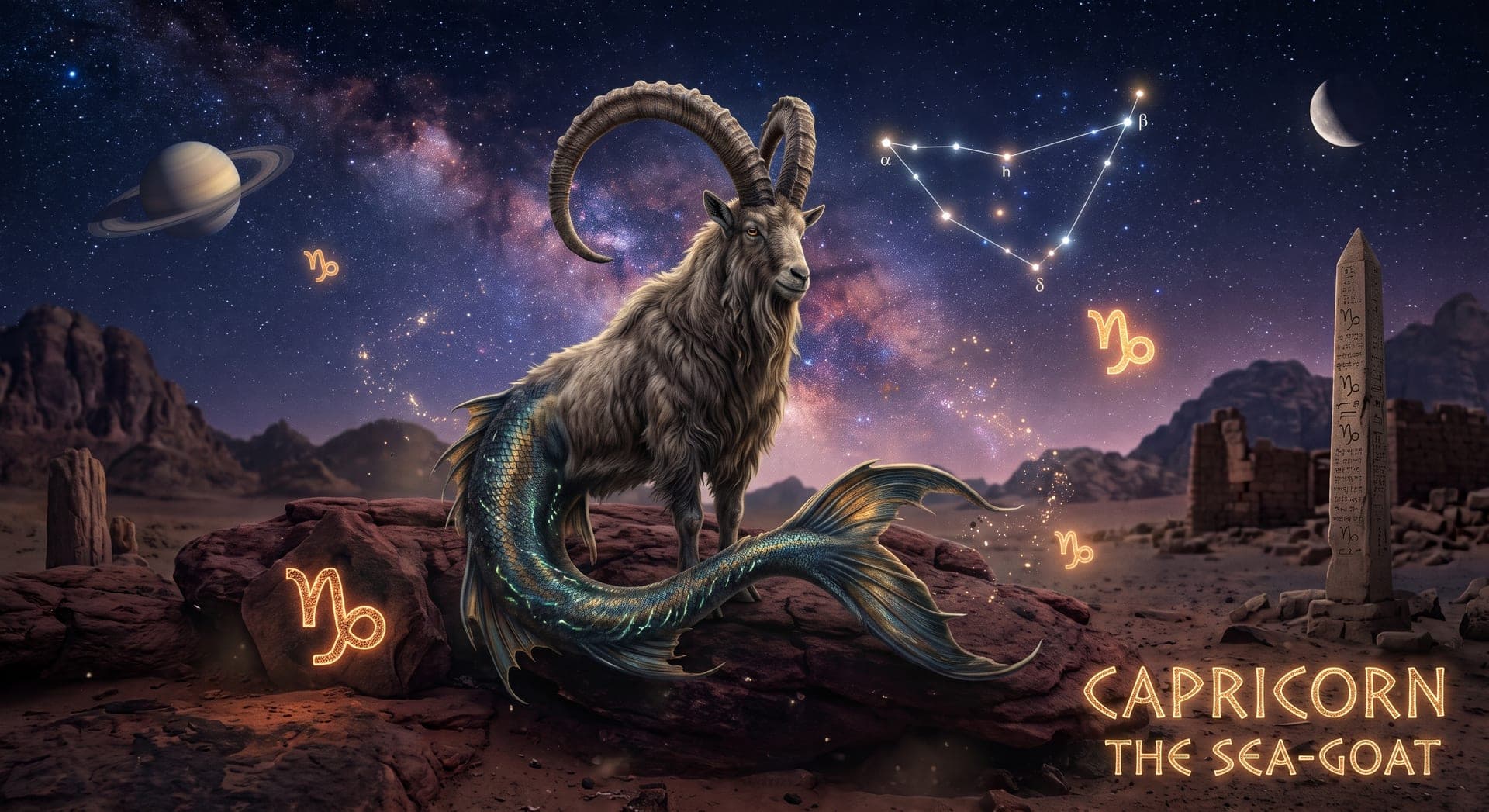
Capricorn, the tenth sign of the zodiac, spans December 22 to January 19 and is represented by the sea-goat, a mythical creature with the body of a goat and the tail of a fish, symbolizing an ability to navigate both the practical, earthly world and deeper emotional currents. Ruled by Saturn, the planet of discipline and time, Capricorns are often characterized as ambitious, patient, and deeply committed to long-term goals, willing to put in steady effort where others give up. As an Earth sign, Capricorn is grounded and practical, valuing tangible results and responsibility over impulsiveness. People born under this sign are frequently drawn to leadership and other structured pursuits where their organizational skills and work ethic can shine. Beneath a reserved, businesslike exterior, Capricorns are often said to carry a dry, understated sense of humor and a loyal, protective nature toward the people closest to them.
Personality Traits
Strengths
- Disciplined and self-controlled
- Responsible and dependable
- Excellent long-term planner
- Hardworking and persistent
- Good sense of humor once comfortable
Weaknesses
- Can be a know-it-all
- Unforgiving of mistakes, including their own
- Prone to pessimism
- Condescending toward those who don't work as hard
- Stubbornly resistant to changing plans
Compatible Signs
Fun Facts
- Capricorn's symbol, the sea-goat, comes from the Greek myth of Pan, who transformed his lower half into a fish tail to escape the monster Typhon while diving into the Nile.
- Saturn, Capricorn's ruling planet, was the Roman god of time, harvest, and generational structure, echoing the sign's association with patience and long-term thinking.
- Capricorn is one of only two zodiac signs represented by a hybrid creature, the other being Sagittarius, the centaur.
- Notable Capricorns include Michelle Obama, Martin Luther King Jr., Dolly Parton, LeBron James, and Isaac Newton.
- In traditional astrology, the winter solstice, the shortest day of the year, falls right at the start of Capricorn season in the Northern Hemisphere.
Born on January 15
- 1622
Moliere
French playwright and actor, one of the great masters of comedy
- 1623
Algernon Sidney
English political theorist and republican thinker executed for treason, later revered as a martyr for liberty
- 1841
Frederick Stanley, 16th Earl of Derby
English statesman and Governor General of Canada who donated the trophy that became the Stanley Cup
- 1879
Ernest Thesiger
English character actor known for his role in the horror film Bride of Frankenstein
- 1893
Ivor Novello
Welsh singer-songwriter, actor, and composer of popular musical theatre
- 1909
Gene Krupa
Influential American jazz drummer and bandleader
- 1918
Gamal Abdel Nasser
Second President of Egypt and pan-Arabist leader
- 1929
Martin Luther King Jr.
Civil rights leader and Nobel Peace Prize laureate
- 1933
Frank Bough
English broadcaster and journalist who presented Grandstand and Breakfast Time
- 1937
Margaret O'Brien
Child star actress of Hollywood's Golden Age
- 1941
Captain Beefheart
American singer-songwriter known for experimental music
- 1943
Margaret Beckett
English politician who served as Britain's first female Foreign Secretary
- 1948
Ronnie Van Zant
Frontman and co-founder of Lynyrd Skynyrd
- 1965
James Nesbitt
Northern Irish actor known for his roles in Cold Feet and Jekyll
- 1972
Claudia Winkleman
English broadcaster known for presenting Strictly Come Dancing
- 1979
Drew Brees
NFL quarterback and Super Bowl champion
On This Day in History
- 1535
Henry VIII formally incorporates the title Supreme Head of the Church of England into his royal styles.
The declaration followed Parliament's Act of Supremacy the previous year, which had severed the English church from papal authority after the Pope refused to annul Henry's marriage to Catherine of Aragon. The move placed the monarch, rather than the Pope, at the head of religious authority in England, a foundational moment in the English Reformation. It triggered years of religious upheaval, including the dissolution of the monasteries that followed shortly after.
- 1559
Elizabeth I is crowned Queen of England and Ireland at Westminster Abbey.
Elizabeth's coronation followed the death of her half-sister Mary I, a Catholic monarch whose persecution of Protestants had earned her the nickname "Bloody Mary." Elizabeth's nearly 45-year reign that followed became known as a golden age, marked by the flourishing of English drama under Shakespeare, victory over the Spanish Armada, and the early growth of English overseas exploration and trade.
- 1559
Elizabeth I is crowned Queen of England and Ireland at Westminster Abbey.
Elizabeth had ascended to the throne two months earlier following the death of her half-sister Mary I, inheriting a kingdom divided by religious conflict and financial strain. Her coronation, conducted with careful ceremonial balance between Protestant and Catholic sensibilities, signaled the beginning of a reign that would last 44 years. Her rule ultimately became known as a golden age of English culture, naval power, and national consolidation.
- 1759
The British Museum opens to the public in London.
Founded through an act of Parliament using the collections of physician Sir Hans Sloane, the British Museum was among the first national public museums in the world, and admission was free from the start. It has since grown into one of the largest and most visited museums globally, though its vast holdings, including the Parthenon Marbles, remain the subject of ongoing repatriation disputes with countries of origin.
- 1759
The British Museum opens to the public in London, becoming the world's first national public museum.
The museum was founded around the collection of physician and naturalist Sir Hans Sloane, who bequeathed his vast assemblage of books, specimens, and antiquities to the nation upon his death. Admission was free, though visitors initially had to apply in advance for a ticket and were guided through in small groups. The collection expanded enormously over the following centuries, eventually including treasures such as the Rosetta Stone and the Parthenon sculptures.
- 1815
The American frigate USS President is captured by a squadron of British frigates during the War of 1812.
Attempting to break through a British blockade of New York harbor, the President ran aground and was badly damaged before being run down and forced to surrender after a fierce engagement with several Royal Navy ships. Her captain, Stephen Decatur, was praised for his defense despite the loss. The Royal Navy took the ship into its own service, a fitting end to one of the war's notable naval duels.
- 1818
Scottish physicist David Brewster announces his discovery of biaxial crystals, advancing the understanding of how light behaves in certain minerals.
Brewster had been investigating the way light polarizes as it passes through different materials, building on his earlier work on the law relating polarization angle to a material's refractive index. His identification of crystals with two optic axes, rather than the single axis found in simpler minerals, expanded the emerging science of optical mineralogy. His research contributed to broader nineteenth-century breakthroughs in the wave theory of light.
- 1867
Forty people die when the ice gives way beneath skaters on the lake in London's Regent's Park.
Hundreds of skaters had taken to the ice during a period of hard frost when it suddenly cracked and collapsed in several places, plunging dozens into the freezing water. Rescue efforts were hampered by the chaos and further ice breakage as would-be rescuers tried to reach victims. The tragedy prompted the park authorities to reduce the lake's depth in the years that followed to prevent similar disasters.
- 1892
James Naismith publishes the original 13 rules of basketball.
Naismith, a physical education instructor in Springfield, Massachusetts, invented the game to give students an active indoor sport during the harsh New England winter, using peach baskets nailed to a railing as goals. His original 13 rules, including no running with the ball and no physical contact, formed the foundation for a game that grew into one of the world's most popular sports.
- 1919
A burst molasses storage tank floods a Boston neighborhood, killing 21 people and injuring 150.
A poorly constructed steel storage tank in Boston's North End burst, unleashing a 25-foot wave of molasses that swept through the streets at an estimated 35 miles per hour, destroying buildings and killing pedestrians and horses caught in its path. The disaster led to major reforms in engineering oversight and building safety codes across Massachusetts.
- 1943
The Pentagon, headquarters of the U.S. Department of Defense, is dedicated in Arlington, Virginia.
Built during the height of World War II to consolidate the rapidly growing U.S. War Department into a single facility, the Pentagon was, at the time, the world's largest office building, constructed in just 16 months. Its five-sided design was reportedly chosen to fit the irregular original building site, and it remains the headquarters of the U.S. Department of Defense.
- 1967
The Green Bay Packers defeat the Kansas City Chiefs in the first Super Bowl.
Played to a stadium that was not even sold out, the first AFL-NFL World Championship Game, later renamed the Super Bowl, pitted the champions of the two rival professional football leagues against each other for the first time. The lopsided Packers win helped validate the older NFL's dominance ahead of the leagues' eventual 1970 merger, and the game grew into the massive annual spectacle it is today.
- 1991
The United Nations deadline for Iraq's withdrawal from Kuwait expires, setting the stage for Operation Desert Storm.
The UN deadline, set by Security Council resolution following Iraq's invasion of Kuwait, gave Saddam Hussein a final chance to withdraw his forces peacefully. When Iraq failed to comply, a U.S.-led coalition launched a massive air campaign the following day, beginning the Gulf War, which liberated Kuwait within weeks through overwhelming coalition air and ground superiority.
- 1991
Queen Elizabeth II signs letters patent creating a separate Australian version of the Victoria Cross, Australia's highest military honor.
The move allowed Australia to award its own version of Britain's most prestigious gallantry decoration independently of the British honors system, reflecting the country's evolving constitutional independence. The medal retained the same design and criteria as the original Victoria Cross, instituted during the Crimean War, but could now be recommended and approved entirely through Australian channels. It reflected a broader trend of Commonwealth nations establishing their own honors systems.
- 2001
Wikipedia, the free online encyclopedia, is officially launched.
Founded by Jimmy Wales and Larry Sanger as a freely editable companion project to the more formally reviewed Nupedia, Wikipedia's open, collaborative model was initially met with skepticism about its reliability. It grew explosively over the following years into the largest reference work ever created, now available in hundreds of languages and edited by volunteers worldwide.
- 2001
Wikipedia launches as a free, collaboratively edited online encyclopedia.
Founded by Jimmy Wales and Larry Sanger as a companion project to the more tightly controlled Nupedia, Wikipedia allowed anyone to create and edit articles using wiki software. Initially viewed skeptically for its open editing model, it grew within years into one of the most visited websites in the world and the largest general reference work ever assembled, available in hundreds of languages and sustained largely by volunteer contributors.
- 2009
US Airways Flight 1549 safely ditches in the Hudson River after striking a flock of birds, saving all 155 people aboard.
The Airbus A320, piloted by Captain Chesley "Sully" Sullenberger, lost power in both engines shortly after takeoff from LaGuardia Airport after striking a flock of Canada geese. Sullenberger's decision to glide the powerless plane to a controlled landing on the Hudson River, and the swift rescue of all 155 passengers and crew by nearby boats, became known as the "Miracle on the Hudson."
- 2018
Carillion, a major British construction and services company, enters liquidation in the largest trading liquidation in UK corporate history.
The firm had been a significant government contractor, running services from hospital maintenance to school meals and major infrastructure projects, employing tens of thousands of workers. Its collapse, driven by heavy debts and troubled contracts, threw thousands of jobs and numerous public projects into jeopardy and raised serious questions about the government's reliance on outsourcing. The episode prompted parliamentary inquiries into corporate governance and the auditing of large public contractors.
- 2019
Prime Minister Theresa May's government suffers the largest defeat in modern British parliamentary history when Parliament rejects her Brexit withdrawal deal.
MPs voted down the negotiated withdrawal agreement with the European Union by 432 votes to 202, a margin unprecedented for a sitting government on a major piece of legislation. The defeat deepened the political crisis over how, or whether, Britain would leave the EU, and May survived a subsequent no-confidence vote days later. The impasse dragged on for months before May eventually resigned that summer without securing a deal through Parliament.
- 2022
The underwater Hunga Tonga volcano erupts, triggering a Pacific-wide tsunami and cutting off communications to Tonga.
The eruption of the underwater volcano near Tonga produced one of the most powerful explosions recorded by modern instruments, generating a sonic boom heard thousands of miles away and a tsunami that struck coastlines across the Pacific. It severed Tonga's undersea internet cable, cutting the island nation off from most outside communication for weeks.