
What’s Observed on January 14
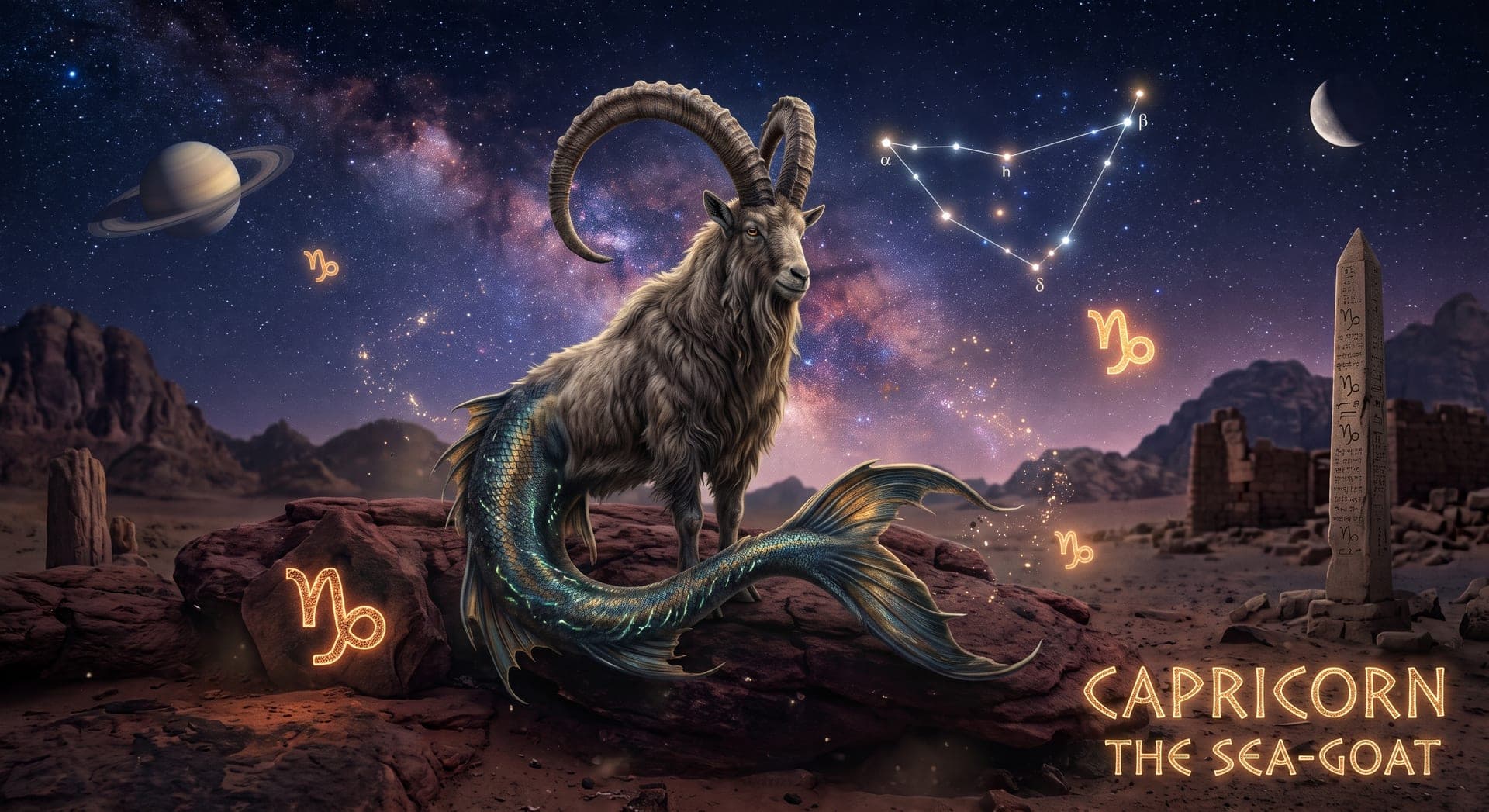
Born on January 14: Capricorn ♑
Capricorn, the tenth sign of the zodiac, spans December 22 to January 19 and is represented by the sea-goat, a mythical creature with the body of a goat and the tail of a fish, symbolizing an ability to navigate both the practical, earthly world and deeper emotional currents. Ruled by Saturn, the planet of discipline and time, Capricorns are often characterized as ambitious, patient, and deeply committed to long-term goals, willing to put in steady effort where others give up. As an Earth sign, Capricorn is grounded and practical, valuing tangible results and responsibility over impulsiveness. People born under this sign are frequently drawn to leadership and other structured pursuits where their organizational skills and work ethic can shine. Beneath a reserved, businesslike exterior, Capricorns are often said to carry a dry, understated sense of humor and a loyal, protective nature toward the people closest to them.
Personality Traits
Strengths
- Disciplined and self-controlled
- Responsible and dependable
- Excellent long-term planner
- Hardworking and persistent
- Good sense of humor once comfortable
Weaknesses
- Can be a know-it-all
- Unforgiving of mistakes, including their own
- Prone to pessimism
- Condescending toward those who don't work as hard
- Stubbornly resistant to changing plans
Compatible Signs
Fun Facts
- Capricorn's symbol, the sea-goat, comes from the Greek myth of Pan, who transformed his lower half into a fish tail to escape the monster Typhon while diving into the Nile.
- Saturn, Capricorn's ruling planet, was the Roman god of time, harvest, and generational structure, echoing the sign's association with patience and long-term thinking.
- Capricorn is one of only two zodiac signs represented by a hybrid creature, the other being Sagittarius, the centaur.
- Notable Capricorns include Michelle Obama, Martin Luther King Jr., Dolly Parton, LeBron James, and Isaac Newton.
- In traditional astrology, the winter solstice, the shortest day of the year, falls right at the start of Capricorn season in the Northern Hemisphere.
Born on January 14
- 1845
Henry Petty-Fitzmaurice, 5th Marquess of Lansdowne
English statesman who served as Governor General of Canada and Viceroy of India
- 1875
Albert Schweitzer
Nobel Peace Prize-winning physician, theologian, and philosopher
- 1886
Hugh Lofting
English author who created the Doctor Dolittle series of children's books
- 1901
Alfred Tarski
Polish-American mathematician and logician
- 1904
Cecil Beaton
English photographer and costume designer known for his fashion and portrait photography
- 1925
Yukio Mishima
Japanese author, poet, and playwright
- 1926
Warren Mitchell
English actor best known for playing Alf Garnett in Till Death Us Do Part
- 1934
Richard Briers
English actor known for the sitcom The Good Life
- 1940
Trevor Nunn
English theatre director renowned for his long tenure leading the Royal Shakespeare Company
- 1941
Faye Dunaway
Academy Award-winning American actress
- 1963
Steven Soderbergh
American film director known for "Ocean's Eleven" and "Erin Brockovich"
- 1967
Emily Watson
English actress known for her roles in Breaking the Waves and Hilary and Jackie
- 1968
LL Cool J
American rapper and actor
- 1969
Dave Grohl
Musician, former Nirvana drummer and Foo Fighters frontman
- 1999
Declan Rice
English footballer who plays for Arsenal and the England national team

On This Day in History
- 1236
King Henry III of England marries Eleanor of Provence at Canterbury Cathedral.
The marriage was arranged to secure an alliance with the powerful county of Provence, and the fourteen-year-old Eleanor was crowned queen at Westminster Abbey shortly after arriving in England. She brought a large retinue of relatives and courtiers from Savoy and Provence, whose influence and land grants at the English court later stirred resentment among English barons. The marriage produced several children, including Henry's eventual successor, Edward I.
- 1301
King Andrew III of Hungary dies, bringing an end to the Árpád dynasty that had ruled Hungary for over four centuries.
Andrew III's death without a surviving male heir plunged Hungary into a prolonged succession crisis, as rival claimants from foreign royal houses vied for the throne. The Árpád line had ruled continuously since the country's founding under Grand Prince Árpád in the ninth century, so its extinction marked a significant turning point. The crown eventually passed to Charles I of the Angevin House of Anjou after years of civil conflict.
- 1761
The Third Battle of Panipat, one of the largest battles of the 18th century, is fought in India.
Fought between the Maratha Empire and an Afghan-led coalition, the battle involved hundreds of thousands of combatants and ended in a catastrophic Maratha defeat that killed tens of thousands of soldiers and civilians. The battle severely weakened Maratha power in northern India, creating a political vacuum that the British East India Company would later exploit to expand its control over the subcontinent.
- 1761
The Durrani Empire decisively defeats the Maratha Empire at the Third Battle of Panipat in northern India.
The battle was one of the largest fought in eighteenth-century India, pitting the Afghan-led forces of Ahmad Shah Durrani against the expanding Maratha Confederacy, which had come to dominate much of the subcontinent. Maratha losses were catastrophic, effectively halting their northward expansion for years. The resulting power vacuum in northern India ultimately helped clear the way for the East India Company's later rise to dominance.
- 1784
The Congress of the Confederation ratifies the Treaty of Paris, formally ending the American Revolutionary War.
Ratification by the Confederation Congress, then meeting in Annapolis, Maryland, formally concluded the Revolutionary War that had begun with fighting at Lexington and Concord nearly nine years earlier. The treaty recognized American independence and set the new nation's boundaries, though the weak Articles of Confederation government it operated under would soon prove inadequate, leading to the drafting of the Constitution.
- 1784
The Congress of the Confederation ratifies the Treaty of Paris, formally ending the American Revolutionary War with Great Britain.
The treaty, originally signed in September 1783, had recognized the independence of the thirteen colonies and set new boundaries for the United States, but ratification by Congress was needed to make it binding. Achieving a quorum proved difficult, delaying the vote for weeks. The agreement formally ended nearly a decade of conflict and marked Britain's acceptance of the loss of its American colonies.
- 1797
Napoleon Bonaparte leads French forces to a decisive victory at the Battle of Rivoli.
Napoleon's forces defeated a larger Austrian army attempting to relieve the besieged fortress city of Mantua during his brilliant Italian campaign, using rapid troop movements to defeat separate enemy columns before they could unite. The victory was considered one of Napoleon's early tactical masterpieces and helped force Austria to the negotiating table, boosting his rising reputation as a military genius.
- 1797
Napoleon Bonaparte wins a decisive victory over Austrian forces at the Battle of Rivoli in northern Italy.
The battle was a critical moment in Napoleon's Italian campaign, as his heavily outnumbered French army outmaneuvered and routed a larger Austrian force attempting to relieve the besieged fortress city of Mantua. The victory secured French control of northern Italy and cemented Napoleon's reputation as a brilliant tactical commander. Mantua itself surrendered weeks later, effectively ending Austrian resistance in the region and paving the way for further French conquests.
- 1814
Denmark cedes Norway to Sweden under the Treaty of Kiel.
The treaty, part of the broader settlement ending the Napoleonic Wars, punished Denmark for having sided with Napoleon by stripping it of Norway, which was transferred to the Swedish crown. Norwegians resisted the arrangement, briefly declaring independence and adopting their own constitution before being forced into a looser union with Sweden that lasted until 1905.
- 1899
The RMS Oceanic, the largest ship in the world since the SS Great Eastern, is launched for the White Star Line.
Built at the Harland and Wolff shipyard in Belfast, the Oceanic was designed to combine speed and luxury for the transatlantic passenger trade, setting new standards of comfort for first-class travelers. At over 700 feet long, she briefly held the title of the world's largest ship before later liners surpassed her. She served for over a decade before running aground off Scotland in 1914 shortly after Britain entered the First World War.
- 1900
Giacomo Puccini's opera Tosca receives its premiere at the Teatro Costanzi in Rome.
Based on a French melodrama by Victorien Sardou, the opera tells a story of love, political intrigue, and betrayal set in Rome during the Napoleonic Wars. Early critical reception was mixed, with some reviewers finding its violence and intensity shocking, but it quickly won over audiences and became one of Puccini's most enduringly popular works. Its dramatic arias, including Vissi d'arte, remain staples of the operatic repertoire today.
- 1907
A devastating earthquake strikes Kingston, Jamaica, killing over 1,000 people.
The earthquake struck Jamaica's capital, then a major British colonial trading hub, collapsing buildings across the city and igniting fires that caused further devastation. Combined with earlier hurricanes and yellow fever outbreaks, the disaster accelerated Kingston's long economic decline relative to other Caribbean ports during the early 20th century.
- 1907
A powerful earthquake devastates Kingston, the capital of the British colony of Jamaica, killing more than 1,000 people.
The quake and the fires that followed destroyed much of the city's commercial center, leaving thousands homeless. The disaster briefly strained relations between Britain and the United States after the colony's governor, Alexander Swettenham, controversially rebuffed American naval assistance, fearing it implied criticism of British colonial administration. He was later forced to resign over the diplomatic incident, even as reconstruction of Kingston continued for years.
- 1943
Franklin D. Roosevelt and Winston Churchill begin the Casablanca Conference to plan Allied strategy in World War II.
Meeting in French Morocco, Roosevelt and Churchill agreed on a strategy for the Allied invasion of Sicily and, controversially, announced a demand for the "unconditional surrender" of Germany, Italy, and Japan. The policy aimed to prevent a repeat of the disputed World War I armistice but has been debated by historians as potentially prolonging Axis resistance in the war's final years.
- 1943
Franklin D. Roosevelt and Winston Churchill begin the Casablanca Conference to plan Allied strategy for the rest of the Second World War.
Meeting in French Morocco, the two leaders, joined by their military chiefs, agreed on plans for the invasion of Sicily and announced their demand for the unconditional surrender of the Axis powers. Soviet leader Joseph Stalin had been invited but could not attend due to the ongoing Battle of Stalingrad. The conference cemented the close wartime partnership between Britain and the United States that shaped Allied strategy through the war's end.
- 1967
The Human Be-In gathering takes place in San Francisco, helping to launch the 1967 Summer of Love.
The gathering in San Francisco's Golden Gate Park drew tens of thousands of young people for a day of music, poetry, and countercultural celebration, featuring figures like Timothy Leary and bands including the Grateful Dead. It's widely seen as a launching point for the 1967 Summer of Love and helped popularize the hippie counterculture movement nationally.
- 1967
The Human Be-In gathers thousands in San Francisco's Golden Gate Park, helping launch the countercultural Summer of Love.
The event brought together prominent countercultural figures, including poet Allen Ginsberg and psychologist Timothy Leary, who urged the crowd to turn on, tune in, and drop out. Bands including Jefferson Airplane and Grateful Dead performed for a crowd estimated at over twenty thousand people. The gathering is widely seen as a precursor to the hippie movement's peak that summer and to the wider counterculture of the late 1960s.
- 1972
Margrethe II becomes Queen of Denmark, the country's first female monarch since 1412.
Margrethe ascended the Danish throne upon her father Frederick IX's death, made possible by a 1953 constitutional change allowing female succession. Her reign, one of the longest in Danish history, made her a widely popular and enduring figure in Danish public life, known also for her artistic pursuits, including illustration and costume design.
- 1973
Elvis Presley's "Aloha from Hawaii" concert is broadcast live by satellite to a huge global audience.
Broadcast live via satellite from Honolulu, Presley's concert was seen by an estimated one to 1.5 billion viewers across dozens of countries, at the time one of the largest television audiences in history, reportedly surpassing the Apollo 11 moon landing broadcast. The elaborate jumpsuit-clad performance became one of the defining images of Presley's later career.
- 2024
Queen Margrethe II of Denmark abdicates the throne, and her son becomes King Frederik X.
Margrethe II's abdication, announced the previous New Year's Eve, was the first by a Danish monarch in nearly 900 years, since voluntary abdication was historically almost unheard of in the Danish monarchy. Her son ascended as King Frederik X, continuing a monarchy that traces its unbroken line back over a thousand years, among the oldest in the world.