What’s Observed on January 13
Born on January 13: Capricorn ♑
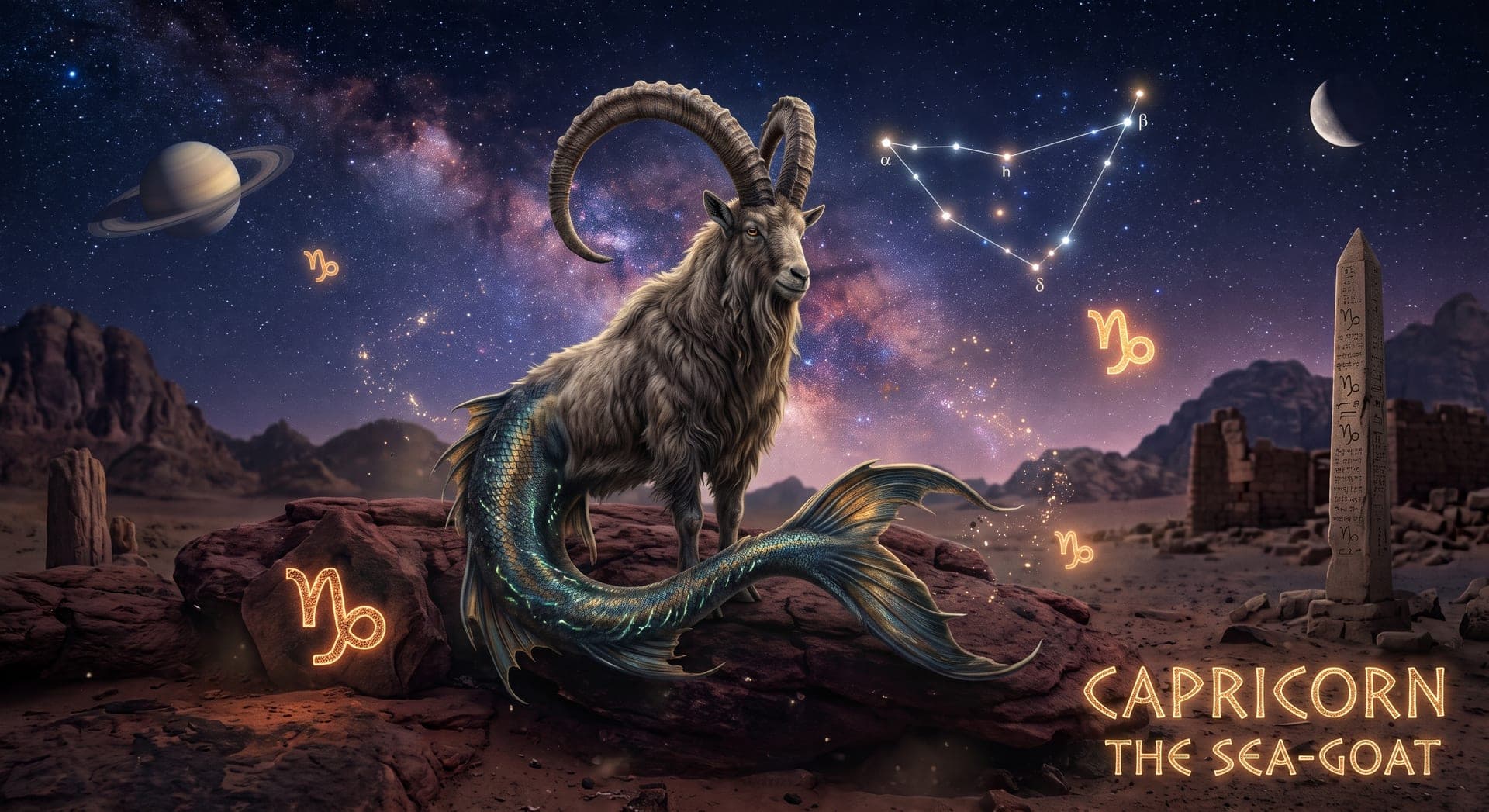
Capricorn, the tenth sign of the zodiac, spans December 22 to January 19 and is represented by the sea-goat, a mythical creature with the body of a goat and the tail of a fish, symbolizing an ability to navigate both the practical, earthly world and deeper emotional currents. Ruled by Saturn, the planet of discipline and time, Capricorns are often characterized as ambitious, patient, and deeply committed to long-term goals, willing to put in steady effort where others give up. As an Earth sign, Capricorn is grounded and practical, valuing tangible results and responsibility over impulsiveness. People born under this sign are frequently drawn to leadership and other structured pursuits where their organizational skills and work ethic can shine. Beneath a reserved, businesslike exterior, Capricorns are often said to carry a dry, understated sense of humor and a loyal, protective nature toward the people closest to them.
Personality Traits
Strengths
- Disciplined and self-controlled
- Responsible and dependable
- Excellent long-term planner
- Hardworking and persistent
- Good sense of humor once comfortable
Weaknesses
- Can be a know-it-all
- Unforgiving of mistakes, including their own
- Prone to pessimism
- Condescending toward those who don't work as hard
- Stubbornly resistant to changing plans
Compatible Signs
Fun Facts
- Capricorn's symbol, the sea-goat, comes from the Greek myth of Pan, who transformed his lower half into a fish tail to escape the monster Typhon while diving into the Nile.
- Saturn, Capricorn's ruling planet, was the Roman god of time, harvest, and generational structure, echoing the sign's association with patience and long-term thinking.
- Capricorn is one of only two zodiac signs represented by a hybrid creature, the other being Sagittarius, the centaur.
- Notable Capricorns include Michelle Obama, Martin Luther King Jr., Dolly Parton, LeBron James, and Isaac Newton.
- In traditional astrology, the winter solstice, the shortest day of the year, falls right at the start of Capricorn season in the Northern Hemisphere.
Born on January 13
- 1864
Wilhelm Wien
German physicist who won the Nobel Prize for work on heat radiation
- 1925
Gwen Verdon
Broadway dancer and actress celebrated for musical theater
- 1926
Michael Bond
English author who created the beloved children's book character Paddington Bear
- 1931
Ian Hendry
English actor known for his roles in The Avengers and Get Carter
- 1961
Julia Louis-Dreyfus
Emmy-winning actress known for "Seinfeld" and "Veep"
- 1961
Suggs
English singer-songwriter and frontman of the ska band Madness
- 1965
Bill Bailey
English musician and comedian known for his surreal musical comedy routines
- 1969
Stephen Hendry
Scottish snooker player who won the World Championship a record seven times
- 1977
Orlando Bloom
British actor known for "The Lord of the Rings" and "Pirates of the Caribbean"
- 1982
Ruth Wilson
English actress known for her roles in Luther and The Affair
- 1990
Liam Hemsworth
Australian actor known for "The Hunger Games" film series
- 1993
Max Whitlock
English artistic gymnast and multiple Olympic gold medalist
- 1997
Connor McDavid
Canadian ice hockey superstar
On This Day in History
- 27 BCE
Octavian formally transfers control of the Roman state back to the Senate, a symbolic step in the founding of the Roman Empire.
Octavian's carefully staged gesture, publicly relinquishing his extraordinary wartime powers back to the Senate after defeating his rivals in Rome's civil wars, was largely theater; the Senate immediately voted to grant him sweeping new authority and, days later, the title "Augustus." The maneuver let him consolidate absolute power while preserving the outward appearance of a restored Republic.
- 532
The Nika riots break out in Constantinople during a chariot race, eventually killing tens of thousands and nearly toppling Emperor Justinian I.
The riots erupted when factions supporting rival chariot-racing teams, the Blues and the Greens, united in anger over taxation and unpopular officials, nearly toppling Emperor Justinian I. As the mob rampaged and burned much of Constantinople, Justinian nearly fled before his wife, Theodora, reportedly urged him to stand firm; his general Belisarius then crushed the revolt, killing tens of thousands in the Hippodrome.
- 1547
Henry Howard, Earl of Surrey, is sentenced to death for treason against King Henry VIII.
Surrey, a celebrated poet credited with helping introduce blank verse and the English sonnet form, fell victim to the paranoid, dying king's suspicion of the powerful Howard family, whose royal blood made them potential rivals to the young heir, Prince Edward. Convicted on flimsy evidence of quartering royal arms improperly, he was beheaded on Tower Hill days later, just over a week before Henry VIII himself died.
- 1815
British troops capture Fort Peter near St. Marys, Georgia, during the final weeks of the War of 1812.
The raid came as part of a broader British campaign along the American Gulf and Atlantic coasts in the war's closing stages, launched from bases in the Caribbean and Bermuda. British forces briefly occupied the area around St. Marys before withdrawing. Ironically, the fighting continued for weeks after the Treaty of Ghent had already been signed in Europe, since news of peace had not yet reached American shores.
- 1842
William Brydon becomes the sole member of a 4,500-strong British-Indian army to reach safety after the disastrous retreat from Kabul.
The retreat came during the First Anglo-Afghan War, after British forces agreed to withdraw from Kabul under an unraveling truce, only to be harried and slaughtered by Afghan tribesmen through snowbound mountain passes. Brydon, an army surgeon, arrived at the British garrison in Jalalabad badly wounded, his story becoming a symbol of one of the worst military disasters in the history of the British Empire in Asia.
- 1847
The Treaty of Cahuenga ends fighting in California during the Mexican–American War.
The treaty, signed by American and Californio forces near Los Angeles, ended organized armed resistance in California during the broader Mexican-American War, without addressing the war's larger territorial questions. California would formally become U.S. territory under the 1848 Treaty of Guadalupe Hidalgo, entering the Union as a state just two years later, fueled by the gold rush already underway.
- 1849
The Colony of Vancouver Island is established as a British Crown colony on Canada's Pacific coast.
Britain granted the Hudson's Bay Company a lease over the island in exchange for developing it as a settlement, partly to secure the region against growing American territorial ambitions following the Oregon boundary dispute. James Douglas, the company's chief factor, became the colony's governor. It later merged with the mainland Colony of British Columbia in 1866, forming the province that joined the Canadian Confederation in 1871.
- 1849
British forces suffer heavy losses and are forced to retreat against the Sikh army at the Battle of Chillianwala during the Second Anglo-Sikh War.
The battle was one of the bloodiest fought by British forces in India, with both sides claiming victory despite British casualties running into the thousands, including the loss of several regimental colours. News of the setback caused alarm in Britain and hastened the dispatch of reinforcements under a new commander to replace Sir Hugh Gough. British forces went on to win the decisive Battle of Gujrat weeks later, ending the war.
- 1888
The National Geographic Society is founded in Washington, D.C.
The National Geographic Society was founded by 33 explorers, geographers, and scientists at Washington's Cosmos Club, aiming to increase and diffuse geographic knowledge. Its magazine, launched the same year, grew from a niche scientific journal into a globally recognized publication known for its photography, funding thousands of scientific expeditions and conservation projects over the following century.
- 1888
The National Geographic Society is founded in Washington, D.C., dedicated to the increase and diffusion of geographic knowledge.
A group of 33 explorers, scientists, and scholars established the society, which soon launched National Geographic Magazine to share discoveries in exploration, geography, and natural history with a broad public audience. The organization went on to fund and support major expeditions across the twentieth century, from polar exploration to deep-sea research, and its magazine became renowned for its photography, shaping popular understanding of the wider world for generations.
- 1893
The Independent Labour Party holds its first meeting in Bradford, marking a key step in the founding of Britain's labour movement.
Delegates from trade unions and socialist societies gathered to establish a political party dedicated to representing working-class interests independently of the Liberal and Conservative parties. Keir Hardie, already the first independent socialist elected to Parliament, became a leading figure in the new organization. The party played a crucial role in the eventual formation of the Labour Party in 1900, which grew to become one of Britain's two dominant political forces.
- 1898
Émile Zola publishes his open letter "J'accuse…!", exposing the Dreyfus affair in France.
Zola's open letter, published on the front page of a Paris newspaper, directly accused the French government and military of antisemitism and a deliberate cover-up in wrongly convicting Alfred Dreyfus. The explosive publication forced the Dreyfus affair into full public view, leading to Zola's own prosecution for libel but ultimately helping secure Dreyfus's exoneration years later.
- 1915
A major earthquake devastates the Avezzano region of Italy, killing tens of thousands of people.
The earthquake devastated the mountainous Avezzano region east of Rome, flattening the town almost entirely within seconds and killing an estimated 30,000 people, a death toll made worse by the era's poor construction standards and slow rescue response. It remains one of the deadliest earthquakes in modern Italian history.
- 1935
A plebiscite in the Saarland shows 90.3 percent of voters wish to end joint British and French administration and rejoin Germany.
The Saar region had been placed under League of Nations control after the First World War, administered jointly by Britain and France, with its coal mines given to France as reparations. The League-supervised vote, held under Nazi Germany's watchful eye, produced an overwhelming result in favor of reunification. The territory formally returned to German control that March, becoming one of Adolf Hitler's early foreign policy successes.
- 1950
The British submarine HMS Truculent collides with a Swedish oil tanker in the Thames Estuary, killing 64 people.
The submarine was on a test run following a refit when it surfaced directly into the tanker's path on a dark, foggy night, and sank within minutes. Many of the crew who escaped through the hatches drowned in the freezing water or were struck by passing ships in the busy shipping lane. The disaster prompted the Royal Navy to introduce fluorescent life jackets and improved escape procedures for submarine crews.
- 1982
Air Florida Flight 90 crashes into Washington, D.C.'s 14th Street Bridge and the Potomac River, killing 78 people.
The Boeing 737, struggling to gain altitude in icy conditions after a snowstorm delay, clipped the 14th Street Bridge during rush hour and plunged into the frozen Potomac River. Bystanders performed dramatic rescues, including a passenger who repeatedly passed a helicopter lifeline to other survivors before drowning himself. The disaster led to major reforms in aircraft de-icing procedures.
- 1991
Soviet troops attack pro-independence demonstrators in Vilnius, Lithuania, killing 14 people.
Soviet troops and tanks moved against crowds defending Lithuania's television tower and other key sites just weeks after Lithuania had declared independence from the crumbling Soviet Union. The bloody crackdown, which killed 14 unarmed civilians, drew international condemnation and ultimately failed to stop Lithuania's independence movement, which succeeded later that year as the USSR itself collapsed.
- 1993
Royal Air Force aircraft join American and French forces in air strikes against Iraqi targets after Iraq violated UN-imposed no-fly zones.
The strikes targeted surface-to-air missile sites in southern Iraq that Baghdad had moved in defiance of restrictions imposed after the 1991 Gulf War. Coming in the final days of George H. W. Bush's presidency, the action was intended to enforce continued compliance with UN Security Council resolutions. Britain, alongside the United States and France, had been enforcing the no-fly zones over Iraq since shortly after the war's end.
- 2012
The cruise ship Costa Concordia capsizes off the coast of Italy, killing 32 people.
The Costa Concordia struck rocks off the Tuscan island of Giglio after its captain deviated from the ship's planned route to sail closer to shore, causing the vessel to partially capsize with over 4,000 people aboard. The disaster, and the captain's controversial early evacuation of the ship, led to his conviction for manslaughter and prompted new international cruise ship safety regulations.
- 2021
The U.S. House of Representatives impeaches President Donald Trump for a second time, following the January 6 Capitol attack.
The impeachment came just one week after a mob of Trump's supporters stormed the Capitol, making Trump the first U.S. president impeached twice. The House charged him with "incitement of insurrection." The Senate trial concluded after he had already left office, and while a majority voted to convict, it fell short of the two-thirds threshold required for conviction.