
What’s Observed on January 12
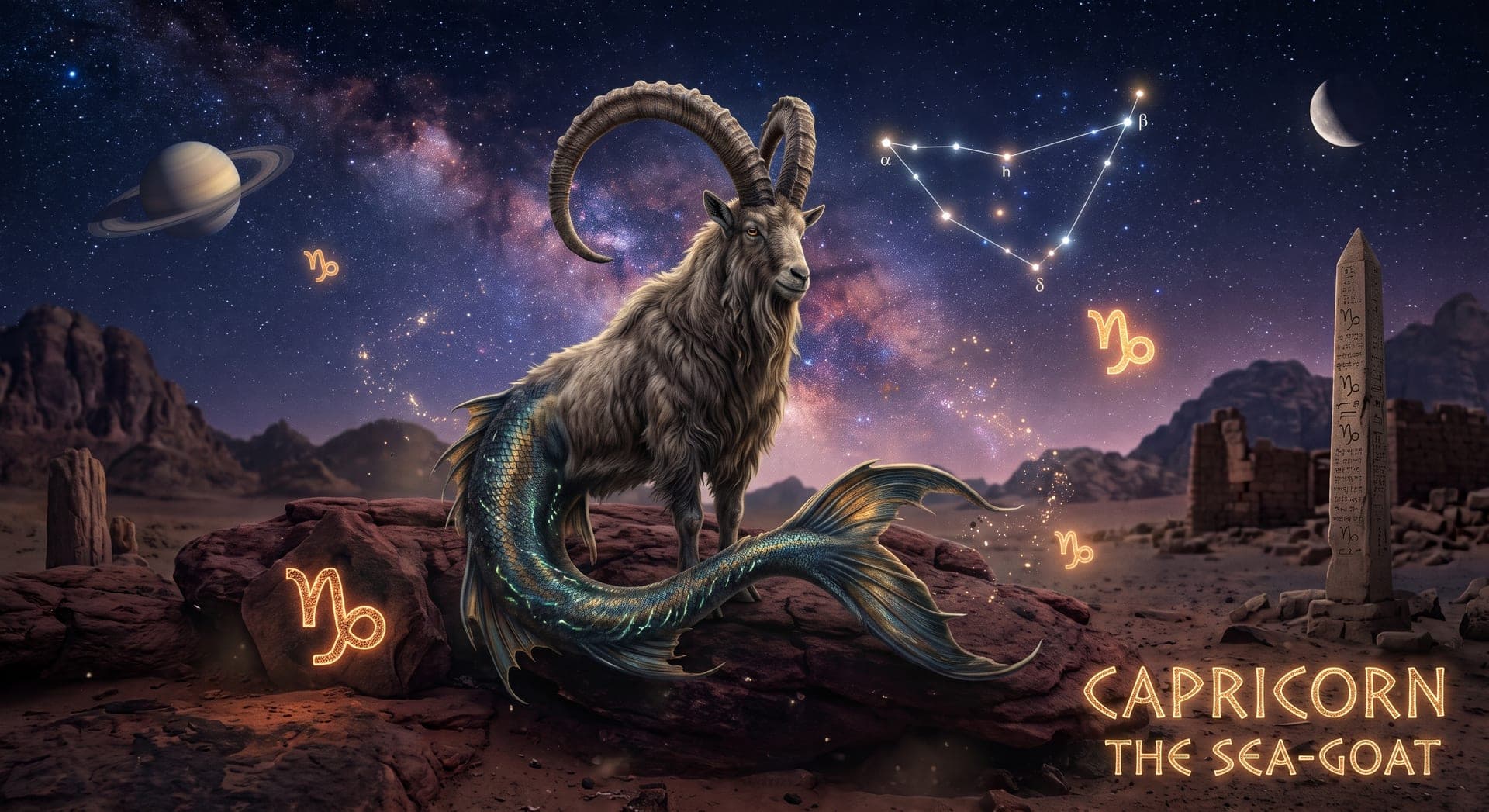
Born on January 12: Capricorn ♑
Capricorn, the tenth sign of the zodiac, spans December 22 to January 19 and is represented by the sea-goat, a mythical creature with the body of a goat and the tail of a fish, symbolizing an ability to navigate both the practical, earthly world and deeper emotional currents. Ruled by Saturn, the planet of discipline and time, Capricorns are often characterized as ambitious, patient, and deeply committed to long-term goals, willing to put in steady effort where others give up. As an Earth sign, Capricorn is grounded and practical, valuing tangible results and responsibility over impulsiveness. People born under this sign are frequently drawn to leadership and other structured pursuits where their organizational skills and work ethic can shine. Beneath a reserved, businesslike exterior, Capricorns are often said to carry a dry, understated sense of humor and a loyal, protective nature toward the people closest to them.
Personality Traits
Strengths
- Disciplined and self-controlled
- Responsible and dependable
- Excellent long-term planner
- Hardworking and persistent
- Good sense of humor once comfortable
Weaknesses
- Can be a know-it-all
- Unforgiving of mistakes, including their own
- Prone to pessimism
- Condescending toward those who don't work as hard
- Stubbornly resistant to changing plans
Compatible Signs
Fun Facts
- Capricorn's symbol, the sea-goat, comes from the Greek myth of Pan, who transformed his lower half into a fish tail to escape the monster Typhon while diving into the Nile.
- Saturn, Capricorn's ruling planet, was the Roman god of time, harvest, and generational structure, echoing the sign's association with patience and long-term thinking.
- Capricorn is one of only two zodiac signs represented by a hybrid creature, the other being Sagittarius, the centaur.
- Notable Capricorns include Michelle Obama, Martin Luther King Jr., Dolly Parton, LeBron James, and Isaac Newton.
- In traditional astrology, the winter solstice, the shortest day of the year, falls right at the start of Capricorn season in the Northern Hemisphere.
Born on January 12
- 1799
Priscilla Susan Bury
British botanical illustrator celebrated for her detailed watercolor studies of exotic plants
- 1863
Swami Vivekananda
Indian Hindu monk who introduced Vedanta philosophy to the West
- 1876
Jack London
American novelist known for "The Call of the Wild" and "White Fang"
- 1916
Mary Wilson, Baroness Wilson of Rievaulx
English poet and wife of Prime Minister Harold Wilson
- 1937
Shirley Eaton
English actress best known for playing the gold-painted Bond girl in Goldfinger
- 1948
Anthony Andrews
English actor known for his role as Sebastian Flyte in Brideshead Revisited
- 1948
William Nicholson
English author and screenwriter known for Shadowlands and co-writing Gladiator
- 1951
Rush Limbaugh
American conservative radio talk show host
- 1951
Kirstie Alley
American actress known for "Cheers"
- 1954
Howard Stern
American radio host and media personality
- 1957
John Lasseter
Animator and director who helped found Pixar
- 1964
Jeff Bezos
Entrepreneur who founded Amazon
- 1969
David Mitchell
English novelist known for acclaimed works including Cloud Atlas
- 1974
Melanie C
English singer-songwriter known as Sporty Spice, a member of the Spice Girls
- 1993
Zayn Malik
English singer known for his time in the boy band One Direction and his solo career

On This Day in History
- 1528
Gustav I is crowned King of Sweden.
Gustav Eriksson Vasa was elected king by the Swedish parliament after leading a successful rebellion against Danish rule during the Kalmar Union period, which had loosely joined Sweden, Denmark, and Norway under one crown. His coronation marked the founding of an independent Swedish monarchy and the Vasa dynasty, which ruled Sweden for the following century.
- 1792
Thomas Pinckney is appointed the first United States minister to Great Britain, formalizing diplomatic relations between the two nations.
The appointment came less than a decade after the American Revolutionary War had ended British rule over the thirteen colonies, and relations remained tense over unresolved issues like frontier forts and trade. Pinckney's posting in London helped lay groundwork for later agreements, including the 1795 Jay Treaty, which addressed lingering disputes. His mission marked an early step toward the more stable, if often strained, Anglo-American relationship that followed.
- 1808
An organizational meeting establishes the Wernerian Natural History Society in Edinburgh, dedicated to the study of natural history.
Founded by mineralogist Robert Jameson and named after his teacher, the German geologist Abraham Gottlob Werner, the society became an important forum for Scottish scientific debate in the early nineteenth century. It published research on geology, zoology, and botany and counted figures connected to Edinburgh's flourishing scientific and medical community among its members, including a young Charles Darwin, who presented his first scientific paper there in 1827.
- 1866
The Royal Aeronautical Society is formed in London, becoming the world's first aeronautical society.
Founded decades before powered flight was achieved, the society brought together scientists and enthusiasts committed to the serious study of aerial navigation at a time when many considered the idea fanciful. Its early members conducted pioneering research into aerodynamics and wing design that laid theoretical groundwork later used by aviation pioneers. The society still exists today as a leading professional body for aerospace engineers worldwide.
- 1895
The National Trust is founded in the United Kingdom to preserve historic and natural sites.
The National Trust was established by three Victorian social reformers, Octavia Hill, Robert Hunter, and Hardwicke Rawnsley, who were alarmed by the rapid loss of Britain's countryside and historic buildings to industrial development. It grew into one of the largest conservation charities in the world, now protecting hundreds of historic properties, gardens, and vast stretches of coastline and countryside across England, Wales, and Northern Ireland.
- 1895
The National Trust is founded in the United Kingdom to preserve historic buildings and natural landscapes for public benefit.
Established by social reformers Octavia Hill, Robert Hunter, and Hardwicke Rawnsley in response to unchecked industrial development and the loss of green space, the organization was given legal powers to hold land and property permanently for the nation. It grew over the following century into one of Britain's largest membership organizations and conservation charities, today caring for hundreds of historic houses, gardens, and stretches of coastline.
- 1918
An underground explosion at the Minnie Pit colliery in Staffordshire kills 155 men and boys.
The blast, caused by an ignition of firedamp gas deep in the coal seam, remains one of the deadliest mining disasters in English history. Rescue efforts were hampered by dangerous conditions underground, and many bodies were never recovered from the flooded workings. The tragedy, coming amid the final year of the First World War, added to a long history of mining catastrophes that eventually spurred tighter safety regulation across British coalfields.
- 1932
Hattie Caraway becomes the first woman elected to the United States Senate.
Caraway, an Arkansas Democrat, had been appointed to fill her late husband's Senate seat and was elected in her own right shortly afterward, becoming the first woman to win a Senate election. She went on to serve for over a decade, later becoming the first woman to chair a Senate committee and to preside over Senate proceedings.
- 1932
Hattie Caraway becomes the first woman elected to the United States Senate, winning a seat from Arkansas.
Caraway had originally been appointed to fill her late husband's seat the previous year but went on to win a full term in her own right, defying expectations that she would step aside for a male candidate. She went on to serve in the Senate for over a decade, championing causes including equal pay and opposing the poll tax. Her election marked a milestone for women's political representation in America.
- 1945
The Red Army launches the Vistula–Oder Offensive against German forces during World War II.
The massive Soviet offensive, launched earlier than planned partly to relieve pressure on American forces during the Battle of the Bulge, pushed German troops out of Poland and drove deep into eastern Germany within weeks. It was one of the largest and fastest military offensives in history and brought the Red Army to within striking distance of Berlin.
- 1962
Operation Chopper, the first American combat helicopter assault of the Vietnam War, takes place.
The operation used newly arrived American helicopters to airlift South Vietnamese troops into a Viet Cong stronghold near Saigon, marking the first large-scale use of helicopter-borne assault tactics that would come to define much of the Vietnam War. Though the mission itself achieved limited results, it demonstrated the growing scope of direct American military involvement in the conflict.
- 1964
The Zanzibar Revolution begins, as African revolutionaries overthrow the Sultan of Zanzibar just weeks after the islands gained independence from Britain.
Zanzibar had become a self-governing constitutional monarchy under British protection only a month earlier, but simmering tensions between the Arab-led government and the African majority erupted into an armed uprising led by John Okello. Thousands were killed in the violence that followed the Sultan's overthrow. Within months, Zanzibar merged with mainland Tanganyika to form Tanzania, ending its brief post-colonial existence as a separate state.
- 1969
The New York Jets defeat the Baltimore Colts to win Super Bowl III, one of the greatest upsets in American football history.
The Jets, led by charismatic quarterback Joe Namath, had guaranteed victory before the game despite being 18-point underdogs against the heavily favored Colts. Their win gave the upstart American Football League credibility against the older, more established National Football League and is widely regarded as one of the most important games in the eventual merger of the two leagues.
- 1970
Biafra surrenders to Nigerian federal forces, ending the Nigerian Civil War.
Biafra's surrender ended a devastating 30-month civil war that began when the region, dominated by the Igbo ethnic group, declared independence from Nigeria. The conflict caused a humanitarian catastrophe, with mass starvation from a Nigerian blockade killing an estimated one to two million people, drawing global attention to the crisis and helping shape modern international humanitarian relief efforts.
- 1970
Biafran forces surrender, bringing an end to the Nigerian Civil War after nearly three years of fighting.
The war began when the southeastern region of Nigeria declared independence as the Republic of Biafra in 1967, triggering a brutal conflict marked by a devastating Nigerian government blockade that caused mass starvation. Images of starving Biafran children drew international humanitarian attention and prompted major relief efforts. The surrender reunited Nigeria, though the war's death toll, estimated in the millions, left lasting scars on the country.
- 1991
The U.S. Congress authorizes the use of military force to expel Iraq from Kuwait, setting the stage for the Gulf War.
The congressional authorization came after Iraq's invasion and annexation of Kuwait the previous August and months of failed diplomatic efforts to force a withdrawal. It gave President George H.W. Bush the legal authority to use military force, and the resulting Gulf War began days later with a massive U.S.-led coalition air campaign, followed by a swift ground invasion that liberated Kuwait.
- 2004
The RMS Queen Mary 2, the largest ocean liner ever built at the time, sets sail on her maiden voyage.
Built for Britain's Cunard Line at a shipyard in Saint-Nazaire, France, the vessel was designed to continue Cunard's tradition of transatlantic liner service between Southampton and New York rather than serve solely as a cruise ship. At over 1,100 feet long, she surpassed every passenger ship afloat and was formally named by Queen Elizabeth II shortly before entering service, reviving a storied name from Cunard's earlier flagship.
- 2006
A stampede during the stoning-of-the-devil ritual at the Hajj in Mina, Saudi Arabia, kills at least 362 pilgrims.
The crush occurred as roughly two million pilgrims converged on a narrow bridge and pillars representing the stoning of the devil, a required ritual of the annual Hajj pilgrimage to Mecca. Overcrowding-related tragedies had recurred repeatedly at the site over the years, eventually prompting Saudi authorities to undertake a major expansion and redesign of the pilgrimage infrastructure to improve crowd flow and safety.
- 2010
A catastrophic earthquake strikes Haiti, killing an estimated 220,000 to 300,000 people and devastating Port-au-Prince.
The magnitude 7.0 earthquake struck near Haiti's densely populated capital, collapsing government buildings, hospitals, and homes built without adequate reinforcement, and left over a million people homeless. It triggered one of the largest international humanitarian relief efforts in history, though Haiti's recovery was slowed for years by weak infrastructure, political instability, and a subsequent cholera outbreak linked to UN peacekeepers.
- 2010
A catastrophic magnitude 7.0 earthquake strikes Haiti, killing an estimated 220,000 to 300,000 people.
The quake's epicenter was near the capital, Port-au-Prince, which suffered catastrophic destruction to homes, hospitals, and government buildings, including the collapse of the presidential palace. It ranks among the deadliest earthquakes in recorded history and triggered a massive international humanitarian response, though reconstruction efforts were hampered for years by weak infrastructure, political instability, and a subsequent cholera outbreak introduced by foreign peacekeepers.