What’s Observed on January 11
Born on January 11: Capricorn ♑
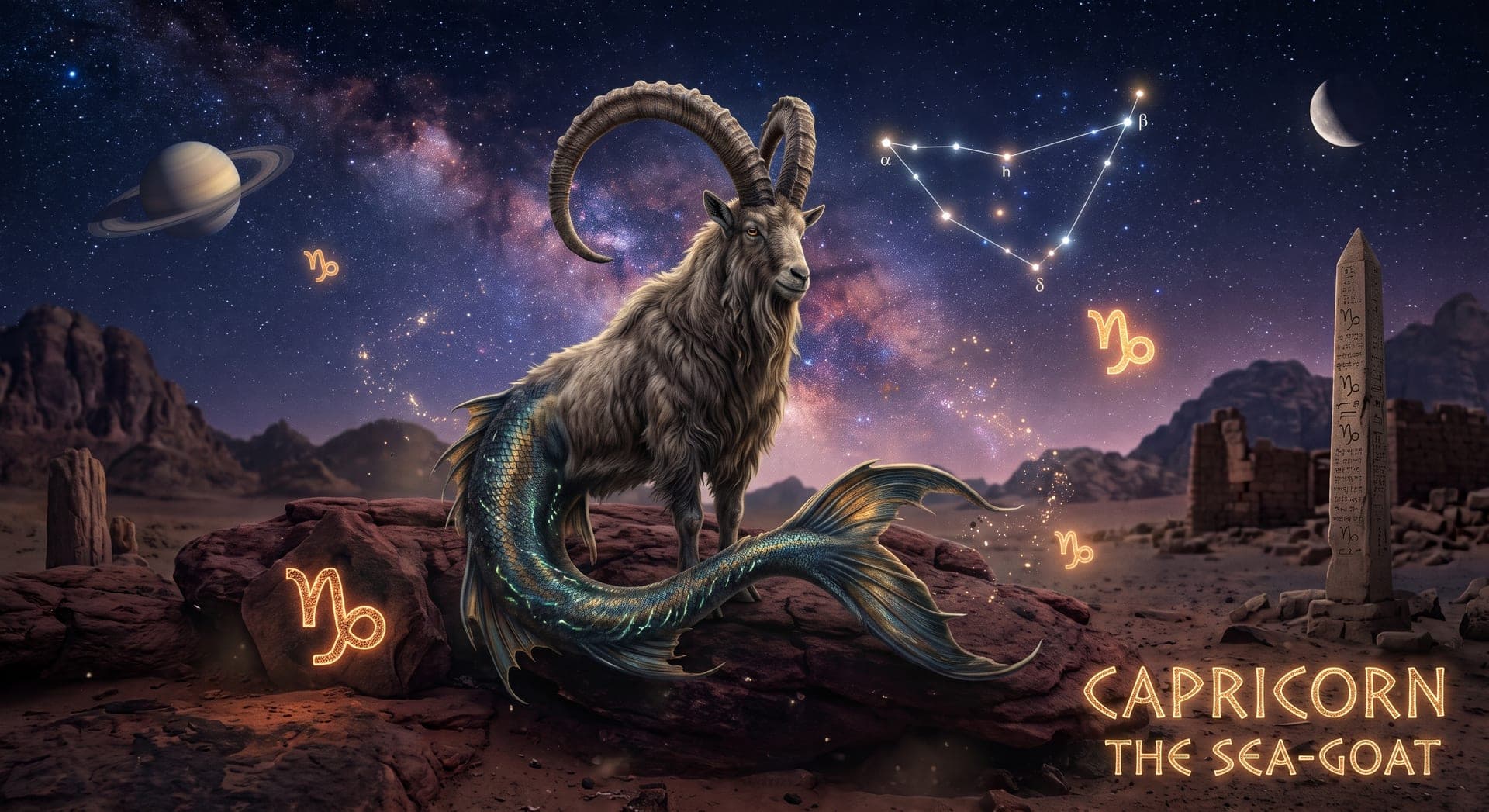
Capricorn, the tenth sign of the zodiac, spans December 22 to January 19 and is represented by the sea-goat, a mythical creature with the body of a goat and the tail of a fish, symbolizing an ability to navigate both the practical, earthly world and deeper emotional currents. Ruled by Saturn, the planet of discipline and time, Capricorns are often characterized as ambitious, patient, and deeply committed to long-term goals, willing to put in steady effort where others give up. As an Earth sign, Capricorn is grounded and practical, valuing tangible results and responsibility over impulsiveness. People born under this sign are frequently drawn to leadership and other structured pursuits where their organizational skills and work ethic can shine. Beneath a reserved, businesslike exterior, Capricorns are often said to carry a dry, understated sense of humor and a loyal, protective nature toward the people closest to them.
Personality Traits
Strengths
- Disciplined and self-controlled
- Responsible and dependable
- Excellent long-term planner
- Hardworking and persistent
- Good sense of humor once comfortable
Weaknesses
- Can be a know-it-all
- Unforgiving of mistakes, including their own
- Prone to pessimism
- Condescending toward those who don't work as hard
- Stubbornly resistant to changing plans
Compatible Signs
Fun Facts
- Capricorn's symbol, the sea-goat, comes from the Greek myth of Pan, who transformed his lower half into a fish tail to escape the monster Typhon while diving into the Nile.
- Saturn, Capricorn's ruling planet, was the Roman god of time, harvest, and generational structure, echoing the sign's association with patience and long-term thinking.
- Capricorn is one of only two zodiac signs represented by a hybrid creature, the other being Sagittarius, the centaur.
- Notable Capricorns include Michelle Obama, Martin Luther King Jr., Dolly Parton, LeBron James, and Isaac Newton.
- In traditional astrology, the winter solstice, the shortest day of the year, falls right at the start of Capricorn season in the Northern Hemisphere.
Born on January 11
- 1591
Robert Devereux, 3rd Earl of Essex
English nobleman and Parliamentarian general during the English Civil War
- 1755
Alexander Hamilton
Founding Father and first U.S. Secretary of the Treasury
- 1757
Samuel Bentham
English naval engineer and inventor known for pioneering innovations in shipbuilding and mechanization
- 1786
Joseph Jackson Lister
English physicist and wine merchant who pioneered the achromatic microscope lens
- 1814
James Paget
English surgeon and pathologist after whom Paget's disease is named
- 1815
John A. Macdonald
First Prime Minister of Canada
- 1842
William James
Pioneering American psychologist and philosopher
- 1859
George Curzon, 1st Marquess Curzon of Kedleston
English statesman who served as Viceroy of India and later British Foreign Secretary
- 1906
Albert Hofmann
Swiss chemist who first synthesized LSD
- 1934
Jean Chretien
20th Prime Minister of Canada
- 1938
Arthur Scargill
English trade unionist who led the National Union of Mineworkers during the 1984-85 miners' strike
- 1956
Phyllis Logan
Scottish actress known for playing Mrs Hughes in the television series Downton Abbey
- 1957
Bryan Robson
English footballer who captained Manchester United and the England national team
- 1971
Mary J. Blige
Acclaimed R&B and hip-hop singer-songwriter
- 1973
Rahul Dravid
Legendary Indian cricketer
- 1987
Jamie Vardy
English footballer known for Leicester City's Premier League title run

On This Day in History
- 532
The Nika riots erupt in Constantinople, beginning a week of violent unrest that nearly toppled Byzantine Emperor Justinian I.
The riots began as a dispute between rival chariot-racing factions at the Hippodrome but escalated into a broader revolt against Justinian's rule and unpopular taxation. Rioters set much of the city ablaze and proclaimed a rival emperor before Justinian's general Belisarius crushed the uprising, reportedly killing tens of thousands in the Hippodrome. The devastation cleared the way for Justinian's rebuilding of the city, including the Hagia Sophia.
- 630
The Prophet Muhammad and his followers peacefully conquer Mecca, and the ruling Quraysh clans surrender.
Muhammad's return to Mecca came eight years after he had fled the city for Medina to escape persecution. His forces entered with minimal bloodshed, and he responded to the city's surrender with a broad amnesty rather than retribution against his former enemies. He then destroyed the idols housed in the Kaaba, establishing Mecca as the spiritual center of Islam.
- 630
Muhammad and his followers peacefully conquer Mecca, a turning point in the founding of Islam.
After years of conflict between the young Muslim community in Medina and the ruling Quraysh tribe of Mecca, Muhammad marched on the city with a large force and it surrendered largely without bloodshed. He then destroyed the idols housed within the Kaaba, rededicating it to the worship of one God. The conquest secured Mecca as the spiritual center of Islam and accelerated the religion's spread across the Arabian Peninsula.
- 1569
England holds its first recorded national lottery, drawn at the west door of St Paul's Cathedral in London.
Queen Elizabeth I had authorized the lottery to raise funds for repairing the country's harbors and other public works. Tickets were sold for ten shillings each, with prizes including cash, plate, and tapestries, and participants were even granted immunity from arrest for most crimes while the draw took place. Though the draw took months to complete, it established a form of state-sanctioned gambling that would recur intermittently in English history.
- 1787
Astronomer William Herschel discovers Titania and Oberon, two moons of Uranus.
Herschel, the German-born British astronomer already famous for discovering Uranus itself six years earlier, spotted its two largest moons using his powerful homemade telescope. He initially struggled to confirm the faint objects against the glare of the planet. They were later named Titania and Oberon, after characters from Shakespeare's "A Midsummer Night's Dream," continuing the literary naming tradition for Uranus's moons.
- 1787
Astronomer William Herschel discovers Titania and Oberon, the two largest moons of Uranus, from his home observatory in England.
Herschel had already made his name six years earlier by discovering Uranus itself, the first planet found in modern times, using a telescope he built himself. Observing from Slough, he identified the two new moons and later named them, at his son John's suggestion, after characters from Shakespeare's A Midsummer Night's Dream. His work established a naming convention still used for Uranus's moons today.
- 1861
Alabama secedes from the United States, joining the Confederacy ahead of the Civil War.
Alabama's secession, following South Carolina and Mississippi, came in direct response to Abraham Lincoln's election on an anti-slavery-expansion platform. Delegates at the state convention voted decisively to leave the Union, and Alabama's capital, Montgomery, briefly served as the first capital of the Confederacy before the government relocated to Richmond, Virginia.
- 1863
Union forces secure control of the Arkansas River at the Battle of Arkansas Post during the Civil War.
Union forces under General John McClernand captured a Confederate fort along the Arkansas River, securing a key waterway and removing a threat to Union supply lines on the Mississippi River. Though smaller in scale than battles like Vicksburg, the victory helped tighten Union control over the western theater of the Civil War.
- 1863
The Confederate raider CSS Alabama, built in England, sinks the USS Hatteras off the coast of Texas during the American Civil War.
The Alabama had been constructed secretly at John Laird Sons' shipyard in Birkenhead, despite Britain's official neutrality in the conflict, and went on to destroy or capture dozens of Union merchant ships. Its origins caused a lasting diplomatic rift between Washington and London, culminating in the Alabama Claims, an international arbitration that ultimately forced Britain to pay the United States $15.5 million in damages in 1872.
- 1879
The Anglo-Zulu War begins in southern Africa.
British High Commissioner Sir Bartle Frere issued an ultimatum to the Zulu kingdom demanding it dismantle its army, hoping to provoke a war that would let Britain seize Zulu territory. When King Cetshwayo refused, British forces invaded, suffering a stunning early defeat at Isandlwana before ultimately crushing Zulu resistance and annexing the kingdom later that year.
- 1879
The Anglo-Zulu War begins as British forces invade the Zulu Kingdom in southern Africa.
British High Commissioner Sir Bartle Frere engineered an ultimatum the Zulu king Cetshwayo could not accept, giving Britain a pretext to invade and dismantle the powerful Zulu state. The war brought early disaster for Britain at the Battle of Isandlwana, where Zulu forces inflicted one of the worst defeats in the history of the British Empire, before British troops regrouped and ultimately conquered the kingdom later that year.
- 1922
Leonard Thompson becomes the first person to receive an insulin injection to treat diabetes.
Fourteen-year-old Leonard Thompson, dying of type 1 diabetes, became the first patient treated with the newly isolated hormone insulin by researchers Frederick Banting and Charles Best at the University of Toronto. His dramatic recovery, after a refined version of the extract was used weeks later, marked one of the most significant breakthroughs in medical history, transforming a once-fatal diagnosis into a manageable condition.
- 1922
Leonard Thompson, a 14-year-old diabetic, becomes the first person successfully treated with insulin injections in Toronto, Canada.
Thompson had been near death from type 1 diabetes when doctors Frederick Banting and Charles Best, who had recently isolated insulin from animal pancreases, administered a purified extract that dramatically improved his condition. The breakthrough transformed diabetes from a near-certain death sentence into a manageable chronic illness. Banting and the lab's director, John Macleod, shared the Nobel Prize in Physiology or Medicine for the discovery later that year.
- 1927
Studio executive Louis B. Mayer announces the creation of the Academy of Motion Picture Arts and Sciences.
Mayer, head of MGM studios, gathered leading figures from across the film industry to form an organization meant to improve the industry's public image, mediate labor disputes, and promote technical advancement. The Academy went on to establish the Oscars, first awarded in 1929, which became the film industry's most prestigious annual honor.
- 1942
Japanese forces capture Kuala Lumpur, the capital of British Malaya, as they advance rapidly down the Malay Peninsula.
The fall of the city came less than six weeks into Japan's invasion, as British, Indian, and Australian defenders retreated in disarray toward Singapore. The speed of the Japanese advance stunned British commanders, who had long considered Malaya well defended. The campaign culminated the following month in the fall of Singapore itself, widely regarded as the worst defeat in British military history.
- 1943
Britain and the United States sign treaties relinquishing their extraterritorial rights and privileges in China.
The agreements ended nearly a century of unequal treaties dating back to the Opium Wars, under which British and other foreign nationals in China had been exempt from Chinese law and enjoyed control over treaty ports and concessions. Signed while China was fighting as a wartime ally against Japan, the treaties were partly a gesture of solidarity, formally restoring Chinese judicial sovereignty over foreign nationals on its soil.
- 1964
The U.S. Surgeon General publishes a landmark report formally linking smoking to serious health risks.
The report, compiled by an advisory committee after reviewing thousands of scientific studies, was the first major U.S. government statement definitively linking cigarette smoking to lung cancer and other serious diseases. It triggered decades of public health campaigns, warning labels, advertising restrictions, and litigation that dramatically reduced smoking rates in the United States over the following decades.
- 1972
East Pakistan is formally renamed Bangladesh following its war of independence.
The renaming came shortly after the region, formerly East Pakistan, won its independence from Pakistan following a brutal nine-month war that killed hundreds of thousands and drew in Indian military intervention on the Bengali side. The new nation of Bangladesh, meaning "Land of the Bengalis," adopted a constitution and began the difficult process of rebuilding after the devastating conflict.
- 1972
East Pakistan is formally renamed Bangladesh following its victory in the war of independence from Pakistan.
The change came just weeks after Pakistani forces surrendered to a joint Indian and Bangladeshi guerrilla force, ending a brutal nine-month war marked by widespread atrocities against the Bengali population. Sheikh Mujibur Rahman, the movement's imprisoned leader, was released and returned to lead the new nation as its first head of government. Bangladesh's independence marked the definitive end of the united Pakistan created at partition in 1947.
- 2020
China reports the first known death linked to COVID-19 in Wuhan.
Chinese officials disclosed that a 61-year-old man in Wuhan had died from a then-unidentified pneumonia-like illness later identified as COVID-19, linked to a local seafood market. It was the first publicly confirmed death from the virus that would go on to cause a global pandemic, infecting hundreds of millions of people and killing millions worldwide over the following years.