
What’s Observed on January 10
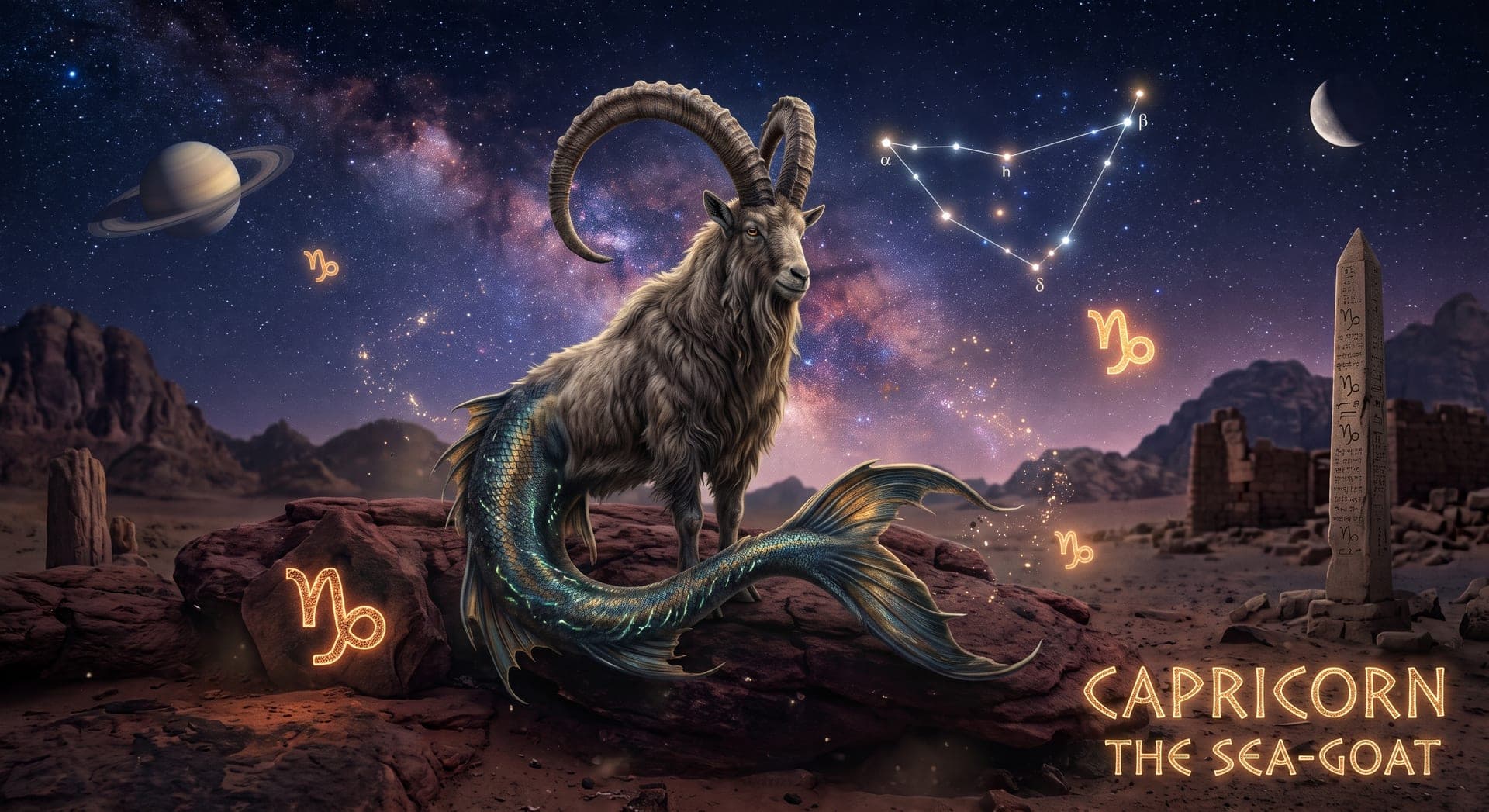
Born on January 10: Capricorn ♑
Capricorn, the tenth sign of the zodiac, spans December 22 to January 19 and is represented by the sea-goat, a mythical creature with the body of a goat and the tail of a fish, symbolizing an ability to navigate both the practical, earthly world and deeper emotional currents. Ruled by Saturn, the planet of discipline and time, Capricorns are often characterized as ambitious, patient, and deeply committed to long-term goals, willing to put in steady effort where others give up. As an Earth sign, Capricorn is grounded and practical, valuing tangible results and responsibility over impulsiveness. People born under this sign are frequently drawn to leadership and other structured pursuits where their organizational skills and work ethic can shine. Beneath a reserved, businesslike exterior, Capricorns are often said to carry a dry, understated sense of humor and a loyal, protective nature toward the people closest to them.
Personality Traits
Strengths
- Disciplined and self-controlled
- Responsible and dependable
- Excellent long-term planner
- Hardworking and persistent
- Good sense of humor once comfortable
Weaknesses
- Can be a know-it-all
- Unforgiving of mistakes, including their own
- Prone to pessimism
- Condescending toward those who don't work as hard
- Stubbornly resistant to changing plans
Compatible Signs
Fun Facts
- Capricorn's symbol, the sea-goat, comes from the Greek myth of Pan, who transformed his lower half into a fish tail to escape the monster Typhon while diving into the Nile.
- Saturn, Capricorn's ruling planet, was the Roman god of time, harvest, and generational structure, echoing the sign's association with patience and long-term thinking.
- Capricorn is one of only two zodiac signs represented by a hybrid creature, the other being Sagittarius, the centaur.
- Notable Capricorns include Michelle Obama, Martin Luther King Jr., Dolly Parton, LeBron James, and Isaac Newton.
- In traditional astrology, the winter solstice, the shortest day of the year, falls right at the start of Capricorn season in the Northern Hemisphere.
Born on January 10
- 1750
Thomas Erskine
Scottish-born lawyer and politician who became Lord Chancellor of Great Britain and a champion of civil liberties
- 1776
George Birkbeck
English physician who founded mechanics' institutes for workers' education, later becoming Birkbeck, University of London
- 1853
Jessie Bond
English mezzo-soprano celebrated for originating roles in Gilbert and Sullivan comic operas
- 1903
Barbara Hepworth
English sculptor renowned as a leading figure of modern abstract art
- 1904
Ray Bolger
Actor and dancer who played the Scarecrow in "The Wizard of Oz"
- 1908
Bernard Lee
English actor best known for playing M in the early James Bond films
- 1911
Norman Heatley
English biologist whose techniques were crucial to developing penicillin for mass production
- 1916
Sune Bergstrom
Swedish biochemist who won the Nobel Prize in Physiology or Medicine
- 1938
Donald Knuth
Computer scientist and author of "The Art of Computer Programming"
- 1943
Jim Croce
American singer-songwriter known for folk-pop ballads
- 1945
Rod Stewart
English singer-songwriter known for hits like Maggie May and his distinctive raspy voice
- 1949
George Foreman
Heavyweight boxing champion and entrepreneur
- 1953
Pat Benatar
American rock singer and four-time Grammy winner

On This Day in History
- 49 BCE
Julius Caesar crosses the Rubicon river with his army, an irreversible act that ignites civil war in Rome.
Roman law forbade a general from bringing his army into Italy proper, so by leading his legion across the small Rubicon river, Caesar committed an act of open rebellion against the Senate with no turning back, giving rise to the phrase "crossing the Rubicon" for an irreversible decision. The resulting civil war ended with Caesar's victory and his rise to dictatorship, paving the way for the end of the Roman Republic.
- 49 BCE
Julius Caesar leads his army across the Rubicon river in northern Italy, an act of insurrection that ignites civil war in Rome.
Roman law forbade any general from bringing an army into Italy proper under arms, so by crossing the small river with his legion, Caesar committed himself irrevocably to conflict with the Senate and his rival Pompey. The phrase 'crossing the Rubicon' endures as a metaphor for passing a point of no return. Caesar's subsequent victory in the civil war paved the way for the end of the Republic and his own dictatorship.
- 1430
Philip the Good, Duke of Burgundy, establishes the Order of the Golden Fleece.
Philip founded the chivalric order to celebrate his marriage to Isabella of Portugal and to bind Burgundy's most powerful nobles to him through a shared code of honor and loyalty, modeled partly on earlier orders like the Knights of the Garter. The Golden Fleece became one of Europe's most prestigious honors, later split between the Spanish and Austrian branches of the Habsburg dynasty, and it is still awarded today.
- 1645
William Laud, Archbishop of Canterbury, is beheaded on Tower Hill after being convicted of treason during the English Civil War.
Laud had been Charles I's closest religious adviser, enforcing strict ceremonial conformity in the Church of England that alienated Puritans and helped provoke rebellion in Scotland. Parliament impeached him in 1640, and after years of imprisonment in the Tower of London, he was executed by a bill of attainder rather than a formal criminal conviction. His death removed one of the king's most divisive allies during the war against Parliament.
- 1776
Thomas Paine publishes his influential pamphlet "Common Sense," advocating American independence from Britain.
Paine's plainly written, forcefully argued pamphlet made the case for American independence to ordinary colonists at a time when many still hoped for reconciliation with Britain. It sold well over 100,000 copies within months, an enormous circulation for the era, and is widely credited with shifting public opinion decisively toward independence in the months before the Declaration was signed.
- 1863
The Metropolitan Railway opens in London, marking the beginning of the London Underground.
The Metropolitan Railway used steam locomotives to pull carriages through shallow underground tunnels beneath London's streets, a pioneering and initially smoky, sooty experience for passengers. Despite the discomfort, the line proved hugely popular and successful, and its network expanded over subsequent decades into the sprawling London Underground system still used by millions of commuters today.
- 1863
The Metropolitan Railway opens in London, running the world's first underground passenger trains and beginning the London Underground.
The line ran between Paddington and Farringdon using steam locomotives pulling gas-lit wooden carriages through shallow cut-and-cover tunnels beneath the city streets. Despite smoke-filled stations, it proved immediately popular, carrying tens of thousands of passengers on its opening day and easing chronic congestion on London's roads. It laid the foundation for what grew into the sprawling London Underground network still in use today.
- 1870
John D. Rockefeller incorporates Standard Oil, which would grow into one of the most powerful and controversial companies in American history.
Founded in Cleveland, Ohio, Standard Oil rapidly consolidated the fragmented American oil refining industry through aggressive pricing and strategic acquisitions. Within a couple of decades it controlled the vast majority of oil refining capacity in the United States, making Rockefeller the richest man in the world. Its dominance eventually drew antitrust scrutiny, culminating in the Supreme Court's 1911 order breaking the company into dozens of separate firms.
- 1901
A major oil gusher is discovered at Spindletop in Texas, launching the modern American oil industry.
The Spindletop gusher, known as the "Lucas Gusher," blew with such force that it took nine days to bring under control, producing far more oil per day than any well drilled before it. The discovery triggered a massive oil boom in Texas, attracted the companies that would become Texaco and Gulf Oil, and helped shift the United States toward an oil-based industrial economy.
- 1917
The seven surviving members of Ernest Shackleton's Ross Sea party are rescued after being stranded in Antarctica for more than a year.
The party had been tasked with laying supply depots for Shackleton's planned crossing of Antarctica when their ship, the Aurora, was torn from its moorings and blown out to sea, marooning the shore team. Three men died from scurvy and exposure before the survivors were finally picked up by the rescue ship Aurora. Their ordeal remains one of the lesser-known but harrowing episodes of the heroic age of Antarctic exploration.
- 1920
The Treaty of Versailles takes effect, officially ending World War I.
The treaty, signed the previous June at the Palace of Versailles, formally ended World War I and imposed harsh reparations and territorial losses on defeated Germany. Its punitive terms, and Germany's deep resentment of them, are widely cited by historians as a major contributing factor to the political instability and extremism that eventually led to the rise of Adolf Hitler and World War II.
- 1920
The Treaty of Versailles takes effect, formally ending the First World War between Germany and the Allied powers.
Signed the previous June after months of negotiation among Britain, France, the United States, and other Allied nations, the treaty imposed harsh reparations and territorial losses on Germany and assigned it responsibility for the war. Britain's prime minister David Lloyd George played a central role in shaping its terms, seeking a middle path between French demands for punitive measures and American calls for leniency. Its perceived unfairness later fueled German resentment.
- 1920
The Covenant of the League of Nations enters into force, establishing the first worldwide intergovernmental organization for maintaining peace.
Britain was among the League's principal founding members and provided much of the diplomatic drafting behind its covenant, though the United States never joined after the Senate rejected membership. Headquartered in Geneva, the League aimed to settle disputes through collective security and arbitration rather than war. It achieved some early successes but ultimately failed to prevent the aggression that led to the Second World War, and was replaced by the United Nations.
- 1927
Fritz Lang's influential science-fiction film "Metropolis" is released in Germany.
Lang's dystopian silent film depicted a starkly divided future city, with wealthy elites living in luxury above ground while workers toiled in an oppressive underground machine-world. Extraordinarily expensive and technically ambitious for its time, it flopped commercially on release but was later recognized as a landmark of science-fiction cinema, influencing the visual style of countless later films.
- 1946
The first General Assembly of the United Nations convenes in London.
Delegates from 51 founding member nations gathered at London's Methodist Central Hall for the UN's first General Assembly, less than five months after the organization's founding charter had been signed in San Francisco. The meeting set the young organization's early agenda in the shadow of the emerging Cold War, and it would relocate to its permanent New York headquarters within a few years.
- 1946
The first General Assembly of the United Nations convenes in London, with delegates from 51 member nations attending.
The session opened at the Methodist Central Hall in Westminster, chosen as a temporary home before the organization's permanent headquarters were built in New York. Delegates elected Paul-Henri Spaak of Belgium as the Assembly's first president and began establishing the UN's founding committees and Security Council. London's selection reflected Britain's central role in the postwar diplomatic order that had shaped the new organization's creation.
- 1954
A BOAC de Havilland Comet airliner, Flight 781, breaks apart in mid-air and crashes into the Mediterranean, killing all 35 aboard.
The Comet had been the world's first commercial jet airliner, a symbol of British aviation prestige, but this crash near Elba followed a similar unexplained disaster months earlier. The fleet was grounded for investigation, and engineers eventually traced the cause to metal fatigue around the aircraft's square window frames, which caused catastrophic decompression. The findings transformed aviation safety standards and fuselage design worldwide.
- 1966
India and Pakistan sign the Tashkent Declaration, a Soviet-brokered peace agreement.
The declaration, brokered by Soviet Premier Alexei Kosygin, ended the brief but intense 1965 Indo-Pakistani War by committing both sides to withdraw troops to pre-war positions. Indian Prime Minister Lal Bahadur Shastri died suddenly of a heart attack in Tashkent just hours after signing, adding a tragic postscript to a rare moment of Cold War-era diplomatic cooperation between rival South Asian nations.
- 1966
India and Pakistan sign the Tashkent Declaration, agreeing to withdraw troops and restore diplomatic relations after their 1965 war.
Brokered by the Soviet Union in the Uzbek capital, the agreement ended the brief but intense conflict that had erupted over Kashmir. Indian Prime Minister Lal Bahadur Shastri and Pakistani President Ayub Khan signed the pact committing both nations to peaceful relations, though it settled none of the underlying territorial disputes. Shastri died of a heart attack in Tashkent just hours after signing, adding a tragic coda to the agreement.
- 2003
North Korea announces its withdrawal from the Treaty on the Non-Proliferation of Nuclear Weapons.
North Korea's withdrawal came amid escalating tension over its nuclear weapons program, after international inspectors found evidence it was violating its earlier non-proliferation commitments. The move signaled Pyongyang's determination to pursue nuclear weapons openly, and North Korea conducted its first nuclear test just three years later, becoming one of the few states to develop nuclear arms outside the treaty framework.