
What’s Observed on January 9
Born on January 9: Capricorn ♑
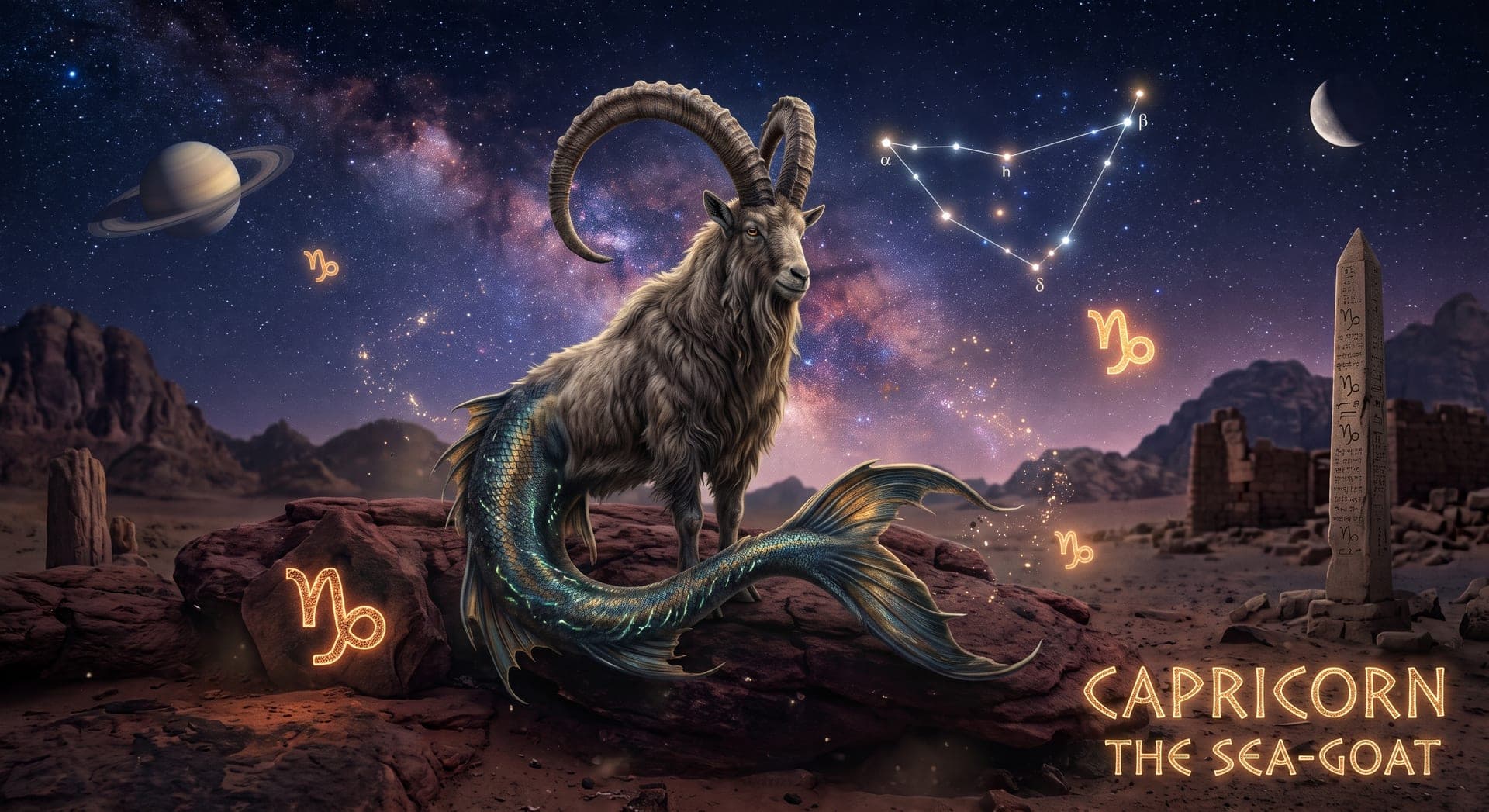
Capricorn, the tenth sign of the zodiac, spans December 22 to January 19 and is represented by the sea-goat, a mythical creature with the body of a goat and the tail of a fish, symbolizing an ability to navigate both the practical, earthly world and deeper emotional currents. Ruled by Saturn, the planet of discipline and time, Capricorns are often characterized as ambitious, patient, and deeply committed to long-term goals, willing to put in steady effort where others give up. As an Earth sign, Capricorn is grounded and practical, valuing tangible results and responsibility over impulsiveness. People born under this sign are frequently drawn to leadership and other structured pursuits where their organizational skills and work ethic can shine. Beneath a reserved, businesslike exterior, Capricorns are often said to carry a dry, understated sense of humor and a loyal, protective nature toward the people closest to them.
Personality Traits
Strengths
- Disciplined and self-controlled
- Responsible and dependable
- Excellent long-term planner
- Hardworking and persistent
- Good sense of humor once comfortable
Weaknesses
- Can be a know-it-all
- Unforgiving of mistakes, including their own
- Prone to pessimism
- Condescending toward those who don't work as hard
- Stubbornly resistant to changing plans
Compatible Signs
Fun Facts
- Capricorn's symbol, the sea-goat, comes from the Greek myth of Pan, who transformed his lower half into a fish tail to escape the monster Typhon while diving into the Nile.
- Saturn, Capricorn's ruling planet, was the Roman god of time, harvest, and generational structure, echoing the sign's association with patience and long-term thinking.
- Capricorn is one of only two zodiac signs represented by a hybrid creature, the other being Sagittarius, the centaur.
- Notable Capricorns include Michelle Obama, Martin Luther King Jr., Dolly Parton, LeBron James, and Isaac Newton.
- In traditional astrology, the winter solstice, the shortest day of the year, falls right at the start of Capricorn season in the Northern Hemisphere.
Born on January 9
- 1873
Hayim Nahman Bialik
Hebrew poet regarded as Israel's national poet
- 1898
Gracie Fields
English actress and singer celebrated as one of Britain's biggest music hall and film stars of the 1930s
- 1908
Simone de Beauvoir
French existentialist philosopher and author of "The Second Sex"
- 1913
Richard Nixon
37th President of the United States
- 1920
Clive Dunn
English actor best known for playing Lance Corporal Jones in the sitcom Dad's Army
- 1939
Susannah York
English actress known for her roles in Tom Jones and They Shoot Horses, Don't They?
- 1941
Joan Baez
American folk singer and civil rights activist
- 1944
Jimmy Page
English guitarist and songwriter who founded and led the rock band Led Zeppelin
- 1950
Alec Jeffreys
English geneticist who invented DNA fingerprinting, revolutionizing forensic science
- 1956
Imelda Staunton
English actress known for Vera Drake and playing Queen Elizabeth II in The Crown
- 1959
Rigoberta Menchu
Guatemalan Indigenous rights activist and Nobel Peace Prize laureate
- 1982
Catherine, Princess of Wales
English member of the British royal family, married to Prince William
- 1987
Paolo Nutini
Scottish singer-songwriter known for albums such as These Streets and Sunny Side Up

On This Day in History
- 1127
Invading Jurchen forces of the Jin dynasty capture Bianjing (Kaifeng), the capital of China's Song dynasty.
The Jin dynasty's Jurchen forces, having already inflicted major defeats on the Song military, besieged and captured the Song capital, taking Emperor Qinzong and his father, the retired Emperor Huizong, prisoner. The disaster, known as the Jingkang Incident, forced the Song court to flee south and re-establish itself as the Southern Song dynasty, permanently losing control of northern China.
- 1349
The Jewish population of Basel is rounded up and killed after being wrongly blamed for the ongoing Black Death.
As the Black Death swept through Europe, killing perhaps a third of the population, communities across the continent scapegoated Jewish residents, falsely accusing them of poisoning wells. In Basel, the city's Jewish population was rounded up and burned in a specially built structure on an island in the Rhine, one of many such massacres that devastated European Jewish communities during the plague years.
- 1431
The trial of Joan of Arc begins in Rouen, France.
Joan of Arc, the young peasant woman who had helped turn the tide of the Hundred Years' War in France's favor, was tried by a pro-English ecclesiastical court on charges of heresy and cross-dressing after being captured by Burgundian forces. The politically motivated trial concluded with her execution by burning at the stake months later; she was posthumously exonerated and later canonized as a saint.
- 1431
The trial of Joan of Arc for heresy begins in Rouen, presided over by a court sympathetic to the English who held her captive.
Joan of Arc had been captured by Burgundian forces the previous year and sold to England's allies, who saw her as a threat to their claim over the French throne during the Hundred Years' War. The ecclesiastical trial, held in English-occupied Normandy, was engineered to discredit her military victories by branding her a heretic. She was convicted and burned at the stake that May, though the verdict was posthumously annulled in 1456.
- 1788
Connecticut becomes the fifth U.S. state to ratify the United States Constitution.
Connecticut's ratification came with relatively little controversy, reflecting broad support in the state for a stronger national government capable of regulating trade and providing for common defense. It became the fifth of the required nine states needed to bring the Constitution into force, part of a wave of early, relatively uncontested ratifications by smaller states.
- 1799
Prime Minister William Pitt the Younger introduces Britain's first income tax to help fund the war against Napoleonic France.
Pitt proposed a graduated tax on incomes above £60 a year, rising to a top rate of about ten percent, as an emergency measure to pay for the escalating cost of the war effort. It was framed as temporary and controversial from the outset, repealed after the Peace of Amiens in 1802, then reintroduced. Despite its unpopularity, it set the precedent for income tax as a permanent feature of British public finance.
- 1806
Admiral Horatio Nelson is given a state funeral at St Paul's Cathedral, more than two months after his death at the Battle of Trafalgar.
Nelson had been killed by a French sharpshooter aboard HMS Victory in October 1805 while securing Britain's decisive naval victory over the combined French and Spanish fleets at Trafalgar. His body was preserved in a cask of brandy for the voyage home, and the funeral procession through London drew enormous crowds. He was laid to rest beneath the cathedral's dome, cementing his status as Britain's greatest naval hero.
- 1816
Chemist Humphry Davy tests his newly invented miners' safety lamp underground at Hebburn Colliery in County Durham.
Davy designed the lamp to enclose a flame within fine wire gauze, which absorbed heat and prevented it from igniting the flammable firedamp gas that caused frequent, deadly explosions in coal mines. The invention, developed independently around the same time as a similar device by engineer George Stephenson, is credited with saving countless miners' lives across Britain's coalfields, though poor mine management meant explosions continued for decades afterward.
- 1839
The French Academy of Sciences announces the invention of the daguerreotype photography process.
The announcement, made by physicist François Arago to the French Academy, revealed Louis Daguerre's process for fixing a permanent image using a silver-coated copper plate and light-sensitive chemicals. The French government purchased the rights and released the process freely to the world as a gift, and "daguerreotypes" quickly became the first widely practical form of photography.
- 1857
The magnitude 7.9 Fort Tejon earthquake strikes Central and Southern California.
The Fort Tejon earthquake, one of the largest ever recorded in California, ruptured roughly 225 miles of the San Andreas Fault. Because the region was sparsely populated at the time, only two deaths were reported despite the quake's immense power, but seismologists still study it today as a benchmark for understanding the potential scale of future major earthquakes along the fault.
- 1909
Ernest Shackleton's Nimrod Expedition plants the British flag on the Antarctic plateau, just 97 nautical miles from the South Pole.
Shackleton and three companions had man-hauled their sledges across the Ross Ice Shelf and up the Beardmore Glacier, pushing further south than anyone before them. With supplies dangerously low and the harsh conditions threatening their survival, Shackleton made the difficult decision to turn back rather than risk reaching the pole itself. His famous remark to his wife, that he preferred a live donkey to a dead lion, reflected the choice.
- 1916
The Battle of Gallipoli concludes with an Ottoman Empire victory during World War I.
The withdrawal of Allied troops from the Gallipoli peninsula ended an eight-month campaign that had aimed to seize the Dardanelles strait and knock the Ottoman Empire out of World War I. The costly failure, which produced roughly 250,000 Allied casualties, became a defining national memory for Australia and New Zealand, whose forces suffered heavily, and contributed to Winston Churchill's political downfall at the time.
- 1916
The Battle of Gallipoli ends in an Ottoman victory as the last Allied troops are evacuated from the peninsula.
The eight-month campaign had aimed to force a naval passage through the Dardanelles and knock the Ottoman Empire out of the war, but British, French, Australian, and New Zealand forces became bogged down against determined Ottoman defenders. The failed campaign cost well over 100,000 Allied lives and became a defining, formative national memory for Australia and New Zealand, while contributing to the political downfall of Winston Churchill, its chief advocate.
- 1917
British Empire forces defeat the Ottoman garrison at the Battle of Rafa, securing the Sinai Peninsula on the Egyptian-Palestinian border.
The battle was the final action of the Sinai campaign, fought by British, Australian, New Zealand, and Egyptian Camel Corps troops under General Philip Chetwode. Capturing the Ottoman position at Rafa cleared the last significant enemy foothold in the Sinai, opening the way for the subsequent British invasion of Ottoman Palestine later that year. The victory came at the cost of several hundred Allied casualties.
- 1941
The Avro Lancaster heavy bomber makes its first flight, going on to become the RAF's primary night bomber of the Second World War.
Developed from the underpowered and troubled Avro Manchester by fitting four Rolls-Royce Merlin engines instead of two, the Lancaster proved far more reliable and capable. It could carry a heavier bomb load further than any other Allied bomber, including the enormous 22,000-pound Grand Slam. Lancasters flew tens of thousands of sorties over occupied Europe and Germany, including the famous 1943 Dambusters raid on the Ruhr dams.
- 1957
British Prime Minister Anthony Eden resigns, his premiership fatally undermined by the failed Suez Canal intervention.
Eden had ordered British and French forces, in coordination with Israel, to intervene after Egyptian President Nasser nationalized the Suez Canal, but the operation collapsed under intense American financial pressure and international condemnation. The debacle exposed the limits of British power after empire and humiliated the government. Citing ill health, Eden stepped down and was succeeded by Harold Macmillan a week later.
- 1960
Egyptian President Gamal Abdel Nasser opens construction on the Aswan Dam.
The Aswan High Dam project, backed by Soviet financing and engineering after the United States withdrew its support amid Cold War tensions, aimed to control the Nile's flooding, generate hydroelectric power, and expand Egypt's irrigated farmland. Completed in 1970, it created Lake Nasser, one of the world's largest reservoirs, though it also displaced tens of thousands of people and submerged ancient Nubian monuments.
- 1961
British authorities publicly announce the discovery of the Portland spy ring, a Soviet espionage network that had stolen Royal Navy secrets.
The ring had been passing classified information on British submarine and anti-submarine warfare technology from the Underwater Weapons Establishment at Portland to Soviet intelligence for years. Its exposure led to the arrest and conviction of several agents, including Gordon Lonsdale and the Krogers, and became one of the most notorious Cold War espionage cases in Britain, prompting a tightening of security vetting procedures.
- 1992
Astronomers Aleksander Wolszczan and Dale Frail announce the first confirmed discovery of planets outside our solar system.
Wolszczan and Frail detected the planets orbiting a pulsar, the rapidly spinning remnant of an exploded star, using precise timing variations in the pulsar's radio signals. Their discovery was the first confirmed detection of planets beyond our solar system, though these strange, radiation-blasted worlds around a dead star differ enormously from the more Earth-like exoplanets found by later missions like Kepler.
- 2007
Apple CEO Steve Jobs unveils the original iPhone at the Macworld conference in San Francisco.
Jobs unveiled the first iPhone after years of secretive development, describing it as a combination of a phone, an iPod, and an internet communication device. Its multi-touch screen and lack of a physical keyboard were radical departures from existing smartphones, and the device's success fundamentally reshaped the mobile phone industry and how people interact with technology.