What’s Observed on December 22
Born on December 22: Capricorn ♑
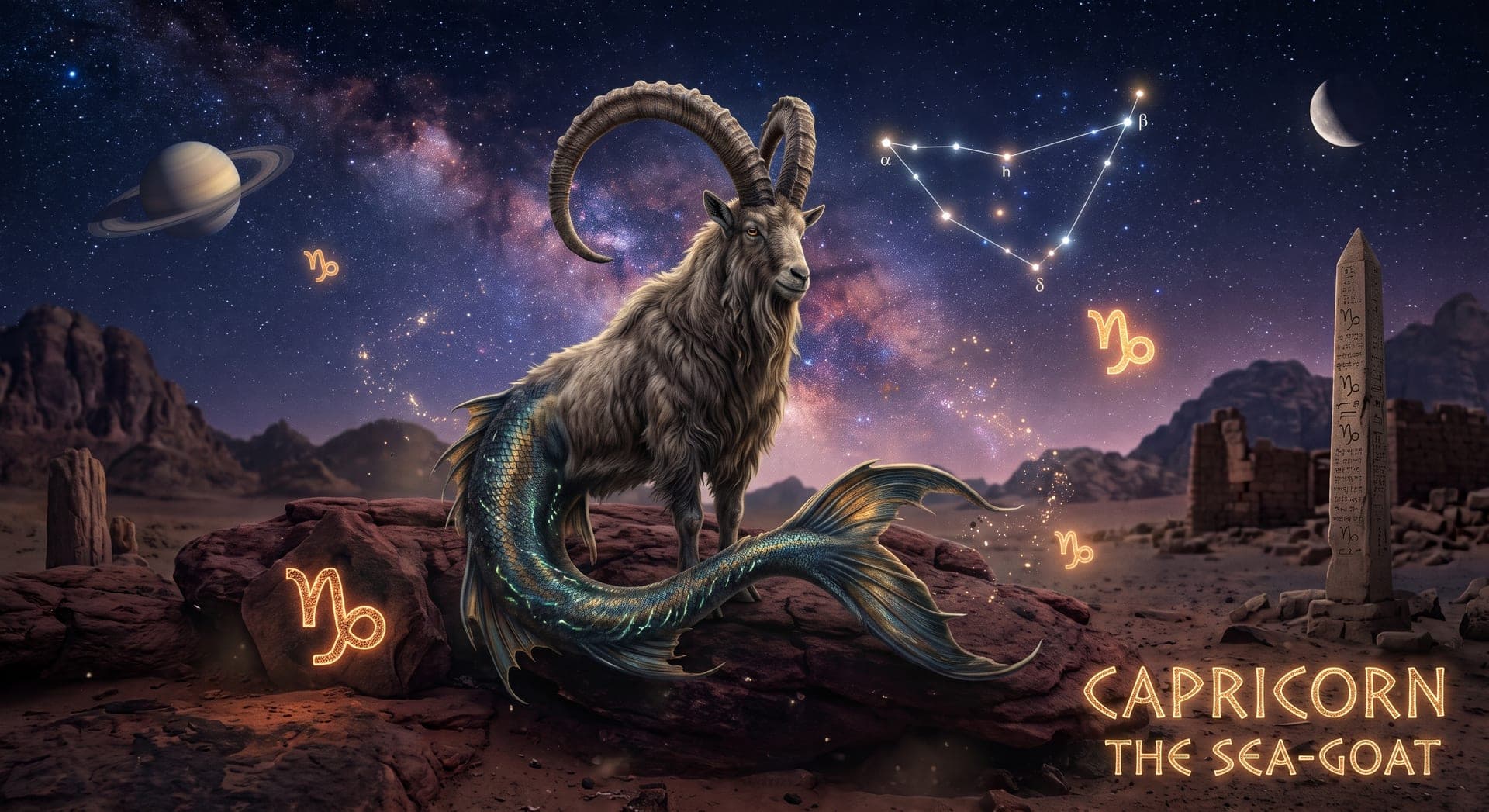
Capricorn, the tenth sign of the zodiac, spans December 22 to January 19 and is represented by the sea-goat, a mythical creature with the body of a goat and the tail of a fish, symbolizing an ability to navigate both the practical, earthly world and deeper emotional currents. Ruled by Saturn, the planet of discipline and time, Capricorns are often characterized as ambitious, patient, and deeply committed to long-term goals, willing to put in steady effort where others give up. As an Earth sign, Capricorn is grounded and practical, valuing tangible results and responsibility over impulsiveness. People born under this sign are frequently drawn to leadership and other structured pursuits where their organizational skills and work ethic can shine. Beneath a reserved, businesslike exterior, Capricorns are often said to carry a dry, understated sense of humor and a loyal, protective nature toward the people closest to them.
Personality Traits
Strengths
- Disciplined and self-controlled
- Responsible and dependable
- Excellent long-term planner
- Hardworking and persistent
- Good sense of humor once comfortable
Weaknesses
- Can be a know-it-all
- Unforgiving of mistakes, including their own
- Prone to pessimism
- Condescending toward those who don't work as hard
- Stubbornly resistant to changing plans
Compatible Signs
Fun Facts
- Capricorn's symbol, the sea-goat, comes from the Greek myth of Pan, who transformed his lower half into a fish tail to escape the monster Typhon while diving into the Nile.
- Saturn, Capricorn's ruling planet, was the Roman god of time, harvest, and generational structure, echoing the sign's association with patience and long-term thinking.
- Capricorn is one of only two zodiac signs represented by a hybrid creature, the other being Sagittarius, the centaur.
- Notable Capricorns include Michelle Obama, Martin Luther King Jr., Dolly Parton, LeBron James, and Isaac Newton.
- In traditional astrology, the winter solstice, the shortest day of the year, falls right at the start of Capricorn season in the Northern Hemisphere.
Born on December 22
- 1639
Jean Racine
French playwright and master of classical tragedy
- 1696
James Oglethorpe
English soldier, MP and prison reformer who founded the American colony of Georgia in 1733 as a haven for the poor and religiously persecuted.
- 1805
John Obadiah Westwood
English entomologist and archaeologist who became the first Hope Professor of Zoology at Oxford, helping to establish entomology as a rigorous scientific discipline.
- 1839
John Nevil Maskelyne
English stage magician and prolific inventor, co-founder of London's Egyptian Hall theatre of magic, who exposed fraudulent spiritualist mediums and patented the coin-operated lock.
- 1858
Giacomo Puccini
Italian opera composer known for "La Bohème"
- 1862
Connie Mack
American baseball manager and team owner
- 1887
Srinivasa Ramanujan
Indian mathematician known for contributions to number theory
- 1888
J. Arthur Rank
English businessman and devout Methodist who founded the Rank Organisation, becoming one of the most powerful figures in the history of British cinema.
- 1907
Peggy Ashcroft
English actress and Dame regarded as one of the great Shakespearean performers of her era, who won an Academy Award late in her career for A Passage to India.
- 1909
Patricia Hayes
English character actress with a long career in British film, radio and television, celebrated for her versatility across comedy and drama.
- 1912
Lady Bird Johnson
38th First Lady of the United States
- 1962
Ralph Fiennes
English actor known for roles including Schindler's List, the Harry Potter films' Voldemort, and James Bond's M, alongside an acclaimed stage career.
- 1989
Jordin Sparks
American singer and actress
On This Day in History
- 1135
Stephen of Blois was crowned King of England, a seizure of the throne that plunged the country into nearly two decades of civil war.
Stephen, a grandson of William the Conqueror, claimed the crown ahead of his cousin Empress Matilda, who had been named Henry I's heir. The disputed succession triggered a prolonged conflict later known as the Anarchy, marked by lawlessness and shifting loyalties among the barons. The war ended only in 1153 with an agreement that Matilda's son would succeed Stephen, founding the Plantagenet dynasty as Henry II.
- 1808
Beethoven conducts the public premiere of his Fifth and Sixth Symphonies at Vienna's Theater an der Wien.
Beethoven's marathon concert, which also premiered his Fourth Piano Concerto and Choral Fantasy in a single sitting, has become legendary among music historians for its sheer ambition, though the underrehearsed orchestra and freezing concert hall reportedly made for a rough initial performance. The Fifth and Sixth Symphonies would go on to become two of the most beloved and frequently performed works in the entire classical repertoire.
- 1864
Union General William Tecumseh Sherman's forces capture Savannah, Georgia, presenting the city as a Christmas gift to President Lincoln.
Sherman's capture of Savannah concluded his infamous March to the Sea, a devastating campaign of destruction across Georgia intended to break the Confederacy's capacity and will to continue fighting. His telegram to Lincoln offering the city "as a Christmas gift" became one of the war's most quoted phrases, symbolizing the Union's growing military dominance in the war's final months.
- 1864
Union General William Tecumseh Sherman's forces captured Savannah, Georgia, completing his devastating March to the Sea.
Confederate defenders abandoned the city as Sherman's army approached, ending a campaign of destruction across Georgia meant to cripple the Confederacy's ability to wage war. Sherman famously presented the captured city to President Lincoln as a Christmas gift. The fall of Savannah was a major blow to Confederate morale in the final months of the American Civil War.
- 1885
Itō Hirobumi becomes Japan's first Prime Minister, marking a significant step in the nation's modernization.
Itō Hirobumi's appointment as Japan's first prime minister came during the Meiji era's sweeping modernization efforts, as Japan rapidly transformed its government structures to resemble Western constitutional systems while retaining the emperor as a unifying symbolic figure. Itō would go on to draft Japan's first constitution and serve multiple terms as prime minister before his assassination in 1909.
- 1885
Itō Hirobumi became the first Prime Minister of Japan under the new cabinet system.
A leading architect of Japan's rapid modernisation during the Meiji era, Itō helped draft the Meiji Constitution and went on to serve four terms as prime minister. His political career later extended to colonial administration in Korea, where he served as Resident-General before being assassinated by a Korean independence activist in 1909.
- 1937
The Lincoln Tunnel opens to traffic, connecting New Jersey and Manhattan beneath the Hudson River.
The Lincoln Tunnel's opening provided a crucial third vehicular crossing beneath the Hudson River, easing growing traffic congestion between New Jersey and Manhattan as automobile ownership expanded rapidly in the interwar period. The tunnel's construction, an enormous engineering undertaking, would eventually be expanded with additional tubes to accommodate ever-increasing traffic demand.
- 1942
Adolf Hitler signed the order authorising development of the V-2 rocket as a weapon.
Developed by scientists including Wernher von Braun at Peenemünde, the V-2 became the world's first long-range guided ballistic missile, capable of reaching the edge of space before falling on its target. It was later used to bomb London and Antwerp in the war's final months, and the technology behind it directly shaped postwar rocketry and space exploration in both the United States and the Soviet Union.
- 1944
During the Battle of the Bulge, American General Anthony McAuliffe famously responds "Nuts!" to German demands that Bastogne surrender.
General McAuliffe's defiant one-word response to a German surrender ultimatum during the besieged defense of Bastogne became one of the most celebrated moments of American resolve during the Battle of the Bulge. The subsequent successful defense and relief of Bastogne by General Patton's forces significantly contributed to the ultimate failure of the German offensive.
- 1965
The United Kingdom extended its 70 mph speed limit to all rural roads.
The limit, first introduced experimentally on motorways two years earlier following a spate of serious accidents in fog, was rolled out nationally amid rising road deaths as car ownership boomed. Transport minister Barbara Castle championed the measure as a road-safety intervention, and the 70 mph limit has remained the standard maximum for UK roads outside built-up areas ever since.
- 1971
A group of French doctors and journalists founded Médecins Sans Frontières (Doctors Without Borders) in Paris.
Formed by physicians including Bernard Kouchner who had grown frustrated with the constraints of the Red Cross's neutrality principles during the Biafran War, the organisation pioneered a model of humanitarian aid that combined emergency medical care with public advocacy about the crises it witnessed. It has since grown into one of the world's largest independent medical humanitarian organisations, active in dozens of countries.
- 1989
Romanian dictator Nicolae Ceaușescu is overthrown as the Romanian Revolution topples his communist government.
Nicolae Ceaușescu's dramatic overthrow, as his own security forces and military abandoned him amid mass popular uprising, brought a violent and swift end to over two decades of increasingly repressive communist rule in Romania. Unlike the largely peaceful revolutions elsewhere in Eastern Europe that year, Romania's transition involved significant bloodshed and culminated in Ceaușescu's own execution just three days later.
- 1989
Berlin's Brandenburg Gate reopens, symbolically ending nearly three decades of division between East and West Germany.
The reopening of Berlin's Brandenburg Gate, which had stood as a stark, inaccessible symbol of the city's division for nearly three decades, allowed pedestrians to pass freely between what had been East and West Berlin for the first time since the wall's construction. The ceremony drew massive celebratory crowds and stands as one of the defining images of Germany's path toward reunification.
- 1989
Romanian dictator Nicolae Ceaușescu was overthrown after his security forces turned against him amid nationwide protests.
Ceaușescu and his wife Elena fled the capital by helicopter as crowds stormed government buildings in Bucharest, ending 24 years of increasingly repressive rule. The couple were captured, given a summary trial, and executed by firing squad three days later. Romania's revolution was the bloodiest of the Eastern Bloc's 1989 uprisings against communist rule.
- 1989
Berlin's Brandenburg Gate reopened after nearly three decades, symbolically ending the city's Cold War division.
West German Chancellor Helmut Kohl and East German premier Hans Modrow walked through the gate together as tens of thousands of Berliners celebrated, six weeks after the fall of the Berlin Wall. The reopening of the iconic 18th-century monument, long stranded in the no-man's-land between East and West Berlin, became one of the most powerful images of Germany's path toward reunification.
- 1990
Lech Wałęsa is sworn in as President of Poland, representing the country's democratic transformation.
Lech Wałęsa's inauguration as Poland's president, following his landslide victory in a runoff election two weeks earlier and his earlier leadership of the Solidarity trade union movement that had helped topple communist rule, marked the culmination of years of dissident activism against Soviet-aligned governance.
- 2001
British national Richard Reid attempted to destroy a transatlantic passenger jet using explosives hidden in his shoes.
Reid, a Londoner who had converted to Islam and become radicalised, tried to detonate explosives packed into his sneakers aboard American Airlines Flight 63 from Paris to Miami, but was overpowered by passengers and crew after failing to ignite the fuse properly. The attempted attack led directly to the requirement that airline passengers worldwide remove their shoes for security screening.
- 2010
President Barack Obama signs the repeal of "Don't Ask, Don't Tell," ending the ban on openly gay military service.
The repeal of "Don't Ask, Don't Tell" ended a 17-year policy that had allowed gay and lesbian service members to serve only if they concealed their sexual orientation, a compromise that itself represented a shift from earlier outright bans. The repeal's implementation allowed openly LGBTQ individuals to serve in the U.S. military for the first time in the nation's history.
- 2010
President Barack Obama signed the repeal of Don't Ask, Don't Tell, ending the ban on openly gay Americans serving in the military.
The 1993 policy had allowed gay, lesbian and bisexual service members to serve only if they concealed their sexual orientation, leading to the discharge of thousands of service members over its seventeen years in effect. Its repeal, passed by Congress with bipartisan support, marked a major milestone in the American LGBT rights movement and took full effect the following year after military certification.
- 2018
A tsunami triggered by the eruption of Indonesia's Anak Krakatau volcano kills more than 430 people.
The Anak Krakatau tsunami struck coastal areas of Indonesia's Sunda Strait without the advance warning typically provided for earthquake-generated tsunamis, since the disaster resulted from a partial collapse of the volcanic island itself into the sea. The unusual triggering mechanism caught many coastal communities completely unprepared, contributing to the disaster's high death toll.