
What’s Observed on December 23
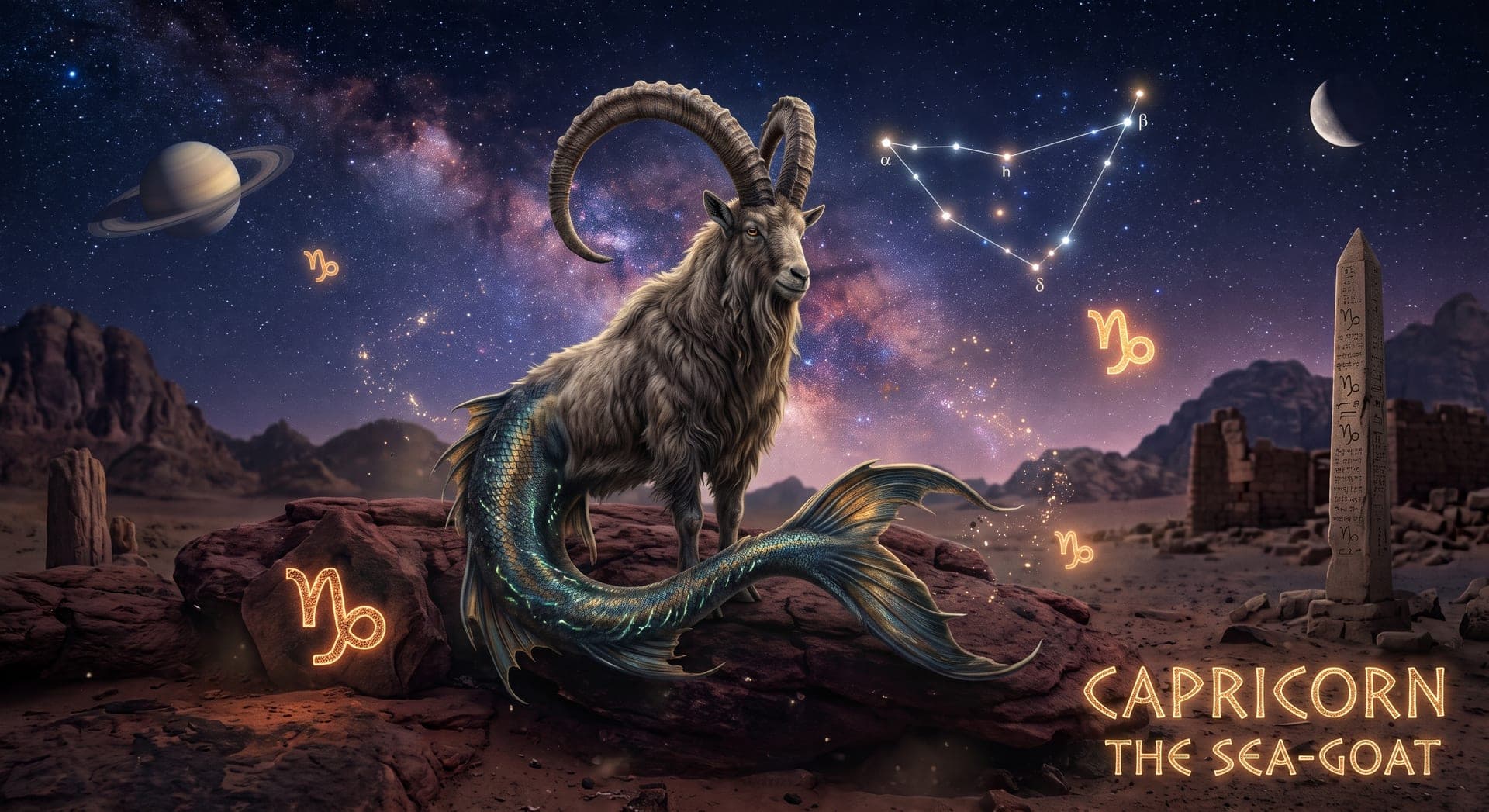
Born on December 23: Capricorn ♑
Capricorn, the tenth sign of the zodiac, spans December 22 to January 19 and is represented by the sea-goat, a mythical creature with the body of a goat and the tail of a fish, symbolizing an ability to navigate both the practical, earthly world and deeper emotional currents. Ruled by Saturn, the planet of discipline and time, Capricorns are often characterized as ambitious, patient, and deeply committed to long-term goals, willing to put in steady effort where others give up. As an Earth sign, Capricorn is grounded and practical, valuing tangible results and responsibility over impulsiveness. People born under this sign are frequently drawn to leadership and other structured pursuits where their organizational skills and work ethic can shine. Beneath a reserved, businesslike exterior, Capricorns are often said to carry a dry, understated sense of humor and a loyal, protective nature toward the people closest to them.
Personality Traits
Strengths
- Disciplined and self-controlled
- Responsible and dependable
- Excellent long-term planner
- Hardworking and persistent
- Good sense of humor once comfortable
Weaknesses
- Can be a know-it-all
- Unforgiving of mistakes, including their own
- Prone to pessimism
- Condescending toward those who don't work as hard
- Stubbornly resistant to changing plans
Compatible Signs
Fun Facts
- Capricorn's symbol, the sea-goat, comes from the Greek myth of Pan, who transformed his lower half into a fish tail to escape the monster Typhon while diving into the Nile.
- Saturn, Capricorn's ruling planet, was the Roman god of time, harvest, and generational structure, echoing the sign's association with patience and long-term thinking.
- Capricorn is one of only two zodiac signs represented by a hybrid creature, the other being Sagittarius, the centaur.
- Notable Capricorns include Michelle Obama, Martin Luther King Jr., Dolly Parton, LeBron James, and Isaac Newton.
- In traditional astrology, the winter solstice, the shortest day of the year, falls right at the start of Capricorn season in the Northern Hemisphere.
Born on December 23
- 1732
Richard Arkwright
English inventor and entrepreneur whose water-powered spinning frame helped launch the factory system, earning him recognition as a founding figure of the Industrial Revolution.
- 1777
Alexander I of Russia
Russian emperor during the Napoleonic era
- 1790
Jean-François Champollion
French scholar who deciphered Egyptian hieroglyphs
- 1805
Joseph Smith
American religious leader who founded the Latter Day Saint movement
- 1812
Samuel Smiles
Scottish author whose bestselling book Self-Help became a defining text of Victorian self-improvement culture and popularised the era's ideal of individual thrift and diligence.
- 1867
Madam C. J. Walker
American businesswoman and philanthropist
- 1918
Helmut Schmidt
Chancellor of West Germany
- 1925
Rayner Unwin
English publisher who, as a ten-year-old, wrote the reader's report that persuaded his father's firm to publish The Hobbit, and who later championed the publication of The Lord of the Rings.
- 1929
Chet Baker
American jazz trumpeter
- 1946
John Sullivan
English screenwriter who created the beloved sitcom Only Fools and Horses, one of the most popular British television comedies of all time.
- 1955
Carol Ann Duffy
Scottish poet and playwright who became the first woman, and the first openly gay poet, to serve as Britain's Poet Laureate.
- 1956
Dave Murray
English guitarist and founding member of Iron Maiden, one of the most influential bands in heavy metal.
- 1964
Eddie Vedder
American musician and Pearl Jam frontman
- 1977
Matt Baker
English television presenter known for hosting the children's programme Blue Peter and the BBC's flagship magazine show The One Show.

On This Day in History
- 1688
King James II of England flees to France amid the Glorious Revolution, clearing the way for William of Orange to take the throne.
James II's flight to France, after William of Orange's forces landed in England with substantial noble support, marked the effective end of his reign without a formal abdication, an ambiguity Parliament resolved by declaring the throne vacant. The largely bloodless transition, celebrated as the Glorious Revolution, established the principle of parliamentary supremacy over royal authority that continues to define British constitutional monarchy.
- 1688
King James II fled England for France after being deposed in the Glorious Revolution.
Having already sent his family ahead and dropped the Great Seal of the Realm into the Thames in a failed bid to paralyse government, James slipped away to exile at the court of Louis XIV. His flight, following the invasion of his son-in-law William of Orange, was treated by Parliament as an abdication, clearing the way for William and Mary to be crowned joint monarchs the following year.
- 1783
George Washington resigns as commander-in-chief of the Continental Army at Annapolis, Maryland.
Washington's resignation of his military commission before the Continental Congress, delivered in a brief but emotional speech, stunned contemporaries and observers including King George III, who reportedly remarked that if Washington truly relinquished power voluntarily, he would be "the greatest man in the world." The gesture profoundly shaped early American political culture's emphasis on civilian control over military authority.
- 1815
Jane Austen's novel "Emma" is first published in London.
Jane Austen's "Emma," published anonymously as was customary for female authors of the era, followed the matchmaking misadventures of its titular character and is now widely regarded as one of the most technically accomplished novels of the Regency period. Austen's subtle irony and keen social observation in the novel have made it an enduring favorite among literary scholars and general readers alike.
- 1815
Jane Austen's novel Emma was first published in London.
Issued by publisher John Murray in three volumes and dedicated, at the Prince Regent's request, to the future King George IV, Emma followed the matchmaking misadventures of its wealthy, headstrong heroine. Though it sold modestly in Austen's lifetime, it is now regarded as one of the most technically accomplished of her novels and a defining work of English fiction.
- 1823
The poem "A Visit from St. Nicholas," later known as "'Twas the Night Before Christmas," is published anonymously in the Troy Sentinel.
The poem now commonly known as "'Twas the Night Before Christmas," published anonymously and later attributed to Clement Clarke Moore, profoundly shaped modern American conceptions of Santa Claus, establishing enduring details including his sleigh, reindeer, and physical appearance. Its imagery has become so deeply embedded in Christmas tradition that many of its specific inventions are now assumed to be ancient folklore.
- 1913
President Woodrow Wilson signs the Federal Reserve Act, establishing the United States' central banking system.
The Federal Reserve Act, signed after considerable congressional debate over how to prevent the recurring financial panics that had plagued the American economy, established a system of regional reserve banks overseen by a central board intended to provide monetary stability. The Federal Reserve System created by this legislation remains the central pillar of American monetary policy over a century later.
- 1913
President Woodrow Wilson signed the Federal Reserve Act, creating the United States' central banking system.
The act established the Federal Reserve System, dividing the country into twelve regional reserve banks overseen by a central board, in response to recurring financial panics including the crisis of 1907. It aimed to provide a more elastic currency and a lender of last resort for the banking system, and the Federal Reserve remains the central pillar of American monetary policy today.
- 1919
The Sex Disqualification (Removal) Act became law in the United Kingdom, opening the professions to women.
The act barred discrimination on grounds of sex or marriage in the civil service, the legal profession and jury service, allowing women to become lawyers, magistrates and civil servants for the first time. Passed a year after some women won the right to vote, it marked a significant step in dismantling the legal barriers that had long excluded British women from public and professional life.
- 1947
The transistor is first successfully demonstrated at Bell Laboratories, launching the modern electronics era.
The transistor's invention at Bell Labs by physicists John Bardeen, Walter Brattain, and William Shockley provided a smaller, more reliable, and more energy-efficient alternative to the bulky vacuum tubes that had previously powered electronic devices. Their breakthrough, which earned the trio a shared Nobel Prize, laid the essential technological foundation for the entire modern electronics and computing industry.
- 1947
Scientists at Bell Laboratories successfully demonstrated the first working transistor.
John Bardeen, Walter Brattain and William Shockley showed that their point-contact device could amplify an electrical signal, a breakthrough that would earn the trio the Nobel Prize in Physics. The transistor's ability to replace bulky, fragile vacuum tubes made it the foundational building block of virtually all modern electronics, from radios to computers to smartphones.
- 1954
Surgeons performed the first successful kidney transplant, transferring a kidney between identical twins in Boston.
Joseph Murray and J. Hartwell Harrison led the operation at Brigham Hospital, transplanting a kidney from Ronald Herrick into his twin brother Richard, who was dying of kidney disease. Because the twins were genetically identical, the transplanted organ avoided immune rejection, a problem that had defeated earlier attempts. The success launched the field of organ transplantation and later earned Murray the Nobel Prize.
- 1972
Franco Harris catches the "Immaculate Reception," giving the Pittsburgh Steelers a dramatic playoff victory.
Franco Harris's Immaculate Reception, a deflected pass caught just before hitting the ground and carried for a game-winning touchdown, remains one of the most debated and celebrated plays in NFL history, still disputed by some regarding whether the catch was legal under the rules of the time. The play cemented the Pittsburgh Steelers' emergence as a dominant football franchise throughout the 1970s.
- 1972
The last survivors of the 1972 Andes plane crash were rescued after 73 days stranded in the mountains.
A Uruguayan Air Force flight carrying a rugby team had crashed high in the Andes in October, and the sixteen who survived endured extreme cold, avalanches and starvation, resorting to eating the flesh of the dead to stay alive. Two survivors eventually trekked for days across the mountains to find help. Their ordeal became one of the most extraordinary stories of human survival, later retold in books and films.
- 1986
The Voyager aircraft completes the first non-stop flight around the world without refueling.
The Voyager aircraft, an experimental plane built from lightweight composite materials and piloted by Dick Rutan and Jeana Yeager, completed the first non-stop, non-refueled flight around the entire world, covering roughly 26,000 miles over more than nine days. The achievement demonstrated significant advances in aircraft fuel efficiency and composite construction techniques.
- 1986
The experimental aircraft Voyager landed in California after completing the first non-stop flight around the world without refuelling.
Piloted by Dick Rutan and Jeana Yeager, the ultra-lightweight, twin-engine aircraft flew for more than nine days, covering roughly 26,000 miles on a single load of fuel. Designed by Dick's brother Burt Rutan, Voyager pushed the limits of aircraft efficiency and endurance, and it now hangs in the Smithsonian's National Air and Space Museum alongside other landmark aircraft.
- 1990
Slovenians voted overwhelmingly for independence from Yugoslavia in a national referendum.
With turnout high and nearly 89 percent backing independence, the referendum result gave Slovenia's government a clear mandate to declare sovereignty the following June. The declaration triggered a brief ten-day war with the Yugoslav federal army, after which Slovenia emerged as an independent state, becoming the first of Yugoslavia's republics to break away amid the country's violent disintegration.
- 2007
Nepal agrees to abolish its monarchy, transitioning toward becoming a federal republic.
Nepal's agreement to abolish its centuries-old monarchy came after a decade-long Maoist insurgency and mass pro-democracy protests had severely weakened royal authority, ultimately leading to the formal declaration of a federal democratic republic the following year. The transition ended one of the world's last remaining Hindu monarchies and reshaped Nepal's political landscape.
- 2007
Nepal's political parties agreed to abolish the country's centuries-old monarchy and become a federal republic.
The agreement, reached amid a fragile peace process following a decade-long civil war between the government and Maoist rebels, paved the way for the formal abolition of the monarchy the following year. King Gyanendra, whose reign had been marked by growing unpopularity, stepped down as Nepal transitioned to a republic, ending a monarchy that had ruled the Himalayan kingdom for over two centuries.