What’s Observed on December 24
Born on December 24: Capricorn ♑
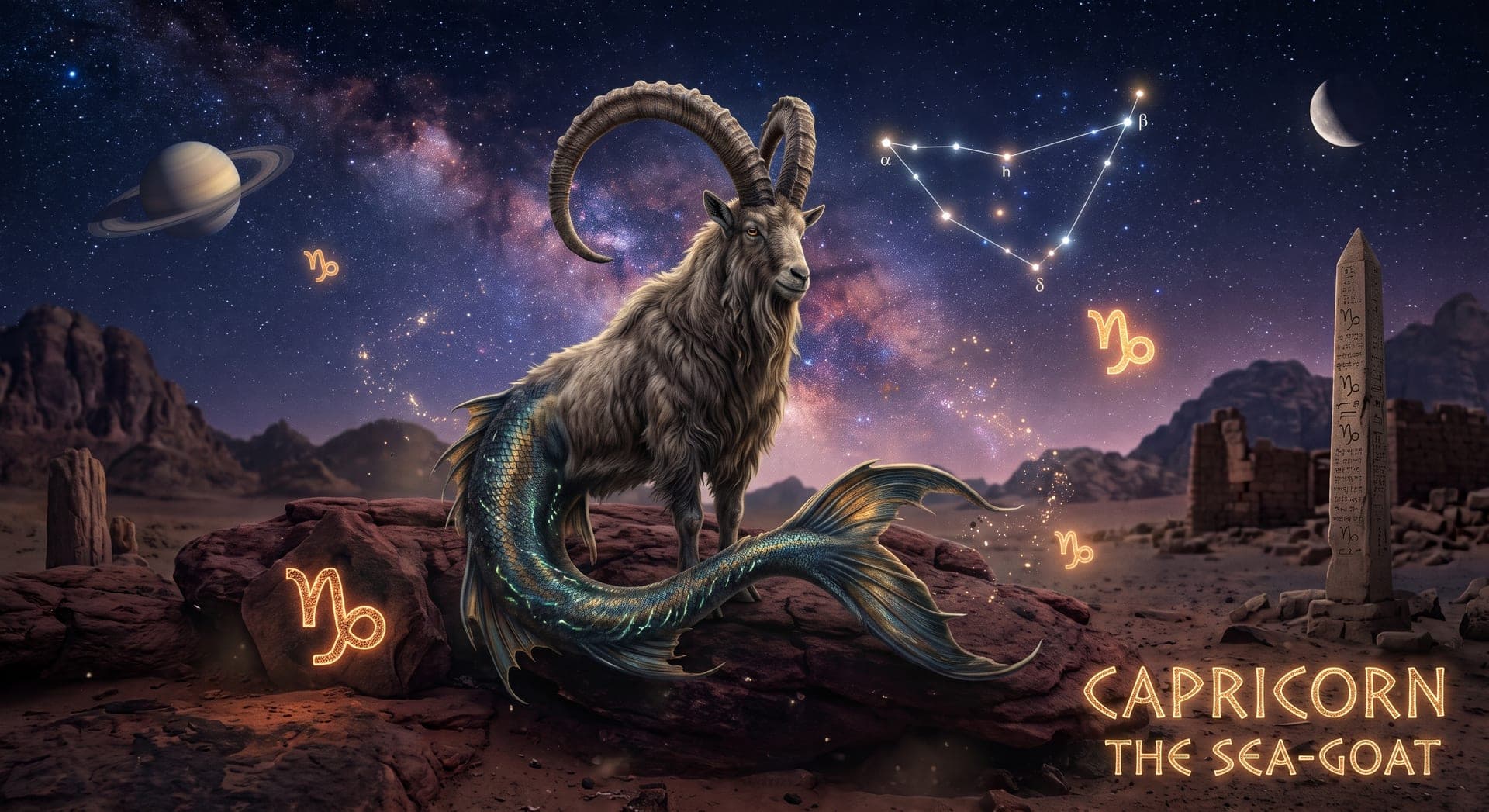
Capricorn, the tenth sign of the zodiac, spans December 22 to January 19 and is represented by the sea-goat, a mythical creature with the body of a goat and the tail of a fish, symbolizing an ability to navigate both the practical, earthly world and deeper emotional currents. Ruled by Saturn, the planet of discipline and time, Capricorns are often characterized as ambitious, patient, and deeply committed to long-term goals, willing to put in steady effort where others give up. As an Earth sign, Capricorn is grounded and practical, valuing tangible results and responsibility over impulsiveness. People born under this sign are frequently drawn to leadership and other structured pursuits where their organizational skills and work ethic can shine. Beneath a reserved, businesslike exterior, Capricorns are often said to carry a dry, understated sense of humor and a loyal, protective nature toward the people closest to them.
Personality Traits
Strengths
- Disciplined and self-controlled
- Responsible and dependable
- Excellent long-term planner
- Hardworking and persistent
- Good sense of humor once comfortable
Weaknesses
- Can be a know-it-all
- Unforgiving of mistakes, including their own
- Prone to pessimism
- Condescending toward those who don't work as hard
- Stubbornly resistant to changing plans
Compatible Signs
Fun Facts
- Capricorn's symbol, the sea-goat, comes from the Greek myth of Pan, who transformed his lower half into a fish tail to escape the monster Typhon while diving into the Nile.
- Saturn, Capricorn's ruling planet, was the Roman god of time, harvest, and generational structure, echoing the sign's association with patience and long-term thinking.
- Capricorn is one of only two zodiac signs represented by a hybrid creature, the other being Sagittarius, the centaur.
- Notable Capricorns include Michelle Obama, Martin Luther King Jr., Dolly Parton, LeBron James, and Isaac Newton.
- In traditional astrology, the winter solstice, the shortest day of the year, falls right at the start of Capricorn season in the Northern Hemisphere.
Born on December 24
- 1166
John, King of England
King of England from 1199 to 1216, remembered above all for being forced by rebellious barons to seal Magna Carta in 1215, a foundational document in the development of constitutional rights.
- 1798
Adam Mickiewicz
Polish Romantic poet
- 1809
Kit Carson
American frontiersman and soldier
- 1818
James Prescott Joule
English physicist known for work on thermodynamics
- 1822
Matthew Arnold
English poet and cultural critic, author of 'Dover Beach' and influential essays on literature and society, who also served for decades as one of Britain's leading school inspectors.
- 1868
Emanuel Lasker
German chess grandmaster and World Chess Champion
- 1905
Howard Hughes
American businessman, aviator, and filmmaker
- 1922
Ava Gardner
American actress
- 1945
Lemmy
English singer, bassist and songwriter who fronted Motörhead, becoming one of hard rock's most iconic and instantly recognisable figures.
- 1960
Carol Vorderman
Welsh television presenter best known for co-hosting the game show Countdown for over two decades, and for her later career as a broadcaster and media personality.
- 1963
Caroline Aherne
English comedian, writer and actress who co-created The Royle Family and starred as chat-show host Mrs Merton, becoming one of the most acclaimed figures in British sitcom history.
- 1969
Ed Miliband
English politician who served as Leader of the Labour Party and Leader of the Opposition from 2010 to 2015, and later as a cabinet minister.
- 1991
Louis Tomlinson
English singer-songwriter who rose to fame as a member of the boy band One Direction before pursuing a solo music career.
On This Day in History
- 1777
Captain James Cook discovers Christmas Island (Kiritimati) in the Pacific Ocean, naming it for the date of his arrival.
Captain Cook's discovery of Christmas Island, a remote coral atoll in the central Pacific that remains one of the largest atolls in the world, occurred during his third and final Pacific voyage, and he named it for the date of his arrival. The island, now part of Kiribati and known locally as Kiritimati, later gained notoriety as a site for British and American nuclear weapons testing in the 1950s.
- 1777
British explorer James Cook discovered the Pacific atoll of Kiritimati, naming it Christmas Island after the date.
Cook sighted the low coral atoll, one of the largest in the world, during his third and final voyage of Pacific exploration. His crew came ashore to celebrate Christmas, giving the island its enduring English name, though it is now known by its Kiribati name, Kiritimati. The island later became notorious as a British and American nuclear weapons testing site in the 1950s and 1960s.
- 1814
Britain and the United States sign the Treaty of Ghent, concluding the War of 1812.
The Treaty of Ghent formally ended the War of 1812 between Britain and the United States, essentially restoring prewar boundaries without resolving the maritime trade disputes that had originally sparked the conflict. Notably, the pivotal Battle of New Orleans was fought after the treaty's signing, as news of the peace agreement had not yet reached American shores.
- 1814
Representatives of the United Kingdom and the United States signed the Treaty of Ghent, ending the War of 1812.
Negotiated in the Flemish city of Ghent, the treaty restored the pre-war borders between Britain and the United States without resolving any of the maritime disputes, such as impressment, that had originally sparked the conflict. News of the peace crossed the Atlantic too slowly to prevent the Battle of New Orleans, fought weeks later. The treaty ushered in two centuries of largely peaceful relations between the two nations.
- 1818
The carol "Silent Night" receives its first performance at a small church in Oberndorf, Austria.
"Silent Night" was composed hastily by an Austrian priest and schoolteacher after their church organ broke down, requiring a simple melody that could be performed on guitar for the Christmas Eve service. The carol's gentle, unassuming beginnings belied its future as one of the most beloved and widely translated Christmas songs in the world.
- 1846
Britain acquired the island of Labuan from the Sultanate of Brunei, establishing a new crown colony in Southeast Asia.
The cession, negotiated by James Brooke, the British adventurer who had become Rajah of neighbouring Sarawak, gave Britain a coaling station and naval base to help suppress piracy in the region and support trade with Borneo and China. Labuan remained a separate British crown colony for decades before later being absorbed into British North Borneo and, eventually, Malaysia.
- 1865
Former Confederate soldiers found the Ku Klux Klan in Pulaski, Tennessee.
The Ku Klux Klan's founding by former Confederate soldiers began as a secret social club before rapidly transforming into a violent white supremacist organization terrorizing newly freed African Americans and their allies during Reconstruction. Though federal legislation and prosecution significantly curtailed the original Klan by the 1870s, subsequent revivals of the organization in later decades continued to perpetrate racial violence and intimidation.
- 1906
Engineer Reginald Fessenden transmits one of the first radio broadcasts, including a poetry reading and violin solo.
Reginald Fessenden's radio broadcast, transmitted to ships equipped with wireless receivers, represented one of the earliest demonstrations of audio broadcasting rather than simple Morse code transmission, astonishing radio operators who had only ever heard dots and dashes. His pioneering work helped lay the technical foundation for the broadcast radio industry that would flourish in subsequent decades.
- 1906
Canadian-American inventor Reginald Fessenden transmitted what is considered the first audio radio broadcast.
Broadcasting from Brant Rock, Massachusetts, Fessenden reportedly played a violin, read from the Bible, and wished listeners a merry Christmas, astonishing ship radio operators along the Atlantic coast who were used to hearing only Morse code. The broadcast demonstrated that radio could carry voice and music, not just dots and dashes, foreshadowing the entire future of broadcast radio.
- 1914
British and German troops along the Western Front began an unofficial Christmas truce, briefly halting the fighting of the First World War.
In stretches of the trenches near Ypres and elsewhere, soldiers on both sides sang carols, exchanged small gifts, and in some places met in no man's land to bury the dead and reportedly play football. Military commanders on both sides frowned on the fraternisation and moved to prevent any repeat in later years. The truce endures as one of the most enduring and human stories to come out of the war's horror.
- 1941
The British Eighth Army captured the Libyan port city of Benghazi during Operation Crusader.
The advance came as British and Commonwealth forces pushed Axis troops back across Cyrenaica in the North African campaign, relieving pressure on besieged Tobruk. The Allied hold proved temporary: Rommel's Afrika Korps recaptured Benghazi barely a month later, one of several times the strategically vital port changed hands during the seesaw desert war.
- 1943
General Dwight D. Eisenhower was named Supreme Allied Commander of the force that would carry out Operation Overlord, the invasion of Normandy.
The appointment placed Eisenhower in charge of the largest combined military operation in history, coordinating American, British, Canadian and other Allied forces for the eventual D-Day landings. He spent the following months overseeing the immense logistical and strategic planning required, before the invasion was launched in June 1944, opening the long-awaited second front in Western Europe.
- 1951
Libya gains independence with the coronation of King Idris I, becoming Africa's first country to achieve independence through the United Nations.
Libya's independence, achieved through a United Nations-supervised process following Italian colonial rule and a brief period of joint British and French administration after World War II, made it the first country to gain independence under UN auspices. King Idris I would rule until his overthrow in a 1969 military coup led by a young officer named Muammar Gaddafi.
- 1951
Libya became independent, with Idris I proclaimed as its first king.
The declaration made Libya the first country to achieve independence through the United Nations, ending years of Italian colonial rule followed by post-war administration. King Idris, who had led resistance to Italian rule as head of the Senussi religious order, ruled the new kingdom until he was overthrown in a 1969 coup led by Muammar Gaddafi.
- 1952
Britain's Handley Page Victor strategic bomber made its maiden flight.
The distinctive crescent-winged aircraft, piloted on its 17-minute first flight by chief test pilot Hedley Hazelden, became the third and last of the RAF's V bomber force alongside the Vulcan and Valiant, built to carry Britain's nuclear deterrent. After being retired from the nuclear role in the 1960s, the Victor found a long second career as an aerial refuelling tanker, notably supporting Vulcan raids during the 1982 Falklands War, before finally retiring in 1993.
- 1968
NASA's Apollo 8 spacecraft enters lunar orbit, making its crew the first humans to orbit the Moon.
Apollo 8's crew, orbiting the Moon on Christmas Eve, delivered a live television broadcast in which they read passages from the Book of Genesis while transmitting images of the lunar surface and Earth rising above it, a moment watched by an estimated one billion people worldwide. The mission's famous "Earthrise" photograph became one of the most iconic images of the twentieth century.
- 1968
The crew of Apollo 8 entered orbit around the Moon, becoming the first humans to do so.
Astronauts Frank Borman, James Lovell and William Anders became the first people to leave Earth's gravitational influence and orbit another celestial body, circling the Moon ten times over twenty hours. During a Christmas Eve broadcast watched by hundreds of millions, the crew read from the Book of Genesis and captured the iconic 'Earthrise' photograph, an image that reframed humanity's view of its home planet.
- 1974
Cyclone Tracy devastates the Australian city of Darwin with catastrophic winds and flooding.
Cyclone Tracy's compact but intensely powerful winds devastated Darwin on Christmas Eve, destroying the vast majority of the city's buildings and forcing the evacuation of most of its population in the disaster's aftermath. The catastrophe prompted a complete rebuilding of Darwin using significantly stricter building codes designed to withstand future cyclones.
- 1979
Europe successfully launches its first Ariane rocket from the spaceport in French Guiana.
Europe's first successful Ariane rocket launch established the European Space Agency's independent capability to place satellites into orbit, reducing reliance on American or Soviet launch services. The Ariane program's subsequent development into a commercially successful family of rockets made Europe a major competitive player in the global satellite launch market.
- 2021
Myanmar's military commits a massacre killing at least 44 civilians in the village of Mo So.
The massacre in Mo So village, attributed to Myanmar's military amid its ongoing civil conflict following the 2021 coup, drew international condemnation as part of a broader pattern of documented atrocities against civilians during the country's continuing political crisis. Human rights organizations have called for accountability for such attacks as part of the broader conflict.