
What’s Observed on December 25
Born on December 25: Capricorn ♑
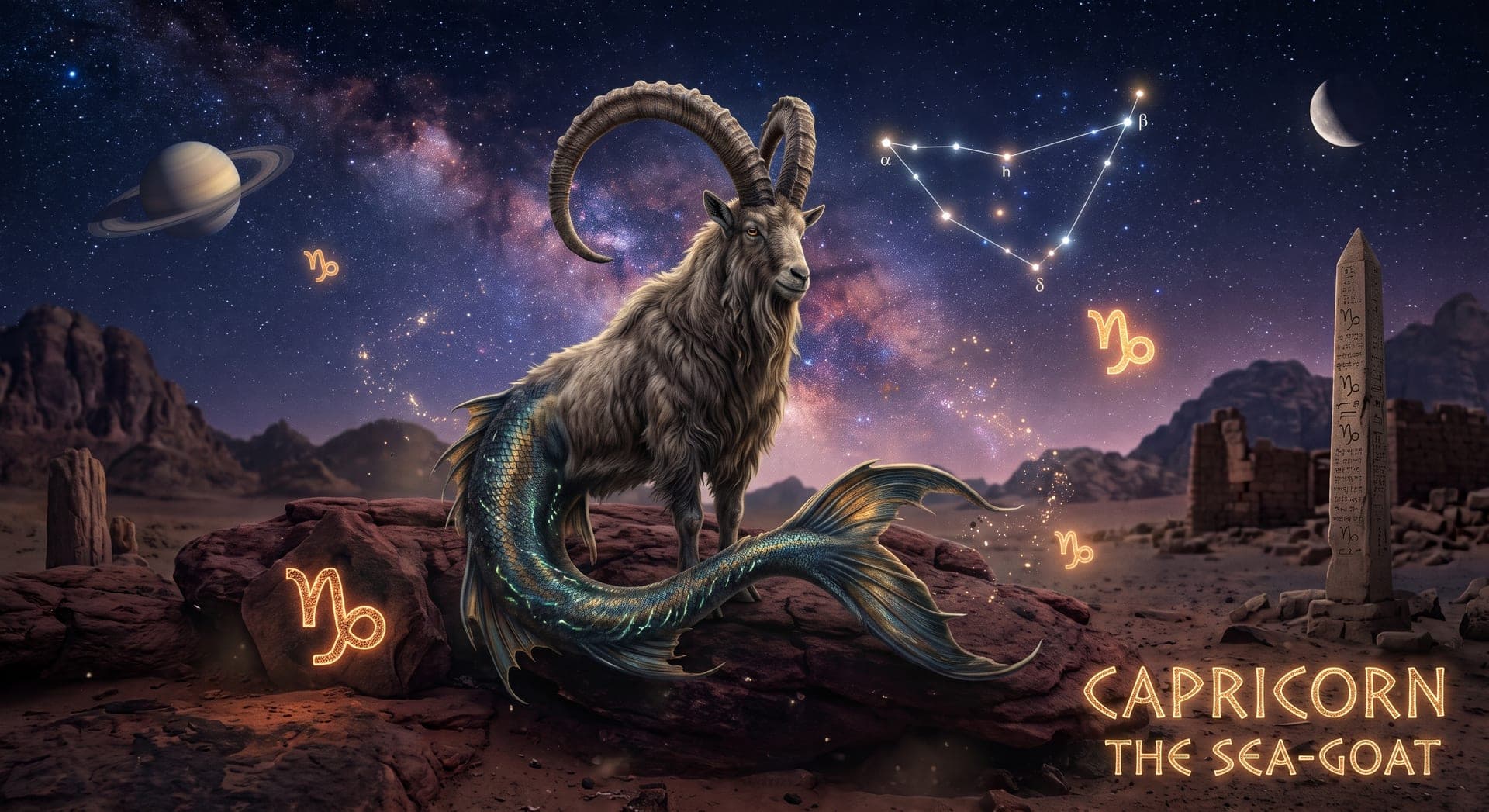
Capricorn, the tenth sign of the zodiac, spans December 22 to January 19 and is represented by the sea-goat, a mythical creature with the body of a goat and the tail of a fish, symbolizing an ability to navigate both the practical, earthly world and deeper emotional currents. Ruled by Saturn, the planet of discipline and time, Capricorns are often characterized as ambitious, patient, and deeply committed to long-term goals, willing to put in steady effort where others give up. As an Earth sign, Capricorn is grounded and practical, valuing tangible results and responsibility over impulsiveness. People born under this sign are frequently drawn to leadership and other structured pursuits where their organizational skills and work ethic can shine. Beneath a reserved, businesslike exterior, Capricorns are often said to carry a dry, understated sense of humor and a loyal, protective nature toward the people closest to them.
Personality Traits
Strengths
- Disciplined and self-controlled
- Responsible and dependable
- Excellent long-term planner
- Hardworking and persistent
- Good sense of humor once comfortable
Weaknesses
- Can be a know-it-all
- Unforgiving of mistakes, including their own
- Prone to pessimism
- Condescending toward those who don't work as hard
- Stubbornly resistant to changing plans
Compatible Signs
Fun Facts
- Capricorn's symbol, the sea-goat, comes from the Greek myth of Pan, who transformed his lower half into a fish tail to escape the monster Typhon while diving into the Nile.
- Saturn, Capricorn's ruling planet, was the Roman god of time, harvest, and generational structure, echoing the sign's association with patience and long-term thinking.
- Capricorn is one of only two zodiac signs represented by a hybrid creature, the other being Sagittarius, the centaur.
- Notable Capricorns include Michelle Obama, Martin Luther King Jr., Dolly Parton, LeBron James, and Isaac Newton.
- In traditional astrology, the winter solstice, the shortest day of the year, falls right at the start of Capricorn season in the Northern Hemisphere.
Born on December 25
- 1642
Isaac Newton
English physicist and mathematician who laid the foundations of classical mechanics with his laws of motion and theory of universal gravitation; his birth is recorded as 25 December by the Julian calendar in use in England at the time (4 January 1643 by today's Gregorian calendar).
- 1771
Dorothy Wordsworth
English writer and diarist whose journals of the Lake District, and close creative partnership with her brother, the poet William Wordsworth, shaped English Romanticism.
- 1821
Clara Barton
American nurse who founded the American Red Cross
- 1876
Muhammad Ali Jinnah
Founder and first Governor-General of Pakistan
- 1899
Humphrey Bogart
American actor known for classic Hollywood films
- 1906
Lew Grade
Ukrainian-born British media mogul who, after emigrating to London as a child, built the ATV and ITC television empires and helped define commercial British broadcasting.
- 1908
Quentin Crisp
English writer and raconteur, celebrated for his memoir The Naked Civil Servant, who became an early, defiantly visible gay icon in Britain.
- 1924
Rod Serling
American screenwriter who created "The Twilight Zone"
- 1924
Atal Bihari Vajpayee
10th Prime Minister of India
- 1936
Princess Alexandra of Kent
British royal and first cousin of Queen Elizabeth II, known for decades of charitable patronage work across the UK.
- 1954
Annie Lennox
Scottish singer-songwriter who found global fame as one half of Eurythmics before a celebrated solo career and prominent HIV/AIDS activism.
- 1957
Chris Kamara
English footballer turned broadcaster, beloved for his enthusiastic Sky Sports commentary and catchphrase 'unbelievable, Jeff!'
- 1971
Justin Trudeau
23rd Prime Minister of Canada
- 1975
Marcus Trescothick
English cricketer and prolific opening batsman for England and Somerset, later an outspoken advocate for mental health awareness in sport.

On This Day in History
- 597
Augustine of Canterbury baptises a large number of Anglo-Saxons in Kent.
Sent to England by Pope Gregory the Great, the Italian monk Augustine had established a mission at Canterbury the previous year. His Christmas baptisms in Kent marked one of the first large-scale conversions of the Anglo-Saxons, laying the groundwork for the Church of England and earning him the title 'Apostle to the English.'
- 800
Charlemagne is crowned Holy Roman Emperor by Pope Leo III in Rome.
Charlemagne's coronation as Holy Roman Emperor by Pope Leo III, reportedly a surprise to Charlemagne himself according to some accounts, symbolically revived the concept of a unified Western Roman Empire that had collapsed over three centuries earlier. The coronation established a complex, enduring relationship between Christian religious authority and secular imperial power that would shape European politics for centuries.
- 1000
Stephen I establishes the Kingdom of Hungary as a Christian state.
Stephen I's establishment of Hungary as a Christian kingdom, achieved with the blessing of Pope Sylvester II, marked a decisive turn away from the country's earlier pagan traditions and integrated Hungary into the broader framework of medieval Christian Europe. His reign and subsequent canonization as a saint made him a foundational figure in Hungarian national identity.
- 1013
Sweyn Forkbeard is proclaimed King of England.
The Danish king had spent months campaigning across England, forcing town after town to submit to him. When King Æthelred the Unready fled to Normandy, English nobles accepted Sweyn as ruler, briefly ending Anglo-Saxon royal continuity. He died just five weeks later, and Æthelred returned to reclaim the throne.
- 1066
William the Conqueror is crowned King of England at Westminster Abbey following the Norman Conquest.
William the Conqueror's coronation followed his decisive victory at the Battle of Hastings earlier that year, during which his Norman forces defeated and killed the English king Harold II. The Norman Conquest that followed fundamentally transformed English language, law, and culture, introducing significant French influence that persists in English vocabulary and institutions to this day.
- 1066
William the Conqueror is crowned King of England at Westminster Abbey.
Ten weeks after defeating King Harold II at the Battle of Hastings, the Norman duke was crowned in the abbey Edward the Confessor had consecrated a year earlier. The ceremony was marred when guards outside, hearing shouts of acclamation within, mistook the noise for an attack and set fire to nearby houses. The coronation cemented Norman rule over England.
- 1492
Christopher Columbus's flagship, the Santa María, runs aground on a reef off the coast of present-day Haiti.
The Santa María's grounding on a reef, caused by a helmsman's negligence while the crew slept, forced Columbus to leave part of his crew behind at a hastily constructed settlement called La Navidad, named for the date of the wreck. When Columbus returned the following year, he found the settlement destroyed and all the men dead, likely killed following conflicts with local Taíno inhabitants.
- 1758
A comet reappears exactly as the English astronomer Edmond Halley had predicted decades earlier.
Halley had died in 1742, but years before he used Newtonian mechanics to calculate that the comets seen in 1531, 1607 and 1682 were a single object that would return around the end of 1758. A German farmer, Johann Georg Palitzsch, was first to spot it on Christmas night, vindicating Halley's forecast; the comet has carried his name ever since.
- 1776
General George Washington leads the Continental Army across the icy Delaware River to launch a surprise attack on Trenton, New Jersey.
Washington's crossing of the ice-choked Delaware River, memorably depicted in a famous nineteenth-century painting, preceded a surprise dawn attack on Hessian mercenary forces garrisoned at Trenton, achieving a much-needed morale-boosting victory after a series of demoralizing defeats. The success helped revitalize flagging enlistment and support for the struggling Continental Army during a critical period of the Revolutionary War.
- 1831
The Baptist War, one of the largest slave uprisings in the British Caribbean, breaks out in Jamaica.
Led by the enslaved Baptist deacon Samuel Sharpe, tens of thousands of enslaved Jamaicans launched a strike that turned into an armed rebellion against British plantation owners. Troops crushed the revolt within days, killing hundreds, but its scale shocked British public opinion and helped accelerate passage of the Slavery Abolition Act less than two years later.
- 1868
President Andrew Johnson grants unconditional pardons to all Confederate veterans following the Civil War.
President Johnson's unconditional pardons extended amnesty to virtually all remaining former Confederate soldiers and officials, completing a process of postwar reconciliation that had begun with more limited pardons issued earlier in his presidency. The sweeping clemency proved controversial among Radical Republicans, who favored harsher Reconstruction policies toward former Confederates.
- 1914
Unofficial truces break out across the Western Front as soldiers briefly celebrate Christmas together during World War I.
The spontaneous Christmas truces along the Western Front saw opposing soldiers briefly emerge from their trenches to exchange greetings, gifts, and in some famous instances, informal games of football in no-man's-land. Military commanders on both sides, alarmed by the fraternization, moved quickly to prevent similar occurrences in subsequent years of the war, and no truce of comparable scale was repeated.
- 1914
Unofficial Christmas truces break out among British, French and German troops along the Western Front.
In several sectors, soldiers who had been trying to kill each other days earlier climbed out of their trenches to exchange greetings, souvenirs and cigarettes across no man's land. Reports of impromptu football matches between British and German units became one of the most enduring, if partly mythologised, stories of the First World War.
- 1941
The British-led garrison of Hong Kong surrenders to Japanese forces.
After 18 days of fighting, the colony's defenders — British, Canadian, Indian and local volunteer troops — capitulated in what became known locally as 'Black Christmas.' It was the first time a British Crown colony had surrendered to an invading force, beginning nearly four years of harsh Japanese occupation.
- 1950
Four Scottish students remove the Stone of Scone from Westminster Abbey.
The ancient stone, used for centuries in the coronation of Scottish and later English monarchs, had been seized from Scotland and taken to London by Edward I in 1296. Wanting it returned home, the students broke into the abbey and smuggled it north; it turned up months later at Arbroath Abbey before eventually being returned to Scotland permanently in 1996.
- 1989
Nicolae Ceaușescu and his wife Elena are executed following Romania's revolution against communist rule.
The executions of Nicolae and Elena Ceaușescu, carried out by firing squad following a hastily conducted military trial on charges including genocide, marked the swift and violent conclusion of Romania's revolution against communist rule. Unlike the largely peaceful transitions elsewhere in Eastern Europe, the Ceaușescus' execution reflected the intensity of popular anger against their increasingly brutal and isolated regime.
- 1991
Mikhail Gorbachev resigns as President of the Soviet Union, leading to the union's formal dissolution the following day.
Gorbachev's resignation, delivered in a televised address acknowledging the Soviet Union's dissolution, formally ended his role as the country's final leader after a tumultuous six-year tenure marked by his reform policies of glasnost and perestroika. The Soviet flag was lowered over the Kremlin for the final time that evening, replaced by the Russian tricolor the following day.
- 1991
Mikhail Gorbachev resigns as President of the Soviet Union.
His resignation, broadcast live on Soviet television, came days after the Supreme Soviet had formally recognised the dissolution of the USSR. It brought a symbolic end to nearly seven decades of Soviet rule and to the Cold War era, with power passing to Boris Yeltsin's Russian Federation and fourteen other newly independent states.
- 2003
The British-built Beagle 2 lander touches down on Mars but fails to make contact with Earth.
Designed by a team led by Professor Colin Pillinger of the Open University, Beagle 2 separated from the European Space Agency's Mars Express orbiter and was due to begin transmitting after landing on Christmas Day. No signal was ever received, and the mission was declared lost in February 2004 — though images taken years later showed it had actually reached the surface, just failing to fully deploy its solar panels.
- 2021
The James Webb Space Telescope is successfully launched into orbit.
The James Webb Space Telescope's launch, following years of delays and cost overruns, sent the most powerful space observatory ever built on a month-long journey to its observation point far beyond the Moon's orbit. The telescope's subsequent images have provided unprecedented views of distant galaxies and exoplanets, significantly advancing astronomical research.