What’s Observed on December 26
Born on December 26: Capricorn ♑
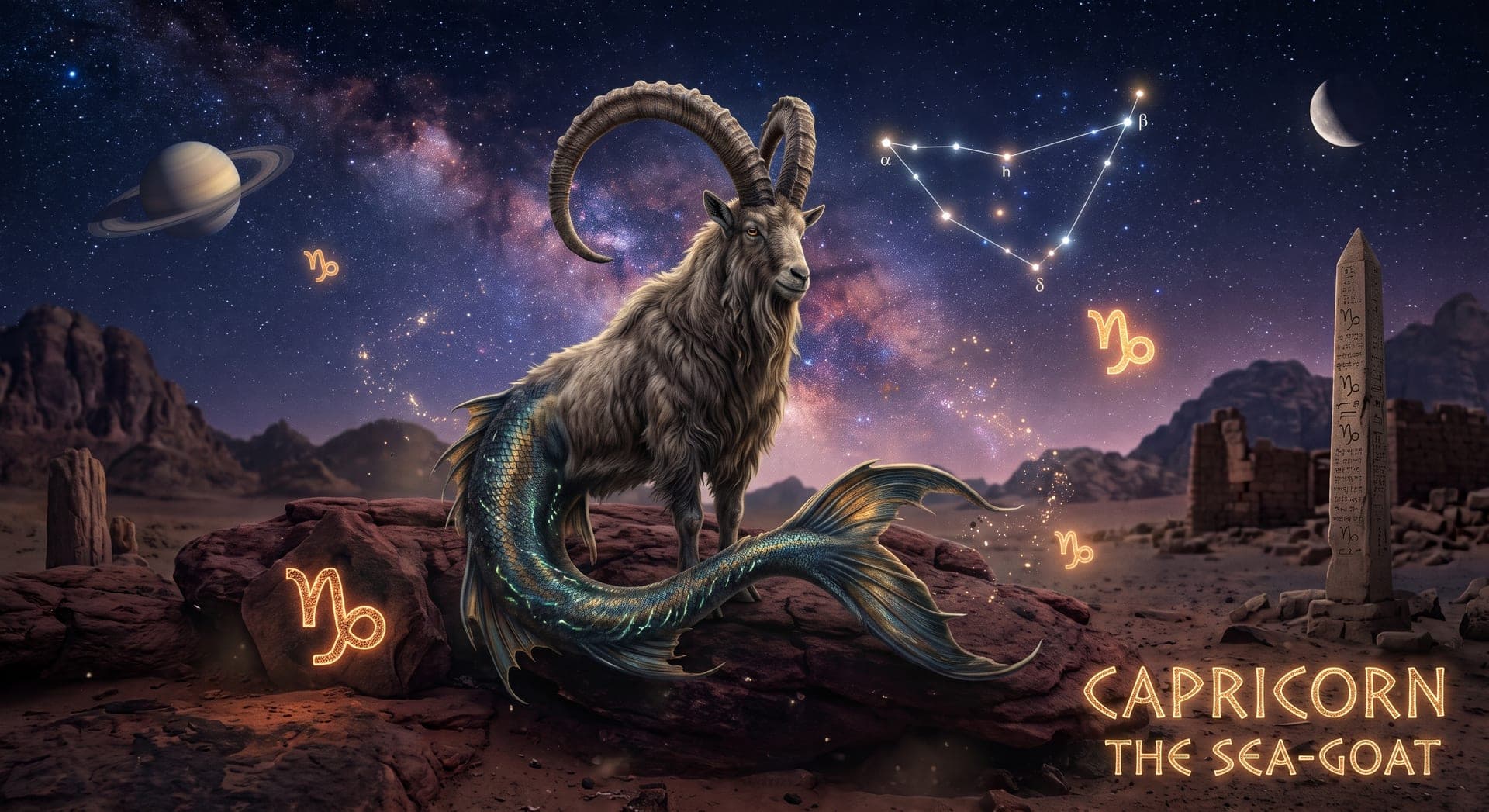
Capricorn, the tenth sign of the zodiac, spans December 22 to January 19 and is represented by the sea-goat, a mythical creature with the body of a goat and the tail of a fish, symbolizing an ability to navigate both the practical, earthly world and deeper emotional currents. Ruled by Saturn, the planet of discipline and time, Capricorns are often characterized as ambitious, patient, and deeply committed to long-term goals, willing to put in steady effort where others give up. As an Earth sign, Capricorn is grounded and practical, valuing tangible results and responsibility over impulsiveness. People born under this sign are frequently drawn to leadership and other structured pursuits where their organizational skills and work ethic can shine. Beneath a reserved, businesslike exterior, Capricorns are often said to carry a dry, understated sense of humor and a loyal, protective nature toward the people closest to them.
Personality Traits
Strengths
- Disciplined and self-controlled
- Responsible and dependable
- Excellent long-term planner
- Hardworking and persistent
- Good sense of humor once comfortable
Weaknesses
- Can be a know-it-all
- Unforgiving of mistakes, including their own
- Prone to pessimism
- Condescending toward those who don't work as hard
- Stubbornly resistant to changing plans
Compatible Signs
Fun Facts
- Capricorn's symbol, the sea-goat, comes from the Greek myth of Pan, who transformed his lower half into a fish tail to escape the monster Typhon while diving into the Nile.
- Saturn, Capricorn's ruling planet, was the Roman god of time, harvest, and generational structure, echoing the sign's association with patience and long-term thinking.
- Capricorn is one of only two zodiac signs represented by a hybrid creature, the other being Sagittarius, the centaur.
- Notable Capricorns include Michelle Obama, Martin Luther King Jr., Dolly Parton, LeBron James, and Isaac Newton.
- In traditional astrology, the winter solstice, the shortest day of the year, falls right at the start of Capricorn season in the Northern Hemisphere.
Born on December 26
- 1716
Thomas Gray
English poet best remembered for 'Elegy Written in a Country Churchyard,' one of the most quoted poems in the English language.
- 1780
Mary Somerville
Scottish science writer and polymath whose clear expositions of astronomy and physics made her one of the 19th century's most influential popularisers of science; the word 'scientist' is said to have been coined partly in her honour.
- 1791
Charles Babbage
English mathematician and inventor whose design for the Analytical Engine is regarded as a conceptual forerunner of the modern computer.
- 1893
Mao Zedong
Founding leader of the People's Republic of China
- 1921
Steve Allen
American entertainer and original host of The Tonight Show
- 1933
Caroll Spinney
American puppeteer who performed Big Bird on Sesame Street
- 1937
John Horton Conway
English mathematician renowned for his playful, wide-ranging work in number theory and combinatorics, including inventing the cellular automaton known as the Game of Life.
- 1947
Liz Lochhead
Scottish poet and playwright who served as Scotland's national poet, the Makar, from 2011 to 2016.
- 1958
Adrian Newey
English automotive and aerodynamics engineer whose championship-winning Formula One car designs for Williams, McLaren and Red Bull make him one of the sport's most successful engineers.
- 1971
Jared Leto
American actor and musician
- 1986
Hugo Lloris
French footballer and goalkeeper
- 1986
Kit Harington
English actor best known for playing Jon Snow in the television series Game of Thrones.
On This Day in History
- 1776
General George Washington executes a successful surprise attack against Hessian forces at the Battle of Trenton.
The Battle of Trenton, following Washington's daring crossing of the Delaware River the night before, resulted in a swift and decisive American victory over surprised Hessian mercenary forces, with minimal Continental Army casualties. The triumph provided a crucial morale boost after a demoralizing series of defeats and helped convince skeptical soldiers and civilians alike that the American cause remained viable.
- 1825
Russian liberal officers launch the Decembrist revolt against Tsar Nicholas I's authoritarian rule, though the uprising is quickly suppressed.
The Decembrist revolt, led by liberal-minded military officers seeking constitutional reform and opposing Nicholas I's succession to the Russian throne, was swiftly and violently suppressed by loyalist troops in St. Petersburg's Senate Square. Though unsuccessful, the uprising became an important symbol for later generations of Russian revolutionaries and reformers opposing autocratic rule.
- 1860
The first Sheffield derby is held between Sheffield F.C. and Hallam F.C., the oldest football fixture in the world.
The Sheffield derby, contested between two of the world's oldest football clubs, represents the earliest documented instance of a recurring local rivalry match in the sport's history, played under early rules that differed considerably from the modern game. Sheffield's pioneering football clubs played a significant role in codifying rules that would eventually influence the broader development of association football.
- 1860
The world's oldest football fixture, the 'Rules' derby between Sheffield F.C. and Hallam F.C., is played.
The two Sheffield clubs, formed within a few years of each other under the pioneering Sheffield Rules, met in what is recognised as the oldest football match still played today between the same two sides. Their annual derby helped shape early association football years before the national Football Association agreed a unified rulebook.
- 1861
Britain and the United States step back from the brink of war as the Trent Affair is resolved.
A month earlier, a US Navy ship had stopped the British mail packet Trent and seized two Confederate diplomats, outraging Britain and pushing the two countries toward conflict during the American Civil War. Washington's decision to release the envoys on Boxing Day eased the crisis and preserved British neutrality.
- 1862
The largest mass execution in American history takes place in Mankato, Minnesota, with 38 Dakota men hanged.
The mass execution in Mankato followed the U.S.-Dakota War of 1862, a brief but bloody conflict sparked by broken treaty promises and desperate conditions on Dakota reservations, and remains the largest single-day execution in American history. President Lincoln personally reviewed the cases and commuted the vast majority of death sentences originally handed down by military tribunals, though the 38 executions still proceeded amid significant public pressure for harsher punishment.
- 1898
Marie and Pierre Curie announce their discovery and isolation of radium, a major scientific breakthrough.
Marie and Pierre Curie's announcement of radium's discovery and isolation, achieved through painstaking processing of tons of pitchblende ore, represented a landmark achievement in the study of radioactivity, a term Marie Curie herself had coined. Their research would ultimately earn Marie Curie two Nobel Prizes, though prolonged exposure to radioactive materials likely contributed to her death decades later.
- 1898
Marie and Pierre Curie announce the discovery of the new element radium.
Working in a converted shed in Paris, the couple had spent months analysing tonnes of pitchblende ore, building on their earlier discovery of polonium, before identifying radium's distinctive properties through spectral analysis. The breakthrough eventually opened the door to radiation-based cancer treatment and helped earn Marie Curie a second Nobel Prize.
- 1941
President Franklin D. Roosevelt signs a bill establishing the fourth Thursday in November as the official date of Thanksgiving.
President Roosevelt's legislation formally standardized Thanksgiving's date after a period of confusion caused by his own earlier attempt to move the holiday a week earlier to extend the Christmas shopping season, a change that had proven unpopular and inconsistently adopted across different states. The new law fixed the holiday permanently on the fourth Thursday of November.
- 1941
Winston Churchill addresses a joint session of the United States Congress.
Just weeks after America's entry into the Second World War following Pearl Harbor, Britain's wartime Prime Minister flew to Washington and delivered a rousing speech urging Anglo-American unity against the Axis powers. Broadcast live, it became one of the defining moments of the 'special relationship' between the two nations.
- 1943
The Royal Navy sinks the German battleship Scharnhorst at the Battle of the North Cape.
British warships intercepted the Scharnhorst off northern Norway as it moved to attack an Arctic convoy bound for the Soviet Union. The battleship was overwhelmed and sunk with the loss of nearly 1,900 of her crew, removing one of Nazi Germany's last major surface threats to Allied shipping.
- 1963
The Beatles' single 'I Want to Hold Your Hand' is released in the United States.
Capitol Records rushed out the American release, backed by an intensive publicity campaign, after strong radio demand. It set the stage for the group's arrival in New York the following February and the explosion of 'Beatlemania' across the US, launching what became known as the British Invasion of pop music.
- 1980
Witnesses report mysterious lights near RAF Woodbridge in Rendlesham Forest, Suffolk.
Over several nights, US Air Force personnel stationed at the joint RAF/USAF base reported strange lights and a landed object in the forest, along with radiation readings above normal. Dubbed 'Britain's Roswell,' it remains the country's most famous and most investigated UFO case.
- 1991
The Supreme Soviet formally dissolves the Soviet Union, marking the definitive end of the Cold War era.
The Supreme Soviet's formal dissolution vote represented the final legal act ending the Soviet Union's existence as a sovereign state, following Gorbachev's resignation the previous day. The dissolution marked the definitive conclusion of the Cold War and set off a complex and often difficult process of political and economic transition across the former Soviet republics.
- 1991
The Soviet Union is formally dissolved.
Following Mikhail Gorbachev's resignation the previous day, the Union of Soviet Socialist Republics ceased to exist, splitting into fifteen independent states. The collapse ended nearly seventy years of Communist rule and reshaped the global balance of power at the close of the Cold War.
- 1998
Iraq announces it will fire on American and British aircraft patrolling the Iraqi no-fly zones.
The threat came days after the US and UK carried out Operation Desert Fox, a four-day bombing campaign targeting Iraqi weapons facilities. Iraq's declaration effectively ended its acceptance of the no-fly zones enforced since the Gulf War, leading to years of intermittent clashes with British and American patrol aircraft.
- 2003
A devastating 6.6 magnitude earthquake strikes Bam, Iran, killing more than 26,000 people.
The Bam earthquake devastated the historic Iranian city, destroying much of its ancient citadel, one of the world's largest adobe structures, along with the vast majority of the modern city's buildings. The disaster prompted a significant international humanitarian response and a lengthy, still-ongoing effort to restore Bam's UNESCO World Heritage-listed historical structures.
- 2004
A massive undersea earthquake triggers one of history's deadliest tsunamis, killing an estimated 227,000 people across multiple Asian nations.
The 2004 Indian Ocean tsunami, triggered by one of the most powerful earthquakes ever recorded, devastated coastal communities across more than a dozen countries with waves reaching heights of up to 100 feet in some locations. The catastrophic death toll and destruction prompted the development of a comprehensive Indian Ocean tsunami warning system to help prevent similar loss of life in the future.
- 2004
A magnitude 9.1 earthquake off Sumatra triggers the Indian Ocean tsunami, which kills an estimated 227,898 people.
The undersea megathrust earthquake, one of the most powerful ever recorded, sent tsunami waves crashing into coastlines across South and Southeast Asia and East Africa within hours. It remains one of the deadliest natural disasters in recorded history and prompted an unprecedented global humanitarian relief effort.
- 2012
China opens the world's longest high-speed rail route, linking Beijing and Guangzhou.
The Beijing-Guangzhou high-speed rail line, spanning over 1,400 miles, showcased China's massive and rapid investment in high-speed rail infrastructure, which expanded from virtually nonexistent to the world's largest network within roughly a decade. The line dramatically reduced travel times between China's political and economic centers, reflecting the country's broader infrastructure development ambitions.