
What’s Observed on December 21
Born on December 21: Sagittarius ♐
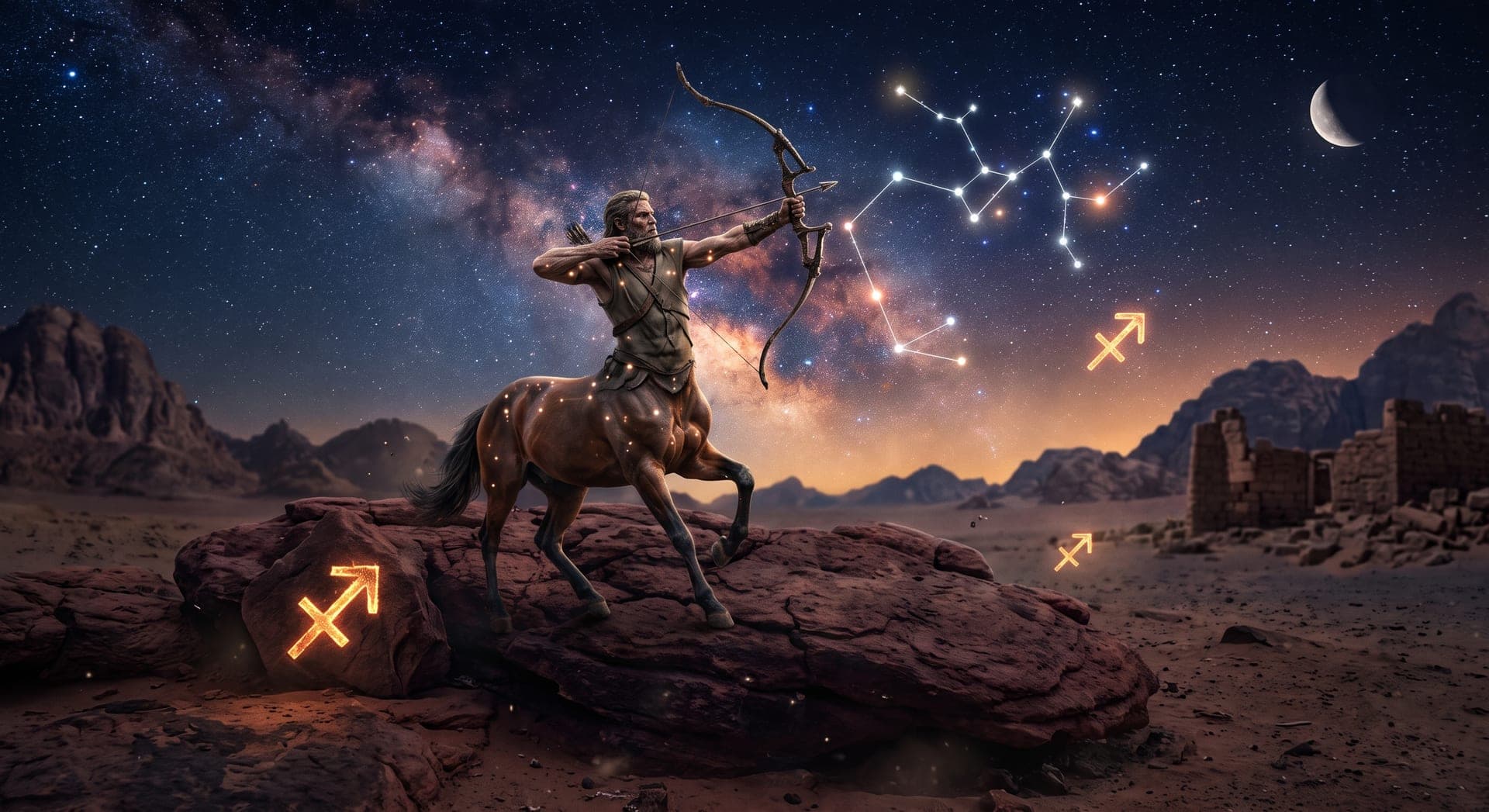
Sagittarius, the ninth sign of the zodiac, spans November 22 to December 21 and is symbolized by the archer, typically depicted as a centaur drawing a bow, representing a restless pursuit of knowledge, adventure, and far-off horizons. Ruled by Jupiter, the largest planet in the solar system and a symbol of growth, luck, and abundance, Sagittarius is widely regarded as one of the most optimistic and freedom-loving signs of the zodiac. As a Fire sign, Sagittarius approaches life with enthusiasm and a genuine hunger for new experiences, whether through literal travel or intellectual and philosophical exploration. Its Mutable modality reflects a deep aversion to routine and confinement, always looking toward the next adventure rather than settling into fixed patterns. People born under this sign are often drawn to travel, higher education, philosophy, or any pursuit that broadens their horizons and understanding of the world. Sagittarius's honesty and optimism make it excellent company, though its blunt directness and restless need for freedom can sometimes come across as tactless or noncommittal to those seeking more stability.
Personality Traits
Strengths
- Adventurous and open to new experiences
- Optimistic and enthusiastic
- Honest and direct
- Philosophical and broad-minded
- Generous and good-humored
Weaknesses
- Tactlessly blunt
- Impatient with routine
- Prone to overpromising
- Restless and commitment-averse
- Careless with details
Compatible Signs
Fun Facts
- Sagittarius's symbol, a centaur drawing a bow and arrow, connects to the Greek myth of Chiron, a wise and scholarly centaur unlike the more unruly members of his kind.
- Jupiter, Sagittarius' ruling planet, is the largest planet in the solar system, reflecting the sign's association with expansion, abundance, and big-picture thinking.
- Sagittarius is one of two zodiac signs, along with Capricorn, represented by a hybrid creature combining human and animal features.
- Notable Sagittarians include Taylor Swift, Walt Disney, Winston Churchill, and Jimi Hendrix.
- Sagittarius season spans the lead-up to the winter solstice, a period historically associated with travel, feasting, and philosophical reflection in many cultures.
Born on December 21
- 1795
Jack Russell
English clergyman and hunting enthusiast whose passion for terriers gave rise to the Jack Russell Terrier breed, which still bears his name.
- 1804
Benjamin Disraeli
British Prime Minister and novelist
- 1805
Thomas Graham
Scottish chemist regarded as a founder of colloid chemistry, whose research on diffusion, known as Graham's Law, laid groundwork for modern dialysis.
- 1811
Archibald Campbell Tait
Scottish-born clergyman who served as Archbishop of Canterbury, leading the Church of England through a period of significant reform and controversy in the Victorian era.
- 1892
Walter Hagen
American professional golfer
- 1892
Rebecca West
English journalist, novelist and literary critic whose sharp reporting included coverage of the Nuremberg trials, and whose Black Lamb and Grey Falcon remains a landmark of travel writing.
- 1937
Jane Fonda
American actress and activist
- 1940
Frank Zappa
American musician and composer
- 1942
Hu Jintao
Former paramount leader of China
- 1943
Albert Lee
English guitarist celebrated among musicians as a virtuoso of country and rock guitar, known for his work with Emmylou Harris's Hot Band and the Everly Brothers.
- 1948
Samuel L. Jackson
American actor
- 1954
Chris Evert
American tennis champion
- 1977
Emmanuel Macron
President of France
- 1982
Tom Payne
English actor known for playing Jesus in the television series The Walking Dead and for roles across British and American film and television.
- 1985
Tom Sturridge
English actor known for playing Dream in the Netflix adaptation of The Sandman and for stage and screen roles across Britain and the United States.

On This Day in History
- 69
The Roman Senate proclaims Vespasian emperor, concluding the chaotic Year of the Four Emperors.
Vespasian's proclamation as emperor concluded the chaotic Year of the Four Emperors, a period of civil war and rapid political turnover following Emperor Nero's death the previous year. His subsequent decade-long reign restored stability to the empire and founded the Flavian dynasty, whose most enduring physical legacy remains the Colosseum, completed by his son Titus.
- 1598
Mapuche warriors achieve a major victory against Spanish colonial troops at the Battle of Curalaba in Chile.
The Mapuche victory at Curalaba, in which Spanish colonial forces suffered a devastating defeat including the death of the Spanish governor, triggered a prolonged uprising that pushed Spanish settlement out of much Mapuche territory in southern Chile for generations. The Mapuche would maintain effective independence from Spanish and later Chilean control longer than almost any other Indigenous group in the Americas.
- 1620
Pilgrims aboard the Mayflower disembark near what would become Plymouth, Massachusetts.
The Pilgrims' landing at Plymouth followed weeks of scouting the Massachusetts coastline after their initial arrival further north than intended, ultimately settling at a site with a natural harbor and previously cleared land, abandoned following a devastating epidemic among the local Wampanoag population. Their first winter proved catastrophic, killing roughly half the colonists before spring.
- 1620
English Pilgrims aboard the Mayflower came ashore near Plymouth Rock, founding Plymouth Colony.
Led by William Bradford, the Separatist settlers had sailed from Plymouth, England, seeking religious freedom, enduring a gruelling Atlantic crossing before landing in present-day Massachusetts. Roughly half the original party died during the first brutal winter, but the colony survived to become one of the earliest permanent English settlements in America, later celebrated in the Thanksgiving tradition.
- 1844
The Rochdale Society of Equitable Pioneers opens its cooperative shop in England, establishing the modern cooperative movement.
The Rochdale Pioneers' cooperative shop, founded by a group of weavers and skilled tradesmen seeking an alternative to exploitative retail practices, established core principles of democratic member ownership and profit-sharing that became the foundation for the modern cooperative movement worldwide. Their model has since been replicated across countless industries, from agriculture to banking to retail.
- 1844
The Rochdale Society of Equitable Pioneers opened its co-operative shop in Rochdale, England, launching the modern Co-operative movement.
A group of weavers and artisans, many unemployed after a failed strike, pooled their savings to open a small shop selling honest goods at fair prices, splitting profits among members as dividends. Their 'Rochdale Principles' of democratic ownership and fair trading became the template for co-operative societies worldwide, influencing retail, banking and agriculture far beyond Lancashire.
- 1872
HMS Challenger departs Portsmouth, England to conduct a groundbreaking global oceanographic survey.
HMS Challenger's four-year global oceanographic expedition, covering nearly 70,000 nautical miles, fundamentally established the modern science of oceanography, cataloging thousands of previously unknown marine species and gathering extensive data on ocean depths, temperatures, and currents. The voyage's findings filled dozens of scientific volumes and remained a foundational reference for oceanographers for decades afterward.
- 1872
HMS Challenger set sail from Portsmouth, England, on the pioneering scientific voyage that founded modern oceanography.
Under Captain George Nares, the converted Royal Navy corvette spent nearly four years circling the globe, dredging the ocean floor, measuring depths and temperatures, and cataloguing thousands of previously unknown marine species. Its findings, published over the following two decades, established oceanography as a scientific discipline and remain a foundational reference for the field.
- 1910
An underground explosion at the Hulton Bank Colliery near Westhoughton, England, killed 344 miners.
A gas explosion tore through the pit, leaving hundreds of families in the small Lancashire town bereaved just before Christmas. The disaster, also known as the Pretoria Pit disaster, remains among the deadliest in British coal mining history, and it spurred renewed public debate over mine safety standards in the years before the First World War.
- 1923
The United Kingdom and Nepal signed a formal treaty of friendship, superseding the 1816 Treaty of Sugauli.
The Nepal-Britain Treaty of 1923 formally recognised Nepal's full independence and sovereignty, moving beyond the more restrictive terms Britain had imposed after the Anglo-Nepalese War a century earlier. The agreement reflected the close but evolving relationship between the two countries, including the continued recruitment of Gurkha soldiers into the British Army, a tradition that continues today.
- 1967
Louis Washkansky, the first person to receive a human-to-human heart transplant, died eighteen days after the operation.
Surgeon Christiaan Barnard had performed the groundbreaking transplant at Groote Schuur Hospital in Cape Town earlier that month, giving Washkansky a new heart from a young accident victim. Though he ultimately died of pneumonia after his immune system was suppressed to prevent organ rejection, the operation proved heart transplantation was technically possible and opened the door to the field's rapid development.
- 1968
Apollo 8 launches toward the Moon, marking humanity's first crewed journey beyond low Earth orbit.
Apollo 8's launch sent the first humans beyond low Earth orbit toward the Moon, a mission whose crew famously read from the Book of Genesis during a Christmas Eve broadcast while orbiting the lunar surface, an event watched by hundreds of millions of people worldwide. The mission's success, achieved despite it being only the third crewed Apollo flight, paved the way for the subsequent lunar landing.
- 1968
Apollo 8 launched from the Kennedy Space Center, sending astronauts on the first crewed journey to another celestial body.
Commanded by Frank Borman with crewmates James Lovell and William Anders, the mission orbited the Moon ten times without landing, testing the systems needed for a future lunar landing. The crew's Christmas Eve reading from the Book of Genesis and their photograph of Earth rising over the lunar horizon, known as Earthrise, became defining images of the space age.
- 1979
The Lancaster House Agreement, granting independence to Rhodesia as Zimbabwe, was signed in London.
After months of negotiations chaired by British Foreign Secretary Lord Carrington, the agreement brought together Rhodesian and guerrilla leaders including Robert Mugabe and Joshua Nkomo to end years of civil war and white minority rule. It established a new constitution and paved the way for elections that made Mugabe the first prime minister of the newly independent Zimbabwe in 1980.
- 1988
A terrorist bomb destroys Pan Am Flight 103 over Lockerbie, Scotland, killing 270 people.
The bombing of Pan Am Flight 103 over Lockerbie, Scotland, killed all 259 people aboard along with eleven residents on the ground, making it the deadliest terrorist attack in British history until the 2017 Manchester Arena bombing. A Libyan intelligence officer was eventually convicted for the bombing, though questions about the full extent of responsibility persisted for years afterward.
- 1988
A bomb destroyed Pan Am Flight 103 over Lockerbie, Scotland, killing all 259 people aboard and 11 on the ground.
The Boeing 747, en route from London to New York, broke apart at 31,000 feet after a bomb concealed in luggage detonated, scattering wreckage across the Scottish town of Lockerbie. It remains the deadliest terrorist attack in British history. Libyan intelligence officer Abdelbaset al-Megrahi was later convicted of the bombing, though questions about the case persisted for decades afterward.
- 1991
Soviet republics sign the Alma-Ata Protocol, formally establishing the Commonwealth of Independent States.
The Alma-Ata Protocol formally expanded the earlier agreement establishing the Commonwealth of Independent States to include eight additional former Soviet republics, effectively finalizing the dissolution of the Soviet Union as a unified state. The protocol addressed practical matters including the fate of Soviet nuclear weapons and the country's UN Security Council seat, which passed to Russia.
- 1991
Leaders of eleven Soviet republics signed the Alma-Ata Protocol, formally establishing the Commonwealth of Independent States.
Meeting in Alma-Ata, Kazakhstan, the republics' leaders confirmed the dissolution of the Soviet Union, effectively ending nearly seven decades of communist rule. The agreement followed the August coup attempt and a wave of republics declaring independence earlier that year. Soviet President Mikhail Gorbachev resigned days later, and the Soviet flag over the Kremlin was lowered for the last time.
- 1995
The Palestinian Authority assumes administrative control of Bethlehem from Israel.
The Palestinian Authority's assumption of control over Bethlehem, part of a broader transfer of West Bank territories under the Oslo Accords, represented one of the first instances of Palestinian self-governance in a significant Palestinian population center. The transfer carried particular symbolic weight given Bethlehem's religious significance as the traditional birthplace of Jesus.
- 2020
Jupiter and Saturn reach their closest planetary conjunction observed from Earth since 1623.
The 2020 Great Conjunction of Jupiter and Saturn, appearing so close together in the night sky that some observers described them as forming a single bright point of light sometimes called the "Christmas Star," represented the closest such alignment visible from Earth in nearly 400 years. The rare astronomical event drew widespread public interest in stargazing during a challenging pandemic year.