What’s Observed on November 22
Born on November 22: Sagittarius ♐
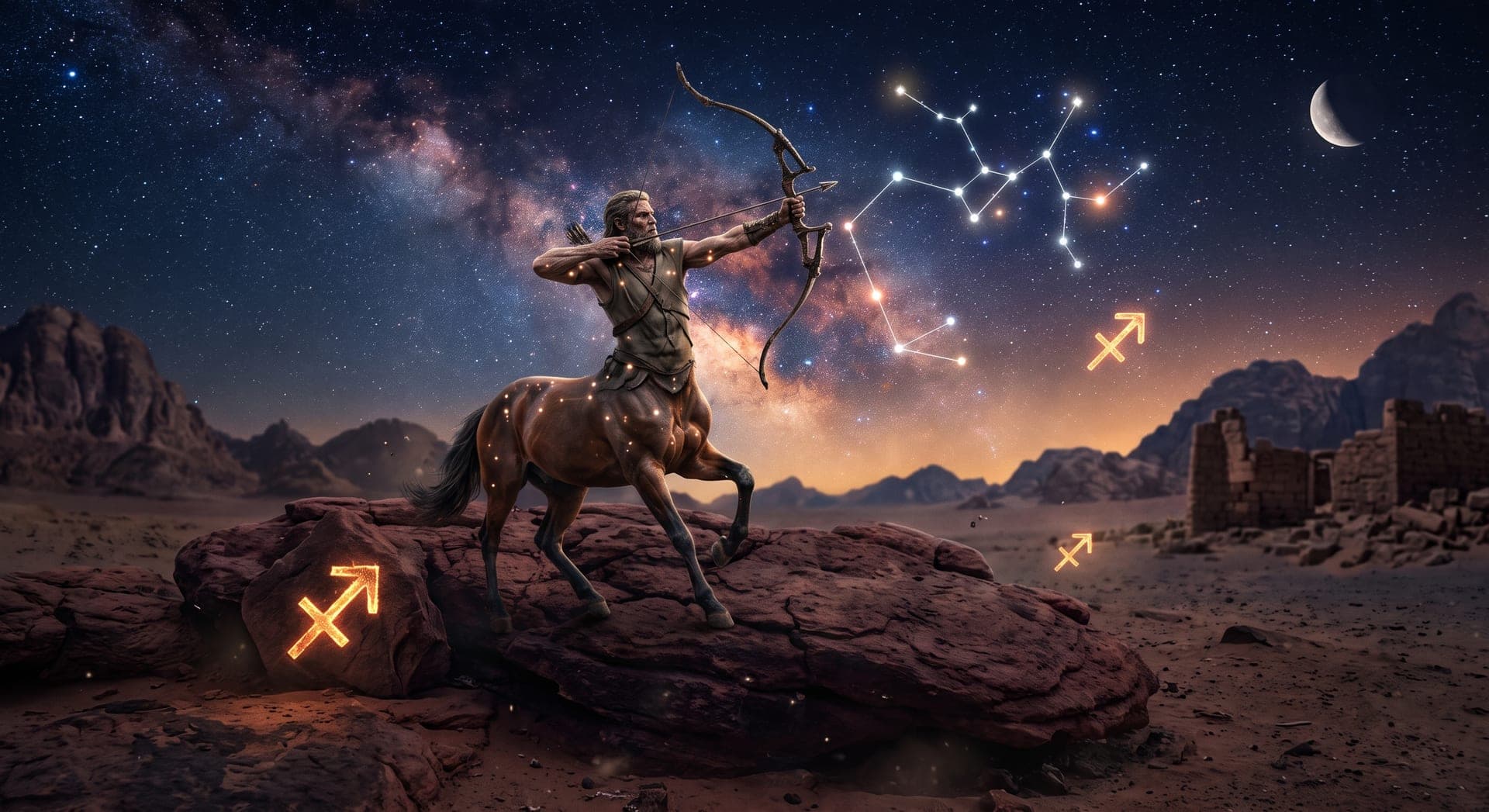
Sagittarius, the ninth sign of the zodiac, spans November 22 to December 21 and is symbolized by the archer, typically depicted as a centaur drawing a bow, representing a restless pursuit of knowledge, adventure, and far-off horizons. Ruled by Jupiter, the largest planet in the solar system and a symbol of growth, luck, and abundance, Sagittarius is widely regarded as one of the most optimistic and freedom-loving signs of the zodiac. As a Fire sign, Sagittarius approaches life with enthusiasm and a genuine hunger for new experiences, whether through literal travel or intellectual and philosophical exploration. Its Mutable modality reflects a deep aversion to routine and confinement, always looking toward the next adventure rather than settling into fixed patterns. People born under this sign are often drawn to travel, higher education, philosophy, or any pursuit that broadens their horizons and understanding of the world. Sagittarius's honesty and optimism make it excellent company, though its blunt directness and restless need for freedom can sometimes come across as tactless or noncommittal to those seeking more stability.
Personality Traits
Strengths
- Adventurous and open to new experiences
- Optimistic and enthusiastic
- Honest and direct
- Philosophical and broad-minded
- Generous and good-humored
Weaknesses
- Tactlessly blunt
- Impatient with routine
- Prone to overpromising
- Restless and commitment-averse
- Careless with details
Compatible Signs
Fun Facts
- Sagittarius's symbol, a centaur drawing a bow and arrow, connects to the Greek myth of Chiron, a wise and scholarly centaur unlike the more unruly members of his kind.
- Jupiter, Sagittarius' ruling planet, is the largest planet in the solar system, reflecting the sign's association with expansion, abundance, and big-picture thinking.
- Sagittarius is one of two zodiac signs, along with Capricorn, represented by a hybrid creature combining human and animal features.
- Notable Sagittarians include Taylor Swift, Walt Disney, Winston Churchill, and Jimi Hendrix.
- Sagittarius season spans the lead-up to the winter solstice, a period historically associated with travel, feasting, and philosophical reflection in many cultures.
Born on November 22
- 1819
George Eliot
English novelist known for "Middlemarch"
- 1890
Charles de Gaulle
French general and President of France
- 1913
Benjamin Britten
English composer, conductor, and pianist regarded as one of the 20th century's most significant composers, known for works including Peter Grimes and the War Requiem.
- 1917
Andrew Huxley
English physiologist awarded the Nobel Prize for unraveling the ionic mechanism behind nerve impulses, alongside Alan Hodgkin.
- 1930
Peter Hall
English theatre and film director who founded the Royal Shakespeare Company and later ran the National Theatre.
- 1940
Terry Gilliam
American-born British animator, director, and member of the Monty Python comedy troupe, later a naturalized UK citizen known for films including Brazil and Twelve Monkeys.
- 1941
Tom Conti
Scottish actor known for stage and screen roles including Shirley Valentine and Reuben, Reuben, and for a career recognized with both Olivier and Tony Awards.
- 1943
Billie Jean King
American tennis champion
- 1955
George Alagiah
British journalist and BBC newsreader who anchored BBC News at Six for two decades.
- 1958
Jamie Lee Curtis
American actress
- 1967
Mark Ruffalo
American actor
- 1971
Kyran Bracken
Irish-born English rugby union scrum-half who won the 2003 Rugby World Cup with England.
- 1984
Scarlett Johansson
American actress

On This Day in History
- 1220
Frederick II is crowned Holy Roman Emperor by Pope Honorius III in Rome.
Frederick II's coronation as Holy Roman Emperor came after years of complex political maneuvering involving competing claims and papal support, ultimately uniting the crowns of Germany, Italy, and Sicily under his rule. Frederick's reign was marked by significant intellectual and cultural achievements as well as recurring conflict with the papacy over the boundaries of secular and religious authority.
- 1307
Pope Clement V issues a papal directive instructing European monarchs to arrest members of the Knights Templar and seize their assets.
Pope Clement V's directive, issued under significant pressure from French King Philip IV, ordered the mass arrest of Knights Templar members across Europe on charges of heresy and corruption, seizing the once-powerful crusading order's substantial financial assets. The subsequent trials and executions effectively destroyed the Templars, an event still surrounded by considerable historical intrigue and legend.
- 1574
Spanish navigator Juan Fernandez discovers the Pacific island chain later named after him off the coast of Chile.
Spanish navigator Juan Fernandez discovered the small, remote island chain off the coast of Chile while sailing along South American trade routes, later becoming famous as the setting for the real-life castaway story that inspired the novel Robinson Crusoe. The islands remain a Chilean national park known for their unique endemic wildlife.
- 1718
Royal Navy Lieutenant Robert Maynard defeats and kills the pirate Blackbeard off North Carolina.
Commanding two sloops sent by Virginia's governor, Maynard boarded Blackbeard's ship after a fierce fight in which the pirate, born Edward Teach, was reportedly shot and cut down after suffering some 20 wounds. Maynard had Blackbeard's severed head displayed from his ship's bowsprit, ending one of the most notorious pirate careers of the Caribbean's Golden Age.
- 1855
Prince Albert lays the foundation stone of the Birmingham and Midland Institute.
Queen Victoria's consort championed the new institute as a centre for adult scientific and cultural education, part of his broader campaign to promote industry, science, and the arts in Victorian Britain. The Institute went on to host prominent lecturers and remains an educational and cultural fixture in Birmingham today.
- 1869
The clipper ship Cutty Sark is launched at Dumbarton, Scotland.
The Cutty Sark, one of the last and fastest tea clipper ships built before steam power rendered sailing vessels obsolete for commercial shipping, was launched at a Scottish shipyard. The vessel survived numerous close calls over its working life and today remains preserved as a museum ship, offering visitors insight into the golden age of sail.
- 1869
The clipper ship Cutty Sark is launched at Dumbarton, Scotland.
Built for the competitive China tea trade, the fast three-masted clipper was soon overtaken by steamships but found new life carrying wool from Australia, setting speed records along the way. Preserved as a museum ship in Greenwich, London, Cutty Sark survives today as one of the world's last remaining tea clippers and a celebrated piece of British maritime heritage.
- 1921
Loyalist gunmen kill 15 Catholics in a wave of revenge attacks across Belfast.
The shootings came amid the sectarian violence that gripped Belfast during the Irish revolutionary period, as the city's Catholic minority faced repeated attacks from loyalist paramilitaries and, at times, state forces. The unrest of 1920-22, sometimes called the Belfast Pogrom, killed several hundred people and helped entrench the sectarian divisions that would shape Northern Ireland for generations.
- 1935
The China Clipper inaugurates the first commercial transpacific airmail service between California and Manila.
Pan American Airways' China Clipper flying boat inaugurated the first scheduled commercial airmail service across the Pacific Ocean, connecting California to the Philippines via a series of island stops requiring specially constructed seaplane bases. The pioneering route dramatically shortened communication and transportation times between the United States and Asia.
- 1942
German General Friedrich Paulus reports to Hitler that his Sixth Army has been fully encircled by Soviet forces at Stalingrad.
Soviet forces completed their pincer movement at Kalach four days after launching Operation Uranus, trapping some 250,000 German and allied troops inside the city. Paulus's request for freedom of action to break out was rejected; Hitler ordered the army to hold its position, a decision that sealed the eventual destruction of the Sixth Army by February 1943.
- 1943
Lebanon gains independence from French colonial rule.
Lebanon's independence from French colonial administration came after French authorities, under pressure amid World War II, arrested Lebanese political leaders who had declared independence, prompting widespread protests that ultimately forced their release and recognition of Lebanese sovereignty. The date is now celebrated annually as Lebanon's Independence Day.
- 1943
The Cairo Conference opens, bringing together Winston Churchill, Franklin D. Roosevelt, and Chiang Kai-shek to plan Allied strategy against Japan.
Held before the Tehran Conference with Stalin, the four-day summit produced the Cairo Declaration, setting out Allied aims in the Pacific War, including stripping Japan of territories it had seized and restoring Manchuria, Formosa, and the Pescadores to China. Churchill used the meeting to press his American and Chinese counterparts on the future shape of the Asian theatre and Britain's postwar colonial interests.
- 1963
President John F. Kennedy is assassinated in Dallas, Texas, and Vice President Lyndon B. Johnson is sworn in as president.
President John F. Kennedy was shot while riding in a presidential motorcade through downtown Dallas, an assassination that stunned the nation and world and remains the subject of enduring conspiracy theories despite official investigations concluding a lone gunman was responsible. His death marked a profound turning point in American political and cultural history.
- 1963
President John F. Kennedy is assassinated while riding in a motorcade through Dallas, Texas.
Kennedy was shot as his open-top car passed the Texas School Book Depository, and was pronounced dead within the hour. Vice President Lyndon B. Johnson was sworn in aboard Air Force One that same afternoon. Kennedy's assassination, and the subsequent killing of suspect Lee Harvey Oswald, left lasting controversy and reshaped American political life.
- 1967
The UN Security Council adopts Resolution 242, establishing principles for peace in the Arab-Israeli conflict.
UN Security Council Resolution 242, adopted following the 1967 Arab-Israeli Six-Day War, established the principle of "land for peace" as a framework for resolving the conflict, calling for Israeli withdrawal from occupied territories in exchange for recognition and secure borders. The resolution remains a foundational reference point in ongoing Middle East peace negotiations.
- 1967
The UN Security Council adopts Resolution 242, drafted by British ambassador Lord Caradon, calling for peace in the Middle East after the Six-Day War.
Lord Caradon, Britain's ambassador to the UN, Hugh Foot, drafted the resolution's deliberately ambiguous call for Israeli 'withdrawal from territories occupied' during the recent conflict, paired with recognition of every state's right to live within secure borders. The wording, debated ever since for its omission of the word 'all' before 'territories,' became the foundational framework for subsequent Arab-Israeli peace negotiations.
- 1971
Five teenage students and an expedition leader die of exposure on Scotland's Cairngorm Plateau during a school hiking trip.
Six fifteen-year-old pupils from an Edinburgh school and their two adult leaders were caught in a severe blizzard while attempting a two-day navigation exercise in the Cairngorms and became stranded overnight without adequate shelter. Only one student and the expedition's main leader survived, suffering severe hypothermia and frostbite. Widely regarded as Britain's worst mountaineering disaster, it led to stricter safety rules for school expeditions.
- 1990
Margaret Thatcher announces her resignation as leader of the Conservative Party amid a leadership challenge.
Margaret Thatcher, Britain's longest-serving prime minister of the twentieth century, announced she would not contest a second round of a Conservative Party leadership challenge after failing to secure a decisive first-round victory, effectively ending her eleven-year premiership. Her departure marked a dramatic end to one of the most consequential political careers in modern British history.
- 1990
Margaret Thatcher announces she will resign as leader of the Conservative Party, ending her 11 years as British Prime Minister.
Facing a leadership challenge from Michael Heseltine after failing to win outright in the first ballot, Thatcher concluded her support within the parliamentary party had collapsed and withdrew from the contest. Britain's longest-serving 20th-century prime minister, credited with sweeping economic reforms and victory in the Falklands War, was succeeded weeks later by John Major.
- 2004
Ukraine's Orange Revolution begins in response to a disputed presidential election result.
Ukraine's Orange Revolution erupted after official results declared a victory for the government-backed candidate in a presidential runoff widely believed to have been marred by significant fraud. Weeks of mass peaceful protests, marked by supporters wearing orange, eventually forced a court-ordered rerun of the election, which was won by the opposition candidate.