What’s Observed on November 21
Born on November 21: Scorpio ♏
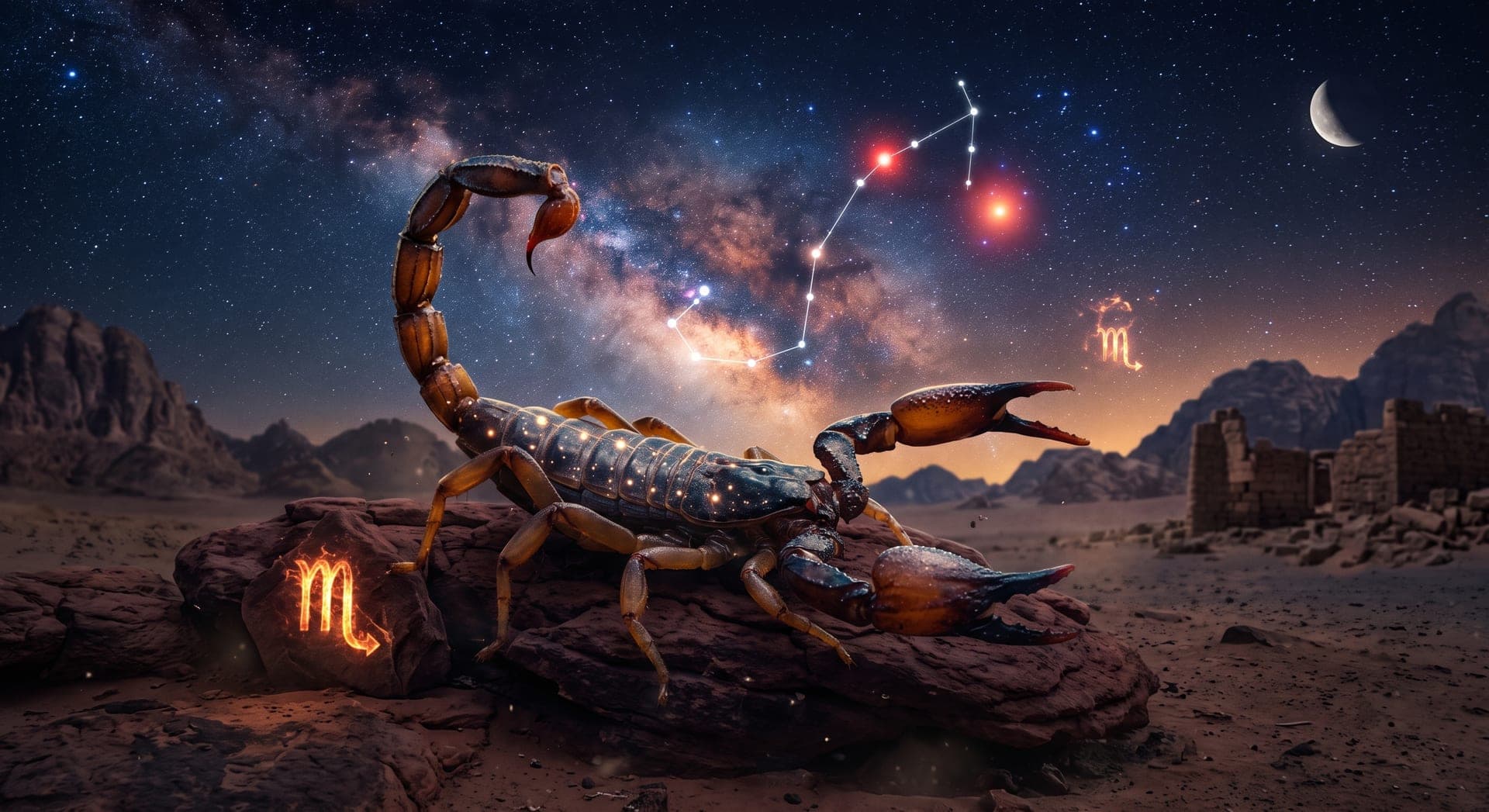
Scorpio, the eighth sign of the zodiac, spans October 23 to November 21 and is symbolized by the scorpion, a creature known for its defensive intensity and the sting it delivers when provoked. Traditionally ruled by Mars and, in modern astrology, by Pluto, the planet of transformation and the underworld, Scorpio carries a reputation as one of the most intense and emotionally powerful signs of the zodiac. As a Water sign, Scorpio experiences the world through deep, often hidden, emotion, guarding its inner life carefully while remaining acutely perceptive of others. Its Fixed modality gives Scorpio remarkable determination and resilience, able to endure hardship and pursue long-term goals with singular focus. People born under this sign are often drawn to work involving psychology, investigation, transformation, or anything requiring the ability to see beneath the surface. Scorpio's loyalty and passion run deep for those it trusts, but that same intensity can curdle into jealousy, suspicion, or an unwillingness to forgive when trust is broken.
Personality Traits
Strengths
- Deeply passionate and determined
- Fiercely loyal to those they trust
- Resourceful and strategic
- Highly perceptive
- Emotionally resilient
Weaknesses
- Prone to jealousy and possessiveness
- Secretive and guarded
- Can be vindictive when wronged
- Distrustful of others
- Prone to obsessiveness
Compatible Signs
Fun Facts
- Scorpio's scorpion symbol connects to the Greek myth of the scorpion sent by Gaia to kill the hunter Orion, with both later placed among the stars.
- Scorpio has two ruling planets: Mars in traditional astrology, and Pluto, discovered in 1930, in the modern system.
- Scorpio is often mistakenly grouped with the Fire signs due to its intensity, but it is actually a Water sign, driven by deep emotion rather than raw aggression.
- Notable Scorpios include Pablo Picasso, Marie Curie, Leonardo DiCaprio, and Hillary Clinton.
- Some astrological traditions associate Scorpio with a secondary, more elevated symbol, the eagle or phoenix, representing transformation and rebirth.
Born on November 21
- 1694
Voltaire
French Enlightenment writer and philosopher
- 1886
Harold Nicolson
English diplomat, author, and politician whose diaries and biographies chronicled British political and literary life; married to writer and gardener Vita Sackville-West.
- 1898
Rene Magritte
Belgian surrealist painter
- 1903
Isaac Bashevis Singer
Polish-American author and Nobel Prize laureate in Literature
- 1904
Coleman Hawkins
American jazz saxophonist
- 1912
Eleanor Powell
American dancer and actress
- 1920
Stan Musial
American Major League Baseball player
- 1924
Christopher Tolkien
English academic and editor who devoted decades to publishing his father J. R. R. Tolkien's unfinished works, including The Silmarillion.
- 1932
Beryl Bainbridge
English novelist celebrated for darkly comic works such as The Bottle Factory Outing and Master Georgie, five times shortlisted for the Booker Prize.
- 1937
Ingrid Pitt
Polish-born British actress best known for starring in Hammer horror films including The Vampire Lovers and Countess Dracula.
- 1953
Tina Brown
English-American journalist and editor who revitalized Tatler, Vanity Fair, and The New Yorker before founding The Daily Beast.
- 1965
Bjork
Icelandic singer-songwriter
- 1968
Alex James
English musician and cheesemaker, best known as the bassist of the Britpop band Blur.
- 1985
Carly Rae Jepsen
Canadian singer-songwriter
- 1990
Dani King
English track cyclist who won Olympic gold in the team pursuit at the 2012 London Games.
On This Day in History
- 164 BCE
Judas Maccabeus rededicates the Second Temple in Jerusalem, an event commemorated annually as Hanukkah.
Judas Maccabeus led a successful Jewish revolt against the Seleucid Greek Empire, reclaiming and rededicating the Second Temple in Jerusalem after it had been desecrated. The rededication and the legendary miracle of oil lasting eight days rather than one became the basis for the annual Jewish festival of Hanukkah, celebrated ever since.
- 1620
English Pilgrim colonists aboard the Mayflower sign the Mayflower Compact off the coast of what is now Massachusetts.
Before going ashore to found Plymouth Colony, 41 adult male passengers, English Separatists and other settlers who had sailed from Plymouth, England, agreed to a basic framework of self-government and mutual cooperation. Though brief, the compact is often cited as an early precedent for constitutional self-rule in what would become the United States.
- 1783
Jean-Francois Pilatre de Rozier and Francois Laurent d'Arlandes complete the first untethered hot air balloon flight over Paris.
French balloonists Pilatre de Rozier and the Marquis d'Arlandes drifted for roughly 25 minutes over Paris in a hot air balloon built by the Montgolfier brothers, marking humanity's first sustained flight carrying passengers. Their successful demonstration launched intense public fascination with ballooning and opened the modern era of human flight.
- 1783
Pilâtre de Rozier and the Marquis d'Arlandes make the first untethered hot air balloon flight, rising over Paris.
Flying a balloon built by the Montgolfier brothers, the two men drifted about 9 kilometres across the city in a flight lasting around 25 minutes, reaching an altitude of roughly 900 metres. The flight proved sustained human flight was possible and launched a wave of public fascination with ballooning across Europe.
- 1877
Thomas Edison publicly announces his invention of the phonograph, a device capable of recording and reproducing sound.
Thomas Edison's announcement of a device capable of both recording and reproducing sound stunned contemporaries, who had assumed such a feat was scientifically impossible. The phonograph's invention, achieved after Edison had already gained fame for the telegraph and telephone improvements, further cemented his reputation as one of history's most prolific inventors.
- 1877
Thomas Edison announces his invention of the phonograph, the first device able to record and reproduce sound.
Edison stumbled upon the idea while working on improvements to the telegraph and telephone, and built a working prototype using a tinfoil-wrapped cylinder within days of conceiving it. The phonograph astonished contemporaries and laid the technical foundation for the recorded-music industry that would emerge in the following decades.
- 1905
Albert Einstein publishes the paper introducing what would become known as the mass-energy equivalence formula, E=mc².
Appearing in Annalen der Physik as a short follow-up to his special relativity paper earlier that year, the work proposed that mass and energy are fundamentally interchangeable. The relationship, later popularized as E=mc², would prove essential to understanding nuclear reactions and became one of the most famous equations in science.
- 1916
A German mine sinks HMHS Britannic in the Aegean Sea, the largest ship lost in the First World War.
Built as the third Olympic-class liner alongside Titanic and Olympic, Britannic had been requisitioned as a hospital ship and was carrying medical staff toward the Dardanelles when it struck a mine laid by the German submarine SM U-73. Quick evacuation limited the loss of life to around 30 of the more than 1,000 people aboard, far fewer than Titanic's disaster four years earlier.
- 1918
The UK Parliament passes the Qualification of Women Act, allowing women to stand for election to the House of Commons.
Passed just weeks after the Armistice and shortly before the general election in which some women had already won the right to vote, the short act removed the legal bar on women becoming MPs. Constance Markievicz became the first woman elected under the new law that December, though as a Sinn Féin member she never took her seat at Westminster; Nancy Astor became the first woman to actually sit in the Commons the following year.
- 1920
On "Bloody Sunday" in Dublin, Irish republican forces kill British intelligence agents while British troops fire into a crowd at a football match, killing fourteen civilians.
Bloody Sunday saw an IRA assassination squad kill several British intelligence operatives across Dublin in coordinated morning attacks, followed by British auxiliary forces firing into a crowd at a Gaelic football match that afternoon in apparent retaliation, killing fourteen civilians and players. The violent day marked a significant escalation in the Irish War of Independence.
- 1920
IRA gunmen assassinate more than a dozen British intelligence operatives across Dublin, and British forces retaliate by firing into the crowd at a Gaelic football match at Croke Park, killing 14 civilians.
Michael Collins's intelligence unit killed at least 14 undercover British agents and informers in coordinated dawn raids during the Irish War of Independence. In apparent reprisal that afternoon, Royal Irish Constabulary Auxiliaries opened fire on spectators at Croke Park, killing 14 civilians, including a player, in one of the conflict's most notorious episodes, remembered as Bloody Sunday.
- 1922
Rebecca Latimer Felton of Georgia becomes the first woman to serve in the United States Senate.
Rebecca Latimer Felton was appointed to a brief, largely symbolic vacancy in the U.S. Senate at age 87, making her the first woman ever to serve in that chamber, though she held the seat for only a single day before her successor was sworn in. Her appointment nonetheless represented a significant symbolic milestone for women's political representation.
- 1953
London's Natural History Museum announces that the celebrated 'Piltdown Man' fossil is an elaborate forgery.
Discovered in Sussex in 1912 and long presented as a crucial 'missing link' in human evolution, the skull was exposed by fluorine dating and other tests as a composite of a modern human cranium and an orangutan jaw, deliberately aged and filed to deceive. The revelation remains one of the most notorious scientific hoaxes in British history, though its perpetrator was never conclusively identified.
- 1964
The Verrazzano-Narrows Bridge opens to traffic in New York, briefly the longest suspension bridge span in the world.
The Verrazzano-Narrows Bridge, connecting Staten Island and Brooklyn, briefly held the title of the world's longest suspension bridge span upon its completion, a significant engineering achievement led by renowned bridge designer Othmar Ammann. The bridge remains a vital transportation link and a recognizable feature of the New York City skyline.
- 1974
Bombs explode in two Birmingham pubs, killing 21 people in one of the deadliest attacks of the Troubles.
Bombs planted in two crowded Birmingham pubs by the Provisional IRA killed 21 people and injured nearly 200 others in one of the deadliest attacks of the Troubles on English soil. The bombings led to a wrongful conviction of six men, later exonerated after spending sixteen years imprisoned, in a notorious miscarriage of British justice.
- 1974
IRA bombs at two Birmingham pubs kill 21 people and injure over 180 in one of the deadliest attacks of the Troubles.
The blasts at the Mulberry Bush and the Tavern in the Town targeted crowded city-centre pubs on a Thursday night. Six Irish men were wrongly convicted of the bombings and spent 16 years in prison before their convictions were quashed in 1991 as a notorious miscarriage of justice; the actual perpetrators have never been successfully prosecuted.
- 1995
The Dayton Agreement is initialed, ending roughly three and a half years of war in Bosnia and Herzegovina.
The Dayton Agreement, negotiated at an American air base in Ohio, brought an end to the brutal Bosnian War by establishing a complex political framework dividing the country into two largely autonomous entities under a unified national government. The accord, formally signed weeks later in Paris, remains the foundational governing structure for Bosnia and Herzegovina today.
- 1995
Negotiators initial the Dayton Agreement at an Ohio air base, bringing an end to the Bosnian War.
After three weeks of intensive US-brokered talks among the presidents of Bosnia, Croatia, and Serbia, the accord divided Bosnia and Herzegovina into two largely autonomous entities while preserving it as a single state. Formally signed in Paris the following month, the agreement ended a conflict that had killed around 100,000 people.
- 2017
Robert Mugabe resigns as President of Zimbabwe after ruling the country for thirty-seven years.
Robert Mugabe's resignation came after nearly four decades in power, following a military intervention and the ruling party's decision to begin impeachment proceedings against him amid widespread public protests. His departure ended one of Africa's longest-running and most controversial presidencies, marked by both early achievements and later economic collapse and repression.
- 2021
An SUV drives into a Christmas parade in Waukesha, Wisconsin, killing six people and injuring dozens more.
A driver deliberately steered an SUV through barricades into a Christmas parade in Waukesha, Wisconsin, striking marching bands and dancers, killing six people including children and injuring dozens more. The attack shocked the small Milwaukee suburb and led to a high-profile murder trial resulting in numerous convictions against the perpetrator.