What’s Observed on October 23
Born on October 23: Scorpio ♏
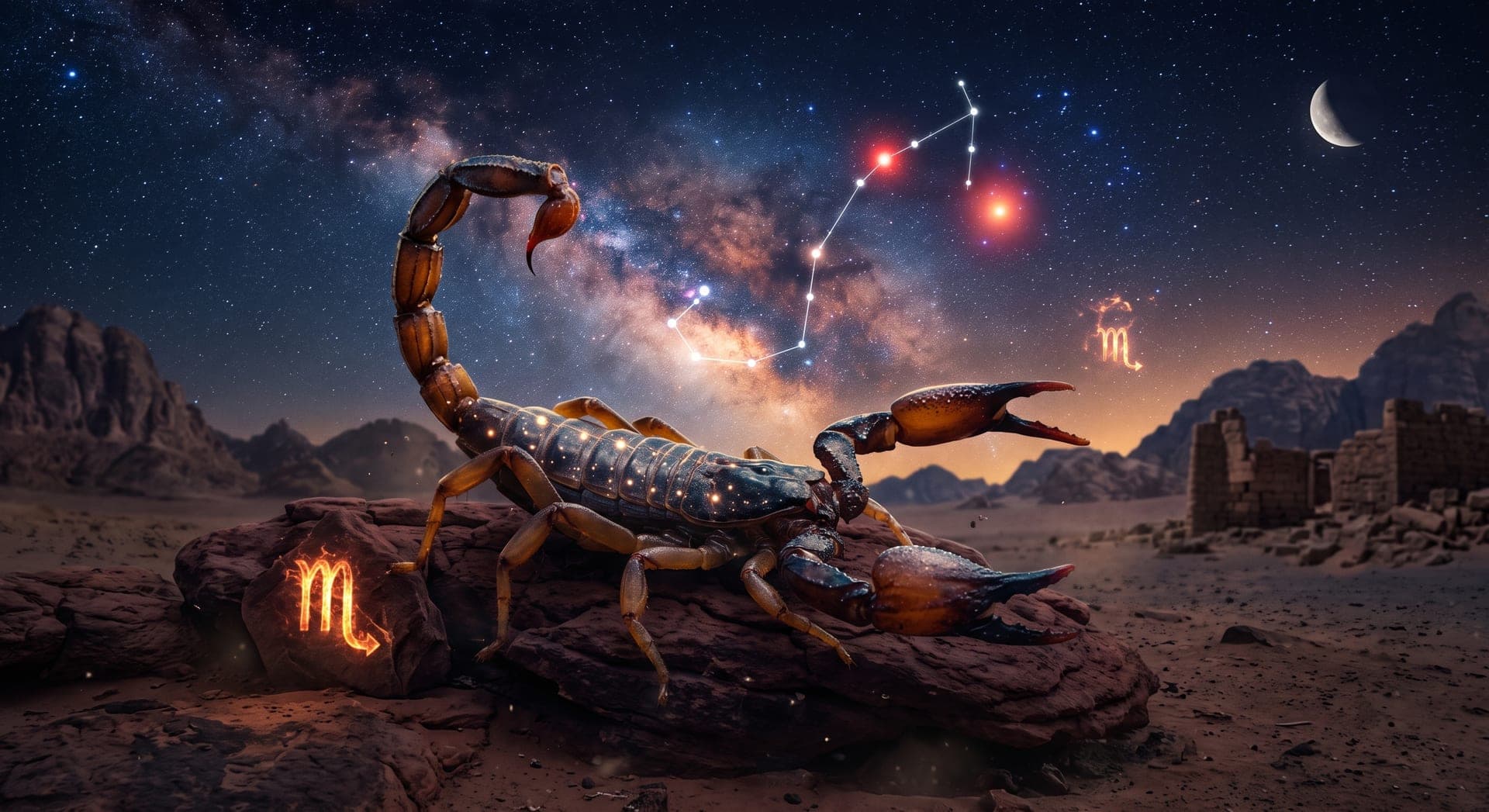
Scorpio, the eighth sign of the zodiac, spans October 23 to November 21 and is symbolized by the scorpion, a creature known for its defensive intensity and the sting it delivers when provoked. Traditionally ruled by Mars and, in modern astrology, by Pluto, the planet of transformation and the underworld, Scorpio carries a reputation as one of the most intense and emotionally powerful signs of the zodiac. As a Water sign, Scorpio experiences the world through deep, often hidden, emotion, guarding its inner life carefully while remaining acutely perceptive of others. Its Fixed modality gives Scorpio remarkable determination and resilience, able to endure hardship and pursue long-term goals with singular focus. People born under this sign are often drawn to work involving psychology, investigation, transformation, or anything requiring the ability to see beneath the surface. Scorpio's loyalty and passion run deep for those it trusts, but that same intensity can curdle into jealousy, suspicion, or an unwillingness to forgive when trust is broken.
Personality Traits
Strengths
- Deeply passionate and determined
- Fiercely loyal to those they trust
- Resourceful and strategic
- Highly perceptive
- Emotionally resilient
Weaknesses
- Prone to jealousy and possessiveness
- Secretive and guarded
- Can be vindictive when wronged
- Distrustful of others
- Prone to obsessiveness
Compatible Signs
Fun Facts
- Scorpio's scorpion symbol connects to the Greek myth of the scorpion sent by Gaia to kill the hunter Orion, with both later placed among the stars.
- Scorpio has two ruling planets: Mars in traditional astrology, and Pluto, discovered in 1930, in the modern system.
- Scorpio is often mistakenly grouped with the Fire signs due to its intensity, but it is actually a Water sign, driven by deep emotion rather than raw aggression.
- Notable Scorpios include Pablo Picasso, Marie Curie, Leonardo DiCaprio, and Hillary Clinton.
- Some astrological traditions associate Scorpio with a secondary, more elevated symbol, the eagle or phoenix, representing transformation and rebirth.
Born on October 23
- 1844
Robert Bridges
English poet who served as Poet Laureate and was a close friend and editor of Gerard Manley Hopkins
- 1922
Jean Barker, Baroness Trumpington
English politician and government minister known for her sharp wit in the House of Lords
- 1925
Johnny Carson
American late-night television host
- 1931
Diana Dors
English actress often described as Britain's answer to Marilyn Monroe
- 1936
Charles Goodhart
English economist known for Goodhart's Law on the behaviour of statistical measures used as policy targets
- 1940
Pele
Brazilian footballer widely regarded as among the greatest of all time
- 1942
Michael Crichton
American author of "Jurassic Park"
- 1942
Douglas Dunn
Scottish poet known for collections including Elegies, written after the death of his wife
- 1942
Anita Roddick
English businesswoman who founded The Body Shop and championed ethical consumerism
- 1945
Maggi Hambling
English painter and sculptor known for public works including the Scallop memorial to Benjamin Britten
- 1954
Ang Lee
Taiwanese-American film director
- 1956
Dwight Yoakam
American country singer
- 1959
"Weird Al" Yankovic
American parody musician
- 1976
Ryan Reynolds
Canadian actor
- 1986
Emilia Clarke
English actress known for "Game of Thrones"
On This Day in History
- 42 BCE
Mark Antony and Octavian defeat Brutus's forces in the second phase of the Battle of Philippi, ending the Liberators' civil war.
In the concluding engagement of the Battle of Philippi, Mark Antony and Octavian's forces finally overwhelmed Brutus's remaining troops, and Brutus took his own life rather than face capture, extinguishing the last significant senatorial resistance to the Second Triumvirate following Julius Caesar's assassination two years earlier.
- 425
Valentinian III becomes Western Roman emperor at just six years old.
Following the death of his father Constantius III, the young Valentinian III was installed as Western Roman Emperor under the regency of his mother, Galla Placidia, beginning a reign during which real power was frequently exercised by powerful military commanders rather than the emperor himself.
- 1086
Almoravid forces defeat Castilian troops at the Battle of Sagrajas during the Spanish Reconquista.
Almoravid forces from North Africa, summoned by Muslim rulers in Spain specifically to counter recent Christian territorial advances, decisively defeated a Castilian army led by King Alfonso VI at Sagrajas near Badajoz. The victory temporarily halted Christian momentum in the Reconquista and established significant Almoravid military and political influence over Muslim-controlled portions of the Iberian Peninsula for the following decades.
- 1295
Scotland and France formally sign the Auld Alliance, a mutual defence treaty aimed at containing English power.
Negotiated between King John Balliol of Scotland and King Philip IV of France, the treaty bound each nation to support the other militarily if attacked by England. It marked the beginning of a long-lasting diplomatic relationship that was periodically renewed for centuries and shaped Scottish and English politics well into the early modern period, giving Scotland a continental counterweight to its powerful southern neighbour.
- 1448
Scotland defeats England at the Battle of Sark, among the last major pitched battles between the kingdoms in the medieval period.
Scottish forces achieved a rare pitched-battle victory over England at Sark near the border, one of the last major formal battles fought between the two kingdoms before centuries of more sporadic border conflict eventually gave way to the peaceful union of their crowns.
- 1448
Scottish forces defeat an invading English army at the Battle of Sark, near the present-day border with England.
Fought along the River Sark during a period of intermittent Anglo-Scottish conflict, the battle saw Scottish forces under Hugh Douglas rout an English raiding army, inflicting heavy casualties. The victory temporarily strengthened Scotland's position along the volatile border region and became a notable, if lesser-known, episode in the long history of medieval warfare between the two kingdoms.
- 1520
Charles V receives the title of Holy Roman Emperor.
Charles V, who had already been elected King of the Romans in Frankfurt the previous year, received the imperial crown in a coronation ceremony at Aachen Cathedral, formally assuming the title of Holy Roman Emperor-elect and uniting his vast inherited Habsburg, Spanish, and Burgundian territories under a single ruler. His resulting domains, famously described as an empire 'on which the sun never set,' made him the most powerful monarch in Europe, though governing such a sprawling, religiously divided realm posed immense challenges throughout his reign.
- 1642
The Battle of Edgehill initiates the English Civil War.
Royalist and Parliamentarian forces clashed inconclusively at Edgehill in the first major battle of the English Civil War, a conflict that ultimately led to the execution of King Charles I and a temporary abolition of the English monarchy under Oliver Cromwell.
- 1642
The Battle of Edgehill, the first major engagement of the English Civil War, is fought between Royalist and Parliamentarian forces.
Fought in Warwickshire, the battle pitted King Charles I's Royalist army against Parliamentarian forces under the Earl of Essex. Though tactically inconclusive, with both sides claiming victory and heavy casualties on each, it signalled that the political crisis between king and Parliament had become full-scale war, opening a conflict that would ultimately lead to Charles's execution and years of republican rule.
- 1666
An intense tornado, later estimated at F4 strength, tears through Lincolnshire, England, with winds thought to have exceeded 200 miles per hour.
The storm devastated the town of Wisbech and surrounding areas, flattening buildings and killing livestock across the low-lying Fens region. Reconstructed from historical accounts by modern meteorologists, the Lincolnshire tornado is considered one of the most powerful ever recorded in the United Kingdom, a country where such violent tornadoes are exceptionally rare.
- 1707
The first Parliament of Great Britain convenes at Westminster following the Acts of Union merging England and Scotland.
The new Parliament combined the former separate legislatures of England and Scotland into a single body governing the newly created Kingdom of Great Britain, formed by the Acts of Union earlier that year. Scottish representatives took their seats at Westminster for the first time, marking a constitutional transformation that laid the institutional foundation for the modern United Kingdom.
- 1856
British naval forces launch an assault on the Barrier Forts near Guangzhou during the opening clashes of the Second Opium War.
The attack followed the Arrow Incident, in which Chinese authorities boarded a Hong Kong-registered ship suspected of piracy, giving Britain a pretext to press its demands for expanded trading rights in China. British warships bombarded and stormed the fortified positions guarding the approach to Guangzhou, opening a conflict that would end with further concessions forced upon the Qing dynasty.
- 1868
Emperor Meiji proclaims the start of Japan's new era after establishing his capital at Edo, renamed Tokyo.
Following the overthrow of the centuries-old Tokugawa shogunate the previous year, the young Emperor Meiji relocated the imperial capital from the traditional city of Kyoto to Edo, which was subsequently renamed Tokyo, meaning "eastern capital." The move symbolically marked the beginning of the Meiji era's rapid modernization program, transforming Japan from an isolated feudal society into a centralized, industrializing nation-state within just a few decades.
- 1906
Alberto Santos-Dumont completes the first officially witnessed heavier-than-air flight in Europe.
Brazilian aviator Alberto Santos-Dumont flew his 14-bis aircraft a short distance before witnesses near Paris, an achievement celebrated in Europe as the continent's first officially documented powered flight, occurring several years after the Wright brothers' less publicly verified flights in the United States.
- 1942
The Second Battle of El Alamein begins, a major turning point in the North African campaign of World War II.
British Commonwealth forces under General Bernard Montgomery launched a massive offensive against German and Italian positions at El Alamein in Egypt, a battle that proved decisive in halting Axis advances toward the Suez Canal and marked a significant turning point in the North African campaign.
- 1944
The Battle of Leyte Gulf, the largest naval battle of the Second World War, begins in the Philippines.
Fought across several distinct engagements over four days, the battle pitted the US Navy against a much-depleted Imperial Japanese Navy attempting to disrupt the American invasion of the Philippines. The battle saw the first organised kamikaze attacks and ended in a decisive American victory that effectively destroyed Japan's ability to conduct further major fleet operations for the rest of the war.
- 1945
Jackie Robinson signs a contract with the Montreal Royals, breaking the modern colour barrier in professional baseball.
The move, orchestrated by Brooklyn Dodgers executive Branch Rickey, placed Robinson with the Dodgers' top minor-league affiliate ahead of his historic 1947 debut in the major leagues. The signing set in motion the integration of American professional baseball, a milestone that reverberated well beyond sport and became an early landmark of the postwar civil rights movement.
- 1983
A truck bomb devastates a U.S. Marine barracks in Beirut, Lebanon, killing 241 military personnel.
A suicide truck bomber detonated an explosive-laden vehicle at a U.S. Marine barracks in Beirut, Lebanon, killing 241 American service members in the deadliest single-day loss of Marine Corps life since World War II, an attack that prompted the eventual withdrawal of American peacekeeping forces from Lebanon.
- 1993
A Provisional IRA bomb detonates prematurely in a fish shop on Belfast's Shankill Road, killing ten people including one of the bombers.
The device, intended for a meeting of loyalist paramilitary leaders believed to be above the shop, exploded early, killing nine civilians and one of the two IRA members who planted it. The attack, among the deadliest single incidents of the Troubles, provoked widespread revulsion and was followed by loyalist reprisal killings within days, deepening the cycle of violence in Northern Ireland.
- 2001
Apple Computer releases the first iPod, transforming the portable music player market.
Apple introduced the first iPod, a compact digital music player capable of storing a thousand songs on a small internal hard drive, marketed with the memorable slogan "1,000 songs in your pocket." The device transformed how people purchased, organized, and listened to music, and its runaway commercial success helped establish Apple's broader resurgence as a dominant force in consumer technology and digital media.
- 2001
Apple releases the first iPod, a portable digital music player that would transform how people bought and listened to music.
Small enough to fit in a pocket yet able to store a thousand songs, the device combined a simple click-wheel interface with a design that set it apart from earlier MP3 players. Paired a few years later with the iTunes Store, the iPod helped drive a broader shift away from physical music formats and reestablished Apple as a dominant force in consumer technology.