What’s Observed on October 22
Born on October 22: Libra ♎
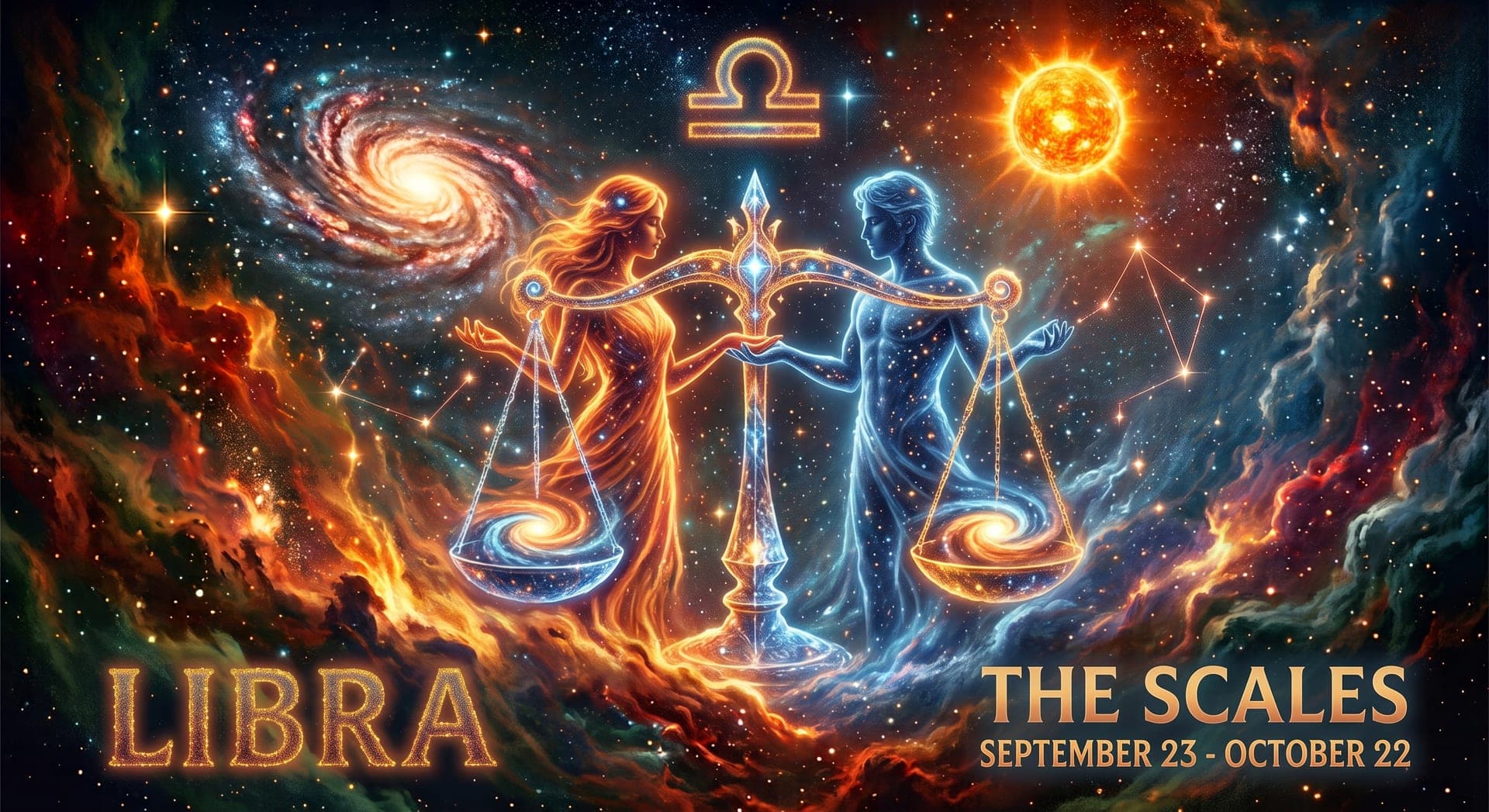
Libra, the seventh sign of the zodiac, spans September 23 to October 22 and is symbolized by the scales, the only zodiac symbol representing an inanimate object rather than a living creature, reflecting the sign's deep concern with balance, fairness, and justice. Ruled by Venus, the planet of love and beauty, Libra shares Taurus's appreciation for aesthetics and pleasure but channels it primarily through relationships, partnership, and social harmony. As an Air sign, Libra approaches the world intellectually and socially, valuing thoughtful conversation and diplomatic problem-solving over confrontation. Its Cardinal modality places it at the very start of autumn, beginning right at the equinox when day and night briefly achieve perfect balance. People born under this sign are often natural mediators, drawn to fairness and equilibrium in their relationships and surroundings, sometimes to the point of struggling to make decisions that might upset that balance. Libra's charm, diplomacy, and genuine desire to see all sides of an issue make it a valued friend and partner, even as its conflict-avoidance can occasionally leave real problems unresolved.
Personality Traits
Strengths
- Strong sense of fairness and justice
- Diplomatic peacemaker
- Charming and sociable
- Appreciates beauty and harmony
- Excellent at seeing multiple perspectives
Weaknesses
- Notoriously indecisive
- Conflict-avoidant to a fault
- Can be superficial
- People-pleasing tendencies
- Struggles with confrontation
Compatible Signs
Fun Facts
- Libra is the only zodiac sign represented by an inanimate object, the scales, rather than an animal or person.
- Libra's scales symbolize balance and justice, echoing the sign's association with fairness, harmony, and diplomacy.
- Venus, Libra's ruling planet, gives the sign its love of beauty, art, and romantic partnership, similar to Taurus but expressed through relationships rather than material comfort.
- As a Cardinal sign, Libra initiates autumn, beginning at the September equinox, when day and night are of equal length, fitting for a sign obsessed with balance.
- Notable Libras include Mahatma Gandhi, Kim Kardashian, John Lennon, and Will Smith.
Born on October 22
- 1811
Franz Liszt
Hungarian composer and virtuoso pianist
- 1844
Sarah Bernhardt
French stage actress
- 1870
Ivan Bunin
Russian author and Nobel laureate
- 1870
Lord Alfred Douglas
English poet best remembered for his close relationship with Oscar Wilde
- 1907
Jimmie Foxx
American Major League Baseball player
- 1920
Timothy Leary
American psychologist known for psychedelic drug advocacy
- 1921
Georges Brassens
French singer-songwriter
- 1938
Derek Jacobi
English actor celebrated for stage Shakespeare and television roles including I, Claudius
- 1939
George Cohen
English footballer who won the 1966 World Cup with England
- 1943
Catherine Deneuve
French actress
- 1946
Kelvin MacKenzie
English journalist who edited The Sun during its most controversial and highest-circulation years
- 1952
Jeff Goldblum
American actor
- 1965
A. L. Kennedy
Scottish novelist and comedian known for darkly comic literary fiction
- 1967
Oona King
British Labour politician who served as a Member of Parliament for Bethnal Green and Bow
- 1972
Saffron Burrows
English actress known for film and television roles including Troy and Law & Order: UK
On This Day in History
- 451
The Council of Chalcedon adopts the Chalcedonian Creed addressing the nature of Christ.
Church leaders gathered at Chalcedon formally adopted a creed articulating that Christ possessed two distinct natures, fully divine and fully human, united in one person, a doctrinal statement accepted by most Christian traditions but rejected by several Oriental Orthodox churches, creating a theological division that persists today.
- 1721
Peter the Great proclaims the Russian Empire following Russia's victory in the Great Northern War.
Following Russia's decisive victory over Sweden in the prolonged Great Northern War, Tsar Peter the Great assumed the title of Emperor of All Russia, formally transforming the Russian state into an empire and marking Russia's emergence as a major European power.
- 1746
The College of New Jersey, later renamed Princeton University, receives its royal charter.
King George II of Britain granted a royal charter establishing the College of New Jersey, an institution founded to train Presbyterian ministers that later relocated to the town of Princeton and was eventually renamed Princeton University, becoming one of America's most prestigious universities.
- 1797
Andre-Jacques Garnerin executes the first recorded parachute jump, descending from a balloon over Paris.
French balloonist Andre-Jacques Garnerin descended from a hydrogen balloon over Paris using a parachute of his own design, completing what is widely credited as the first successful parachute jump from significant altitude, a daring demonstration of an entirely new technology for descending safely from the sky.
- 1836
Sam Houston is inaugurated as the first President of the Republic of Texas.
Sam Houston, who had led Texan forces to victory over Mexican General Santa Anna at the decisive Battle of San Jacinto, was inaugurated as the first president of the newly independent Republic of Texas, which existed as a sovereign nation for nearly a decade before joining the United States.
- 1877
An underground explosion at the Blantyre colliery in Scotland kills 207 miners in Britain's worst mining disaster.
The blast tore through two pits at High Blantyre, south of Glasgow, at the start of the morning shift, filling the workings with choking afterdamp gas. Many of the dead were teenage boys employed alongside their fathers, and the disaster left over 90 widows and hundreds of fatherless children. It remains the deadliest coal mining accident in Scottish history and helped spur later reforms to mine safety inspection.
- 1879
Thomas Edison successfully tests an improved incandescent light bulb using carbonized thread, which burns for over 13 hours.
After extensive experimentation with hundreds of different filament materials sourced from around the world, Thomas Edison and his team at Menlo Park successfully tested a carbonized cotton thread filament that burned steadily for over thirteen hours inside a vacuum-sealed glass bulb. This crucial breakthrough demonstrated that commercially practical, long-lasting incandescent electric lighting was genuinely achievable, setting the stage for its rapid subsequent commercialization.
- 1883
The Metropolitan Opera House opens in New York City with a performance of Gounod's "Faust."
New York's Metropolitan Opera House opened its doors for the first time with a performance of Charles Gounod's "Faust," establishing what became one of the world's premier opera companies and a defining institution of American classical music and performing arts.
- 1884
Delegates at the International Meridian Conference vote to designate the meridian passing through Greenwich, England, as the world's prime meridian.
Meeting in Washington, D.C., representatives from 25 nations selected the line running through the Royal Observatory in Greenwich as the zero-degree reference point for global longitude and timekeeping, largely because it was already used on the majority of the world's nautical charts. The decision cemented Greenwich's place at the centre of international navigation and gave rise to Greenwich Mean Time as a global time standard.
- 1910
Hawley Harvey Crippen is convicted at the Old Bailey of murdering his wife, in one of the most sensational criminal trials in British history.
Crippen, an American-born doctor living in London, had fled to Canada with his mistress disguised as a boy after his wife's disappearance, but was identified by an alert ship's captain who alerted authorities by wireless telegraph, allowing Scotland Yard detectives to intercept him before he landed. The case was the first murder investigation solved with the help of radio communication and became a landmark of early twentieth-century British criminal history.
- 1936
English trawler skipper Dod Orsborne is convicted after secretly sailing his boat, the Girl Pat, across the Atlantic without authorisation.
Orsborne had taken the Grimsby-registered trawler on an unauthorised transatlantic voyage that captured huge public attention in Britain, with newspapers following the vessel's disappearance and eventual discovery off West Africa. Though officially charged over the theft of the boat, the escapade turned Orsborne into something of a folk anti-hero, and the case became one of the more colourful maritime scandals of interwar Britain.
- 1943
The Royal Air Force carries out a devastating night raid on the German city of Kassel, killing around 10,000 people and displacing 150,000 more.
The attack, part of the Allied strategic bombing campaign against German industry, created a firestorm that destroyed much of Kassel's historic centre and its Henschel armaments works. It ranks among the deadliest single air raids of the war in terms of civilian casualties, comparable in scale to the later, more widely remembered bombing of Dresden.
- 1962
President Kennedy publicly announces the discovery of Soviet nuclear missiles in Cuba, escalating the missile crisis.
President Kennedy addressed the American public in a televised speech revealing the presence of Soviet nuclear missile installations in Cuba and announcing a naval blockade of the island, publicly escalating what became the most dangerous nuclear confrontation of the Cold War.
- 1962
President John F. Kennedy addresses the American public to announce the discovery of Soviet nuclear missile installations in Cuba.
The televised address revealed photographic evidence gathered by U-2 spy planes and announced a naval quarantine of the island, publicly opening the tensest phase of the Cuban Missile Crisis. The confrontation brought the United States and Soviet Union closer to nuclear war than at any other point in the Cold War before a resolution was reached days later.
- 1963
The prototype British Aircraft Corporation One-Eleven airliner crashes during stall tests, killing all seven people on board.
The jet entered an unrecoverable deep stall during trials near Chicklade, Wiltshire, a previously little-understood aerodynamic hazard for its rear-engined, T-tailed design. The crash led to significant changes in stall-recovery systems fitted to the One-Eleven and influenced the design of other rear-engined jets that followed, even as the aircraft went on to become a commercial success for Britain's aviation industry.
- 1975
The Soviet probe Venera 9 becomes the first spacecraft to transmit images from the surface of another planet.
After descending through Venus's crushing atmosphere, the lander survived the planet's extreme heat and pressure for less than an hour, long enough to relay black-and-white photographs of a rocky, sunlit landscape back to Earth. The mission was a major milestone in the Soviet Union's ambitious programme of planetary exploration during the Cold War space race.
- 2008
India launches Chandrayaan-1, its first uncrewed lunar probe mission.
India successfully launched Chandrayaan-1, its first mission to the Moon, aboard a domestically built rocket from the Satish Dhawan Space Centre. The uncrewed orbiter went on to make significant scientific discoveries, including compelling evidence of water molecules on the lunar surface, establishing India as a serious and increasingly capable presence in international space exploration alongside more established spacefaring nations.
- 2008
India launches its first lunar probe, Chandrayaan-1, marking the country's entry into deep space exploration.
Lifting off from the Satish Dhawan Space Centre, the unmanned orbiter carried instruments from several countries and went on to help confirm the presence of water molecules on the Moon's surface, a discovery that reshaped scientific understanding of lunar composition. The mission established India as a serious player in international space exploration.
- 2014
A gunman attacks Canada's Parliament in Ottawa, killing a ceremonial guard before being stopped.
A lone gunman fatally shot a ceremonial guard at Canada's National War Memorial before storming the nearby Parliament building, where he was ultimately shot and killed by security forces, an attack that prompted significant reviews of security procedures at Canadian government facilities.
- 2019
Same-sex marriage and abortion are decriminalised in Northern Ireland after Westminster legislation takes effect at midnight.
The changes followed years of campaigning after Northern Ireland's devolved assembly, suspended since 2017, failed to legislate on either issue, prompting the UK Parliament to step in directly. The reforms brought Northern Ireland's laws into closer alignment with the rest of the United Kingdom, where same-sex marriage had already been legal for several years and abortion law had been liberalised earlier.