What’s Observed on October 21
Born on October 21: Libra ♎
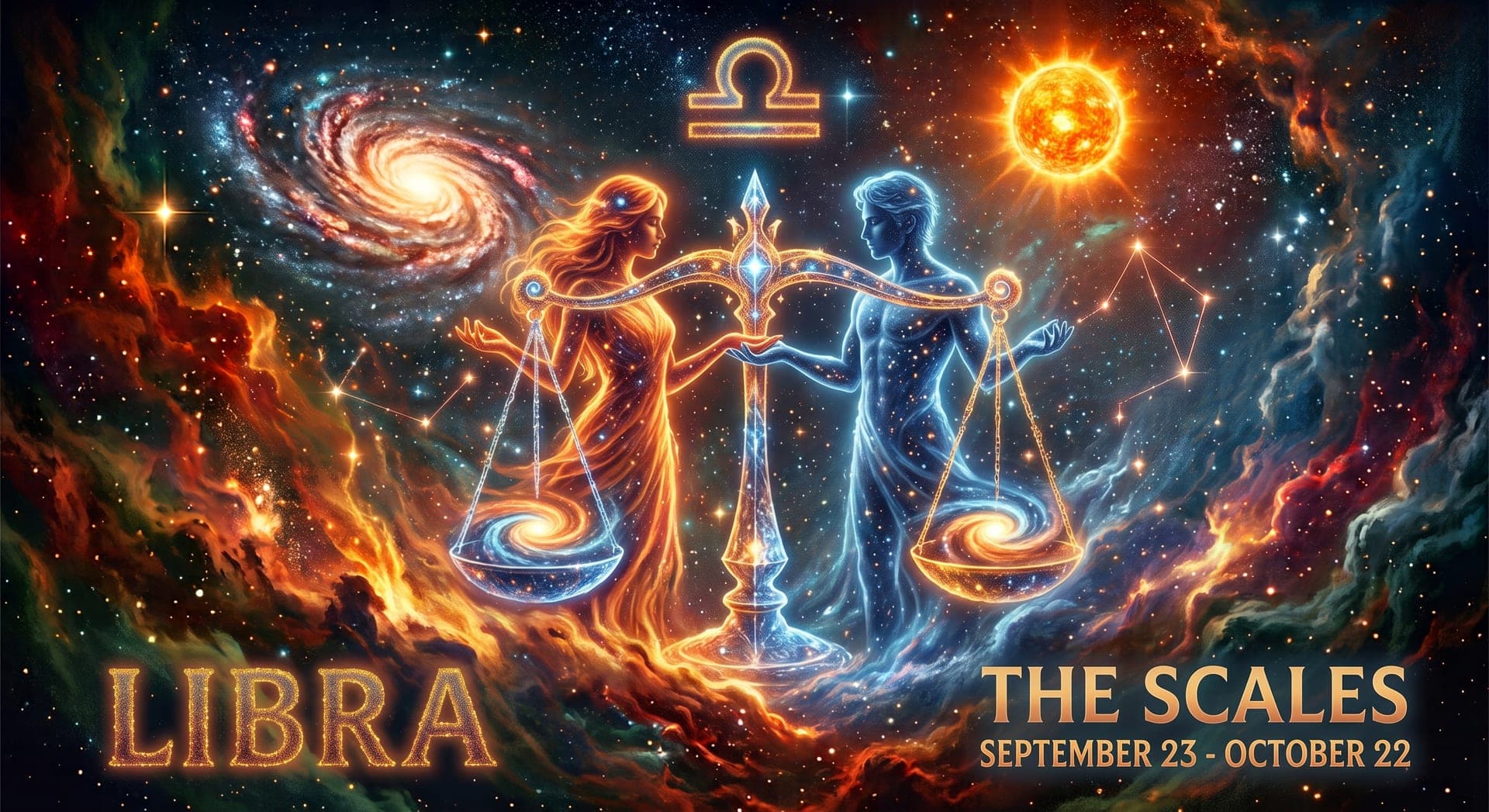
Libra, the seventh sign of the zodiac, spans September 23 to October 22 and is symbolized by the scales, the only zodiac symbol representing an inanimate object rather than a living creature, reflecting the sign's deep concern with balance, fairness, and justice. Ruled by Venus, the planet of love and beauty, Libra shares Taurus's appreciation for aesthetics and pleasure but channels it primarily through relationships, partnership, and social harmony. As an Air sign, Libra approaches the world intellectually and socially, valuing thoughtful conversation and diplomatic problem-solving over confrontation. Its Cardinal modality places it at the very start of autumn, beginning right at the equinox when day and night briefly achieve perfect balance. People born under this sign are often natural mediators, drawn to fairness and equilibrium in their relationships and surroundings, sometimes to the point of struggling to make decisions that might upset that balance. Libra's charm, diplomacy, and genuine desire to see all sides of an issue make it a valued friend and partner, even as its conflict-avoidance can occasionally leave real problems unresolved.
Personality Traits
Strengths
- Strong sense of fairness and justice
- Diplomatic peacemaker
- Charming and sociable
- Appreciates beauty and harmony
- Excellent at seeing multiple perspectives
Weaknesses
- Notoriously indecisive
- Conflict-avoidant to a fault
- Can be superficial
- People-pleasing tendencies
- Struggles with confrontation
Compatible Signs
Fun Facts
- Libra is the only zodiac sign represented by an inanimate object, the scales, rather than an animal or person.
- Libra's scales symbolize balance and justice, echoing the sign's association with fairness, harmony, and diplomacy.
- Venus, Libra's ruling planet, gives the sign its love of beauty, art, and romantic partnership, similar to Taurus but expressed through relationships rather than material comfort.
- As a Cardinal sign, Libra initiates autumn, beginning at the September equinox, when day and night are of equal length, fitting for a sign obsessed with balance.
- Notable Libras include Mahatma Gandhi, Kim Kardashian, John Lennon, and Will Smith.
Born on October 21
- 1772
Samuel Taylor Coleridge
English poet and critic, co-founder of the Romantic movement and author of The Rime of the Ancient Mariner
- 1833
Alfred Nobel
Swedish inventor of dynamite and founder of the Nobel Prize
- 1868
Ernest Swinton
English army officer credited with pioneering the development of the tank
- 1917
Dizzy Gillespie
American jazz trumpeter
- 1921
Malcolm Arnold
English composer known for his symphonies and film scores, including The Bridge on the River Kwai
- 1925
Celia Cruz
Cuban-American singer
- 1926
Leonard Rossiter
English actor celebrated for his comic roles in Rising Damp and The Fall and Rise of Reginald Perrin
- 1940
Geoffrey Boycott
English cricketer and later broadcaster, one of the most prolific opening batsmen of his era
- 1944
Mandy Rice-Davies
Welsh model whose testimony during the 1963 Profumo affair made her a household name
- 1949
Benjamin Netanyahu
Prime Minister of Israel
- 1953
Peter Mandelson
English Labour politician and key architect of New Labour who later became a European Commissioner
- 1956
Carrie Fisher
American actress known for playing Princess Leia
- 1980
Kim Kardashian
American media personality and businesswoman
- 1995
Doja Cat
American rapper and singer
On This Day in History
- 1094
El Cid defeats Almoravid forces at the Battle of Cuarte during the Spanish Reconquista.
The Castilian military leader known as El Cid, fighting sometimes for Christian and sometimes for Muslim rulers during his complex career, defeated an Almoravid army at Cuarte near Valencia, helping secure his control over the city, which he governed as an independent ruler until his death.
- 1097
Crusader leaders begin the Siege of Antioch during the First Crusade.
Crusader armies advancing toward Jerusalem during the First Crusade began a prolonged siege of the heavily fortified city of Antioch, a grueling campaign lasting many months that tested the Crusaders' resolve through starvation and disease before their eventual dramatic capture of the city.
- 1600
Tokugawa Ieyasu defeats rival Japanese clans at the Battle of Sekigahara, paving his path to becoming shogun.
Tokugawa Ieyasu's forces decisively defeated a coalition of rival Japanese warlords at Sekigahara in one of the largest and most consequential battles in Japanese history, a victory that paved the way for Ieyasu's establishment of the Tokugawa shogunate, which governed Japan for the following two and a half centuries.
- 1797
The frigate USS Constitution is launched in Boston Harbor.
One of the U.S. Navy's original six frigates, the USS Constitution, was launched in Boston, later earning the nickname "Old Ironsides" for its resilience in battle during the War of 1812 and remaining in commission today as the world's oldest floating commissioned naval vessel.
- 1805
A British fleet led by Lord Nelson defeats a combined French and Spanish fleet at the Battle of Trafalgar.
A British fleet commanded by Lord Nelson decisively destroyed a combined French and Spanish fleet off Spain's Cape Trafalgar, securing lasting British naval supremacy for the remainder of the Napoleonic Wars, though Nelson himself was mortally wounded during the battle and died shortly after learning of the victory.
- 1805
A British fleet under Vice-Admiral Lord Nelson destroys a combined French and Spanish fleet at the Battle of Trafalgar off the coast of Spain.
Nelson's 27 ships broke the enemy line in two columns, a bold tactic that overwhelmed the 33-ship Franco-Spanish fleet under Admiral Villeneuve. The British lost no ships, while the enemy lost 22, though Nelson himself was fatally wounded by a French sniper during the battle and died shortly after learning of victory. Trafalgar secured British naval supremacy for the rest of the Napoleonic Wars and ended any prospect of a French invasion of Britain.
- 1824
English bricklayer Joseph Aspdin patents Portland cement, the binding material that would become the foundation of modern construction.
Aspdin, working in Leeds, developed a process of burning limestone and clay together and grinding the result into a fine powder, producing a stronger and more durable cement than earlier formulations. He named it after the prized building stone quarried on the Isle of Portland, whose grey colour his cement resembled. Portland cement went on to become the most widely used construction material in the world.
- 1854
Florence Nightingale departs for the Crimean War with a team of nurses, work that would transform the practice of modern nursing.
Responding to reports of appalling conditions in British military hospitals, Nightingale led 38 volunteer nurses to Scutari, near Constantinople, to care for wounded soldiers. Her insistence on hygiene and sanitation dramatically reduced death rates among patients. Her wartime experience and subsequent writings established nursing as a respectable profession and laid the foundations for modern hospital administration in Britain.
- 1879
Thomas Edison and his team successfully test a carbonized cotton-thread filament in an incandescent light bulb at Menlo Park.
After months of experimenting with hundreds of filament materials, Thomas Edison and his team at Menlo Park achieved a breakthrough when a carbonized cotton-thread filament, sealed inside a vacuum glass bulb, glowed steadily for hours, a result confirmed and extended the following day when the same design burned for more than thirteen hours. October 21 is popularly remembered as the birthdate of Edison's practical incandescent light bulb, though his patent application for the design was not formally filed until several weeks later, on November 4, 1879.
- 1879
Thomas Edison applies for a US patent on his incandescent light bulb, days after achieving a bulb that burned for over thirteen hours.
Edison's Menlo Park laboratory had spent months testing filament materials before settling on a carbonised thread that offered a practical, long-lasting glow. The patent application formalised a breakthrough that would make electric lighting commercially viable, and Edison's Edison Electric Light Company went on to bring electric illumination into homes and streets across the United States and beyond within a decade.
- 1892
Dedication ceremonies open the World's Columbian Exposition in Chicago, commemorating the 400th anniversary of Columbus's arrival in the Americas.
Although the fairgrounds would not officially open to the public until the following May, the October dedication ceremony drew huge crowds to Jackson Park. The exposition's gleaming, neoclassical 'White City' showcased American industrial and cultural achievement, introduced visitors to novelties such as the Ferris wheel, and profoundly influenced American architecture and urban planning for decades afterward.
- 1910
HMS Niobe arrives in Halifax as the first ship of the newly formed Royal Canadian Navy, a gift from Britain's Royal Navy.
The cruiser, transferred from the Royal Navy along with HMCS Rainbow on the Pacific coast, marked Canada's first independent naval force separate from direct British command. The move reflected Britain's gradual devolution of imperial defence responsibilities to its dominions in the years before the First World War, while the two navies continued to train and operate closely together.
- 1959
The Solomon R. Guggenheim Museum opens to the public in New York City.
Frank Lloyd Wright's distinctive spiral-shaped museum building, featuring a continuous ramp gallery winding upward around an open central atrium, opened in New York City to house Solomon Guggenheim's modern art collection. The architecturally groundbreaking design, completed shortly after Wright's death, proved itself as celebrated and controversial as the abstract artworks displayed within its unconventional, curving gallery spaces.
- 1959
The Solomon R. Guggenheim Museum, designed by Frank Lloyd Wright, opens in New York City.
Wright's distinctive spiral building, with galleries arranged along a continuous ramp, was completed just months after the architect's death and became instantly controversial for its unconventional design. Despite early criticism from artists who felt the curved walls were unsuited to displaying paintings, the museum became one of the twentieth century's most celebrated works of architecture and a landmark of Manhattan's Upper East Side.
- 1966
A coal waste tip collapses onto a school in Aberfan, Wales, killing 144 people, mostly children.
A colliery spoil tip destabilized by heavy rain slid down a hillside in the Welsh village of Aberfan, engulfing a primary school and nearby houses, killing 144 people including 116 children, a preventable tragedy that prompted major reforms to mining waste disposal safety regulations.
- 1966
A colliery spoil tip collapses onto the village of Aberfan in Wales, engulfing a school and houses and killing 144 people, mostly children.
Days of heavy rain destabilised a mountain of mining waste above the South Wales village, sending a wall of slurry down onto Pantglas Junior School just after the morning bell. A tribunal later found the National Coal Board responsible for ignoring known dangers of tipping on the site. The Aberfan disaster remains one of the deadliest tragedies in British history and led to lasting changes in mine waste safety regulation.
- 1971
A gas explosion destroys a block of flats in Clarkston, near Glasgow, killing 22 people in one of Scotland's worst peacetime disasters.
A leak from a fractured gas main seeped into the underground shopping precinct beneath the flats and ignited, flattening the structure in seconds during a busy Saturday afternoon. The Clarkston disaster prompted a public inquiry into gas main safety in Scotland and changes to how utility companies inspected ageing pipe networks beneath residential developments.
- 1984
Niki Lauda clinches his third Formula One Drivers' Championship title.
Austrian driver Niki Lauda secured his third Formula One World Championship, completing a remarkable comeback story following a horrific, near-fatal crash and severe burns he had suffered just a few years earlier, an achievement widely regarded as one of the most inspiring in motorsport history.
- 1994
North Korea and the United States sign the Agreed Framework, under which North Korea agreed to freeze its plutonium weapons programme.
Negotiated after months of tension over North Korea's nuclear activities, the agreement committed Pyongyang to halting and eventually dismantling its plutonium-producing reactors in exchange for two proliferation-resistant light-water reactors and interim fuel oil shipments. Though initially hailed as a breakthrough in nonproliferation diplomacy, the framework collapsed in the early 2000s amid mutual accusations of noncompliance.
- 2019
Canada's federal election concludes with Justin Trudeau's Liberal Party forming a minority government.
Canada's federal election resulted in Justin Trudeau's Liberal Party retaining power but losing its previous parliamentary majority, forming a minority government that required cooperation with opposition parties to pass legislation for the remainder of the term. The result reflected declining public support for Trudeau's government amid ongoing controversies, though voters ultimately stopped short of removing the Liberals from power entirely.