
What’s Observed on January 8
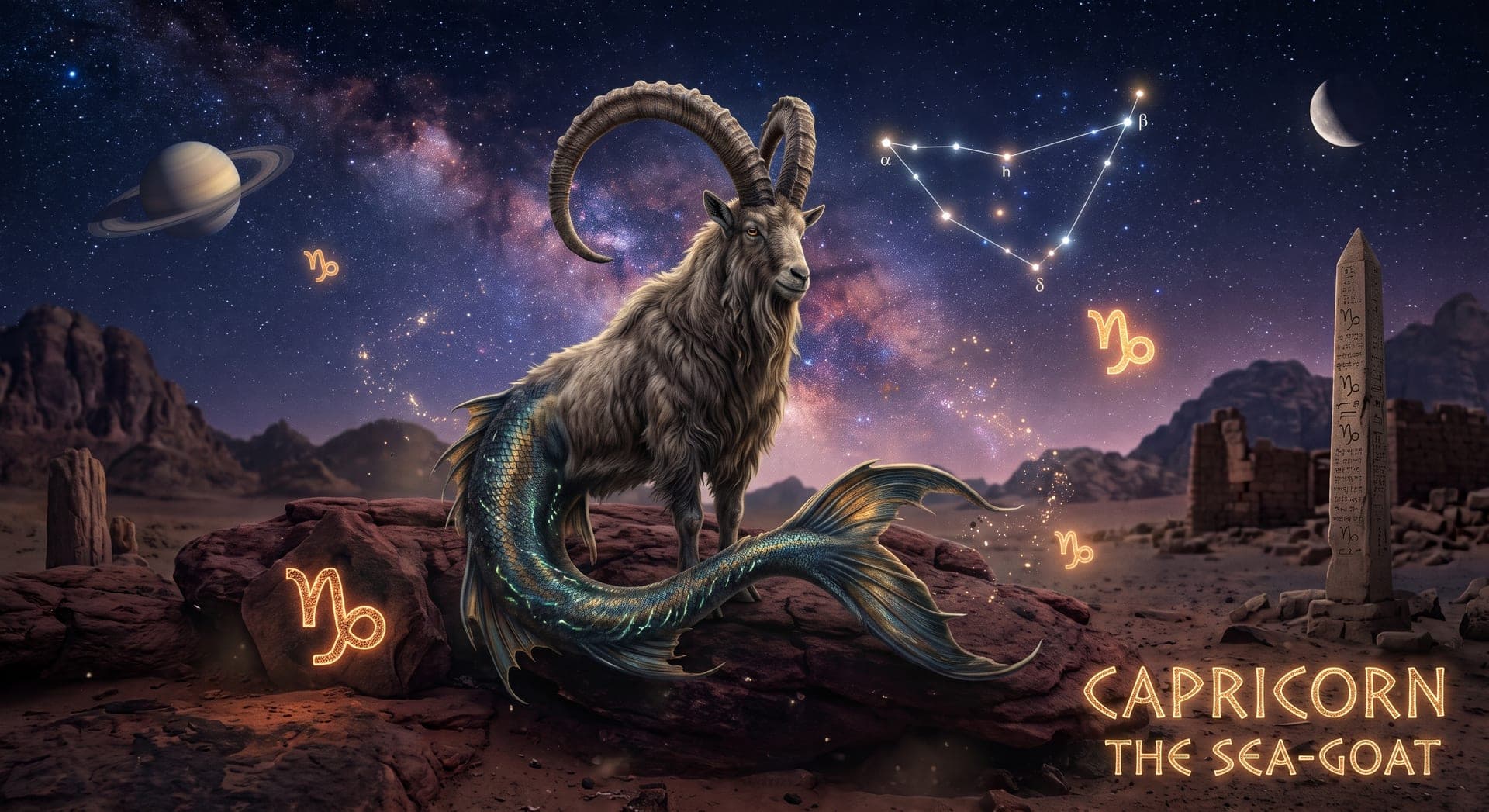
Born on January 8: Capricorn ♑
Capricorn, the tenth sign of the zodiac, spans December 22 to January 19 and is represented by the sea-goat, a mythical creature with the body of a goat and the tail of a fish, symbolizing an ability to navigate both the practical, earthly world and deeper emotional currents. Ruled by Saturn, the planet of discipline and time, Capricorns are often characterized as ambitious, patient, and deeply committed to long-term goals, willing to put in steady effort where others give up. As an Earth sign, Capricorn is grounded and practical, valuing tangible results and responsibility over impulsiveness. People born under this sign are frequently drawn to leadership and other structured pursuits where their organizational skills and work ethic can shine. Beneath a reserved, businesslike exterior, Capricorns are often said to carry a dry, understated sense of humor and a loyal, protective nature toward the people closest to them.
Personality Traits
Strengths
- Disciplined and self-controlled
- Responsible and dependable
- Excellent long-term planner
- Hardworking and persistent
- Good sense of humor once comfortable
Weaknesses
- Can be a know-it-all
- Unforgiving of mistakes, including their own
- Prone to pessimism
- Condescending toward those who don't work as hard
- Stubbornly resistant to changing plans
Compatible Signs
Fun Facts
- Capricorn's symbol, the sea-goat, comes from the Greek myth of Pan, who transformed his lower half into a fish tail to escape the monster Typhon while diving into the Nile.
- Saturn, Capricorn's ruling planet, was the Roman god of time, harvest, and generational structure, echoing the sign's association with patience and long-term thinking.
- Capricorn is one of only two zodiac signs represented by a hybrid creature, the other being Sagittarius, the centaur.
- Notable Capricorns include Michelle Obama, Martin Luther King Jr., Dolly Parton, LeBron James, and Isaac Newton.
- In traditional astrology, the winter solstice, the shortest day of the year, falls right at the start of Capricorn season in the Northern Hemisphere.
Born on January 8
- 1823
Alfred Russel Wallace
Welsh naturalist and biologist who independently developed a theory of evolution by natural selection alongside Charles Darwin
- 1824
Wilkie Collins
English novelist and playwright regarded as a pioneer of detective fiction, known for works including The Woman in White and The Moonstone
- 1885
John Curtin
Australian Prime Minister who led the country through World War II
- 1908
William Hartnell
English actor best known for originating the role of the Doctor in the television series Doctor Who
- 1935
Elvis Presley
American singer and actor, the "King of Rock and Roll"
- 1937
Shirley Bassey
Welsh singer famous for her powerful voice and recordings of James Bond theme songs including Goldfinger
- 1941
Graham Chapman
English actor and writer, a founding member of the comedy troupe Monty Python
- 1942
Junichiro Koizumi
Prime Minister of Japan known for major economic reforms
- 1942
Stephen Hawking
English theoretical physicist and author known for his work on black holes and cosmology, including the bestselling book A Brief History of Time
- 1947
David Bowie
English singer-songwriter and actor renowned for his musical innovation and reinvention across a decades-long career
- 1987
Cynthia Erivo
English actress and singer known for her Tony-winning performance in The Color Purple and film roles including Harriet and Wicked

On This Day in History
- 871
Æthelred of Wessex and his brother Alfred defeat a Viking army at the Battle of Ashdown.
The victory came just days after the same Anglo-Saxon forces had been defeated by the Danes at Reading, and it provided a rare and badly needed success against the invading Great Heathen Army. Alfred, who commanded a key portion of the West Saxon force, would become king himself later that year following his brother's death and eventually earn lasting fame as Alfred the Great.
- 1735
George Frideric Handel's opera Ariodante premieres at the Covent Garden theatre in London.
Composed for Handel's own opera company during a highly productive period in London, where the German-born composer had settled and become a naturalized British subject, Ariodante was written amid fierce rivalry with a competing opera company backed by the nobility. Though it fell out of the repertoire for two centuries, the opera has since been revived and is now considered one of Handel's finest works.
- 1746
Charles Edward Stuart, known as Bonnie Prince Charlie, occupies the town of Stirling during the Jacobite rising of 1745.
The occupation came as Jacobite forces retreated north after their advance into England had stalled, and they laid siege to Stirling Castle in an attempt to secure central Scotland. The rising, aimed at restoring the exiled Stuart dynasty to the British throne, ultimately collapsed months later at the Battle of Culloden, ending Jacobite hopes for good.
- 1806
The Dutch Cape Colony becomes the British Cape Colony after British forces defeat Dutch defenders at the Battle of Blaauwberg.
Britain seized the strategically vital colony at the southern tip of Africa to secure the sea route to India during the Napoleonic Wars, having briefly held it once before in the 1790s. British control was formalized in 1814 and laid the foundation for a colonial presence in southern Africa that would shape the region's history for the next century and a half.
- 1815
Andrew Jackson leads American forces to victory over the British at the Battle of New Orleans during the War of 1812.
Fought after a peace treaty had already been signed in Europe, though news had not yet crossed the Atlantic, Jackson's outnumbered but well-fortified forces inflicted devastating losses on the attacking British army. The lopsided victory made Jackson a national hero, propelling his political career toward the presidency, even though the battle had no actual bearing on the war's outcome.
- 1815
American forces under Andrew Jackson decisively defeat an invading British army at the Battle of New Orleans.
The battle was fought after the Treaty of Ghent had already been signed to end the War of 1812, though news had not yet reached the armies in the field. British troops suffered heavy casualties in a failed frontal assault on fortified American positions, and the lopsided defeat became a celebrated symbol of American resolve, even as it had no real bearing on the war's outcome.
- 1912
The African National Congress is founded in Bloemfontein, South Africa, as the South African Native National Congress.
Founded to unite Black South Africans in opposition to discriminatory laws under British colonial and later Union rule, the organization became the leading force in the struggle against apartheid over the following decades. It was banned by the South African government in 1960 before being legalized again in 1990, eventually forming the government under Nelson Mandela after the country's first fully democratic elections in 1994.
- 1918
President Woodrow Wilson outlines his Fourteen Points as a basis for ending World War I.
Wilson's speech to Congress laid out a vision for a just and lasting peace after World War I, including self-determination for nations, freedom of the seas, and a new international body to prevent future wars. Many of the points were watered down at the Paris Peace Conference, but the proposed League of Nations became Wilson's central legacy, though the U.S. Senate ultimately refused to join it.
- 1918
US President Woodrow Wilson announces his Fourteen Points, outlining principles for ending the First World War and shaping the postwar peace.
Wilson's proposals called for open diplomacy, free trade, self-determination for nations, and the creation of an international body to preserve peace, an idea that later took shape as the League of Nations. Though many of the points were diluted or ignored in the eventual Treaty of Versailles, the speech had a lasting influence on twentieth-century ideas about international order.
- 1940
Britain introduces food rationing as part of its World War II effort.
Rationing began with bacon, butter, and sugar as Britain sought to manage scarce supplies threatened by German naval blockades early in World War II. The system eventually expanded to cover meat, cheese, and other staples, and remained in place, with some items rationed even after the war ended, until the final restrictions were lifted in 1954.
- 1940
Britain introduces food rationing for the first time during the Second World War, initially limiting purchases of butter, sugar, and bacon.
The scheme was designed to ensure fair distribution of scarce supplies as German U-boats disrupted imports of food into Britain. Rationing gradually expanded to cover most staple foods and other goods over the course of the war and continued for years afterward, with some restrictions not lifted until 1954, nearly a decade after the war ended.
- 1959
Charles de Gaulle is proclaimed the first president of the French Fifth Republic.
De Gaulle, who had led the Free French resistance during World War II, returned to power in 1958 amid a crisis over the Algerian War and helped draft a new constitution creating a stronger presidency. His inauguration as the first president of the Fifth Republic marked the beginning of a political system that continues to govern France today.
- 1964
President Lyndon B. Johnson declares a "War on Poverty" in his State of the Union address.
Johnson's declaration launched a sweeping set of Great Society programs, including Medicare, Medicaid, Head Start, and expanded food assistance, aimed at reducing poverty and expanding the social safety net. The initiative reshaped the role of the federal government in American life, though debates over its effectiveness and cost have continued among policymakers ever since.
- 1982
AT&T agrees to break up the Bell System, divesting itself of 22 regional subsidiaries.
The settlement, reached after years of antitrust litigation, broke up AT&T's near-total monopoly over American telephone service, spinning off seven regional "Baby Bell" companies while allowing AT&T to keep its long-distance business and enter the computer industry. It fundamentally reshaped the U.S. telecommunications landscape and opened the door to greater competition in the years before mobile phones and the internet.
- 1989
British Midland Flight 92 crashes onto the M1 motorway near Kegworth, England, killing 47 of the 126 people on board.
The Boeing 737 suffered an engine fire shortly after takeoff, but the flight crew mistakenly shut down the healthy engine instead of the damaged one, leading to a crash landing as the aircraft attempted to reach East Midlands Airport. The Kegworth air disaster led to significant changes in cockpit procedures and to the redesign of aircraft seating to improve survivability in crash landings.
- 2002
President George W. Bush signs the No Child Left Behind Act into law.
The law, a bipartisan overhaul of federal education policy, required states to set academic standards and administer annual standardized tests, tying federal funding to measurable student performance. It significantly expanded the federal government's role in K-12 education oversight and sparked ongoing debate over standardized testing's effects on teaching and learning before being replaced by a new law in 2015.
- 2004
The ocean liner RMS Queen Mary 2 is christened by Queen Elizabeth II in a ceremony in Southampton.
At the time of her launch, the Queen Mary 2 was the largest passenger ship ever built, designed for Cunard Line's transatlantic crossings between Southampton and New York. The christening continued a tradition of royal involvement in launching major British ocean liners, and the ship remains in service as one of the few still offering regular scheduled transatlantic voyages.
- 2011
U.S. Representative Gabby Giffords is shot in the head, along with 18 others, in a mass shooting in Tucson, Arizona.
Giffords was shot at a public meet-and-greet event outside a supermarket by a gunman who also killed six people, including a federal judge and a nine-year-old girl. Giffords survived a devastating brain injury and later became a prominent advocate for gun control, co-founding an organization that remains active in national gun policy debates.
- 2020
Ukraine International Airlines Flight 752 crashes shortly after takeoff from Tehran, killing all 176 people aboard.
The Boeing 737 crashed minutes after takeoff from Tehran, killing all aboard, most of them Iranian and Canadian citizens. Iran initially denied responsibility before admitting, three days later, that its own air defenses had mistakenly shot the plane down amid heightened military tension with the United States following the killing of Qasem Soleimani days earlier.
- 2023
Supporters of former Brazilian president Jair Bolsonaro storm the National Congress in Brasília.
Supporters of Bolsonaro, who had lost the previous year's presidential election to Luiz Inácio Lula da Silva, stormed and vandalized Brazil's Congress, presidential palace, and Supreme Court, echoing the U.S. Capitol riot two years earlier. Security forces eventually retook the buildings, and the unrest led to hundreds of arrests and renewed scrutiny of Bolsonaro's role in stoking distrust of the election results.