
What’s Observed on January 7
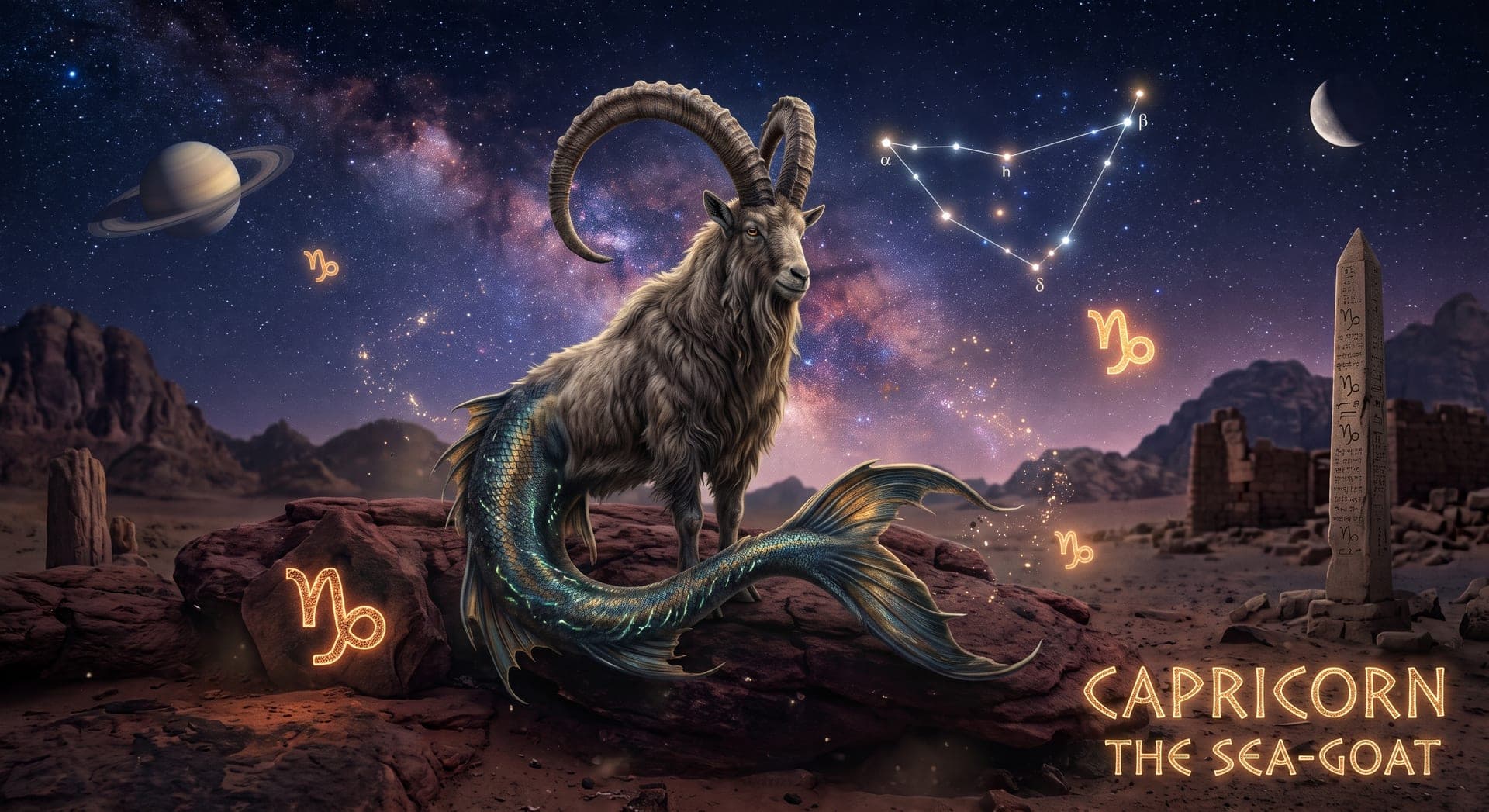
Born on January 7: Capricorn ♑
Capricorn, the tenth sign of the zodiac, spans December 22 to January 19 and is represented by the sea-goat, a mythical creature with the body of a goat and the tail of a fish, symbolizing an ability to navigate both the practical, earthly world and deeper emotional currents. Ruled by Saturn, the planet of discipline and time, Capricorns are often characterized as ambitious, patient, and deeply committed to long-term goals, willing to put in steady effort where others give up. As an Earth sign, Capricorn is grounded and practical, valuing tangible results and responsibility over impulsiveness. People born under this sign are frequently drawn to leadership and other structured pursuits where their organizational skills and work ethic can shine. Beneath a reserved, businesslike exterior, Capricorns are often said to carry a dry, understated sense of humor and a loyal, protective nature toward the people closest to them.
Personality Traits
Strengths
- Disciplined and self-controlled
- Responsible and dependable
- Excellent long-term planner
- Hardworking and persistent
- Good sense of humor once comfortable
Weaknesses
- Can be a know-it-all
- Unforgiving of mistakes, including their own
- Prone to pessimism
- Condescending toward those who don't work as hard
- Stubbornly resistant to changing plans
Compatible Signs
Fun Facts
- Capricorn's symbol, the sea-goat, comes from the Greek myth of Pan, who transformed his lower half into a fish tail to escape the monster Typhon while diving into the Nile.
- Saturn, Capricorn's ruling planet, was the Roman god of time, harvest, and generational structure, echoing the sign's association with patience and long-term thinking.
- Capricorn is one of only two zodiac signs represented by a hybrid creature, the other being Sagittarius, the centaur.
- Notable Capricorns include Michelle Obama, Martin Luther King Jr., Dolly Parton, LeBron James, and Isaac Newton.
- In traditional astrology, the winter solstice, the shortest day of the year, falls right at the start of Capricorn season in the Northern Hemisphere.
Born on January 7
- 1746
George Elphinstone, 1st Viscount Keith
Scottish admiral in the Royal Navy who commanded British fleets during the French Revolutionary and Napoleonic Wars, including overseeing Napoleon's exile in 1815
- 1800
Millard Fillmore
13th President of the United States
- 1827
Sandford Fleming
Scottish-born Canadian engineer who proposed the system of worldwide standard time zones still used today
- 1873
Adolph Zukor
Film industry pioneer who co-founded Paramount Pictures
- 1891
Zora Neale Hurston
American novelist and folklorist of the Harlem Renaissance
- 1912
Charles Addams
Cartoonist who created "The Addams Family"
- 1941
Iona Brown
English violinist and conductor who led the Academy of St Martin in the Fields for many years
- 1941
John E. Walker
English chemist who won the Nobel Prize in Chemistry for explaining the enzymatic mechanism behind the synthesis of ATP
- 1947
Tony Elliott
English publisher who founded Time Out magazine, which grew into a major international listings and culture brand
- 1948
Kenny Loggins
Singer-songwriter known for soft rock hits
- 1957
Katie Couric
American television journalist and news anchor
- 1964
Nicolas Cage
Academy Award-winning American actor
- 1967
Nick Clegg
English politician who served as Deputy Prime Minister of the United Kingdom and leader of the Liberal Democrats
- 1985
Lewis Hamilton
English racing driver who is one of the most successful Formula One drivers in history, with a record-tying seven World Championships

On This Day in History
- 49 BCE
Tribunes sympathetic to Julius Caesar flee Rome for his camp after the Senate delivers an ultimatum demanding he disband his army.
The standoff between Caesar and the Senate, backed by his rival Pompey, was the immediate prelude to civil war. Days later, Caesar defied the Senate's authority by crossing the Rubicon River with his legions, an act that plunged the Roman Republic into civil war and set Caesar on the path to becoming its sole ruler.
- 1558
French forces capture Calais, ending more than two centuries of English control over the city.
Calais had been an English possession since its capture by Edward III in 1347 and was prized as England's last remaining continental foothold and a vital wool-trading port. Its loss under Queen Mary I was a significant blow to English prestige; Mary is said to have remarked that when she died, 'Calais' would be found engraved on her heart.
- 1610
Galileo Galilei observes the four largest moons of Jupiter for the first time using his telescope.
Galileo's telescope, one of the most powerful instruments of its time, revealed four bright points of light orbiting Jupiter rather than the Earth, direct observational evidence against the prevailing view that everything in the heavens circled the Earth. The discovery of these moons, later named Io, Europa, Ganymede, and Callisto, provided crucial support for the Copernican, sun-centered model of the solar system.
- 1610
Galileo Galilei observes what he later identifies as four moons orbiting Jupiter, using his newly improved telescope.
The moons—later named Io, Europa, Ganymede, and Callisto—were the first celestial bodies discovered to orbit a planet other than Earth. The observation provided crucial evidence supporting the Copernican model of a Sun-centered solar system and challenged the prevailing Aristotelian view that all heavenly bodies revolved around the Earth.
- 1785
Jean-Pierre Blanchard and John Jeffries complete the first crossing of the English Channel by hot air balloon.
Blanchard, a French balloonist, and Jeffries, an American physician, made the risky crossing in a hydrogen balloon, dumping ballast, food, and even some of their clothing overboard to stay aloft after losing altitude over the Channel. Their successful flight demonstrated that ballooning could achieve genuine long-distance travel and was among the earliest instances of international air transport.
- 1785
Jean-Pierre Blanchard and John Jeffries complete the first crossing of the English Channel by air, flying from Dover to Calais in a hydrogen balloon.
The pair had to jettison much of their equipment and even some of their clothing to stay aloft after losing altitude partway across, narrowly avoiding a landing in the sea. Their flight was the first time anyone had crossed the Channel by air, decades before powered flight, and it captured public imagination on both sides of the water.
- 1835
HMS Beagle, with naturalist Charles Darwin aboard, anchors near the Chonos Archipelago off the coast of Chile.
The Beagle's five-year survey voyage around South America and the Pacific gave Darwin extensive opportunity to study geology, fossils, and living species across diverse environments. Observations gathered during stops like this one fed directly into the ideas he would later develop into the theory of evolution by natural selection, published two decades later in On the Origin of Species.
- 1922
Dáil Éireann narrowly ratifies the Anglo-Irish Treaty, approving the creation of the Irish Free State.
The treaty, signed the previous month, ended the Irish War of Independence and granted southern Ireland dominion status within the British Commonwealth while Northern Ireland remained part of the United Kingdom. The narrow 64–57 vote deeply divided Irish nationalists over the treaty's compromises, particularly the continued oath of allegiance to the British Crown, and triggered the Irish Civil War later that year.
- 1927
The first transatlantic commercial telephone service is established between New York City and London.
The service, a joint venture between AT&T and the British Post Office, used long-wave radio transmission rather than an undersea cable, since transatlantic telephone cables did not yet exist. Initial calls were expensive and limited in number, but the achievement marked a major step toward real-time global communication, decades before the first transatlantic telephone cable was laid in 1956.
- 1927
The first commercial transatlantic telephone service begins, connecting New York and London by radio link.
The service, launched jointly by AT&T and the British General Post Office, allowed callers to speak across the Atlantic for the first time, though at a substantial cost and with limited capacity for simultaneous calls. It replaced the far slower medium of transatlantic telegraph cables for voice communication and marked a major step in linking Britain and America in real time.
- 1928
A flood on the River Thames kills 14 people in London after heavy rain, snowmelt, and a high tidal surge overwhelm the river's defenses.
The flood breached embankments in several low-lying areas, including around the Tower of London, and inundated basements where many of the victims drowned while sleeping. The disaster exposed serious weaknesses in London's flood defenses and helped drive the eventual construction of the Thames Barrier, completed more than half a century later in 1982.
- 1955
Marian Anderson becomes the first Black singer to perform at New York's Metropolitan Opera.
Anderson's performance in Verdi's "Un ballo in maschera" broke a significant racial barrier in American classical music, coming 16 years after her celebrated 1939 open-air concert at the Lincoln Memorial, arranged after she had been barred from performing at a segregated Washington concert hall. Her career helped pave the way for greater representation of Black artists in classical music institutions.
- 1959
The United States formally recognizes Fidel Castro's new government in Cuba.
U.S. recognition came just days after Castro's rebel forces overthrew the American-backed dictator Fulgencio Batista, whom Washington had grown increasingly uneasy about. Relations quickly soured as Castro's government nationalized American businesses and moved toward the Soviet Union, and the United States severed diplomatic ties entirely within two years, beginning a Cold War standoff that lasted over 50 years.
- 1979
Vietnamese forces capture Phnom Penh, overthrowing the Khmer Rouge regime in Cambodia.
Vietnamese troops, aided by Cambodian rebels opposed to the Khmer Rouge, captured the capital after a swift invasion launched in response to Khmer Rouge border raids into Vietnam. The offensive ended the genocidal Khmer Rouge regime, under which an estimated 1.5 to 2 million Cambodians had died, though guerrilla remnants of the group continued fighting from remote areas for years afterward.
- 1989
Emperor Hirohito of Japan dies after a 62-year reign, the longest in Japanese history to that point.
Hirohito had reigned since 1926, presiding over Japan's militarist expansion, World War II, and the country's subsequent pacifist post-war transformation under American occupation. His death marked the end of the Showa era and the ascension of his son Akihito. Hirohito's actual wartime role and responsibility remain subjects of historical debate among scholars.
- 1989
Non-league Sutton United defeats top-flight Coventry City 2–1 in one of the greatest upsets in FA Cup history.
Sutton, then playing several divisions below Coventry in the English football pyramid, pulled off the shock win in the FA Cup's third round, a competition famous for occasionally allowing small amateur or semi-professional clubs to beat major professional sides. The result remains one of the most celebrated giant-killings in the tournament's long history.
- 1999
The impeachment trial of U.S. President Bill Clinton begins in the Senate.
The Senate trial followed Clinton's impeachment by the House of Representatives on charges of perjury and obstruction of justice related to his relationship with White House intern Monica Lewinsky. After weeks of proceedings, the Senate acquitted Clinton on both charges in February, falling well short of the two-thirds majority needed for conviction and removal from office.
- 2015
Gunmen attack the Paris offices of satirical magazine Charlie Hebdo, killing twelve people.
Two gunmen forced their way into the offices of the satirical magazine, known for controversial cartoons depicting the Prophet Muhammad, and killed twelve people, including several prominent cartoonists, in retaliation for the publication's content. The attack sparked global rallies under the slogan "Je suis Charlie" and reignited fierce debates over free speech, satire, and religious sensitivity.
- 2015
Gunmen attack the Paris offices of satirical magazine Charlie Hebdo, killing twelve people.
The attackers, who claimed allegiance to al-Qaeda's branch in Yemen, targeted the magazine in retaliation for its publication of cartoons depicting the Prophet Muhammad. The killings sparked massive solidarity rallies across France and around the world under the slogan 'Je suis Charlie' and ignited fierce debate about free speech, satire, and religious sensitivity.
- 2023
Kevin McCarthy is elected Speaker of the U.S. House after the longest speakership vote since before the Civil War.
McCarthy's election required fifteen rounds of voting over four days, as a small bloc of hardline Republicans repeatedly withheld their support despite his party holding a majority. The prolonged standoff, the longest since 1859, forced McCarthy to make significant concessions to his critics, concessions that would later be cited when he was ousted from the speakership just months later.