
What’s Observed on January 6
Born on January 6: Capricorn ♑
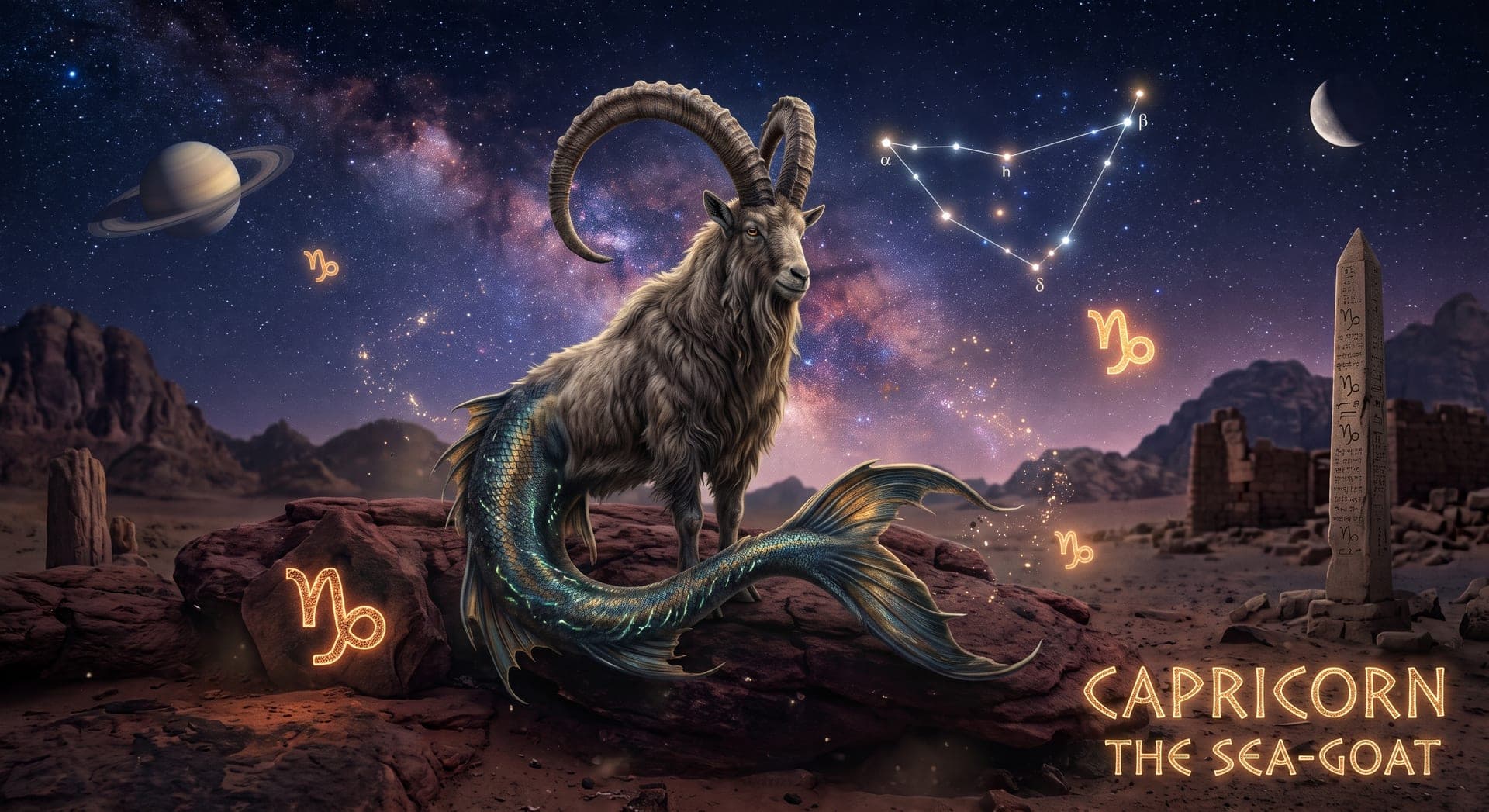
Capricorn, the tenth sign of the zodiac, spans December 22 to January 19 and is represented by the sea-goat, a mythical creature with the body of a goat and the tail of a fish, symbolizing an ability to navigate both the practical, earthly world and deeper emotional currents. Ruled by Saturn, the planet of discipline and time, Capricorns are often characterized as ambitious, patient, and deeply committed to long-term goals, willing to put in steady effort where others give up. As an Earth sign, Capricorn is grounded and practical, valuing tangible results and responsibility over impulsiveness. People born under this sign are frequently drawn to leadership and other structured pursuits where their organizational skills and work ethic can shine. Beneath a reserved, businesslike exterior, Capricorns are often said to carry a dry, understated sense of humor and a loyal, protective nature toward the people closest to them.
Personality Traits
Strengths
- Disciplined and self-controlled
- Responsible and dependable
- Excellent long-term planner
- Hardworking and persistent
- Good sense of humor once comfortable
Weaknesses
- Can be a know-it-all
- Unforgiving of mistakes, including their own
- Prone to pessimism
- Condescending toward those who don't work as hard
- Stubbornly resistant to changing plans
Compatible Signs
Fun Facts
- Capricorn's symbol, the sea-goat, comes from the Greek myth of Pan, who transformed his lower half into a fish tail to escape the monster Typhon while diving into the Nile.
- Saturn, Capricorn's ruling planet, was the Roman god of time, harvest, and generational structure, echoing the sign's association with patience and long-term thinking.
- Capricorn is one of only two zodiac signs represented by a hybrid creature, the other being Sagittarius, the centaur.
- Notable Capricorns include Michelle Obama, Martin Luther King Jr., Dolly Parton, LeBron James, and Isaac Newton.
- In traditional astrology, the winter solstice, the shortest day of the year, falls right at the start of Capricorn season in the Northern Hemisphere.
Born on January 6
- 1714
Percivall Pott
English surgeon regarded as one of the founders of orthopedic medicine, known for identifying Pott's disease and Pott's fracture
- 1872
Alexander Scriabin
Russian composer and pianist known for innovative classical music
- 1883
Kahlil Gibran
Lebanese-American writer and poet, author of "The Prophet"
- 1920
John Maynard Smith
English biologist who applied game theory to evolutionary biology, becoming one of the most influential evolutionary theorists of the twentieth century
- 1945
Barry John
Welsh rugby union player, a celebrated fly-half nicknamed 'The King' who starred for Wales and the British and Irish Lions in the early 1970s
- 1946
Syd Barrett
English singer-songwriter and guitarist who co-founded and originally led the rock band Pink Floyd
- 1955
Rowan Atkinson
English actor and comedian best known for creating and starring in the television character Mr. Bean
- 1960
Nigella Lawson
English food writer, journalist, and television presenter known for her cookery shows and bestselling cookbooks
- 1967
A. R. Rahman
Indian composer known as the "Mozart of Madras"
- 1982
Eddie Redmayne
English actor who won the Academy Award for Best Actor for his portrayal of Stephen Hawking in The Theory of Everything

On This Day in History
- 1066
Harold Godwinson is confirmed as King of England, setting off the succession crisis that leads to the Norman Conquest later that year.
Harold's confirmation as king came the day after Edward the Confessor's death, based on Edward's reported deathbed wish, but his claim was disputed by William, Duke of Normandy, and Norwegian king Harald Hardrada. Harold defeated the Norwegian invasion at Stamford Bridge in September, only to be killed weeks later at the Battle of Hastings, opening England to Norman rule.
- 1066
Harold Godwinson is crowned King of England following the death of Edward the Confessor, triggering a succession crisis.
Harold's coronation was contested by rival claimants, most notably William, Duke of Normandy, and Harald Hardrada of Norway, both of whom believed they had stronger claims to the throne. The dispute led directly to the Norman Conquest later that year, when William defeated and killed Harold at the Battle of Hastings, reshaping English history.
- 1492
King Ferdinand and Queen Isabella of Spain enter Granada, completing the Reconquista.
The monarchs' ceremonial entry into the Alhambra palace marked the formal end of the decade-long Granada War and completed the centuries-long Reconquista of the Iberian Peninsula from Muslim rule. The victory freed Spanish resources and prestige just as Columbus was preparing his westward voyage, which Ferdinand and Isabella agreed to fund later that same year.
- 1492
Ferdinand and Isabella enter the city of Granada, concluding the Granada War and the centuries-long Reconquista of the Iberian Peninsula.
The surrender of Granada's last Muslim ruler, Boabdil, ended nearly 800 years of Muslim political presence in Spain. The same year, the Catholic Monarchs expelled Spain's Jewish population and financed Christopher Columbus's westward voyage, making 1492 one of the most consequential years in Spanish and world history.
- 1540
King Henry VIII of England marries his fourth wife, Anne of Cleves.
The marriage was arranged for political reasons, to forge an alliance with German Protestant states, but Henry reportedly found Anne unattractive in person compared to her portrait. The union was never consummated and was annulled just six months later. Anne negotiated a generous settlement and, unlike two of Henry's other wives, kept both her head and her freedom.
- 1540
King Henry VIII marries Anne of Cleves, his fourth wife, in a match arranged for political reasons.
The marriage had been engineered by chief minister Thomas Cromwell to forge an alliance with German Protestant states, but Henry reportedly found Anne unappealing in person compared to her flattering portrait by Hans Holbein. The marriage was annulled after just six months, and Cromwell's role in arranging it contributed to his fall from favor and execution later that year.
- 1661
A small band of Fifth Monarchist rebels attempts an unsuccessful uprising in London, seeking to establish the rule of Christ on Earth.
Led by Thomas Venner, the group believed the overthrow of the recently restored monarchy would usher in the biblical 'Fifth Monarchy' following the fall of four ancient empires. The rising was quickly crushed by royal troops, but the panic it caused contributed to harsher government treatment of religious and political dissenters in the early years of the Restoration.
- 1721
A parliamentary inquiry into the collapse of the South Sea Company reveals widespread fraud among its directors.
The South Sea Bubble had been one of the first major stock market crashes in history, wiping out the fortunes of thousands of investors after speculative shares in the company collapsed in 1720. The inquiry exposed bribery of government ministers and led to the seizure of directors' estates to compensate victims, while Robert Walpole's handling of the crisis helped establish him as Britain's first de facto prime minister.
- 1781
British forces defeat an attempted French invasion of the Channel Island of Jersey at the Battle of Jersey.
A French force had landed on the island and briefly captured the lieutenant governor before being defeated by a hastily assembled British garrison led by Major Francis Peirson, who was killed in the fighting. The battle secured British control of Jersey and became a celebrated episode in the island's history, later commemorated in a famous painting by John Singleton Copley.
- 1809
Combined British and Portuguese forces begin the invasion of Cayenne, the capital of French Guiana, during the Napoleonic Wars.
The campaign was part of Britain's broader strategy of seizing French and allied colonial territories overseas while Napoleon's forces were tied down in Europe. The invasion succeeded within weeks, and Cayenne remained under Portuguese administration on Britain's behalf until it was returned to France after Napoleon's defeat.
- 1900
Boer forces launch a major assault on the besieged British garrison at Ladysmith, but are driven back after fierce fighting.
The attack, known as the Battle of Platrand, came during the prolonged Siege of Ladysmith in the Second Boer War, one of three key British garrisons besieged by Boer forces in South Africa. British troops held their positions despite heavy casualties, and the town was eventually relieved by a relief force the following month.
- 1912
New Mexico is admitted as the 47th U.S. state.
New Mexico's admission followed decades of delay, partly due to congressional concerns about its large Spanish-speaking population and territorial size. Its statehood, along with Arizona's the following month, completed the addition of the contiguous 48 states, a process that had begun over a century earlier and would only be finished later by Alaska and Hawaii in 1959.
- 1912
Geophysicist Alfred Wegener presents his theory of continental drift to the scientific community for the first time.
Wegener proposed that Earth's continents had once been joined in a single landmass, since separated and drifted apart, based on matching coastlines, fossils, and rock formations across oceans. The scientific community largely rejected his theory for decades, since he could not explain the mechanism, but plate tectonics later vindicated his core idea in the mid-20th century.
- 1912
German scientist Alfred Wegener publicly presents his theory of continental drift, proposing that Earth's continents were once joined together.
Wegener argued that the continents had slowly drifted apart over geological time, pointing to matching coastlines and fossil distributions across the Atlantic as evidence. His theory was widely rejected by geologists in his lifetime for lacking a convincing mechanism, but it was vindicated decades later by the discovery of plate tectonics, which confirmed the continents do indeed move.
- 1941
President Franklin D. Roosevelt delivers his "Four Freedoms" speech during the State of the Union address.
Delivered months before the U.S. entered World War II, Roosevelt's speech outlined four essential liberties, freedom of speech, freedom of worship, freedom from want, and freedom from fear, that he argued should be enjoyed everywhere in the world. The speech helped build American public support for eventually joining the Allied cause and later influenced the framing of the Universal Declaration of Human Rights.
- 1960
National Airlines Flight 2511 is destroyed by an onboard bomb, killing all aboard.
The bomb, hidden in the cargo hold, detonated while the plane was over North Carolina, killing all 34 people aboard. Investigators determined it had been planted as part of an apparent murder-suicide and insurance fraud scheme by a passenger. It remains one of the deadliest acts of aircraft sabotage in U.S. aviation history.
- 1994
Figure skater Nancy Kerrigan is attacked by an assailant connected to rival skater Tonya Harding.
The attack, in which an assailant clubbed Kerrigan's knee just weeks before the Winter Olympics, was later traced to associates of rival skater Tonya Harding, including Harding's ex-husband. The scandal became a sensational national media story, and Harding was ultimately banned from competitive figure skating for life after admitting she knew about the plot afterward.
- 2005
Edgar Ray Killen is indicted for his role in the 1964 murders of civil rights workers Chaney, Goodman, and Schwerner.
Killen, a former Ku Klux Klan leader, had organized the murders of civil rights workers James Chaney, Andrew Goodman, and Michael Schwerner near Philadelphia, Mississippi, during the 1964 Freedom Summer voter registration campaign. Federal charges in the 1960s had ended in a hung jury, but Mississippi authorities reopened the case decades later, finally convicting Killen of manslaughter in 2005.
- 2021
Supporters of President Trump storm the United States Capitol in an attempt to disrupt certification of the 2020 election results.
A crowd of Trump supporters, urged on by the president's false claims of a stolen election, breached security barriers and entered the Capitol as Congress met to certify Joe Biden's victory, forcing lawmakers to evacuate. Five people died in connection with the events, and the riot led to Trump's second impeachment and hundreds of subsequent criminal prosecutions.
- 2021
Supporters of President Donald Trump storm the United States Capitol in an attempt to disrupt certification of the 2020 election results.
The riot forced lawmakers to evacuate mid-session and resulted in several deaths, along with dozens of injuries to police officers. It was among the most serious breaches of the US Capitol in the building's history and led to a second impeachment of President Trump, along with prosecutions of hundreds of participants in the following years.