
What’s Observed on January 5
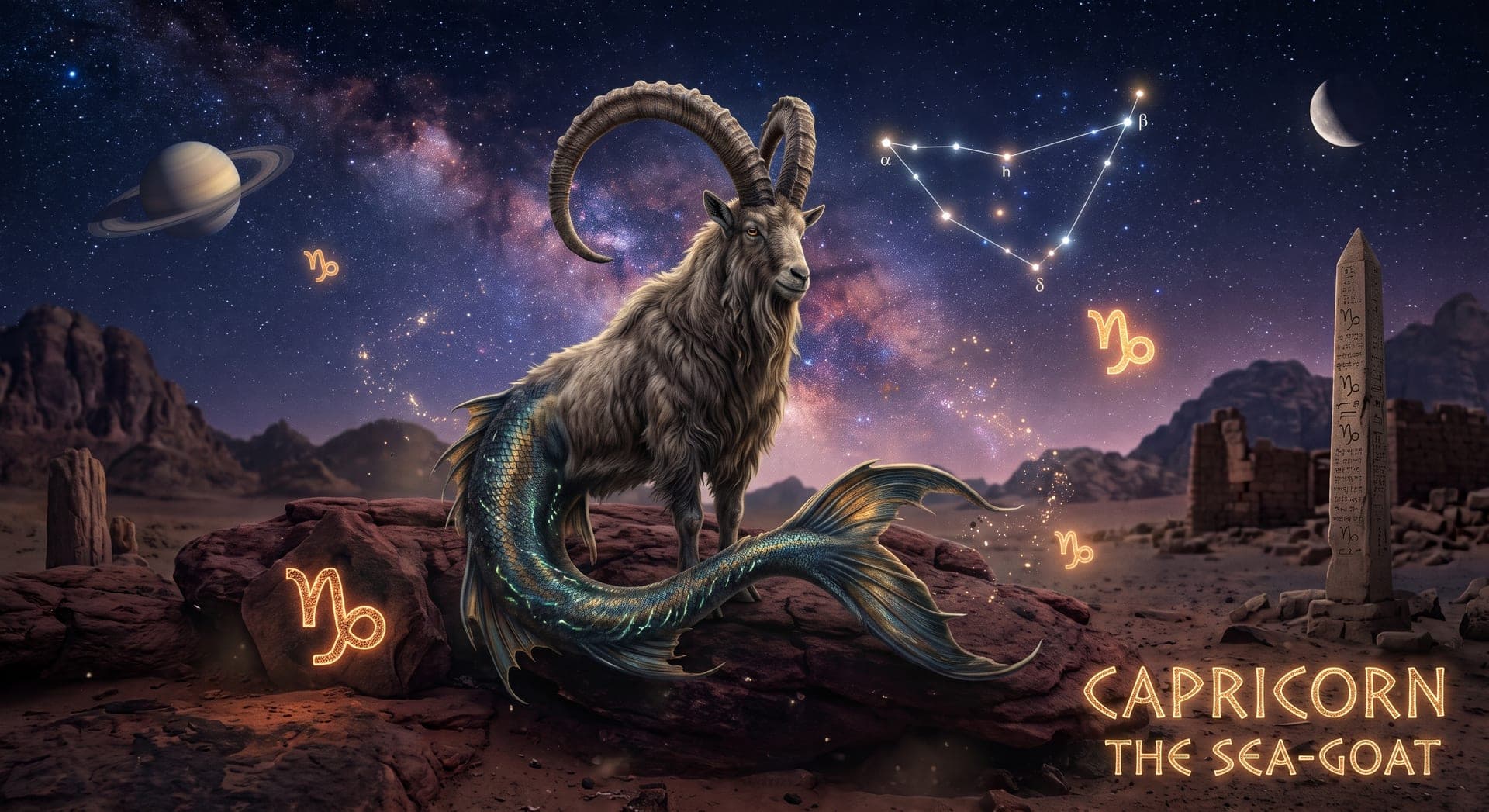
Born on January 5: Capricorn ♑
Capricorn, the tenth sign of the zodiac, spans December 22 to January 19 and is represented by the sea-goat, a mythical creature with the body of a goat and the tail of a fish, symbolizing an ability to navigate both the practical, earthly world and deeper emotional currents. Ruled by Saturn, the planet of discipline and time, Capricorns are often characterized as ambitious, patient, and deeply committed to long-term goals, willing to put in steady effort where others give up. As an Earth sign, Capricorn is grounded and practical, valuing tangible results and responsibility over impulsiveness. People born under this sign are frequently drawn to leadership and other structured pursuits where their organizational skills and work ethic can shine. Beneath a reserved, businesslike exterior, Capricorns are often said to carry a dry, understated sense of humor and a loyal, protective nature toward the people closest to them.
Personality Traits
Strengths
- Disciplined and self-controlled
- Responsible and dependable
- Excellent long-term planner
- Hardworking and persistent
- Good sense of humor once comfortable
Weaknesses
- Can be a know-it-all
- Unforgiving of mistakes, including their own
- Prone to pessimism
- Condescending toward those who don't work as hard
- Stubbornly resistant to changing plans
Compatible Signs
Fun Facts
- Capricorn's symbol, the sea-goat, comes from the Greek myth of Pan, who transformed his lower half into a fish tail to escape the monster Typhon while diving into the Nile.
- Saturn, Capricorn's ruling planet, was the Roman god of time, harvest, and generational structure, echoing the sign's association with patience and long-term thinking.
- Capricorn is one of only two zodiac signs represented by a hybrid creature, the other being Sagittarius, the centaur.
- Notable Capricorns include Michelle Obama, Martin Luther King Jr., Dolly Parton, LeBron James, and Isaac Newton.
- In traditional astrology, the winter solstice, the shortest day of the year, falls right at the start of Capricorn season in the Northern Hemisphere.
Born on January 5
- 1209
Richard, 1st Earl of Cornwall
English prince, the younger son of King John, who was elected King of the Romans and played a major role in thirteenth-century English politics
- 1834
William John Wills
English-born surveyor and explorer who, with Robert O'Hara Burke, led the first expedition to cross Australia from south to north
- 1876
Konrad Adenauer
First Chancellor of West Germany, guiding its postwar recovery
- 1902
Stella Gibbons
English journalist and author best known for her comic novel Cold Comfort Farm
- 1906
Kathleen Kenyon
English archaeologist known for her excavations at Jericho, which uncovered evidence of one of the world's oldest continuously inhabited settlements
- 1917
Jane Wyman
Academy Award-winning actress of Hollywood's golden age
- 1923
Sam Phillips
Founder of Sun Records, who helped launch Elvis Presley's career
- 1928
Zulfikar Ali Bhutto
Former President and Prime Minister of Pakistan
- 1931
Robert Duvall
Acclaimed American actor known for "The Godfather" and "Apocalypse Now"
- 1932
Umberto Eco
Italian novelist and semiotician, author of "The Name of the Rose"
- 1941
Hayao Miyazaki
Japanese animator and director behind Studio Ghibli films
- 1965
Vinnie Jones
English footballer turned actor, known for his hard-tackling playing style and later film roles including Lock, Stock and Two Smoking Barrels
- 1974
Iwan Thomas
Welsh sprinter who won gold in the 400 metres at the 1998 Commonwealth Games and held the British record in the event
- 1975
Bradley Cooper
American actor and filmmaker known for "A Star Is Born" and "American Sniper"

On This Day in History
- 1477
At the Battle of Nancy, Charles the Bold of Burgundy is defeated and killed, and Burgundy is subsequently absorbed into France.
Charles the Bold had spent years trying to build a powerful independent duchy stretching from the Low Countries to Switzerland, clashing repeatedly with the Swiss Confederacy and Lorraine. His death in battle, his body found stripped and partly eaten by wolves days later, left Burgundy without a male heir. The territory was subsequently divided between France and the Habsburgs through marriage.
- 1757
King Louis XV of France survives an assassination attempt by Robert-François Damiens.
Damiens, a domestic servant who believed the king had failed to defend the Catholic Church against Jansenist reformers, stabbed Louis XV with a small knife, inflicting only a minor wound. Damiens was tortured and executed by drawing and quartering in a brutal public spectacle, the last time this punishment was used in France, reflecting the era's harsh treatment of crimes against the monarch.
- 1781
British naval forces led by former American general Benedict Arnold burn Richmond, Virginia, during the Revolutionary War.
Arnold, once one of America's most celebrated generals, had defected to the British the previous year after growing resentful over perceived slights and financial troubles. Leading a British raiding force, he burned government buildings, warehouses, and private homes in the Virginia capital with little resistance, a painful demonstration of the vulnerability Virginia faced late in the Revolutionary War.
- 1781
British naval forces led by the American turncoat Benedict Arnold burn Richmond, Virginia, during the American Revolutionary War.
Arnold, who had defected to the British side after his plot to surrender West Point was discovered, led a raiding force up the James River and torched the Virginia capital with minimal resistance. The raid demonstrated Britain's continued ability to strike deep into American territory even as the war entered its final years.
- 1895
French army officer Alfred Dreyfus is publicly stripped of his rank and sentenced to life imprisonment in the Dreyfus affair.
Dreyfus, a Jewish artillery officer falsely convicted of passing military secrets to Germany, was publicly stripped of his rank in a humiliating ceremony before being sent to the penal colony of Devil's Island. The case exposed deep antisemitism within the French military and became a national scandal that divided the country for years before Dreyfus was ultimately exonerated in 1906.
- 1895
Alfred Dreyfus, a French army officer wrongly convicted of treason, is publicly stripped of his rank in a humiliating ceremony.
Dreyfus, who was Jewish, had been convicted on fabricated evidence and sentenced to life imprisonment on Devil's Island. The case became one of the most notorious miscarriages of justice in modern history and exposed deep currents of antisemitism in French society, eventually leading to his exoneration in 1906 after years of public campaigning.
- 1900
Irish nationalist leader John Edward Redmond calls for revolt against British rule in Ireland.
Redmond, who led the Irish Parliamentary Party, was generally associated with constitutional efforts to secure Irish Home Rule rather than armed rebellion, making this call notable within the broader context of rising nationalist frustration. Tensions over Ireland's status within the United Kingdom continued to escalate over the following decades, culminating in the 1916 Easter Rising and the Irish War of Independence.
- 1919
The German Workers' Party, which would later become the Nazi Party, is founded in Munich.
The tiny party, founded by locksmith Anton Drexler, had only a handful of members when a young army veteran named Adolf Hitler joined later that year as its 55th member. Hitler quickly took over leadership and transformed it into the National Socialist German Workers' Party, exploiting the economic despair and resentment of the Weimar era to build it into a mass movement.
- 1919
The German Workers' Party is founded in Munich, later renamed the National Socialist German Workers' Party.
Founded by locksmith Anton Drexler and a small group of nationalist activists, the party attracted little attention until Adolf Hitler joined later that year and quickly rose to lead it. Renamed the Nazi Party in 1920, it would go on to seize power in Germany in 1933, with catastrophic consequences for Europe and the world.
- 1933
Construction begins on the Golden Gate Bridge in San Francisco Bay.
Construction of the Golden Gate Bridge, spanning the mile-wide strait connecting San Francisco Bay to the Pacific Ocean, was led by chief engineer Joseph Strauss despite widespread skepticism that a bridge could withstand the strait's strong currents and frequent fog. Completed in 1937, it became one of the most recognizable structures in the world and, for decades, the longest suspension bridge span ever built.
- 1941
Pioneering British aviator Amy Johnson disappears after bailing out over the Thames Estuary while flying for the Air Transport Auxiliary.
Johnson had become internationally famous in 1930 as the first woman to fly solo from Britain to Australia. During the Second World War she served ferrying aircraft for the Air Transport Auxiliary, and her death in poor weather over the Thames remains something of a mystery, with her body never recovered despite an extensive search.
- 1944
The Daily Mail becomes the first major London newspaper to be printed and published simultaneously on both sides of the Atlantic.
The paper achieved this by transmitting page facsimiles to a printing plant in New York, allowing American readers to receive a same-day edition despite wartime disruptions to transatlantic shipping. It was an early example of using long-distance communications technology to extend a newspaper's reach beyond its home market.
- 1953
Samuel Beckett's play "Waiting for Godot" premieres in Paris.
Beckett's absurdist play, in which two characters wait endlessly for someone who never arrives, baffled and divided its first Paris audience but went on to become one of the most influential works of 20th-century theater. Its bleak humor and minimalist style helped define the Theatre of the Absurd movement and permanently reshaped ideas about what a play could be.
- 1968
Alexander Dubček comes to power in Czechoslovakia, effectively beginning the reformist Prague Spring.
Dubček's rise to First Secretary of the Communist Party ushered in a brief period of liberalization known as "socialism with a human face," easing censorship and expanding personal freedoms. The reforms alarmed Soviet leadership, and within months the Soviet Union and Warsaw Pact allies invaded Czechoslovakia to crush the movement, ending the Prague Spring by force.
- 1969
Ariana Afghan Airlines Flight 701 crashes near Gatwick Airport in West Sussex, England, killing 50 people.
The Boeing 727 was attempting to land at Gatwick in poor visibility when it struck high ground short of the runway. It remains one of the deadliest aviation accidents to have occurred on British soil, and the crash prompted scrutiny of the airline's approach procedures and crew training standards.
- 1972
U.S. President Richard Nixon announces the development of the Space Shuttle program.
Nixon's approval came as NASA searched for its next major mission following the winding down of the Apollo program, aiming to build a reusable spacecraft that could dramatically cut the cost of reaching orbit. The Space Shuttle program launched its first mission in 1981 and flew for 30 years, becoming central to building the International Space Station before retiring in 2011.
- 1976
Gunmen kill ten Protestant civilians in the Kingsmill massacre, an ambush on a minibus of workers in County Armagh, Northern Ireland.
The attackers stopped the bus, separated out the one Catholic passenger, and shot the remaining ten Protestant men, an attack widely seen as retaliation for a spate of killings of Catholics in the area days earlier. It remains one of the deadliest sectarian atrocities of the Troubles and continues to be the subject of long-running investigations into paramilitary and state involvement.
- 1993
The oil tanker MV Braer runs aground off the Shetland Islands, spilling roughly 84,700 tonnes of crude oil into the sea.
Powerful storms that followed the grounding helped disperse much of the oil more quickly than initially feared, sparing Shetland's coastline the worst-case damage predicted at the time. Even so, the spill caused significant short-term harm to local marine life and fisheries and prompted a renewed debate over tanker safety in British waters.
- 2005
Astronomers announce the discovery of the dwarf planet Eris, a finding that later prompts the redefinition of "planet" by the International Astronomical Union.
Eris, initially nicknamed "Xena" by its discoverers, was found to be slightly more massive than Pluto, forcing astronomers to confront an awkward question about what actually counts as a planet. The controversy led the International Astronomical Union to adopt a formal definition later that year, a decision that controversially reclassified both Eris and Pluto as "dwarf planets."
- 2005
Astronomers at Palomar Observatory discover Eris, a dwarf planet in the outer Solar System more massive than Pluto.
The discovery, made by a team led by Mike Brown, was announced in 2005 and prompted renewed debate within the astronomical community about the definition of a planet. That debate led the International Astronomical Union to formally reclassify Pluto as a dwarf planet the following year, alongside Eris and several other similar bodies.