What’s Observed on January 4
Born on January 4: Capricorn ♑
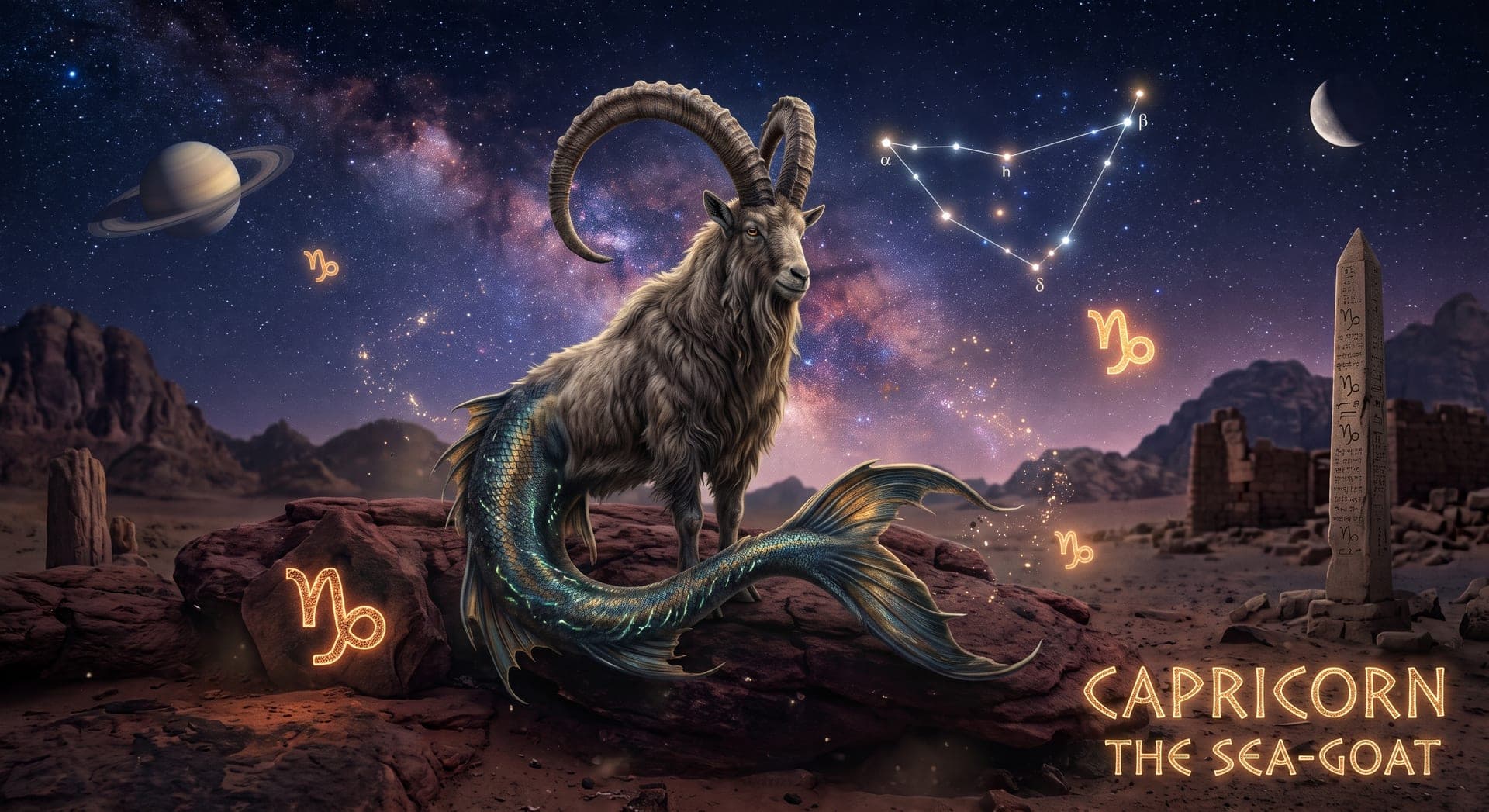
Capricorn, the tenth sign of the zodiac, spans December 22 to January 19 and is represented by the sea-goat, a mythical creature with the body of a goat and the tail of a fish, symbolizing an ability to navigate both the practical, earthly world and deeper emotional currents. Ruled by Saturn, the planet of discipline and time, Capricorns are often characterized as ambitious, patient, and deeply committed to long-term goals, willing to put in steady effort where others give up. As an Earth sign, Capricorn is grounded and practical, valuing tangible results and responsibility over impulsiveness. People born under this sign are frequently drawn to leadership and other structured pursuits where their organizational skills and work ethic can shine. Beneath a reserved, businesslike exterior, Capricorns are often said to carry a dry, understated sense of humor and a loyal, protective nature toward the people closest to them.
Personality Traits
Strengths
- Disciplined and self-controlled
- Responsible and dependable
- Excellent long-term planner
- Hardworking and persistent
- Good sense of humor once comfortable
Weaknesses
- Can be a know-it-all
- Unforgiving of mistakes, including their own
- Prone to pessimism
- Condescending toward those who don't work as hard
- Stubbornly resistant to changing plans
Compatible Signs
Fun Facts
- Capricorn's symbol, the sea-goat, comes from the Greek myth of Pan, who transformed his lower half into a fish tail to escape the monster Typhon while diving into the Nile.
- Saturn, Capricorn's ruling planet, was the Roman god of time, harvest, and generational structure, echoing the sign's association with patience and long-term thinking.
- Capricorn is one of only two zodiac signs represented by a hybrid creature, the other being Sagittarius, the centaur.
- Notable Capricorns include Michelle Obama, Martin Luther King Jr., Dolly Parton, LeBron James, and Isaac Newton.
- In traditional astrology, the winter solstice, the shortest day of the year, falls right at the start of Capricorn season in the Northern Hemisphere.
Born on January 4
- 1643
Isaac Newton
English mathematician and physicist whose laws of motion and universal gravitation laid the foundations of classical mechanics
- 1809
Louis Braille
French educator who invented the Braille reading system for the blind
- 1813
Isaac Pitman
English linguist and educator who invented Pitman shorthand, a phonetic writing system widely used for rapid transcription
- 1878
Augustus John
Welsh painter renowned for his portraits and etchings, considered one of the leading British artists of the early twentieth century
- 1935
Floyd Patterson
American boxer and youngest heavyweight champion of his era
- 1937
Dyan Cannon
American actress, director, and screenwriter
- 1940
Brian Josephson
Welsh physicist who won the Nobel Prize in Physics for predicting the Josephson effect in superconductors
- 1942
John McLaughlin
English guitarist known for pioneering jazz fusion
- 1956
Bernard Sumner
English singer-songwriter and guitarist, a founding member of Joy Division and later frontman of New Order
- 1958
Julian Sands
English actor known for films including A Room with a View and Warlock
- 1960
Michael Stipe
Frontman of the rock band R.E.M.
- 1965
Beth Gibbons
English singer-songwriter known as the vocalist of the trip-hop band Portishead
- 1990
Toni Kroos
German footballer and World Cup champion midfielder
On This Day in History
- 871
A Danish invasion army defeats the forces of King Æthelred of Wessex and his brother Alfred at the Battle of Reading.
The battle was part of the broader Viking assault on Anglo-Saxon England during the campaigns of the 'Great Heathen Army' in the 860s and 870s. Though defeated here, Æthelred and Alfred fought on and won a victory days later at Ashdown; Alfred would go on to become king later that year and eventually earn the title 'the Great' for resisting the Danes.
- 1642
King Charles I attempts to arrest five members of the English Parliament, sharply escalating tensions that lead to the English Civil War.
Charles I personally led soldiers into the House of Commons to arrest five members he accused of treason, only to find they had already fled, famously remarking "the birds have flown." No English monarch had ever entered the Commons chamber before, and the breach of parliamentary privilege badly damaged the king's authority, helping trigger the English Civil War later that year.
- 1642
King Charles I enters the House of Commons with armed men in a failed attempt to arrest five members of Parliament.
The five MPs, who had been tipped off, had already fled by the time Charles arrived, famously prompting him to remark that 'the birds have flown.' The confrontation shattered relations between the king and Parliament beyond repair and is widely regarded as one of the direct triggers of the English Civil War, which broke out later that year.
- 1649
England's Rump Parliament votes to put King Charles I on trial for treason.
The vote followed Charles's defeat in the English Civil War and his refusal to accept Parliament's authority. It led to the creation of a special High Court of Justice, and Charles was tried, convicted, and executed later that January—an unprecedented act that briefly abolished the English monarchy and established the Commonwealth of England under Oliver Cromwell.
- 1717
The Dutch Republic, Great Britain, and France sign the Triple Alliance, a defensive pact aimed at preserving the postwar settlement in Europe.
The alliance brought together former adversaries from the War of the Spanish Succession to guard against renewed Spanish or Jacobite attempts to disrupt the balance of power. It reflected Britain's growing role in continental European diplomacy under the Hanoverian dynasty and was later expanded into the Quadruple Alliance with the addition of Austria.
- 1762
Great Britain declares war on Spain, drawing Spain into the Seven Years' War.
Spain entered the Seven Years' War, already raging across Europe, North America, and Asia, after signing a family pact with France's Bourbon monarchy. The additional conflict opened new fronts in the Caribbean and the Philippines, ultimately ending badly for Spain, which was forced to cede Florida to Britain in the 1763 peace settlement, though it gained Louisiana from France in compensation.
- 1762
Great Britain declares war on Spain, drawing Spain into the Seven Years' War on the side of France.
The declaration followed the discovery of a secret Bourbon family pact between France and Spain. British forces went on to seize Spanish territories including Havana and Manila before the war ended in 1763, with the resulting Treaty of Paris significantly expanding British colonial holdings, including Florida, at Spain's expense.
- 1884
The Fabian Society, a socialist organization advocating gradual reform, is founded in London.
The society took its name from the Roman general Fabius Maximus, celebrated for his strategy of patient, incremental advances rather than direct confrontation. Early members included George Bernard Shaw and Sidney and Beatrice Webb, and the organization played a significant role in shaping British socialist thought and later helped found the Labour Party in 1900.
- 1896
Utah is admitted as the 45th U.S. state.
Utah's path to statehood had been unusually long and contentious, delayed for decades largely over the Mormon church's practice of polygamy, which Congress viewed as incompatible with admission. Statehood was finally granted after the church officially renounced the practice in 1890. Utah entered as the 45th state, completing a process that had begun with its first application 46 years earlier.
- 1912
The Scout Association, the organization overseeing Scouting in the United Kingdom, is incorporated by royal charter.
The charter formalized the structure of the movement founded by Robert Baden-Powell just five years earlier, following the success of his experimental camp on Brownsea Island in 1907 and his handbook Scouting for Boys. The organization grew rapidly in Britain and inspired similar scouting movements that spread around the world.
- 1918
Finland's declaration of independence from Russia is formally recognized by Russia, Sweden, Germany, and France.
Finland had declared independence from Russia the previous month, taking advantage of the chaos following the Bolshevik Revolution. Soviet Russia, under Lenin, recognized the declaration first, hoping for good relations with the new socialist-leaning state, and other European powers quickly followed suit. Finland's independence was nonetheless soon tested by a bloody civil war between socialist and conservative factions.
- 1948
Burma (Myanmar) gains independence from the United Kingdom, becoming a republic.
Burma's independence came after a long British colonial administration and Japanese wartime occupation, negotiated by independence leader Aung San, who was assassinated just months before the transfer of power took place. Unlike many former British colonies, Burma chose not to join the Commonwealth of Nations, reflecting the strength of anti-colonial sentiment that had built up during decades of British rule.
- 1948
Burma gains independence from the United Kingdom, becoming a sovereign republic outside the Commonwealth.
Unlike most other former British colonies, Burma chose not to join the Commonwealth of Nations upon independence, reflecting the strength of anti-colonial sentiment following the wartime Japanese occupation and the assassination of independence leader Aung San in 1947. The transition marked one of the earlier steps in the postwar dismantling of the British Empire in Asia.
- 1958
Sputnik 1, the first artificial satellite, falls back to Earth after months in orbit.
Sputnik 1, launched by the Soviet Union in October 1957, was the first artificial satellite to orbit Earth and had stunned the world, sparking the Cold War space race. After about three months in a decaying low orbit, atmospheric drag pulled the beach-ball-sized satellite back down, and it burned up on reentry, having already achieved its historic mission of proving orbital spaceflight possible.
- 1972
Rose Heilbron becomes the first female judge to sit at the Old Bailey, London's Central Criminal Court.
Heilbron had already broken multiple barriers for women in the British legal profession, including becoming one of the first female King's Counsel decades earlier. Her appointment to the Old Bailey was a landmark moment for women in a legal system that had long been dominated by men, and she continued to be a prominent advocate for judicial reform throughout her career.
- 1976
The Ulster Volunteer Force shoots six Irish Catholic civilians during an attack in Northern Ireland.
The shooting was part of the sustained sectarian violence of the Troubles, the decades-long conflict between republican and loyalist paramilitary groups, British security forces, and civilians in Northern Ireland. Attacks like this one, often targeting civilians based on religious identity, characterized the darkest periods of the conflict, which claimed more than 3,000 lives before the 1998 Good Friday Agreement.
- 1998
A severe ice storm begins across eastern Canada and the northeastern United States, causing widespread damage over the following week.
The storm deposited unprecedented amounts of freezing rain over several days, coating power lines, trees, and roads in inches of ice across Quebec, Ontario, and parts of New York and New England. Millions lost electricity for weeks in the depths of winter, and the Canadian military was deployed for its largest domestic peacetime operation to help with cleanup and emergency relief.
- 2004
NASA's Spirit rover successfully lands on Mars to begin its exploration mission.
Spirit was one of twin rovers, along with Opportunity, sent to search for evidence of past water activity on the Martian surface. Designed for a 90-day mission, Spirit vastly outlasted its expected lifespan, operating for over six years before becoming stuck in soft sand and eventually losing contact, a mission whose remarkable durability captured public imagination about robotic space exploration.
- 2007
Nancy Pelosi is elected as the first female Speaker of the United States House of Representatives.
Pelosi's election as Speaker came after Democrats retook control of the House in the 2006 midterm elections. She had risen through party leadership over two decades representing San Francisco, and her election broke a 218-year barrier as the highest-ranking woman ever to serve in American government up to that point, second in the presidential line of succession.
- 2010
The Burj Khalifa in Dubai, the tallest building in the world, officially opens.
Standing over 828 meters tall, the Burj Khalifa nearly doubled the height of the previous record holder, Taiwan's Taipei 101. Its construction pushed the boundaries of engineering, requiring innovative techniques to pump concrete to record heights and manage the building's sway. It remains the tallest human-made structure in the world, a centerpiece of Dubai's rapid transformation into a global city.