What’s Observed on January 3
Born on January 3: Capricorn ♑
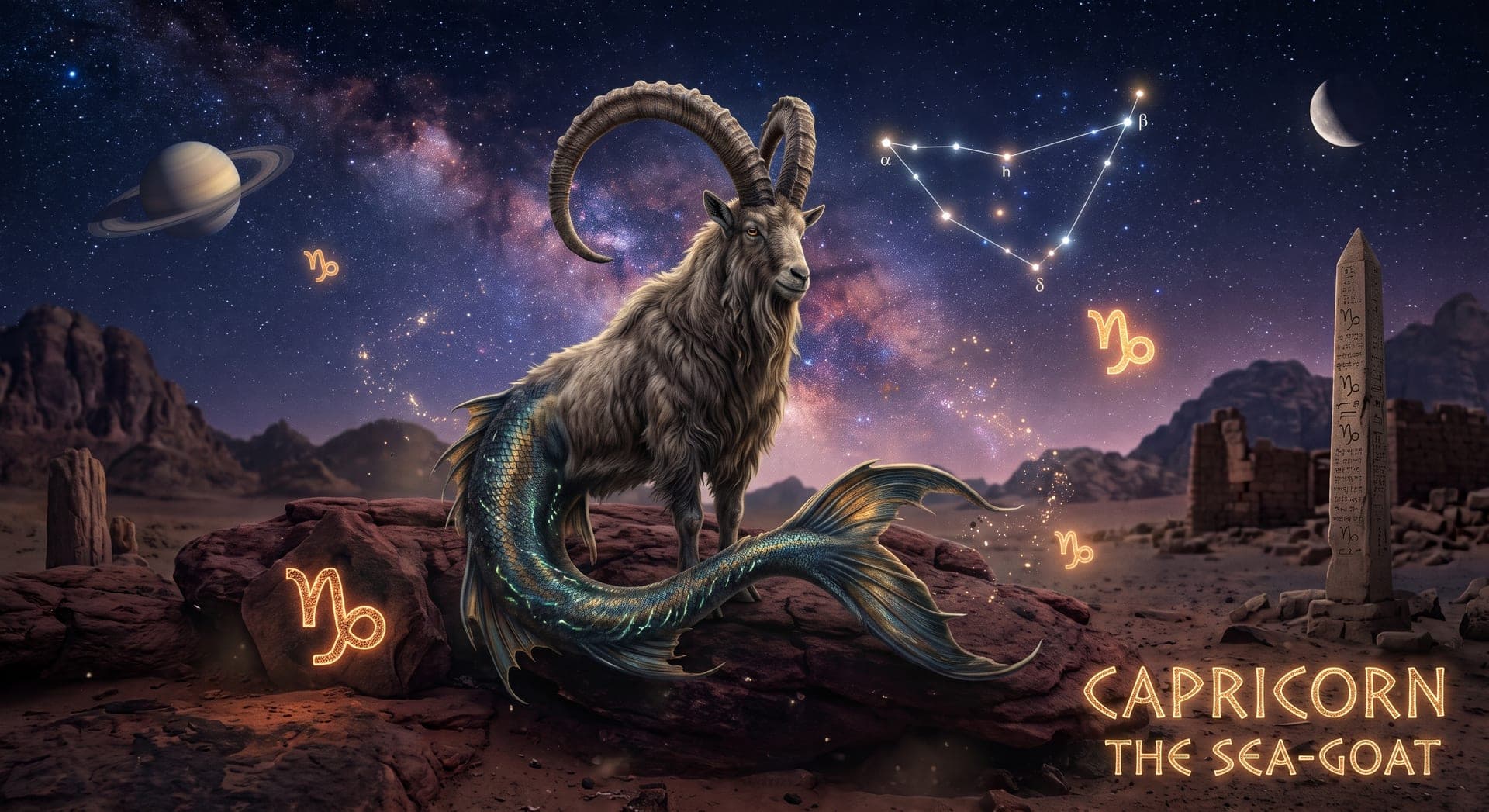
Capricorn, the tenth sign of the zodiac, spans December 22 to January 19 and is represented by the sea-goat, a mythical creature with the body of a goat and the tail of a fish, symbolizing an ability to navigate both the practical, earthly world and deeper emotional currents. Ruled by Saturn, the planet of discipline and time, Capricorns are often characterized as ambitious, patient, and deeply committed to long-term goals, willing to put in steady effort where others give up. As an Earth sign, Capricorn is grounded and practical, valuing tangible results and responsibility over impulsiveness. People born under this sign are frequently drawn to leadership and other structured pursuits where their organizational skills and work ethic can shine. Beneath a reserved, businesslike exterior, Capricorns are often said to carry a dry, understated sense of humor and a loyal, protective nature toward the people closest to them.
Personality Traits
Strengths
- Disciplined and self-controlled
- Responsible and dependable
- Excellent long-term planner
- Hardworking and persistent
- Good sense of humor once comfortable
Weaknesses
- Can be a know-it-all
- Unforgiving of mistakes, including their own
- Prone to pessimism
- Condescending toward those who don't work as hard
- Stubbornly resistant to changing plans
Compatible Signs
Fun Facts
- Capricorn's symbol, the sea-goat, comes from the Greek myth of Pan, who transformed his lower half into a fish tail to escape the monster Typhon while diving into the Nile.
- Saturn, Capricorn's ruling planet, was the Roman god of time, harvest, and generational structure, echoing the sign's association with patience and long-term thinking.
- Capricorn is one of only two zodiac signs represented by a hybrid creature, the other being Sagittarius, the centaur.
- Notable Capricorns include Michelle Obama, Martin Luther King Jr., Dolly Parton, LeBron James, and Isaac Newton.
- In traditional astrology, the winter solstice, the shortest day of the year, falls right at the start of Capricorn season in the Northern Hemisphere.
Born on January 3
- 1861
William Renshaw
English tennis player who won seven Wimbledon singles titles in the 1880s and helped popularize the modern game of lawn tennis
- 1883
Clement Attlee
English politician who served as Labour Prime Minister of the United Kingdom from 1945 to 1951, overseeing the creation of the National Health Service
- 1892
J. R. R. Tolkien
English author of "The Lord of the Rings" and "The Hobbit"
- 1905
Anna May Wong
Groundbreaking Chinese-American film actress
- 1907
Ray Milland
Welsh-American actor who won the Academy Award for Best Actor for his role in The Lost Weekend
- 1926
George Martin
English record producer and composer often called 'the fifth Beatle' for his role producing nearly all of the Beatles' albums
- 1929
Sergio Leone
Italian director famous for "Spaghetti Western" films
- 1939
Bobby Hull
Canadian ice hockey Hall of Famer
- 1942
John Thaw
English actor best known for playing the title role in the television detective series Inspector Morse
- 1946
John Paul Jones
English bassist, keyboardist, and arranger who was a founding member of the rock band Led Zeppelin
- 1956
Mel Gibson
Actor and director known for "Braveheart" and "Lethal Weapon"
- 1962
Gavin Hastings
Scottish rugby union player who captained the national team and the British and Irish Lions as a record-scoring full back
- 1969
Michael Schumacher
German Formula One driver with a record-setting career
- 2003
Greta Thunberg
Swedish climate activist

On This Day in History
- 1521
Pope Leo X excommunicates Martin Luther in the papal bull "Decet Romanum Pontificem," a defining moment of the Protestant Reformation.
The excommunication followed Luther's refusal to recant the 95 Theses and other writings that challenged papal authority and the sale of indulgences. It formally severed Luther from the Catholic Church and set the stage for his dramatic appearance before the Diet of Worms later that year. The rupture accelerated the Protestant Reformation, which would permanently fracture Western Christianity.
- 1521
Pope Leo X issues the papal bull Decet Romanum Pontificem, formally excommunicating Martin Luther from the Catholic Church.
The excommunication followed Luther's refusal to recant his writings challenging Church doctrine, particularly the sale of indulgences, after he had been given an ultimatum the previous year. The breach proved permanent and accelerated the Protestant Reformation, which would fracture Western Christianity and reshape the religious and political map of Europe for centuries.
- 1777
George Washington's forces defeat British troops at the Battle of Princeton during the American Revolutionary War.
After crossing the icy Delaware River days earlier to win at Trenton, Washington outmaneuvered Cornwallis's larger force by slipping away at night and striking the British rear guard at Princeton at dawn. The victory, though small in scale, was hugely important psychologically, proving the Continental Army could beat British regulars and reviving flagging American support for the revolution.
- 1777
American forces under General George Washington defeat British troops at the Battle of Princeton, New Jersey.
Coming just days after Washington's victory at Trenton, the battle boosted flagging American morale during a difficult winter of the Revolutionary War and forced British forces to abandon much of New Jersey. The twin victories are often credited with keeping the fledgling Continental Army intact at a critical moment in the conflict.
- 1815
Austria, the United Kingdom, and France sign a secret defensive alliance against Prussia and Russia amid disputes at the Congress of Vienna.
The treaty emerged from tensions over how to redraw Europe's map after Napoleon's defeat, particularly disagreements over the fate of Saxony and Poland. Though the alliance was never put to the test militarily, its existence illustrated how quickly wartime cooperation among the victorious powers could give way to rivalry once peace terms were being negotiated.
- 1833
Captain James Onslow of the Royal Navy reasserts British sovereignty over the Falkland Islands, expelling the Argentine garrison stationed there.
Britain had claimed the islands decades earlier but only reoccupied them after a period of Argentine settlement following independence from Spain. The move established uninterrupted British administration of the Falklands that has continued since, and the sovereignty dispute it created remained a source of tension between Britain and Argentina, culminating in the 1982 Falklands War.
- 1848
Joseph Jenkins Roberts is sworn in as the first president of Liberia.
Roberts, a free-born Black American from Virginia who emigrated to the colony founded by the American Colonization Society, led Liberia to independence from that society's oversight the previous year. As the country's first president, he worked to gain international recognition for the new republic, though Liberia's relationship with the United States, which did not recognize it until 1862, remained complicated for decades.
- 1868
Japan's Meiji Restoration begins as the Tokugawa shogunate is formally abolished.
The restoration ended over 260 years of feudal rule by the Tokugawa shoguns and nominally returned political power to Emperor Meiji, though a group of reformist samurai actually drove policy. It launched a rapid, state-directed modernization campaign that transformed Japan from an isolated agrarian society into an industrial and military power within a generation, reshaping East Asian geopolitics.
- 1868
The Tokugawa shogunate is formally abolished as Satsuma and Chōshū forces seize the imperial palace in Kyoto, launching the Meiji Restoration.
The coup restored direct imperial rule under the young Emperor Meiji after more than two and a half centuries of shogunate government. It triggered a sweeping transformation of Japan into a modern industrial and military power, ending its long period of relative isolation and reshaping its relationships with Western nations, including Britain.
- 1911
A gun battle in the East End of London leaves two dead, sparking a political row over the involvement of Home Secretary Winston Churchill.
The confrontation, later known as the Siege of Sidney Street, erupted when police and army troops surrounded a group of armed revolutionaries linked to a recent jewellery heist. Churchill personally attended the scene to observe the operation, drawing criticism that a government minister had overstepped his role, in an episode that became one of the most talked-about incidents of his early career.
- 1920
A magnitude 6.4 earthquake strikes the Mexican states of Puebla and Veracruz, killing more than 600 people.
The quake triggered landslides and mudflows around the Popocatépetl volcano that buried several villages, contributing heavily to the death toll. It remains one of the deadliest earthquakes in Mexican history and prompted early efforts to improve seismic monitoring in the region.
- 1958
The West Indies Federation is formally established, uniting ten British Caribbean colonies under a single political structure.
The federation was intended to prepare Britain's Caribbean territories for eventual independence as a single nation, following similar moves elsewhere in the decolonizing British Empire. Internal rivalries and disagreements over federal powers led to its dissolution just four years later, after which Jamaica and Trinidad and Tobago pursued independence separately.
- 1959
Alaska is admitted as the 49th U.S. state.
Alaska's admission, championed for years despite its small population and remote location, followed a 1958 congressional vote and local referendum overwhelmingly in favor of statehood. It became the first new state added to the Union in 47 years, expanding the country's land area by roughly a fifth overnight, and was quickly followed by Hawaii's admission later that same year.
- 1961
The United States severs diplomatic relations with Cuba.
The break came two years after Fidel Castro's revolutionary government seized power and began nationalizing American-owned businesses and aligning with the Soviet Union. Relations remained severed for more than half a century, through the Bay of Pigs invasion and the Cuban Missile Crisis, until a historic thaw and partial normalization was announced by Presidents Obama and Castro in 2014.
- 1977
Apple Computer, Inc. is officially incorporated.
Founded by Steve Jobs, Steve Wozniak, and Ronald Wayne in a Los Altos garage, the company had already begun selling the hand-built Apple I computer before formal incorporation. Wayne sold his 10 percent stake back to the other two founders for just $800 within two weeks, a decision that would have made him a billionaire had he kept it.
- 1977
Apple Computer, Inc. is officially incorporated by Steve Jobs, Steve Wozniak, and Ronald Wayne.
The incorporation followed roughly a year after the trio had begun selling the Apple I computer kit from Jobs's garage in Los Altos, California. The company would go on to become one of the most valuable and influential technology firms in the world, pioneering the personal computer and later the smartphone and tablet markets.
- 2009
Satoshi Nakamoto mines the Bitcoin genesis block, launching the cryptocurrency.
The genesis block, the first block of the Bitcoin blockchain, contained a hidden message referencing a newspaper headline about a British bank bailout, widely interpreted as commentary on the 2008 financial crisis that inspired the cryptocurrency's creation. Bitcoin introduced a decentralized digital currency that required no central bank, launching an entire industry of blockchain-based technologies in the years that followed.
- 2009
The first block of the Bitcoin blockchain, known as the genesis block, is mined by the cryptocurrency's pseudonymous creator, Satoshi Nakamoto.
Embedded in the block was a headline referencing a British newspaper story about a government bank bailout, widely interpreted as commentary on the instability of the traditional financial system Bitcoin was designed to circumvent. The genesis block marked the practical launch of the first decentralized digital currency, which has since spawned a vast cryptocurrency industry.
- 2019
China's Chang'e 4 probe achieves the first-ever soft landing on the far side of the Moon.
The Chang'e 4 mission required a relay satellite positioned beyond the Moon to communicate with Earth, since the far side never faces our planet directly and is impossible to reach by direct radio signal. The rover, named Yutu-2, went on to study lunar soil and geology in a region never before explored up close, expanding humanity's understanding of the Moon's mysterious hidden hemisphere.
- 2020
Iranian military commander Qasem Soleimani is killed in a U.S. airstrike near Baghdad.
Soleimani commanded Iran's elite Quds Force and was considered the architect of Iran's regional military strategy across Iraq, Syria, and Lebanon. The strike, ordered by President Trump, marked a dramatic escalation in U.S.-Iran tensions and prompted Iran to retaliate with missile strikes on U.S. bases in Iraq, bringing the two countries closer to open conflict than at any point in decades.