What’s Observed on January 2
Born on January 2: Capricorn ♑
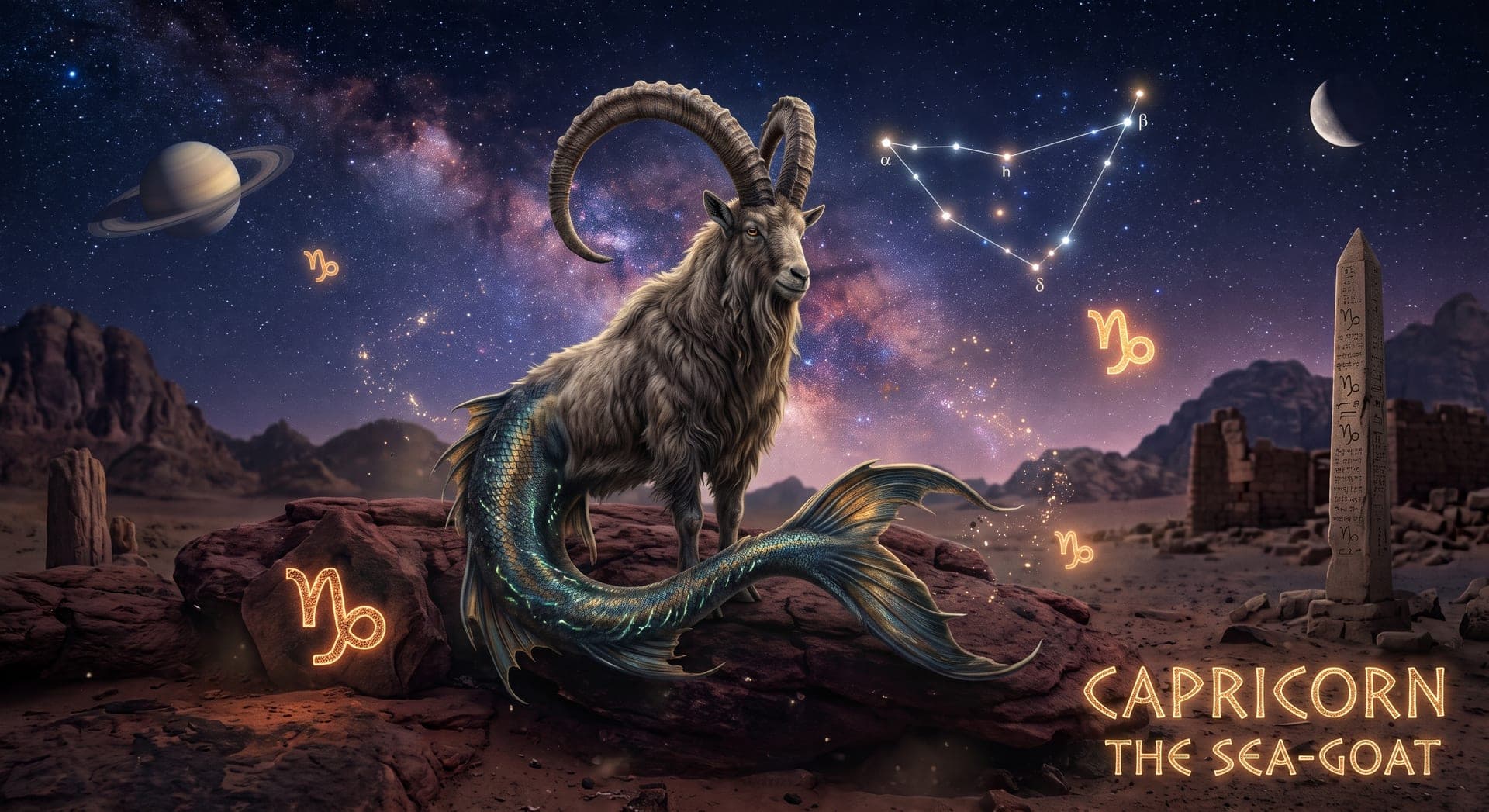
Capricorn, the tenth sign of the zodiac, spans December 22 to January 19 and is represented by the sea-goat, a mythical creature with the body of a goat and the tail of a fish, symbolizing an ability to navigate both the practical, earthly world and deeper emotional currents. Ruled by Saturn, the planet of discipline and time, Capricorns are often characterized as ambitious, patient, and deeply committed to long-term goals, willing to put in steady effort where others give up. As an Earth sign, Capricorn is grounded and practical, valuing tangible results and responsibility over impulsiveness. People born under this sign are frequently drawn to leadership and other structured pursuits where their organizational skills and work ethic can shine. Beneath a reserved, businesslike exterior, Capricorns are often said to carry a dry, understated sense of humor and a loyal, protective nature toward the people closest to them.
Personality Traits
Strengths
- Disciplined and self-controlled
- Responsible and dependable
- Excellent long-term planner
- Hardworking and persistent
- Good sense of humor once comfortable
Weaknesses
- Can be a know-it-all
- Unforgiving of mistakes, including their own
- Prone to pessimism
- Condescending toward those who don't work as hard
- Stubbornly resistant to changing plans
Compatible Signs
Fun Facts
- Capricorn's symbol, the sea-goat, comes from the Greek myth of Pan, who transformed his lower half into a fish tail to escape the monster Typhon while diving into the Nile.
- Saturn, Capricorn's ruling planet, was the Roman god of time, harvest, and generational structure, echoing the sign's association with patience and long-term thinking.
- Capricorn is one of only two zodiac signs represented by a hybrid creature, the other being Sagittarius, the centaur.
- Notable Capricorns include Michelle Obama, Martin Luther King Jr., Dolly Parton, LeBron James, and Isaac Newton.
- In traditional astrology, the winter solstice, the shortest day of the year, falls right at the start of Capricorn season in the Northern Hemisphere.
Born on January 2
- 1727
James Wolfe
English general who led British forces to victory at the Battle of the Plains of Abraham, securing Quebec, though he was killed in the fighting
- 1886
Apsley Cherry-Garrard
English explorer and author who took part in Robert Falcon Scott's fatal Terra Nova expedition to Antarctica and wrote the memoir The Worst Journey in the World
- 1903
Kane Tanaka
Japanese supercentenarian who became one of the oldest verified people in history
- 1905
Michael Tippett
English composer and conductor known for major works including the oratorio A Child of Our Time
- 1909
Barry Goldwater
American senator and 1964 Republican presidential nominee
- 1920
Isaac Asimov
Prolific science fiction author and biochemist
- 1936
Roger Miller
Country music singer-songwriter behind hits like "King of the Road"
- 1938
David Bailey
English photographer whose portraits of 1960s fashion, music, and celebrity culture helped define the era's visual style
- 1967
Tia Carrere
American actress known for "Wayne's World" and "Lilo & Stitch"
- 1968
Cuba Gooding Jr.
Academy Award-winning actor known for "Jerry Maguire"
- 1980
Kemi Badenoch
English politician who served as a Conservative cabinet minister and became leader of the Conservative Party in 2024
- 1991
Ben Hardy
English actor known for roles in the film Bohemian Rhapsody and the television series EastEnders and The Umbrella Academy

On This Day in History
- 533
Mercurius is consecrated as Pope John II, becoming the first pope to adopt a new papal name upon his elevation.
Mercurius took a new name reportedly because his birth name invoked the Roman god Mercury, considered inappropriate for a Christian pontiff. His choice began a tradition that would later become standard practice among popes, though it did not become consistent until well into the medieval period.
- 1492
The Emirate of Granada, the last Muslim stronghold in Spain, surrenders to the Catholic Monarchs, ending centuries of Moorish rule.
The fall of Granada ended nearly 800 years of Muslim presence on the Iberian Peninsula, which had begun with the Umayyad conquest in 711. The surrender was negotiated by Emir Muhammad XII, known as Boabdil, in exchange for guarantees of religious tolerance that were later broken. The same year, the newly unified Spanish crown funded Christopher Columbus's voyage west across the Atlantic.
- 1492
The Emirate of Granada, the last Muslim stronghold on the Iberian Peninsula, surrenders to the Catholic Monarchs Ferdinand and Isabella.
The fall of Granada ended nearly 800 years of Muslim rule in Spain and completed the centuries-long Reconquista. The same year, the Catholic Monarchs expelled Spain's Jewish population and funded Christopher Columbus's voyage across the Atlantic, making 1492 a pivotal turning point in European and world history.
- 1777
American forces under George Washington repulse a British attack at the Battle of the Assunpink Creek during the Revolutionary War.
The skirmish came the night after Washington's larger victory at the Second Battle of Trenton, as his outnumbered Continental Army held a defensive line along the creek against British General Cornwallis. The successful delay allowed Washington to slip away overnight and strike Princeton the next morning, a bold maneuver that revived American morale after a string of earlier defeats.
- 1788
Georgia becomes the fourth U.S. state to ratify the United States Constitution.
Georgia's quick ratification, following Delaware, Pennsylvania, and New Jersey, reflected its hope that a strong federal union would provide protection against Spanish Florida and Native American nations along its borders. Unanimous approval by the state convention made Georgia one of the least contentious ratifications, in contrast to the fierce debates that would follow in larger states like Virginia and New York.
- 1818
The Institution of Civil Engineers is founded in London, becoming the world's first professional engineering body.
Established by a group of young engineers, the institution received a royal charter in 1828 under its first president, Thomas Telford. It set out to formalize civil engineering as a profession with defined standards and qualifications, and it played a central role in supporting Britain's canal, railway, and infrastructure boom during the Industrial Revolution.
- 1863
The Battle of Stones River in Tennessee ends in a Union victory during the American Civil War.
Fought over three brutal days near Murfreesboro, Tennessee, the battle produced one of the highest casualty rates of the entire Civil War relative to the number of troops engaged. Union General William Rosecrans's costly victory boosted Northern morale at a critical moment, coming shortly after the Emancipation Proclamation took effect, and helped secure Union control of central Tennessee.
- 1863
The Battle of Stones River in Tennessee ends in a Union victory during the American Civil War, after three days of heavy fighting.
Fought between Union forces under William Rosecrans and Confederate troops under Braxton Bragg, the battle produced one of the highest casualty rates of the war relative to the number of troops engaged. The Union victory boosted Northern morale at a low point in the war and helped secure Tennessee for the Union.
- 1900
U.S. Secretary of State John Hay announces the Open Door Policy, aimed at ensuring equal trade access to China among foreign powers.
Secretary Hay's policy sought to prevent the major powers, including Britain, Russia, Japan, and Germany, from carving China into exclusive colonial spheres of influence, instead insisting on equal trading rights for all nations within China. Though never formally accepted by other powers, it became a cornerstone of American diplomatic rhetoric toward Asia for decades and reflected growing U.S. commercial ambitions abroad.
- 1900
US Secretary of State John Hay circulates the Open Door Notes, calling for equal trading rights for all nations in China.
Hay's policy sought to prevent any single power from monopolizing trade with China as European nations and Japan carved out spheres of influence there. Though it lacked binding force, the Open Door Policy became a cornerstone of American foreign policy in East Asia for decades and shaped diplomatic relations among the major powers in the region.
- 1941
German bombing during the Cardiff Blitz severely damages Llandaff Cathedral in Cardiff, Wales.
The raid was part of the wider Luftwaffe bombing campaign against British cities during the Second World War, targeting Cardiff's docks and industrial areas as well as residential neighborhoods. Llandaff Cathedral, one of Wales's most historic churches, suffered extensive structural damage and required years of restoration work after the war.
- 1959
The Soviet Union launches Luna 1, the first spacecraft to reach the vicinity of the Moon.
Luna 1 was intended to impact the Moon but missed its target by several thousand miles due to a timing error in its launch, instead becoming the first human-made object to escape Earth's gravity entirely. It confirmed the existence of the solar wind during its flight. The Soviet Union's early space successes intensified the Cold War space race that would culminate in the Moon landings a decade later.
- 1959
The Soviet Union launches Luna 1, the first spacecraft to reach the vicinity of the Moon.
Though it was intended to impact the lunar surface, Luna 1 missed its target and instead became the first man-made object to escape Earth's gravity and enter orbit around the Sun. The mission was an early triumph in the Soviet space program and intensified the space race with the United States during the Cold War.
- 1967
Ronald Reagan is sworn in as Governor of California.
Reagan's inauguration as California's 33rd governor followed a landslide 1966 election victory over incumbent Pat Brown, built on a conservative message opposing student protests and welfare spending. His two terms running the country's most populous state gave him the national profile and political experience that propelled him toward the presidency, which he won in 1980.
- 1971
A crowd crush at Ibrox Stadium in Glasgow during a football match kills 66 people.
The disaster occurred on stairway 13 as fans were leaving an Old Firm match between Rangers and Celtic, when a crush developed following a late equalizing goal. It remains the deadliest stadium disaster in British football history and led directly to major new safety legislation, the Safety of Sports Grounds Act, aimed at preventing overcrowding at similar venues.
- 1971
Sixty-six football fans are killed in a crush on a stairway at Ibrox Stadium in Glasgow following an Old Firm match between Rangers and Celtic.
The disaster occurred as spectators were leaving the stadium at the match's end, when a crowd surge caused a fatal crush on Stairway 13. It was the deadliest incident in British football history at the time and led directly to the Safety of Sports Grounds Act 1975, which introduced new safety regulations for stadiums across the country.
- 1976
A powerful windstorm begins sweeping across the United Kingdom and northern Europe, bringing severe coastal flooding and dozens of deaths.
The storm produced hurricane-force winds that battered Britain's east coast and caused extensive flooding, damaging sea defenses built after the catastrophic North Sea flood of 1953. Combined with its effects across the wider North Sea region, the storm killed more than 80 people and prompted a major review of British flood-defense infrastructure.
- 1981
Peter Sutcliffe, the serial killer known as the Yorkshire Ripper, is arrested in Sheffield, England.
Sutcliffe had murdered at least thirteen women across northern England between 1975 and 1980, evading one of the largest manhunts in British police history. He was caught almost by chance during a routine stop involving false number plates, and his arrest ended years of public fear and brought fierce scrutiny of police investigative failures.
- 2004
NASA's Stardust spacecraft flies past Comet Wild 2, successfully collecting samples later returned to Earth.
Stardust had launched in 1999 on a roughly five-billion-kilometer round trip to intercept the comet using a novel collector filled with aerogel, an ultra-light material capable of capturing high-speed dust particles without vaporizing them. The samples, returned to Earth in 2006, gave scientists their first direct physical evidence about the composition of a comet formed at the solar system's birth.
- 2022
Mass protests erupt across Kazakhstan over a sharp rise in fuel prices.
The unrest began over the government's abrupt removal of price caps on liquefied petroleum gas, a fuel widely used for cars and heating, but rapidly broadened into protests against long-standing economic inequality and authoritarian rule. The government declared a state of emergency and requested help from a Russian-led military alliance to restore order, resulting in dozens of deaths.