What’s Observed on February 6
Born on February 6: Aquarius ♒
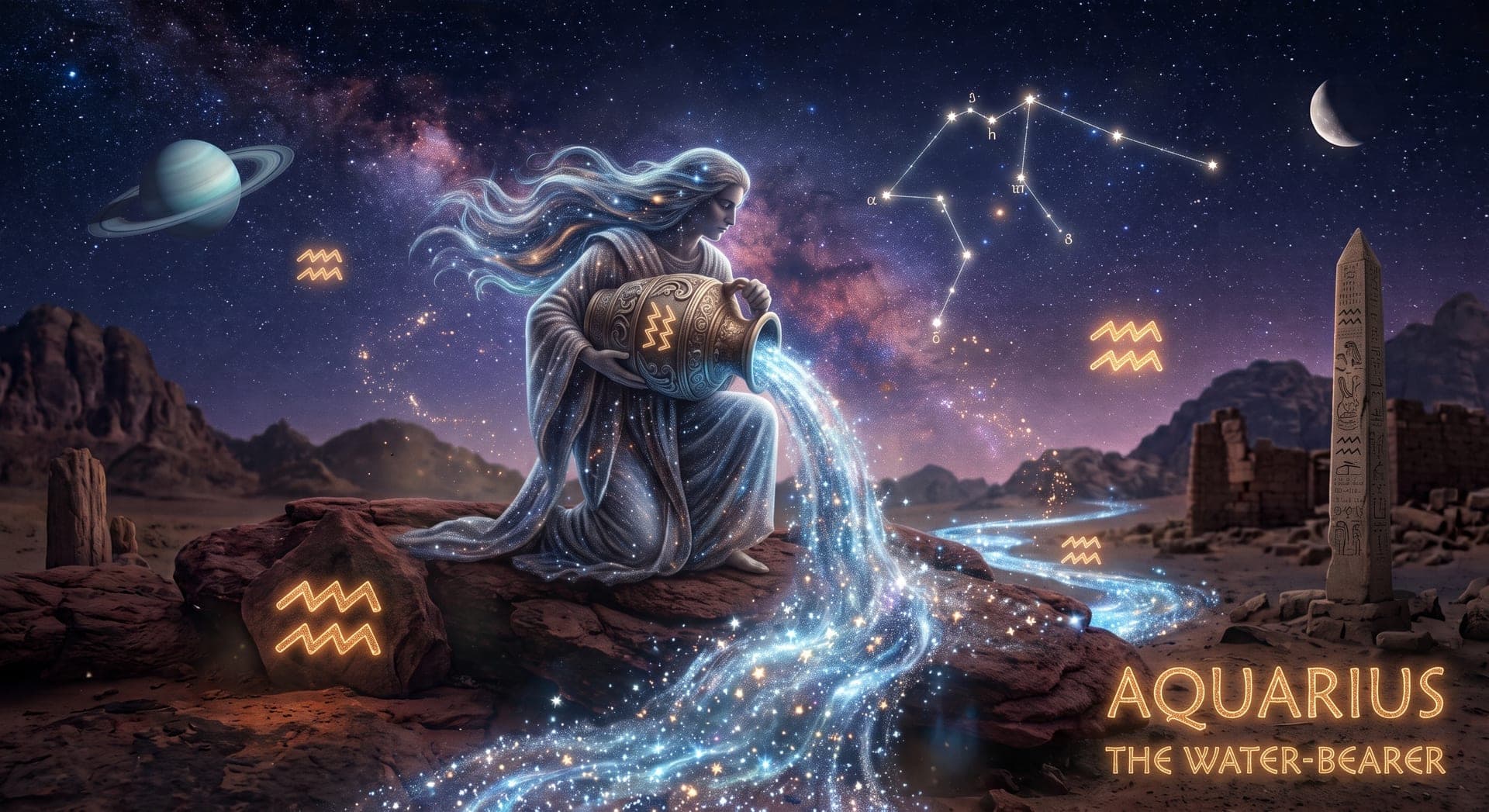
Aquarius, the eleventh sign of the zodiac, spans January 20 to February 18 and is symbolized by the water bearer, an image of someone pouring out knowledge and life-giving ideas to the world, despite Aquarius actually being an air sign rather than a water sign. Traditionally ruled by disciplined Saturn and, in modern astrology, by unpredictable Uranus, the planet of innovation and rebellion, Aquarius carries a distinctive blend of structure and originality. People born under this sign are often described as independent thinkers, forward-looking, and drawn to humanitarian causes, valuing the collective good over convention. As a Fixed sign, Aquarius can be famously stubborn once its mind is made up, even while championing change for everyone else. Intellectually curious and sometimes emotionally guarded, Aquarians tend to value friendship and community deeply, often serving as the visionary of their social circle, more comfortable debating ideas than discussing feelings.
Personality Traits
Strengths
- Original and forward-thinking
- Strong sense of fairness and justice
- Independent and self-sufficient
- Loyal to friends and causes alike
- Sees the bigger picture others miss
Weaknesses
- Can run from emotional expression
- Uncompromising once a position is fixed
- Prone to aloofness or detachment
- Sometimes contrarian just to stand apart
- Can prioritize ideas over people's feelings
Compatible Signs
Fun Facts
- Despite its watery name and imagery, Aquarius is classified as an air sign, grouped with Gemini and Libra as a sign of thought and communication rather than emotion.
- Aquarius has two ruling planets: Saturn in classical astrology, and Uranus, discovered in 1781, in the modern system most Western astrologers use today.
- The water bearer symbol traces back to Ganymede in Greek mythology, a cupbearer to the gods said to pour out a life-giving stream from the heavens.
- Notable Aquarians include Oprah Winfrey, Abraham Lincoln, Charles Darwin, Thomas Edison, and Bob Marley.
- Aquarius is one of the rarer signs to be represented by a person rather than an animal or object, alongside Gemini, Virgo, and Sagittarius's centaur half.
Born on February 6
- 1665
Anne, Queen of Great Britain
Queen of England, Scotland, and Ireland who became the first monarch of a united Great Britain following the 1707 Act of Union
- 1802
Charles Wheatstone
English physicist and inventor known for the Wheatstone bridge and his pioneering work on the electric telegraph
- 1838
Henry Irving
English actor and theatre manager, the first actor to be awarded a knighthood
- 1895
Babe Ruth
Legendary baseball slugger for the New York Yankees
- 1903
Claudio Arrau
Renowned Chilean classical pianist
- 1911
Ronald Reagan
40th President of the United States and former actor
- 1913
Mary Leakey
English-born archaeologist and paleoanthropologist who discovered important early hominid fossils in East Africa
- 1924
Billy Wright
English footballer who became the first player in the world to earn 100 international caps
- 1931
Fred Trueman
English cricketer and the first bowler in history to take 300 Test wickets
- 1966
Rick Astley
English pop singer known for his hit single 'Never Gonna Give You Up'

On This Day in History
- 1685
James II of England and VII of Scotland is proclaimed king following the death of his brother, Charles II.
James, a devout Catholic in an overwhelmingly Protestant kingdom, inherited the throne despite earlier attempts by Parliament to exclude him from the succession. His reign proved short and turbulent; his efforts to expand religious tolerance for Catholics alarmed the political establishment, and he was overthrown just three years later in the Glorious Revolution of 1688, which brought his Protestant daughter Mary and her husband William of Orange to the throne.
- 1778
The United States and France sign treaties of alliance and commerce, marking France's formal recognition of American independence and its entry into the Revolutionary War as an ally.
The treaties marked the first formal recognition of American independence by a foreign power, providing crucial military and financial support that proved decisive in the Revolutionary War. French assistance, including naval power that helped trap British forces at Yorktown, played a major role in securing the eventual American victory.
- 1788
Massachusetts becomes the sixth state to ratify the U.S. Constitution, after a contentious debate that produced early calls for a Bill of Rights.
Massachusetts's ratification came only after fierce debate and a promise from Federalist supporters that a Bill of Rights would be added, a compromise that helped secure ratification in several other closely divided states. The eventual Bill of Rights, adopted in 1791, directly reflected these ratification-era concessions.
- 1806
A British naval squadron wins a decisive victory over a French fleet at the Battle of San Domingo in the Caribbean.
The battle, fought off the coast of Santo Domingo, saw a British squadron under Vice-Admiral John Duckworth intercept and largely destroy a French force that had escaped a blockade in Europe. The victory eliminated one of the few remaining significant French naval threats following Trafalgar the previous year, further cementing British naval dominance during the Napoleonic Wars.
- 1819
The Treaty of Singapore is signed, allowing the British East India Company to establish a trading post on the island, an event now recognized as the founding of modern Singapore.
The agreement was negotiated by Sir Stamford Raffles with the local Malay rulers, granting Britain rights to develop a settlement at the mouth of the Singapore River. Its strategic location along the trade route between India and China quickly transformed the settlement into one of the busiest ports in Southeast Asia, and it remained under British rule until achieving self-government in 1959 and full independence in 1965.
- 1840
The Treaty of Waitangi is signed between the British Crown and Māori chiefs, establishing British sovereignty over New Zealand.
The treaty, signed between the British Crown and over 500 Māori chiefs, remains New Zealand's founding constitutional document, though disputed translations between the English and Māori versions have fueled ongoing legal and political conflicts over land and sovereignty rights that continue to be addressed today.
- 1840
The Treaty of Waitangi is signed between the British Crown and Māori chiefs, establishing New Zealand as a British colony.
The treaty, signed at Waitangi in the Bay of Islands, was intended to grant Māori the rights of British subjects while ceding governance to the Crown, though differences between the English and Māori-language versions of the text led to lasting disputes over its true meaning. It remains New Zealand's founding constitutional document and continues to shape debates over Māori rights and land claims today.
- 1918
British women over 30 who meet property qualifications win the right to vote, a landmark, if partial, victory for the suffrage movement.
The Representation of the People Act granted voting rights to roughly 8.4 million British women, though full equal suffrage with men, who could vote from age 21, wasn't achieved until 1928. The partial victory followed decades of suffragist campaigning, intensified by women's contributions to the workforce during World War I.
- 1918
The Representation of the People Act 1918 is passed, giving British women over the age of 30 who met certain property qualifications the right to vote.
The act was a landmark victory for the suffrage movement, which had campaigned for decades, including through the militant tactics of the suffragettes before World War I. It also abolished most property qualifications for men, nearly tripling the size of the British electorate overall. Full equal voting rights for women, on the same terms as men at age 21, would not be achieved until a further act in 1928.
- 1922
The Washington Naval Treaty is signed by Britain, the United States, Japan, France, and Italy, limiting the construction of capital warships.
The treaty set fixed tonnage ratios for battleships among the signatory powers and required Britain, which had maintained the world's largest navy for over a century, to accept naval parity with the United States for the first time. It marked a significant attempt at international arms control between the World Wars, though the restrictions gradually broke down during the 1930s as tensions escalated toward another global conflict.
- 1952
Elizabeth II becomes Queen of the United Kingdom upon the death of her father, King George VI, beginning what would become the longest reign in British history at the time.
Elizabeth learned of her accession while on a visit to Kenya, following the sudden death of her father, King George VI, from lung cancer. Her subsequent reign of over 70 years made her the longest-reigning monarch in British history until her death in 2022.
- 1952
Princess Elizabeth becomes Queen Elizabeth II of the United Kingdom upon the death of her father, King George VI.
Elizabeth learned of her father's death and her own accession while on a visit to Kenya with her husband, Prince Philip, and returned to Britain immediately to begin her reign. She was 25 years old at the time. Her coronation took place the following year at Westminster Abbey, and she went on to become the longest-reigning monarch in British history, ruling for over seventy years until her death in 2022.
- 1958
A plane carrying Manchester United's football team crashes on takeoff in Munich, killing 23 people, including eight players, in one of football's most mourned tragedies.
The Munich air disaster killed several of the "Busby Babes," a celebrated young Manchester United squad, after their plane failed to take off properly in slushy conditions during a refueling stop. Manager Matt Busby survived his injuries and rebuilt the club, which won the European Cup a decade later in a poignant tribute to those lost.
- 1958
Eight Manchester United footballers and fifteen other passengers are killed when their plane crashes on takeoff from Munich Airport.
The British European Airways charter flight was carrying the Manchester United team, known as the 'Busby Babes', home from a European Cup match in Belgrade, with a refueling stop in Munich, when it crashed after a third takeoff attempt in slushy conditions. Manager Matt Busby survived but was badly injured, and the tragedy devastated the club, which nonetheless rebuilt over the following decade to win the European Cup in 1968.
- 1989
Poland's communist government and the Solidarity opposition begin Round Table Talks, launching the process that would end communist rule across Eastern Europe.
The talks brought together representatives of Poland's communist government and the once-banned Solidarity trade union movement to negotiate a path toward political reform. The resulting agreements led to Poland's first partially free elections since World War II, a breakthrough that helped trigger the broader collapse of communist governments across Eastern Europe that year.
- 1989
The Round Table Talks between Poland's Communist government and the opposition Solidarity movement begin in Warsaw.
The negotiations brought together representatives of the ruling Communist party with Solidarity leaders, including Lech Wałęsa, whose independent trade union had been suppressed under martial law earlier in the decade. The talks led to partially free elections held in June 1989, which Solidarity won overwhelmingly, setting off a chain of events that ended Communist rule in Poland and helped trigger the wider collapse of Soviet influence across Eastern Europe.
- 2000
Russian forces capture Grozny, the Chechen capital, forcing the separatist government into exile after a brutal urban siege.
Russian forces captured the Chechen capital after a prolonged and devastating siege during the Second Chechen War, reasserting Moscow's control over the breakaway republic. The city, heavily damaged by the fighting, became a symbol of the brutal conflict that helped consolidate Vladimir Putin's early political rise.
- 2018
SpaceX's Falcon Heavy rocket makes its maiden flight, at the time the most powerful operational rocket in the world.
The Falcon Heavy's debut launch famously carried a red Tesla Roadster with a mannequin "driver" as its test payload, sending the car into a solar orbit extending beyond Mars. The successful flight demonstrated SpaceX's ability to land and recover multiple rocket boosters simultaneously, a major milestone for reusable rocket technology.
- 2018
SpaceX's Falcon Heavy rocket makes its maiden flight, becoming the most powerful operational rocket in the world at the time.
The launch, from NASA's Kennedy Space Center, notably carried Elon Musk's own Tesla Roadster as a test payload, sending it into orbit around the Sun. The mission also demonstrated the return and landing of two of the rocket's three reusable boosters, a milestone in SpaceX's effort to dramatically reduce the cost of spaceflight through reusable rocket technology.
- 2023
Twin earthquakes strike near the Turkey-Syria border, killing tens of thousands of people in one of the deadliest disasters of the 21st century.
The earthquakes struck densely populated areas of southern Turkey and northern Syria, collapsing thousands of buildings, many already weakened by years of conflict in Syria. The disaster prompted a massive international relief response and renewed scrutiny of lax building code enforcement in the affected regions.