
What’s Observed on February 5
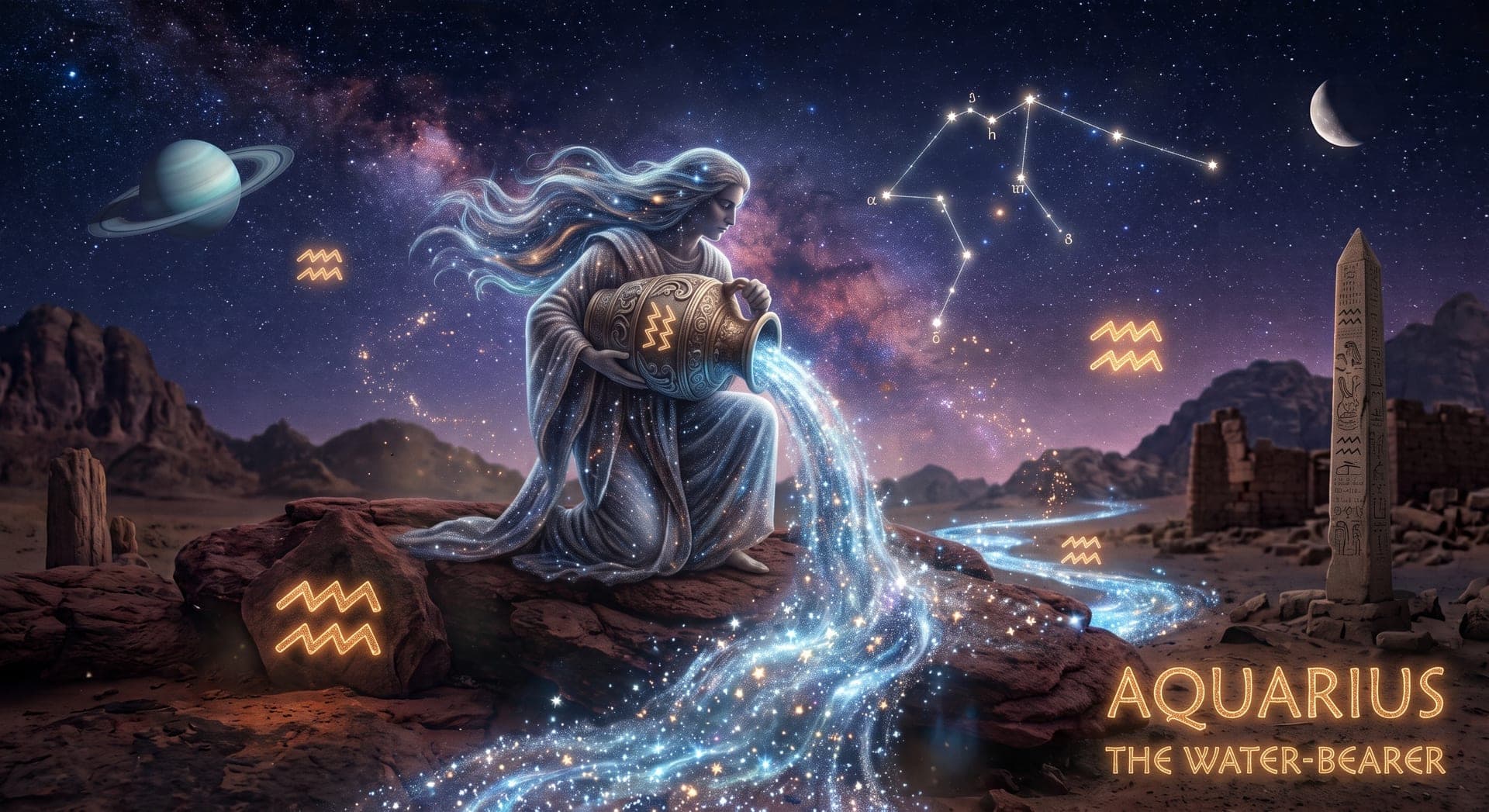
Born on February 5: Aquarius ♒
Aquarius, the eleventh sign of the zodiac, spans January 20 to February 18 and is symbolized by the water bearer, an image of someone pouring out knowledge and life-giving ideas to the world, despite Aquarius actually being an air sign rather than a water sign. Traditionally ruled by disciplined Saturn and, in modern astrology, by unpredictable Uranus, the planet of innovation and rebellion, Aquarius carries a distinctive blend of structure and originality. People born under this sign are often described as independent thinkers, forward-looking, and drawn to humanitarian causes, valuing the collective good over convention. As a Fixed sign, Aquarius can be famously stubborn once its mind is made up, even while championing change for everyone else. Intellectually curious and sometimes emotionally guarded, Aquarians tend to value friendship and community deeply, often serving as the visionary of their social circle, more comfortable debating ideas than discussing feelings.
Personality Traits
Strengths
- Original and forward-thinking
- Strong sense of fairness and justice
- Independent and self-sufficient
- Loyal to friends and causes alike
- Sees the bigger picture others miss
Weaknesses
- Can run from emotional expression
- Uncompromising once a position is fixed
- Prone to aloofness or detachment
- Sometimes contrarian just to stand apart
- Can prioritize ideas over people's feelings
Compatible Signs
Fun Facts
- Despite its watery name and imagery, Aquarius is classified as an air sign, grouped with Gemini and Libra as a sign of thought and communication rather than emotion.
- Aquarius has two ruling planets: Saturn in classical astrology, and Uranus, discovered in 1781, in the modern system most Western astrologers use today.
- The water bearer symbol traces back to Ganymede in Greek mythology, a cupbearer to the gods said to pour out a life-giving stream from the heavens.
- Notable Aquarians include Oprah Winfrey, Abraham Lincoln, Charles Darwin, Thomas Edison, and Bob Marley.
- Aquarius is one of the rarer signs to be represented by a person rather than an animal or object, alongside Gemini, Virgo, and Sagittarius's centaur half.
Born on February 5
- 1788
Robert Peel
English statesman who served twice as Prime Minister of the United Kingdom and founded London's Metropolitan Police force
- 1840
John Boyd Dunlop
Scottish inventor and businessman who developed the first practical pneumatic tire and co-founded Dunlop Rubber
- 1914
William S. Burroughs
Influential Beat Generation novelist
- 1914
Alan Lloyd Hodgkin
English physiologist who shared the Nobel Prize for uncovering how nerve cells transmit electrical impulses
- 1934
Hank Aaron
Baseball Hall of Famer and former home run record holder
- 1940
H. R. Giger
Swiss artist who designed the creature for "Alien"
- 1946
Charlotte Rampling
English actress known for her roles in films such as The Night Porter and 45 Years
- 1948
Barbara Hershey
American actress with a decades-long film career
- 1948
Christopher Guest
British-American actor and director known for mockumentary films including This Is Spinal Tap and Best in Show
- 1948
Tom Wilkinson
English actor known for his roles in films including The Full Monty and Michael Clayton
- 1962
Jennifer Jason Leigh
American actress and filmmaker
- 1964
Laura Linney
Acclaimed American film and television actress
- 1969
Michael Sheen
Welsh actor known for portraying Tony Blair and David Frost in acclaimed film roles
- 1985
Cristiano Ronaldo
Portuguese footballer and one of the sport's greatest goal scorers
- 1992
Neymar
Brazilian footballer and international star
On This Day in History
- 2 BCE
The Roman Senate grants Caesar Augustus the honorary title "pater patriae," or father of the country, cementing his status as the empire's revered founding ruler.
The honorific title, roughly meaning "father of the fatherland," was among the highest honors the Roman Senate could bestow, reflecting Augustus's transformation of Rome from a war-torn republic into a stable empire. He reportedly considered it one of the greatest achievements of his reign, second only to ending decades of civil war.
- 62
A powerful earthquake devastates Pompeii and the surrounding region, causing damage the city was still repairing when Mount Vesuvius erupted seventeen years later.
The earthquake caused significant damage to Pompeii's buildings, temples, and infrastructure, and ancient accounts describe panic and superstitious fear that it might be a divine omen. Archaeological evidence shows the city was still undergoing repairs when Vesuvius's catastrophic eruption in 79 CE buried it and neighboring Herculaneum under volcanic ash.
- 1810
The Siege of Cádiz begins as French forces attempt to capture one of the last unconquered cities in Spain during the Peninsular War.
With most of Spain under French occupation, Cádiz became the seat of the Spanish resistance government and a vital port for British supplies and reinforcements. A combined Spanish, British, and Portuguese garrison, backed by the Royal Navy's control of the harbor, held the city against the siege for more than two years. Cádiz's successful defense allowed Spain's liberal Cortes to convene there and draft the influential Constitution of 1812.
- 1818
French-born marshal Jean-Baptiste Bernadotte ascends the thrones of Sweden and Norway, founding the House of Bernadotte, which still reigns in Sweden today.
Bernadotte, a former marshal under Napoleon, was elected heir to the Swedish throne after the country's royal line ran short of successors, an unusual choice of a foreign military commander with no Swedish royal blood. His pragmatic decision to align Sweden against his former emperor helped the country avoid the worst of the Napoleonic Wars' devastation.
- 1901
Financier J.P. Morgan incorporates the United States Steel Corporation in New Jersey.
Formed through the merger of Andrew Carnegie's steel empire with several other major producers, U.S. Steel became the world's first billion-dollar corporation and, at the time, the largest company in the world. Its creation marked the height of the era of industrial consolidation in the United States and made Morgan one of the most powerful financiers in American history.
- 1907
Belgian chemist Leo Baekeland announces Bakelite, the world's first fully synthetic plastic, launching the modern plastics industry.
Baekeland's invention resulted from experiments seeking a synthetic substitute for shellac, a natural resin used as an electrical insulator. Bakelite's durability, heat resistance, and moldability made it enormously popular for everything from telephones and radios to jewelry, and it is widely regarded as launching the modern age of plastics.
- 1907
Chemist Leo Baekeland announces the invention of Bakelite, the world's first fully synthetic plastic.
Unlike earlier semi-synthetic materials such as celluloid, Bakelite was made entirely from synthetic components and could be molded into durable, heat-resistant shapes, making it ideal for everything from telephones and radios to jewelry and firearms. Its success launched the modern plastics industry, and Baekeland's invention is widely regarded as a foundational moment in twentieth-century materials science and industrial design.
- 1917
Mexico adopts its current constitution, establishing a federal republic and enshrining sweeping labor and land reforms.
Drafted in the aftermath of the Mexican Revolution, the constitution enshrined progressive protections for workers, land redistribution provisions aimed at breaking up large estates, and restrictions on the power of the Catholic Church. Though frequently amended since, it remains the foundational legal document of the modern Mexican state.
- 1918
The British-registered liner SS Tuscania, serving as an American troop transport, is torpedoed by a German U-boat off the coast of Ireland.
The sinking caused significant loss of life among the American soldiers and crew aboard, marking the first time a ship carrying US troops was sunk during World War I. The disaster underscored the danger German submarines posed to the transatlantic convoys ferrying American forces to the European front, and helped prompt improvements to convoy escort and anti-submarine tactics for the remainder of the war.
- 1919
Film stars Charlie Chaplin, Mary Pickford, and Douglas Fairbanks, together with director D. W. Griffith, launch the studio United Artists.
The four founders, among the biggest names in early Hollywood, formed the company to gain greater creative and financial control over their own films, free from the constraints of the large studios that dominated the industry at the time. English-born Chaplin, already one of the world's most famous entertainers, used the studio to produce and distribute some of his most celebrated later films, including The Gold Rush and City Lights.
- 1924
The Royal Greenwich Observatory begins broadcasting hourly time signals, forerunners of the BBC's famous 'pips'.
The signals, based on the Greenwich Mean Time standard the observatory had defined since the nineteenth century, were transmitted in partnership with the BBC and quickly became a fixture of British radio, allowing listeners across the country to set their clocks precisely. Greenwich's role as the world's reference point for timekeeping and longitude had been formalized decades earlier at the 1884 International Meridian Conference.
- 1941
Allied forces, largely made up of British and Commonwealth troops, begin the Battle of Keren to capture the fortified Eritrean town from Italian forces.
The battle formed part of the East African Campaign, fought as Britain sought to eliminate Italy's colonial presence in the Horn of Africa. Indian, British, and Free French troops faced fierce Italian and colonial resistance in the mountainous terrain around Keren before finally breaking through after weeks of hard fighting the following month. The victory paved the way for the fall of the Italian colonial capital, Asmara.
- 1945
General Douglas MacArthur returns to Manila as Allied forces liberate the Philippine capital from Japanese occupation.
MacArthur's return fulfilled a promise he had made nearly three years earlier upon evacuating the Philippines ahead of the Japanese invasion, famously declaring "I shall return." The recapture of Manila came at a heavy cost, however, with brutal urban fighting and Japanese atrocities against civilians causing massive destruction and loss of life.
- 1958
A U.S. Air Force bomber jettisons a hydrogen bomb off the coast of Georgia after a mid-air collision; the weapon, known as the Tybee Bomb, was never recovered.
During a training exercise, a mid-air collision forced the bomber crew to jettison the Mark 15 nuclear bomb into shallow coastal waters near Savannah to prevent it from detonating during an emergency landing. Despite extensive Air Force searches over the following decades, the weapon, believed to lack its plutonium core, has never been recovered.
- 1962
French President Charles de Gaulle publicly calls for Algerian independence, signaling a major shift in France's colonial policy.
De Gaulle's statement came after years of brutal conflict in the Algerian War, which had bitterly divided French society and even prompted an attempted military coup against his own government. His acceptance of Algerian self-determination paved the way for the Évian Accords, signed shortly afterward, which ended the war and led to Algeria's independence from France in July 1962.
- 1971
Astronauts Alan Shepard and Edgar Mitchell land on the Moon during the Apollo 14 mission, the third crewed lunar landing.
Shepard and Mitchell's mission collected the largest haul of lunar rock samples up to that point, and Shepard famously hit two golf balls across the surface using a makeshift club. The mission successfully redirected NASA's program after Apollo 13's near-disastrous failure the previous year.
- 1971
Astronauts Alan Shepard and Edgar Mitchell land on the Moon as part of NASA's Apollo 14 mission.
The mission marked the third crewed Moon landing and returned the space program to success after the near-disastrous Apollo 13 flight the previous year. Shepard, who had been the first American in space back in 1961, became the fifth person to walk on the Moon and famously hit two golf balls across the lunar surface during the mission's final moonwalk.
- 1994
Byron De La Beckwith is convicted of the 1963 assassination of civil rights leader Medgar Evers, more than three decades after the murder.
Beckwith, a white supremacist, had twice escaped conviction in the 1960s after two trials ended in hung juries composed entirely of white jurors. The case was reopened in the early 1990s after new evidence emerged, and a racially mixed jury finally convicted him in 1994. The long-delayed verdict was seen as a landmark moment in the pursuit of justice for civil rights-era crimes.
- 2016
Hackers attempt to steal nearly $1 billion from Bangladesh's central bank, successfully transferring $101 million before spelling errors in a fraudulent request triggered suspicion.
The Bangladesh Bank cyberheist exploited the SWIFT international banking messaging system to issue fraudulent transfer requests, routing stolen funds through casinos in the Philippines. A simple spelling error, "fandation" instead of "foundation," in one transfer request alerted a routing bank and helped block billions more in attempted theft.
- 2020
The U.S. Senate acquits President Donald Trump in his first impeachment trial, largely along party lines.
The Senate acquitted Trump on charges of abuse of power and obstruction of Congress related to his dealings with Ukraine, with only one senator from his own party voting to convict on one of the two charges. It marked just the third presidential impeachment trial in U.S. history to that point.