
What’s Observed on February 4
Born on February 4: Aquarius ♒
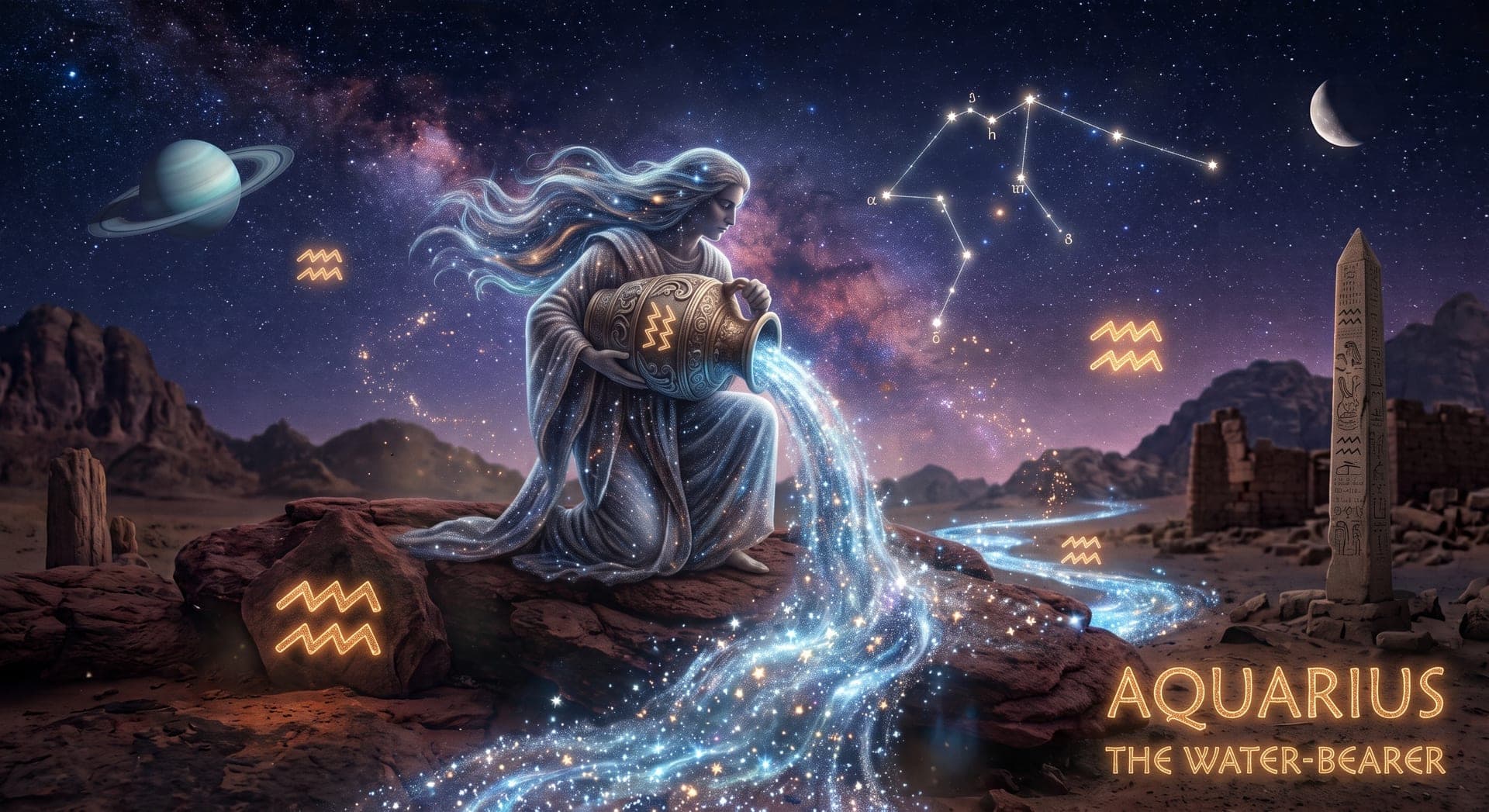
Aquarius, the eleventh sign of the zodiac, spans January 20 to February 18 and is symbolized by the water bearer, an image of someone pouring out knowledge and life-giving ideas to the world, despite Aquarius actually being an air sign rather than a water sign. Traditionally ruled by disciplined Saturn and, in modern astrology, by unpredictable Uranus, the planet of innovation and rebellion, Aquarius carries a distinctive blend of structure and originality. People born under this sign are often described as independent thinkers, forward-looking, and drawn to humanitarian causes, valuing the collective good over convention. As a Fixed sign, Aquarius can be famously stubborn once its mind is made up, even while championing change for everyone else. Intellectually curious and sometimes emotionally guarded, Aquarians tend to value friendship and community deeply, often serving as the visionary of their social circle, more comfortable debating ideas than discussing feelings.
Personality Traits
Strengths
- Original and forward-thinking
- Strong sense of fairness and justice
- Independent and self-sufficient
- Loyal to friends and causes alike
- Sees the bigger picture others miss
Weaknesses
- Can run from emotional expression
- Uncompromising once a position is fixed
- Prone to aloofness or detachment
- Sometimes contrarian just to stand apart
- Can prioritize ideas over people's feelings
Compatible Signs
Fun Facts
- Despite its watery name and imagery, Aquarius is classified as an air sign, grouped with Gemini and Libra as a sign of thought and communication rather than emotion.
- Aquarius has two ruling planets: Saturn in classical astrology, and Uranus, discovered in 1781, in the modern system most Western astrologers use today.
- The water bearer symbol traces back to Ganymede in Greek mythology, a cupbearer to the gods said to pour out a life-giving stream from the heavens.
- Notable Aquarians include Oprah Winfrey, Abraham Lincoln, Charles Darwin, Thomas Edison, and Bob Marley.
- Aquarius is one of the rarer signs to be represented by a person rather than an animal or object, alongside Gemini, Virgo, and Sagittarius's centaur half.
Born on February 4
- 1868
Constance Markievicz
Revolutionary and politician born in London who became the first woman elected to the UK House of Commons, though she never took her seat
- 1895
Nigel Bruce
English actor best remembered for playing Dr. Watson opposite Basil Rathbone's Sherlock Holmes in a long-running film series
- 1902
Charles Lindbergh
Aviator who made the first solo nonstop transatlantic flight
- 1905
Hylda Baker
English comedian and music hall performer known for her catchphrase-laden comic act and malapropisms
- 1906
Clyde Tombaugh
American astronomer who discovered Pluto
- 1913
Rosa Parks
Civil rights icon whose bus protest sparked the Montgomery boycott
- 1915
Norman Wisdom
English comedian, actor, and singer-songwriter known for his slapstick film comedies and his enduring popularity in Albania
- 1918
Ida Lupino
English-American actress and one of Hollywood's few female film directors of the 1950s
- 1921
Betty Friedan
Author and pioneering feminist activist
- 1925
Christopher Zeeman
English mathematician known for his work in topology and for founding catastrophe theory
- 1948
Alice Cooper
Rock musician known as the "Godfather of Shock Rock"
- 1957
Matthew Cobb
British zoologist and author known for his popular science writing on genetics and the history of science
- 1973
Oscar De La Hoya
Olympic and world champion boxer
- 1975
Natalie Imbruglia
Australian singer-songwriter and actress
On This Day in History
- 211
Roman Emperor Septimius Severus dies at Eboracum, in what is now York, England, while preparing a campaign against the Caledonian tribes.
Severus had traveled to Britain with his sons Caracalla and Geta to lead a major military campaign into Scotland, but fell ill and died at the imperial headquarters in York. On his deathbed he urged his quarrelling sons to rule jointly and stay united, but the pair, who despised each other, abandoned the Caledonian campaign and returned to Rome, where Caracalla soon had Geta murdered.
- 960
General Zhao Kuangyin declares himself Emperor Taizu of Song, founding China's Song dynasty after the fall of the Later Zhou.
Zhao Kuangyin, a respected general, seized power in a largely bloodless coup after his troops proclaimed him emperor, reportedly against his own initial wishes. His Song dynasty went on to preside over a golden age of Chinese economic growth, technological innovation, and culture, including the widespread use of paper money and gunpowder weapons.
- 1555
Clergyman John Rogers is burned at the stake in London, becoming the first English Protestant executed for heresy under Queen Mary I.
Rogers, a Bible translator and preacher, was condemned for refusing to renounce his Protestant faith after Mary I, a devout Catholic, moved to reverse the English Reformation begun by her father, Henry VIII. His death at Smithfield marked the start of the Marian persecutions, in which some 280 Protestants were burned over the following four years, an era that earned the queen the epithet 'Bloody Mary'.
- 1789
George Washington is unanimously elected the first President of the United States by the Electoral College.
Washington's election was a formality reflecting the near-universal respect he commanded after leading the Continental Army to victory, and he remains the only U.S. president to receive 100 percent of the electoral vote. He was inaugurated weeks later in New York City, the nation's first capital.
- 1794
Revolutionary France's National Convention abolishes slavery throughout French territories, though Napoleon would later reinstate it in the colonies.
The abolition decree, passed amid the radical phase of the French Revolution, was a response partly to the massive slave uprising already underway in the colony of Saint-Domingue. Napoleon reversed the policy in 1802, attempting to restore slavery in the colonies, a decision that fueled the successful Haitian independence movement.
- 1810
British forces seize the French Caribbean island of Guadeloupe during the Napoleonic Wars.
The invasion was part of a broader British campaign to strip France of its Caribbean colonies, valuable for their sugar production and as bases for privateers preying on British shipping. British troops, supported by the Royal Navy, overcame French defenses after several weeks of fighting. Guadeloupe remained under British control until it was returned to France following Napoleon's final defeat in 1815.
- 1820
The Chilean Navy, under the command of British officer Lord Cochrane, completes the capture of the Spanish stronghold of Valdivia with just 300 men and two ships.
Cochrane, a celebrated but controversial Royal Navy officer, had taken command of Chile's fledgling navy after being expelled from the British service over a stock exchange scandal. His daring assault on Valdivia's supposedly impregnable fortifications, achieved through surprise and audacity rather than numbers, was one of the most celebrated feats of the Chilean War of Independence and cemented his reputation as a brilliant naval tactician.
- 1861
Delegates from seceded Southern states meet in Montgomery, Alabama, to begin forming the Confederate States of America.
Delegates from six seceded states convened in Montgomery to draft a provisional constitution and elect Jefferson Davis as president just days later. Montgomery served as the Confederacy's first capital before the government relocated to Richmond, Virginia, a few months after the war began.
- 1938
Adolf Hitler appoints himself head of the German Armed Forces High Command, abolishing the War Ministry.
The move followed a manufactured scandal that forced the resignations of War Minister Werner von Blomberg and army commander-in-chief Werner von Fritsch, both seen as insufficiently enthusiastic about Hitler's aggressive foreign policy. By taking direct personal command of the military, Hitler eliminated an important check on his power and cleared the way for the rapid rearmament and expansionist moves that led to World War II.
- 1945
The Yalta Conference opens in Crimea, where Churchill, Roosevelt, and Stalin negotiate the postwar reorganization of Europe.
Meeting at a former tsarist palace in Crimea, the three Allied leaders negotiated the postwar division of Germany into occupation zones, the structure of the future United Nations, and Soviet entry into the war against Japan. The conference's compromises, particularly regarding Poland and Eastern Europe, later drew criticism for effectively ceding the region to Soviet influence.
- 1945
The Yalta Conference between Winston Churchill, Franklin D. Roosevelt, and Joseph Stalin opens at the Livadia Palace in Crimea.
With Germany's defeat in World War II now assured, the 'Big Three' Allied leaders met to plan the postwar order, including the division of Germany into occupation zones, the establishment of the United Nations, and Soviet entry into the war against Japan. The agreements reached at Yalta, particularly regarding the fate of Eastern Europe, remain controversial, seen by critics as effectively ceding the region to Soviet domination.
- 1945
British Indian Army forces begin a series of battles against the Imperial Japanese Army around Pokoku and the Irrawaddy River in Burma.
The operations formed part of the wider Burma Campaign, in which General William Slim's Fourteenth Army sought to cross the Irrawaddy River and advance on the Japanese-held city of Mandalay. Crossing the river under fire was a major logistical and tactical challenge, but the campaign's eventual success proved decisive in driving Japanese forces out of Burma later in 1945.
- 1948
Ceylon, later renamed Sri Lanka, gains independence from Britain within the Commonwealth.
Ceylon's independence came through a negotiated transfer of power rather than armed struggle, following a gradual process of constitutional reform under British rule. The country was renamed Sri Lanka in 1972 after adopting a new republican constitution that severed its remaining formal ties to the British crown.
- 1948
Ceylon, now known as Sri Lanka, becomes an independent dominion within the British Commonwealth.
Independence came after decades of gradual constitutional reform under British colonial rule, achieved largely through peaceful negotiation rather than armed struggle. Don Stephen Senanayake became the country's first prime minister. Ceylon retained the British monarch as head of state until 1972, when it adopted a republican constitution and formally changed its name to Sri Lanka.
- 1961
The Angolan War of Independence begins, part of a broader Portuguese Colonial War that would drag on for over a decade.
Angolan nationalist guerrillas launched coordinated attacks on colonial targets in Luanda, beginning a 13-year armed struggle against Portuguese rule. The conflict, fought alongside similar independence wars in Portugal's other African colonies, eventually contributed to the collapse of Portugal's own authoritarian government in 1974 and led to Angolan independence the following year.
- 1974
Newspaper heiress Patty Hearst is kidnapped from her Berkeley apartment by the radical Symbionese Liberation Army.
Hearst, granddaughter of publishing magnate William Randolph Hearst, was abducted at gunpoint from her apartment by members of a small radical group. In a bizarre turn, she later appeared in a bank robbery committed by her captors, claiming to have joined their cause, a case that became a sensational and legally contested media spectacle.
- 1974
The Provisional IRA detonates a bomb on a coach carrying off-duty British Armed Forces personnel and their families on the M62 motorway in Yorkshire, killing twelve.
The blast, which struck a coach traveling between Manchester and a British Army base, killed nine soldiers and three civilians, including two young children. It was one of the deadliest attacks of the early years of the Troubles to occur on the British mainland. Judith Ward was wrongly convicted of the bombing and spent eighteen years in prison before her conviction was overturned in 1992.
- 1976
A devastating earthquake strikes Guatemala, killing more than 22,000 people and leaving over a million homeless.
The earthquake struck early in the morning while many people were still asleep in vulnerable adobe and unreinforced masonry homes, contributing to the massive death toll. The disaster prompted significant reforms to Guatemalan and regional building codes and drew large-scale international humanitarian relief efforts.
- 2004
Mark Zuckerberg and Eduardo Saverin launch Facebook from a Harvard dorm room, a social network that would eventually reshape global communication.
Originally launched as a Harvard-only social network called "TheFacebook," the site expanded to other universities and eventually the general public over the following years. It grew into one of the largest companies in the world, fundamentally reshaping advertising, media, and interpersonal communication while also drawing scrutiny over privacy and misinformation.
- 2004
Mark Zuckerberg launches Facebook, a social networking website, from his dormitory room at Harvard University.
Originally created as a networking site restricted to Harvard students, Facebook was co-founded with fellow students including Eduardo Saverin, Andrew McCollum, Dustin Moskovitz, and Chris Hughes. It rapidly expanded to other universities and then the general public, eventually growing into one of the largest social media platforms in the world with billions of users, and reshaping how people communicate, share news, and consume media.