
What’s Observed on February 3
Born on February 3: Aquarius ♒
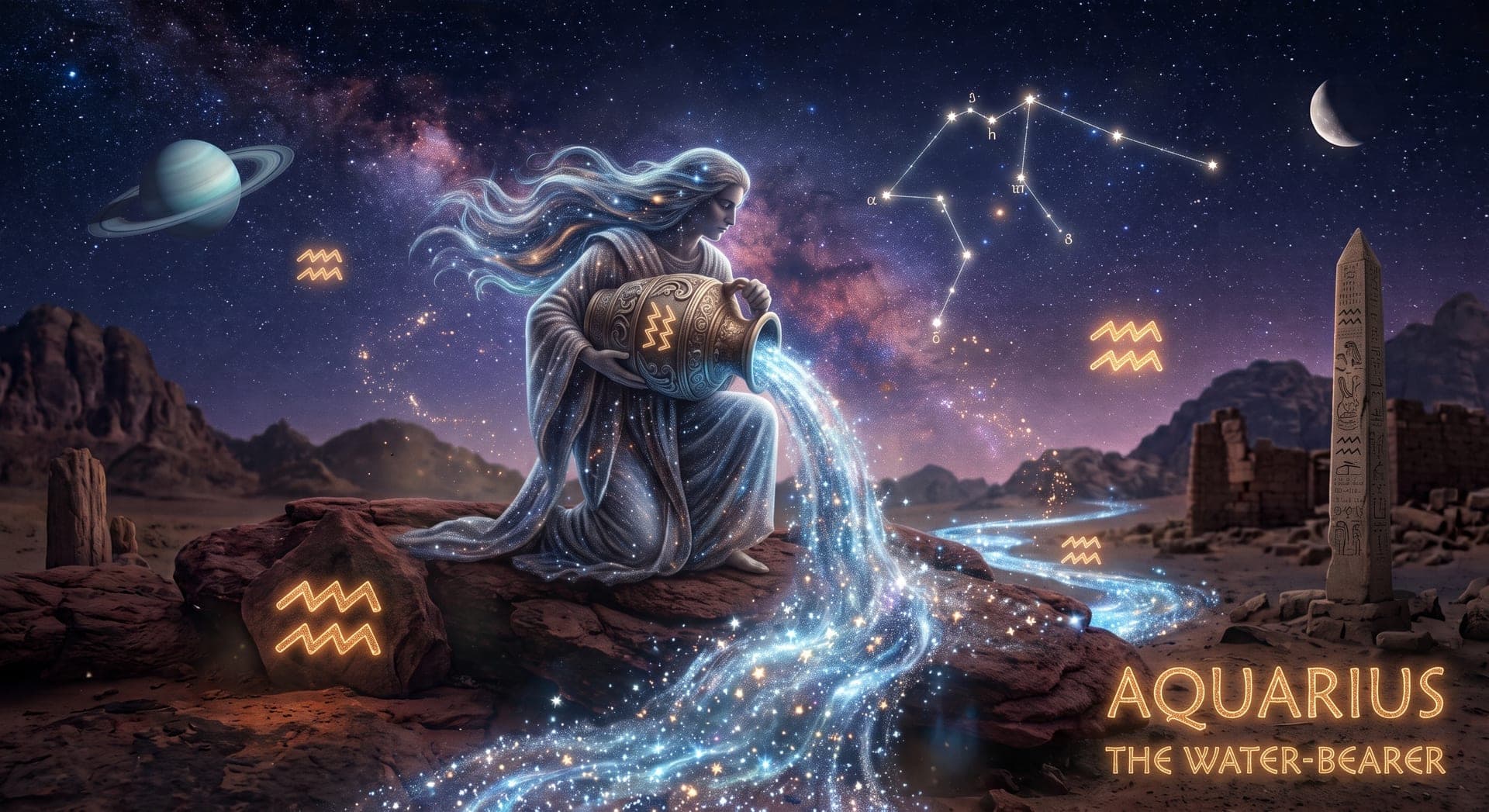
Aquarius, the eleventh sign of the zodiac, spans January 20 to February 18 and is symbolized by the water bearer, an image of someone pouring out knowledge and life-giving ideas to the world, despite Aquarius actually being an air sign rather than a water sign. Traditionally ruled by disciplined Saturn and, in modern astrology, by unpredictable Uranus, the planet of innovation and rebellion, Aquarius carries a distinctive blend of structure and originality. People born under this sign are often described as independent thinkers, forward-looking, and drawn to humanitarian causes, valuing the collective good over convention. As a Fixed sign, Aquarius can be famously stubborn once its mind is made up, even while championing change for everyone else. Intellectually curious and sometimes emotionally guarded, Aquarians tend to value friendship and community deeply, often serving as the visionary of their social circle, more comfortable debating ideas than discussing feelings.
Personality Traits
Strengths
- Original and forward-thinking
- Strong sense of fairness and justice
- Independent and self-sufficient
- Loyal to friends and causes alike
- Sees the bigger picture others miss
Weaknesses
- Can run from emotional expression
- Uncompromising once a position is fixed
- Prone to aloofness or detachment
- Sometimes contrarian just to stand apart
- Can prioritize ideas over people's feelings
Compatible Signs
Fun Facts
- Despite its watery name and imagery, Aquarius is classified as an air sign, grouped with Gemini and Libra as a sign of thought and communication rather than emotion.
- Aquarius has two ruling planets: Saturn in classical astrology, and Uranus, discovered in 1781, in the modern system most Western astrologers use today.
- The water bearer symbol traces back to Ganymede in Greek mythology, a cupbearer to the gods said to pour out a life-giving stream from the heavens.
- Notable Aquarians include Oprah Winfrey, Abraham Lincoln, Charles Darwin, Thomas Edison, and Bob Marley.
- Aquarius is one of the rarer signs to be represented by a person rather than an animal or object, alongside Gemini, Virgo, and Sagittarius's centaur half.
Born on February 3
- 1790
Gideon Mantell
English scientist and obstetrician whose discovery of Iguanodon fossils helped establish the study of dinosaurs
- 1809
Felix Mendelssohn
German Romantic-era composer and conductor
- 1821
Elizabeth Blackwell
English-born physician who became the first woman to receive a medical degree in the United States
- 1826
Walter Bagehot
English journalist and essayist who edited The Economist and wrote influential works on the British constitution and economics
- 1830
Robert Gascoyne-Cecil
English statesman who served three times as Prime Minister of the United Kingdom during the late Victorian era
- 1874
Gertrude Stein
American novelist, poet, and modernist art patron
- 1894
Norman Rockwell
American painter celebrated for iconic magazine illustrations
- 1898
Alvar Aalto
Finnish architect and design pioneer
- 1903
Douglas Douglas-Hamilton
Scottish soldier and pilot, 14th Duke of Hamilton, who led the first flight over Mount Everest
- 1907
James A. Michener
American author of sweeping historical novels
- 1924
E. P. Thompson
English historian and author best known for The Making of the English Working Class
- 1947
Dave Davies
English guitarist and songwriter, co-founder of the rock band the Kinks
- 1977
Daddy Yankee
Puerto Rican reggaeton artist
- 1978
Amal Clooney
British-Lebanese human rights lawyer

On This Day in History
- 1451
Mehmed II inherits the Ottoman throne, going on to conquer Constantinople two years later and end the Byzantine Empire.
Mehmed II inherited the Ottoman throne as a young teenager and quickly proved a formidable military strategist, orchestrating the 1453 siege that finally captured Constantinople after centuries of failed attempts by earlier Muslim rulers. The conquest ended the thousand-year-old Byzantine Empire and secured Ottoman control over a crucial crossroads between Europe and Asia.
- 1488
Portuguese explorer Bartolomeu Dias becomes the first known European to round the southern tip of Africa, opening a sea route toward Asia.
Dias's voyage, commissioned by the Portuguese crown to find a sea route around Africa, was nearly cut short by a mutinous crew demanding to turn back. His discovery of the passage around what he named the "Cape of Storms," later renamed the Cape of Good Hope, opened the way for Vasco da Gama's historic voyage to India a decade later.
- 1583
Three English warships under navigator Edward Fenton engage three Spanish galleons off Portuguese Brazil at the Battle of São Vicente, sinking one.
Fenton had originally set out from England in 1582 on an expedition intended to reach the East Indies via the Strait of Magellan, part of a broader English effort to challenge Spanish and Portuguese dominance of overseas trade. The expedition never reached its goal, but the clash off Brazil stood as one of the earliest naval engagements between English and Spanish forces in the Americas, foreshadowing the larger Anglo-Spanish War.
- 1637
Speculative trading in tulip bulbs collapses in the Dutch Republic, an episode often cited as one of history's first recorded financial bubbles.
At the height of the speculative frenzy, single rare tulip bulbs sold for prices exceeding those of luxury homes, driven by a futures market in bulbs that hadn't even flowered yet. The sudden collapse wiped out fortunes overnight and is frequently cited by economists as an early cautionary example of speculative market bubbles.
- 1781
British forces under Admiral George Rodney seize the Dutch-owned Caribbean island of Sint Eustatius during the American Revolutionary War.
The tiny island had become a crucial hub for smuggling arms and supplies to the American rebels, earning it the nickname 'Golden Rock'. Rodney's capture yielded an enormous haul of merchant goods and led to the arrest of hundreds of merchants, but the operation drew criticism in Britain for diverting naval resources away from the wider war effort against France and Spain.
- 1807
A British military force under Brigadier-General Samuel Auchmuty captures the city of Montevideo from Spanish colonial forces.
The capture came during Britain's attempted invasions of the Río de la Plata region, an ambitious campaign to seize Spanish South American territory while Spain was allied with Napoleonic France. British occupation of Montevideo lasted only a matter of months before local resistance and a subsequent defeat at Buenos Aires forced a full British withdrawal from the region later that year.
- 1830
The London Protocol formally establishes Greece as a fully independent, sovereign nation after its long war against Ottoman rule.
The protocol, negotiated by Britain, France, and Russia, formally recognized Greek independence after a lengthy war of liberation from the Ottoman Empire that had drawn sympathy and volunteers from across Europe, including the poet Lord Byron. It established Greece as a fully sovereign kingdom rather than an autonomous Ottoman province.
- 1830
The London Protocol of 1830 formally establishes Greece as a fully independent and sovereign state, ending the Greek War of Independence.
The protocol was signed in London by representatives of Britain, France, and Russia, the three great powers that had intervened militarily on Greece's behalf, most notably by destroying the Ottoman-Egyptian fleet at the Battle of Navarino in 1827. Britain's role as a guarantor power gave it lasting influence over the new Greek kingdom, which was placed under a Bavarian prince, Otto, as its first monarch.
- 1870
The Fifteenth Amendment to the U.S. Constitution is ratified, prohibiting the denial of voting rights based on race.
The amendment completed the Reconstruction-era trio of constitutional changes addressing slavery and citizenship, following the Thirteenth and Fourteenth Amendments. Despite its clear language, discriminatory practices like poll taxes and literacy tests were used for nearly a century afterward to suppress Black voting, particularly in the South, until the Voting Rights Act of 1965.
- 1870
The Fifteenth Amendment to the United States Constitution is ratified, prohibiting the denial of voting rights based on race, color, or previous condition of servitude.
The amendment was the last of the three Reconstruction Amendments passed in the years following the American Civil War, aimed at securing legal and civil rights for formerly enslaved people. Despite its guarantees, many Southern states subsequently enacted poll taxes, literacy tests, and other discriminatory measures that effectively disenfranchised Black voters for nearly another century, until the Voting Rights Act of 1965.
- 1917
The United States severs diplomatic relations with Germany over its resumption of unrestricted submarine warfare, a major step toward American entry into World War I.
The break followed Germany's announcement that it would resume sinking merchant and passenger ships without warning, including those flying neutral flags, a policy that had previously outraged American public opinion after the sinking of the Lusitania. The severance of relations was a direct precursor to the U.S. declaration of war on Germany two months later.
- 1917
The United States severs diplomatic relations with Germany after Berlin resumes unrestricted submarine warfare, a key step toward American entry into World War I.
Germany had announced it would resume sinking merchant and passenger ships without warning in an effort to cut off supplies to Britain and its allies, despite the risk of provoking American intervention. President Woodrow Wilson's decision to break relations was followed just two months later by a formal US declaration of war on Germany, bringing fresh troops and resources to the exhausted Allied war effort.
- 1933
Adolf Hitler privately outlines his goals for German expansion into Eastern Europe and the harsh subjugation of its populations.
Speaking privately to German army leaders shortly after becoming chancellor, Hitler laid out ambitions for conquering territory in the East to provide "living space" for the German population, foreshadowing the brutal occupation policies later carried out during the invasion of the Soviet Union. The speech offers early evidence of his expansionist and genocidal intentions.
- 1945
Roughly 1,000 American bombers strike Berlin in one of the largest daylight bombing raids of World War II.
The raid was part of a sustained Allied strategic bombing campaign intended to cripple German industry and morale in the war's final months. Berlin, though repeatedly targeted throughout the war, endured some of its heaviest bombardment in these final months as Allied forces closed in from both east and west.
- 1959
Musicians Buddy Holly, Ritchie Valens, and J. P. "The Big Bopper" Richardson die in a plane crash, an event later immortalized as "The Day the Music Died."
The three young musicians, all rising stars of early rock and roll, died when their chartered small plane crashed in an Iowa snowstorm shortly after takeoff. The tragedy, later commemorated in Don McLean's song "American Pie," is widely regarded as one of the first great losses in rock music history.
- 1959
Rock and roll musicians Buddy Holly, Ritchie Valens, and J. P. 'the Big Bopper' Richardson are killed when their chartered plane crashes near Clear Lake, Iowa.
The three performers, along with their pilot, died shortly after takeoff on a night flight between tour stops during a Midwest winter tour. The crash, later immortalized as 'the day the music died' in Don McLean's 1971 song American Pie, cut short the careers of three of early rock and roll's most influential young stars at the height of the genre's first golden age.
- 1960
British Prime Minister Harold Macmillan delivers his 'wind of change' speech to the South African Parliament, signalling support for decolonisation.
Speaking in Cape Town, Macmillan warned that a growing nationalist consciousness was sweeping the continent and that Britain intended to support the process rather than resist it. The speech marked a decisive shift in British policy toward its African colonies and unsettled South Africa's apartheid government, which left the Commonwealth the following year. Within a decade, most of Britain's African territories had gained independence.
- 1966
The Soviet probe Luna 9 achieves the first successful soft landing on the Moon, transmitting the first images from its surface.
Luna 9's landing, achieved after several earlier Soviet and American attempts had crashed or missed the Moon entirely, proved that a spacecraft could survive touchdown on the lunar surface without sinking into deep dust, a real concern among scientists at the time. The mission provided crucial data ahead of the crewed Apollo landings.
- 1966
The Soviet Union's Luna 9 probe becomes the first spacecraft to achieve a soft landing on the Moon.
Luna 9 touched down in the Ocean of Storms and transmitted the first photographs ever taken from the lunar surface, dispelling fears among some scientists that the Moon's surface was covered in deep, impassable dust. The achievement was a major milestone in the Space Race and provided crucial data that helped pave the way for the later crewed Apollo landings.
- 1989
A military coup led by General Andrés Rodríguez overthrows Alfredo Stroessner, dictator of Paraguay since 1954.
Stroessner had ruled Paraguay under an authoritarian one-party system for thirty-five years, one of the longest dictatorships in modern Latin American history. His overthrow by Rodríguez, a fellow military officer and former ally, ended the regime but did not immediately bring full democracy; Rodríguez went on to win a tightly controlled election later that year before genuine multiparty democracy took hold in the following decade.