
What’s Observed on February 10
Born on February 10: Aquarius ♒
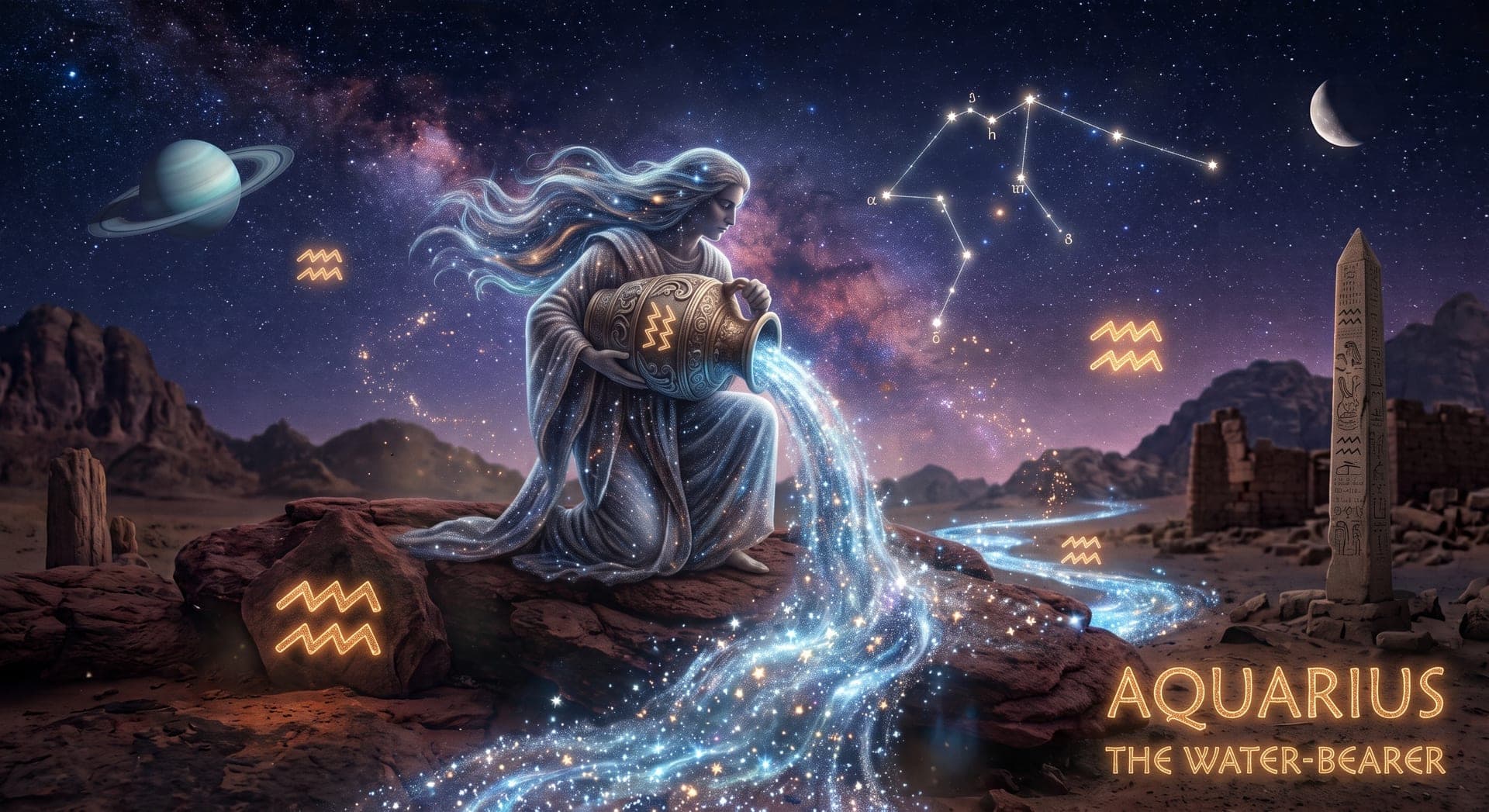
Aquarius, the eleventh sign of the zodiac, spans January 20 to February 18 and is symbolized by the water bearer, an image of someone pouring out knowledge and life-giving ideas to the world, despite Aquarius actually being an air sign rather than a water sign. Traditionally ruled by disciplined Saturn and, in modern astrology, by unpredictable Uranus, the planet of innovation and rebellion, Aquarius carries a distinctive blend of structure and originality. People born under this sign are often described as independent thinkers, forward-looking, and drawn to humanitarian causes, valuing the collective good over convention. As a Fixed sign, Aquarius can be famously stubborn once its mind is made up, even while championing change for everyone else. Intellectually curious and sometimes emotionally guarded, Aquarians tend to value friendship and community deeply, often serving as the visionary of their social circle, more comfortable debating ideas than discussing feelings.
Personality Traits
Strengths
- Original and forward-thinking
- Strong sense of fairness and justice
- Independent and self-sufficient
- Loyal to friends and causes alike
- Sees the bigger picture others miss
Weaknesses
- Can run from emotional expression
- Uncompromising once a position is fixed
- Prone to aloofness or detachment
- Sometimes contrarian just to stand apart
- Can prioritize ideas over people's feelings
Compatible Signs
Fun Facts
- Despite its watery name and imagery, Aquarius is classified as an air sign, grouped with Gemini and Libra as a sign of thought and communication rather than emotion.
- Aquarius has two ruling planets: Saturn in classical astrology, and Uranus, discovered in 1781, in the modern system most Western astrologers use today.
- The water bearer symbol traces back to Ganymede in Greek mythology, a cupbearer to the gods said to pour out a life-giving stream from the heavens.
- Notable Aquarians include Oprah Winfrey, Abraham Lincoln, Charles Darwin, Thomas Edison, and Bob Marley.
- Aquarius is one of the rarer signs to be represented by a person rather than an animal or object, alongside Gemini, Virgo, and Sagittarius's centaur half.
Born on February 10
- 1609
John Suckling
English poet and playwright associated with the Cavalier poets and traditionally credited with inventing the card game cribbage
- 1775
Charles Lamb
English essayist and poet best known for Essays of Elia and for Tales from Shakespeare, co-written with his sister Mary
- 1824
Samuel Plimsoll
English politician and social reformer who campaigned for maritime safety laws, leading to the load-line marking known as the Plimsoll line
- 1890
Boris Pasternak
Russian novelist and Nobel Prize laureate, author of "Doctor Zhivago"
- 1893
Jimmy Durante
American actor, comedian, and pianist
- 1894
Harold Macmillan
English politician who served as Prime Minister of the United Kingdom from 1957 to 1963
- 1898
Bertolt Brecht
Influential German playwright and poet
- 1906
Lon Chaney Jr.
American actor known for classic horror films
- 1926
Danny Blanchflower
Northern Irish footballer who captained Tottenham Hotspur to the English league and cup double in 1961
- 1927
Leontyne Price
Acclaimed American operatic soprano
- 1930
Robert Wagner
American actor with a long film and television career
- 1940
Mary Rand
English sprinter and long jumper who became the first British woman to win Olympic athletics gold, at the 1964 Tokyo Games
- 1967
Laura Dern
Academy Award-winning American actress
- 1981
Holly Willoughby
English television presenter known for co-hosting the daytime show This Morning
On This Day in History
- 1258
The Siege of Baghdad ends as the last Abbasid caliph surrenders to Mongol forces led by Hulegu Khan, a devastating blow to the Islamic world.
The fall of Baghdad, then a leading center of Islamic scholarship and the Abbasid capital for five centuries, brought catastrophic destruction, including the burning of its famed libraries and the deaths of hundreds of thousands of residents. Historians often cite the sack as marking the symbolic end of the Islamic Golden Age.
- 1258
The Mongol siege of Baghdad ends with the surrender and execution of the last Abbasid caliph, Al-Musta'sim, at the hands of Hulagu Khan's forces.
The Mongol army sacked the city, destroying its libraries, palaces, and the House of Wisdom, and massacred a large portion of its population. The fall of Baghdad, one of the great intellectual centres of the medieval Islamic world, is often seen as marking the end of the Islamic Golden Age and the collapse of the Abbasid Caliphate's political power.
- 1306
Robert the Bruce kills his rival John Comyn during a meeting at Greyfriars Church in Dumfries, Scotland.
The two men were rival claimants to the Scottish throne, and the killing took place before the church's altar, an act of sacrilege that saw Bruce excommunicated by the Pope. Weeks later Bruce had himself crowned King of Scots at Scone, launching the phase of the Wars of Scottish Independence that culminated in Scotland's victory at Bannockburn in 1314.
- 1355
A tavern dispute between students and townspeople in Oxford, England, escalates into a deadly riot that leaves dozens of scholars and locals dead.
What began as a quarrel over wine at the Swindlestock Tavern spiralled into two days of violence between the town and the university, with the town summoning armed reinforcements from the surrounding countryside. In the aftermath, the university was granted extensive privileges over the town as compensation, a settlement that shaped Oxford's town-gown relations for centuries.
- 1502
Vasco da Gama sets sail from Lisbon on his second voyage to India, this time commanding a heavily armed fleet to assert Portuguese dominance over the spice trade.
Da Gama's second voyage was far more heavily armed than his first, reflecting Portugal's determination to seize control of the lucrative spice trade by force if necessary. His fleet attacked rival Arab and Indian trading vessels along the route, establishing Portuguese naval dominance in the Indian Ocean for decades.
- 1567
Henry Stuart, Lord Darnley, husband of Mary, Queen of Scots, is found dead by strangulation in the garden of Kirk o' Field in Edinburgh after an explosion destroyed the house where he was staying.
Darnley's death, following a mysterious blast that failed to kill him outright, was widely suspected to be murder, with the Earl of Bothwell among the chief suspects. Mary's subsequent marriage to Bothwell scandalised Scotland and contributed to the rebellion that forced her abdication the following year, reshaping the course of Scottish and English royal history.
- 1763
The Treaty of Paris ends the French and Indian War, with France ceding Quebec and its North American territories to Great Britain.
The treaty ended the North American theater of the broader Seven Years' War, dramatically reshaping colonial power by removing France as a major territorial power in North America. Britain's massive new territorial gains, combined with war debts, contributed directly to the taxation disputes that sparked the American Revolution just over a decade later.
- 1763
The Treaty of Paris ends the Seven Years' War, with France ceding Quebec and the rest of New France to Great Britain.
The treaty marked a decisive expansion of the British Empire, giving Britain control over nearly all of North America east of the Mississippi River. It resolved the North American theatre of the wider global conflict, sometimes called the first world war, and reshaped the colonial balance of power on the continent ahead of the American Revolution just over a decade later.
- 1840
Queen Victoria marries her cousin Prince Albert of Saxe-Coburg and Gotha, beginning a famously devoted royal partnership.
Victoria and Albert's marriage, which she famously proposed herself given her status as reigning queen, became a model of domestic royal partnership that shaped Victorian-era ideals of marriage and family. Albert's influence on British politics and culture, and Victoria's prolonged mourning after his 1861 death, left a lasting mark on the era.
- 1840
Queen Victoria marries her first cousin, Prince Albert of Saxe-Coburg and Gotha, at the Chapel Royal in St James's Palace, London.
The marriage became one of the most influential royal partnerships in British history, with Albert playing a major role in modernising the monarchy and promoting science, industry, and the arts, including the Great Exhibition of 1851. Victoria's choice of a white wedding dress helped popularise the tradition still followed by brides today. The couple had nine children before Albert's death in 1861.
- 1846
British East India Company forces decisively defeat the Sikh Khalsa Army at the Battle of Sobraon, ending the First Anglo-Sikh War.
The battle was fought on the banks of the Sutlej River in Punjab and resulted in heavy Sikh casualties as their army was pinned against the river during the British assault. The subsequent Treaty of Lahore forced the Sikh Empire to cede territory and pay a large indemnity, setting the stage for Britain's eventual full annexation of Punjab a few years later.
- 1906
The Royal Navy battleship HMS Dreadnought, the first of a revolutionary new class of all-big-gun battleships, is christened at Portsmouth.
Built in just over a year on the initiative of First Sea Lord Jackie Fisher, Dreadnought rendered all existing battleships obsolete with its uniform heavy armament and turbine propulsion. The ship gave its name to an entire generation of warships and triggered an intense naval arms race between Britain and Germany in the years leading up to the First World War.
- 1939
Nationalist forces complete their conquest of Catalonia during the Spanish Civil War, sealing the border with France.
Franco's Nationalist forces completed their conquest of the Catalonia region after a grueling campaign that sent hundreds of thousands of refugees fleeing across the border into France. The fall of Catalonia effectively decided the outcome of the Spanish Civil War, which ended in Nationalist victory weeks later.
- 1947
The Paris Peace Treaties are signed, formally settling peace terms between the Allies and several defeated Axis-aligned nations after World War II.
The Paris treaties formally settled reparations, border adjustments, and other postwar terms with Italy, Romania, Hungary, Bulgaria, and Finland, distinct from the earlier agreements governing Germany and Japan. They helped stabilize Europe's political map in the early Cold War period.
- 1947
Allied powers, including the United Kingdom, sign the Paris Peace Treaties with Italy, Romania, Hungary, Bulgaria, and Finland, formally settling their status after the Second World War.
The treaties finalised border adjustments, reparations, and military restrictions for the former Axis-aligned states that had fought against the Allies. Britain, alongside the United States and Soviet Union, was among the principal Allied signatories, and the settlement marked one of the last major pieces of the post-war European order before Cold War divisions hardened across the continent.
- 1962
Captured American U-2 pilot Francis Gary Powers is exchanged for Soviet spy Rudolf Abel in a Cold War prisoner swap on Berlin's Glienicke Bridge.
The exchange of Powers, whose U-2 spy plane had been shot down over Soviet territory in 1960, for Abel, a longtime KGB operative caught in New York, took place on a bridge connecting East and West Berlin, cementing the location's enduring reputation as a symbol of Cold War espionage exchanges.
- 1967
The 25th Amendment to the U.S. Constitution is ratified, clarifying presidential succession and procedures for presidential disability.
Prompted partly by the assassination of President Kennedy and lingering questions about presidential incapacity, the amendment established clear procedures for filling a vice-presidential vacancy and for temporarily transferring presidential power during a president's incapacitation.
- 1996
IBM's Deep Blue computer defeats world chess champion Garry Kasparov in a single game, the first time a computer beat a reigning champion under standard time controls.
Deep Blue's win came in the second of a six-game rematch series against Kasparov, who had defeated an earlier version of the machine the previous year. Kasparov ultimately lost the full match, a result many considered a landmark moment in the development of artificial intelligence's capabilities relative to elite human cognition.
- 1996
IBM's supercomputer Deep Blue defeats world chess champion Garry Kasparov in a single game, the first time a computer had beaten a reigning world champion under standard tournament conditions.
Kasparov went on to win the six-game match overall, but the milestone stunned the chess world and reignited debate over the capabilities of artificial intelligence. IBM's improved successor system defeated Kasparov in a full rematch the following year, a result often cited as a landmark moment in the history of computing and machine intelligence.
- 2021
A catastrophic winter storm triggers the Texas power crisis, causing widespread blackouts and hundreds of deaths amid a failure of the state's isolated electrical grid.
A severe winter storm overwhelmed Texas's independent power grid, which was not required to meet the same weatherization standards as other U.S. regional grids, leaving millions without electricity or heat during freezing temperatures. The crisis exposed serious vulnerabilities in the state's energy infrastructure and regulatory oversight.