
What’s Observed on February 26
Born on February 26: Pisces ♓
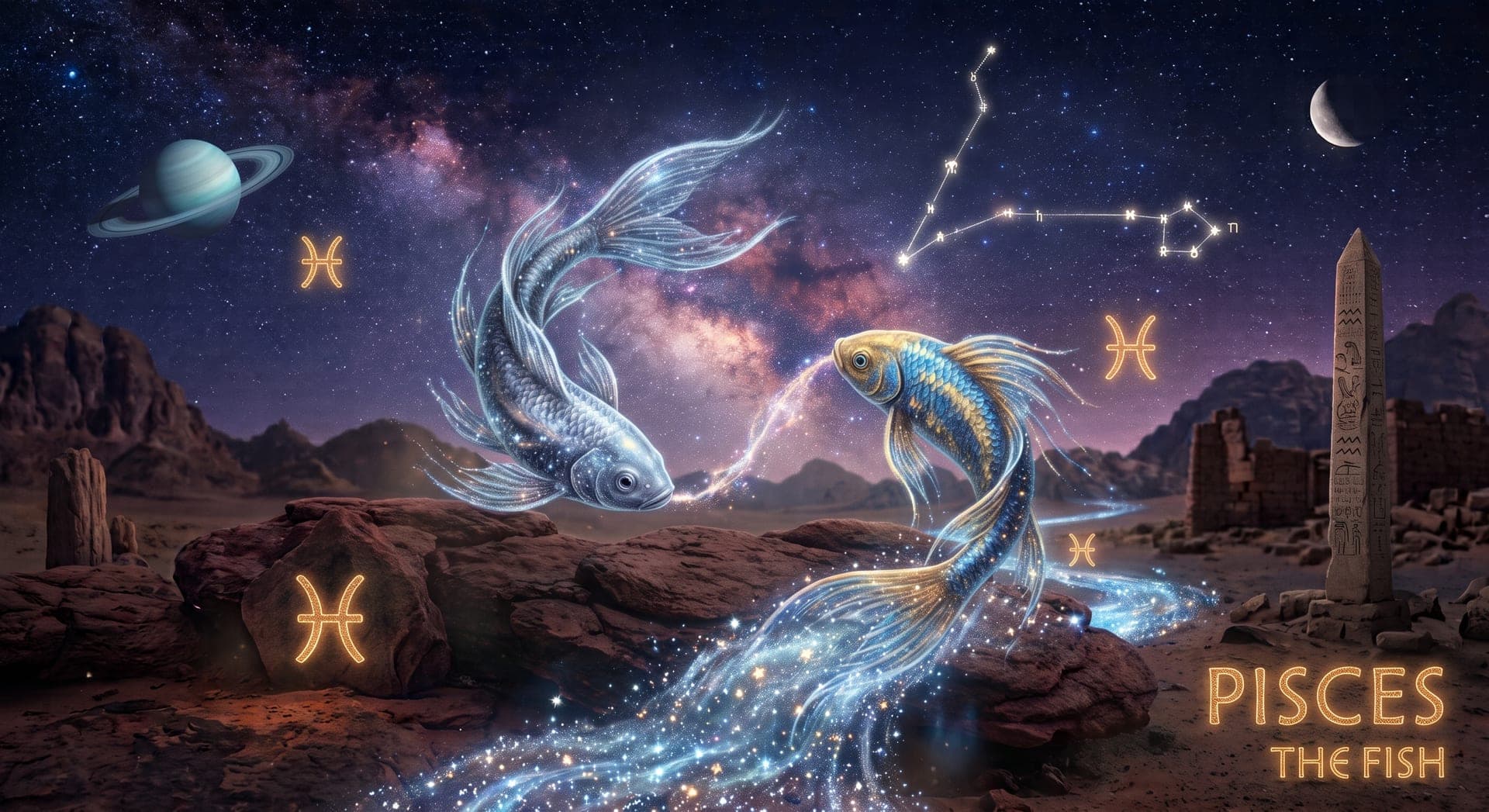
Pisces, the twelfth and final sign of the zodiac, spans February 19 to March 20 and is symbolized by two fish swimming in opposite directions, tied together by a cord, representing the tension between fantasy and reality, or the conscious and subconscious mind. Ruled by Neptune, the planet of dreams, intuition, and illusion, Pisces is widely regarded as the most emotionally sensitive and imaginative sign of the zodiac. As a Water sign, Pisces navigates the world primarily through feeling and empathy, often absorbing the moods of people around it as though they were its own. Its Mutable modality reflects a deep adaptability and fluidity, comfortable going with the flow rather than forcing rigid plans. People born under this sign are often drawn to art, music, and other creative or spiritual pursuits where their vivid imagination can take shape. Compassionate to a fault, Pisces individuals are frequently the ones quietly caring for others, sometimes at the expense of their own boundaries and needs.
Personality Traits
Strengths
- Deeply empathetic and compassionate
- Highly imaginative and artistic
- Intuitive and perceptive
- Selfless and generous
- Adaptable to change
Weaknesses
- Prone to escapism or avoidance
- Overly trusting, can be taken advantage of
- Difficulty setting boundaries
- Tends toward melancholy
- Indecisive
Compatible Signs
Fun Facts
- Pisces' symbol of two fish bound together swimming in opposite directions comes from a Greek myth in which Aphrodite and Eros transformed into fish and tied themselves together to escape the monster Typhon.
- As the twelfth and final sign of the zodiac, Pisces is often described as embodying traits of all the preceding signs, a kind of culmination of the zodiac wheel.
- Neptune, Pisces' modern ruling planet, is the Roman god of the sea, discovered in 1846 and named for its blue, oceanic appearance.
- Notable Pisces include Albert Einstein, Rihanna, Steve Jobs, and Kurt Cobain.
- Classical astrology assigns Jupiter as Pisces' ruler, before Neptune's discovery in the 19th century gave the sign its modern ruling planet.
Born on February 26
- 1564
Christopher Marlowe
English playwright and poet of the Elizabethan era, celebrated for works such as Doctor Faustus and Tamburlaine
- 1671
Anthony Ashley-Cooper, 3rd Earl of Shaftesbury
English philosopher and politician whose writings on moral sense and aesthetics influenced the Enlightenment
- 1802
Victor Hugo
French author of "Les Miserables" and "The Hunchback of Notre-Dame"
- 1829
Levi Strauss
Founder of the Levi Strauss & Co. denim company
- 1846
Buffalo Bill Cody
American showman famous for his Wild West exhibitions
- 1879
Frank Bridge
English composer and violist known for chamber music and as the teacher of Benjamin Britten
- 1903
Orde Wingate
English general who led the Chindit forces behind Japanese lines in Burma during the Second World War
- 1906
Madeleine Carroll
English actress and Hollywood leading lady best known for Alfred Hitchcock's The 39 Steps
- 1928
Fats Domino
Pioneering rock and roll singer and pianist
- 1928
Ariel Sharon
Israeli general and Prime Minister
- 1947
Sandie Shaw
English pop singer who became the first British act to win the Eurovision Song Contest, with 'Puppet on a String'
- 1956
Michel Houellebecq
Acclaimed French novelist
- 1973
Marshall Faulk
NFL Hall of Fame running back
- 1977
Shane Williams
Welsh rugby union player and prolific try-scorer for Wales and the British and Irish Lions
On This Day in History
- 320
Chandragupta I is crowned as the first emperor of the Gupta Empire in northern India.
Chandragupta's marriage alliance with the powerful Licchavi clan and his subsequent conquests laid the foundation for what became one of the largest empires in Indian history. Under his successors, the Gupta Empire ushered in a period later celebrated as a golden age of Indian science, mathematics, astronomy, and the arts, though the exact date of Chandragupta's coronation is drawn from later Gupta-era chronology.
- 1616
The Roman Catholic Church formally bans Galileo Galilei from teaching or defending the Copernican view that the Earth orbits the Sun.
The Catholic Church's ban followed a formal inquiry into Galileo's astronomical writings, warning him not to teach or defend heliocentrism as established fact. He was later tried and condemned more severely in 1633 after publishing a book seen as defying the earlier warning, resulting in house arrest for the rest of his life.
- 1616
The Roman Catholic Church formally orders Galileo Galilei to abandon and stop teaching the Copernican theory that the Earth orbits the Sun.
Church officials had examined the heliocentric model and declared it 'formally heretical,' prompting Cardinal Robert Bellarmine to warn Galileo in person to cease advocating it. Galileo largely complied for over a decade, but his 1632 publication defending heliocentrism led to his trial and condemnation by the Inquisition, a case that became a defining episode in the historical tension between science and religious authority.
- 1775
Moro pirates destroy the British East India Company's trading post on Balambangan Island, off the coast of Borneo.
The company had established the settlement in 1773 as a base for trade in the Sulu Archipelago, hoping to open a route into Chinese and Southeast Asian markets. A surprise raid by Sulu-based Moro raiders overran the lightly defended post, killing and capturing many of its garrison and forcing the British to abandon the venture, a setback for the company's ambitions in the region.
- 1815
Napoleon Bonaparte escapes his exile on the island of Elba, beginning the dramatic hundred-day return to power that ended at Waterloo.
Napoleon's escape from his exile on the small Mediterranean island of Elba began the dramatic period known as the Hundred Days, during which he rapidly regathered political and military support in France before his final defeat by allied forces at the Battle of Waterloo.
- 1815
Napoleon Bonaparte escapes the island of Elba, where he had been exiled, beginning his return to power in France.
Napoleon had been confined to Elba after his abdication in 1814 following defeat by the allied European powers, but grew frustrated with his small domain and reports of unrest in France. Slipping past naval patrols with a small force, he landed in France on 1 March and marched on Paris, gathering troops along the way and beginning the Hundred Days that would end at Waterloo, where a British-led coalition army finally defeated him that June.
- 1909
Kinemacolor, the first commercially successful colour motion-picture process, is shown to the public for the first time at the Palace Theatre in London.
Developed by George Albert Smith and marketed by Charles Urban, Kinemacolor worked by filming and projecting alternating red- and green-filtered frames in rapid succession, which the eye blended into a colour image. The London demonstration proved a sensation, and the process was soon used for newsreels and travelogues around the world before being superseded within a decade by improved colour technologies.
- 1914
HMHS Britannic, the third and largest of the White Star Line's Olympic-class ocean liners, is launched at the Harland and Wolff shipyard in Belfast.
Britannic was built as a sister ship to the Titanic and Olympic, incorporating design changes made in response to the Titanic disaster, including a double hull and higher-reaching watertight bulkheads. She never entered civilian passenger service, being converted into a hospital ship on the outbreak of the First World War, and sank in the Aegean Sea in 1916 after striking a mine.
- 1919
President Woodrow Wilson signs legislation establishing Grand Canyon National Park, protecting one of America's most iconic natural landmarks.
Wilson's designation of Grand Canyon National Park capped decades of conservation advocacy, including earlier efforts by President Theodore Roosevelt to protect the site as a national monument. It remains one of the most visited and iconic national parks in the United States.
- 1935
Adolf Hitler secretly orders the reformation of the Luftwaffe, Germany's air force, in direct violation of the Treaty of Versailles.
Hitler's secret order to rebuild the Luftwaffe, explicitly banned under the Treaty of Versailles that ended World War I, was part of a broader pattern of German military rearmament that Western powers largely failed to meaningfully counter in the years leading up to World War II.
- 1935
Scottish physicist Robert Watson-Watt demonstrates that aircraft can be detected and located using radio waves, in a trial near Daventry, England.
The Daventry Experiment used a BBC shortwave transmitter and a receiver in a field van to detect a Handley Page Heyford bomber flying overhead, proving the practicality of radio detection and ranging. The success led the British government to fund development of what became known as radar, and a chain of coastal radar stations built before the Second World War proved decisive in Britain's victory in the Battle of Britain.
- 1936
A group of young nationalist Japanese army officers attempts a coup in Tokyo, assassinating several government ministers in what became known as the February 26 Incident.
The February 26 Incident saw a faction of young nationalist army officers attempt to purge Japan's government of perceived corrupt influences, briefly seizing central Tokyo and assassinating several officials before the coup was suppressed, strengthening the military's overall political influence in the years leading to World War II.
- 1936
A group of young nationalist officers in the Imperial Japanese Army stages an attempted coup in Tokyo, assassinating several senior government ministers.
The rebels, drawn from the ultranationalist Kōdō-ha faction, seized the centre of Tokyo and killed prominent officials including a former prime minister, hoping to purge moderate leaders and restore direct imperial rule. Emperor Hirohito refused to endorse the uprising and ordered it suppressed; loyalist troops surrounded the rebels, who surrendered three days later. The failed coup strengthened militarist influence over the government even as its leaders were executed.
- 1945
American troops recapture the fortress island of Corregidor in the Philippines from Japanese forces.
American forces recaptured Corregidor after a combined parachute and amphibious assault against Japanese defenders holed up in the island's extensive tunnel system, a hard-fought victory that helped secure Manila Bay ahead of the war's final Pacific campaigns.
- 1980
Egypt and Israel establish full diplomatic relations, a landmark step following the 1979 Camp David peace treaty.
The establishment of full diplomatic relations followed the 1979 Egypt-Israel peace treaty, the first such agreement between Israel and an Arab nation, and marked a historic, if still politically contentious, thaw between the two former wartime adversaries.
- 1993
A truck bomb detonates beneath the World Trade Center's North Tower in New York, killing six people and injuring over a thousand in an early act of Islamist terrorism on U.S. soil.
The 1993 World Trade Center bombing, carried out by Islamist militants using a truck bomb parked in the building's underground garage, aimed to topple one tower into the other but caused far less damage than intended, foreshadowing the far deadlier attack on the same complex eight years later.
- 1993
A truck bomb detonates in the parking garage beneath the North Tower of the World Trade Center in New York City, killing six people and injuring over a thousand.
Islamist militants led by Ramzi Yousef parked a rented van packed with explosives in the basement garage, intending to topple the North Tower into the South Tower and kill thousands. The towers withstood the blast, but the explosion killed six people, injured over a thousand, and caused extensive damage. Yousef and several co-conspirators were later captured, tried, and convicted for the attack, which foreshadowed the September 11 attacks eight years later.
- 1995
Barings Bank, Britain's oldest merchant bank, collapses after rogue trader Nick Leeson's unauthorised derivatives trading in Singapore loses an estimated £827 million.
Leeson, a trader in Barings' Singapore office, had concealed mounting losses on speculative bets on the Japanese stock market in a hidden account for years before an earthquake in Kobe sent markets tumbling further and exposed the scale of the losses. The bank, which had financed the Napoleonic Wars and counted the British monarchy among its clients, collapsed within days and was sold to ING for a nominal sum, becoming a lasting case study in inadequate risk controls.
- 2008
The New York Philharmonic performs in Pyongyang, North Korea, an unprecedented cultural exchange amid otherwise frozen diplomatic relations.
The New York Philharmonic's Pyongyang performance, including the American and North Korean national anthems, was a rare and closely watched moment of cultural diplomacy between two nations with no formal diplomatic relations, though it produced little lasting political thaw.
- 2019
Indian fighter jets strike an alleged militant training camp in Balakot, Pakistan, sharply escalating tensions between the two nuclear-armed neighbors.
India's airstrike on an alleged militant camp inside Pakistani territory, in retaliation for a deadly attack on Indian security forces, marked the first such cross-border strike between the nuclear-armed rivals since a 1971 war, triggering a brief but tense military confrontation.