What’s Observed on February 19
Born on February 19: Pisces ♓
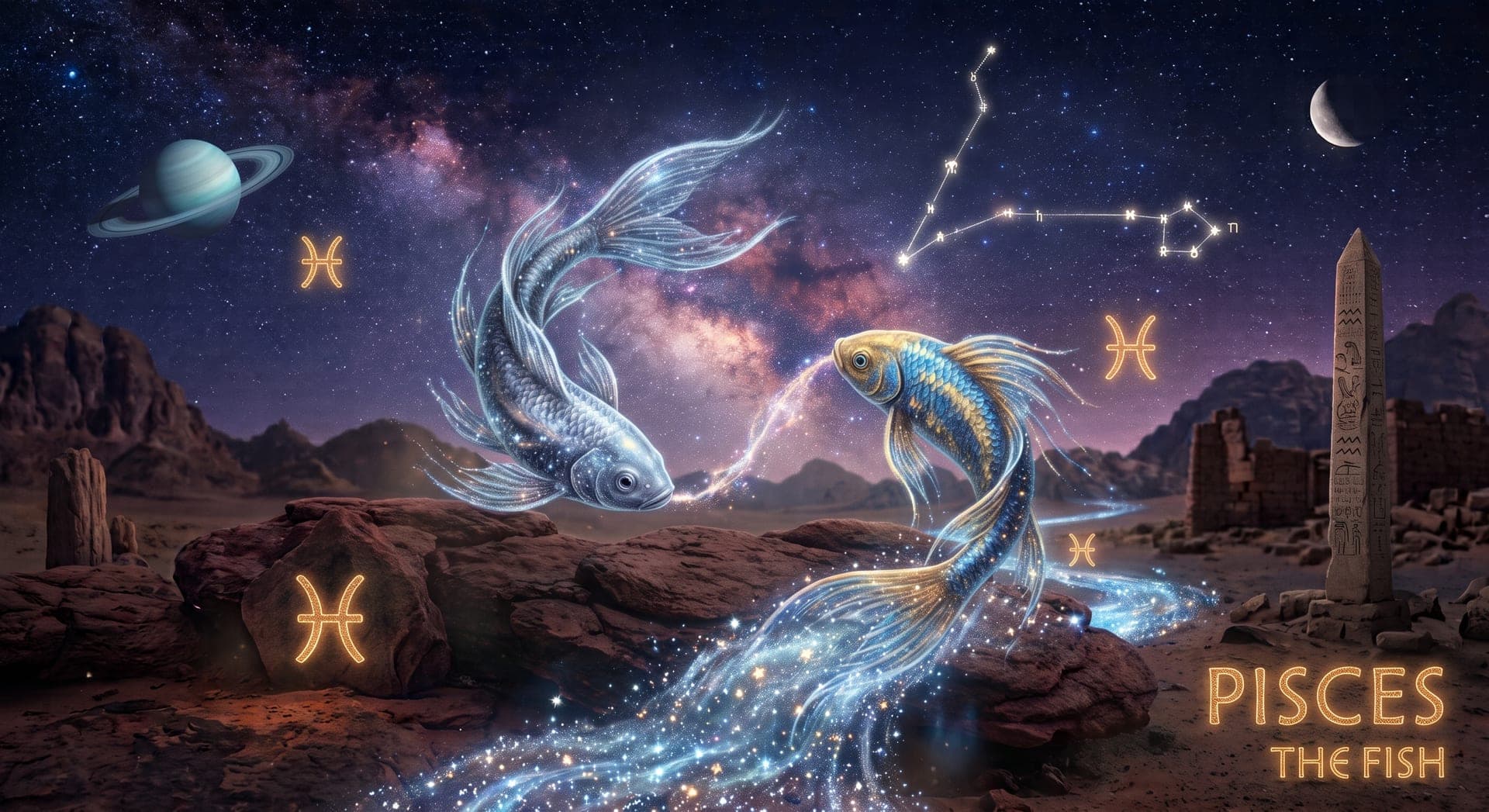
Pisces, the twelfth and final sign of the zodiac, spans February 19 to March 20 and is symbolized by two fish swimming in opposite directions, tied together by a cord, representing the tension between fantasy and reality, or the conscious and subconscious mind. Ruled by Neptune, the planet of dreams, intuition, and illusion, Pisces is widely regarded as the most emotionally sensitive and imaginative sign of the zodiac. As a Water sign, Pisces navigates the world primarily through feeling and empathy, often absorbing the moods of people around it as though they were its own. Its Mutable modality reflects a deep adaptability and fluidity, comfortable going with the flow rather than forcing rigid plans. People born under this sign are often drawn to art, music, and other creative or spiritual pursuits where their vivid imagination can take shape. Compassionate to a fault, Pisces individuals are frequently the ones quietly caring for others, sometimes at the expense of their own boundaries and needs.
Personality Traits
Strengths
- Deeply empathetic and compassionate
- Highly imaginative and artistic
- Intuitive and perceptive
- Selfless and generous
- Adaptable to change
Weaknesses
- Prone to escapism or avoidance
- Overly trusting, can be taken advantage of
- Difficulty setting boundaries
- Tends toward melancholy
- Indecisive
Compatible Signs
Fun Facts
- Pisces' symbol of two fish bound together swimming in opposite directions comes from a Greek myth in which Aphrodite and Eros transformed into fish and tied themselves together to escape the monster Typhon.
- As the twelfth and final sign of the zodiac, Pisces is often described as embodying traits of all the preceding signs, a kind of culmination of the zodiac wheel.
- Neptune, Pisces' modern ruling planet, is the Roman god of the sea, discovered in 1846 and named for its blue, oceanic appearance.
- Notable Pisces include Albert Einstein, Rihanna, Steve Jobs, and Kurt Cobain.
- Classical astrology assigns Jupiter as Pisces' ruler, before Neptune's discovery in the 19th century gave the sign its modern ruling planet.
Born on February 19
- 1473
Nicolaus Copernicus
Astronomer who formulated the heliocentric model of the solar system
- 1594
Henry Frederick, Prince of Wales
Heir apparent to the English and Scottish thrones under King James I, whose early death at eighteen reshaped the Stuart succession
- 1717
David Garrick
English actor, playwright, and theatre manager who transformed Georgian-era stage acting and ran the Drury Lane Theatre for decades
- 1859
Svante Arrhenius
Nobel Prize-winning physicist and chemist
- 1876
Constantin Brancusi
Pioneering modernist sculptor
- 1893
Cedric Hardwicke
English stage and film actor known for his commanding presence in classical theatre and Hollywood character roles
- 1940
Smokey Robinson
Motown singer-songwriter and producer
- 1948
Tony Iommi
English guitarist and co-founder of Black Sabbath, widely credited as a pioneering architect of heavy metal music
- 1955
Jeff Daniels
American actor and playwright
- 1958
Helen Fielding
English author best known for creating the Bridget Jones novels
- 1961
Justin Fashanu
English footballer who became the first professional player in Britain to publicly come out as gay
- 1963
Seal
English singer-songwriter known for soulful pop hits including 'Kiss from a Rose'
- 1967
Benicio del Toro
Academy Award-winning actor
On This Day in History
- 197
Roman emperor Septimius Severus defeats rival claimant Clodius Albinus at the Battle of Lugdunum, one of the largest and bloodiest battles fought between Roman armies.
The Battle of Lugdunum, fought in what is now Lyon, France, pitted two rival claimants for the Roman throne against each other in a civil war following the assassination of Emperor Commodus. Severus's victory secured his hold on power, though the immense casualties on both sides weakened Rome's military strength.
- 1600
The Peruvian volcano Huaynaputina erupts violently, the most powerful volcanic eruption recorded in South American history.
The Huaynaputina eruption blanketed the surrounding region in volcanic ash, destroyed nearby towns, and is believed to have contributed to unusually cold weather and crop failures recorded as far away as Europe and Russia in the following years, an early example of a volcanic eruption's global climate impact.
- 1600
Huaynaputina volcano in southern Peru erupts catastrophically, in the largest recorded volcanic eruption in South American history.
The explosion buried nearby towns under ash and pumice, killed well over a thousand people, and disrupted the regional climate for years afterward, with unusually cold summers recorded as far away as Europe. Some historians have linked the eruption's atmospheric effects to a severe famine in Russia that began just a few years later.
- 1674
The Treaty of Westminster ends the Third Anglo-Dutch War, with the Dutch formally ceding New Netherland, including New Amsterdam, to England.
The war had drained both nations' resources without a decisive winner, and the treaty restored the pre-war status quo in Europe while confirming England's hold on the North American colony it had already seized in 1664. New Amsterdam was renamed New York after the Duke of York, and the transfer marked the end of Dutch colonial ambitions on the eastern American seaboard.
- 1819
British merchant sea captain William Smith sights the South Shetland Islands while sailing his brig Williams around Cape Horn, becoming the first person known to discover land south of 60° south latitude.
Smith had been blown off his usual course to Valparaíso when he spotted Williams Point, the northeastern tip of what became Livingston Island. His report reached the Royal Navy, which sent him back later that year to survey the archipelago and formally claim it for Britain. The discovery opened the region to a rush of British and American sealers and helped pave the way for later Antarctic exploration.
- 1836
King William IV issues letters patent authorising the founding of the Province of South Australia as a British colony.
The letters patent followed years of lobbying by reformers who envisioned South Australia as a colony of free settlers rather than convicts, funded through the sale of land rather than government subsidy. The document set out the boundaries of the new province and the rights of its future colonists, laying the legal groundwork for the founding of Adelaide later that year.
- 1878
Thomas Edison patents the phonograph, one of his most celebrated inventions and the first device capable of recording and reproducing sound.
Edison's phonograph, which recorded sound onto a tinfoil-wrapped cylinder, astonished the public as the first device capable of both recording and playing back sound. Though the technology was crude and impractical at first, it laid the groundwork for the entire recorded music and audio industry.
- 1878
Thomas Edison is granted a US patent for the phonograph, the first device capable of both recording and reproducing sound.
Edison had built a working prototype only months earlier, using a tinfoil-wrapped cylinder and a stylus to capture sound vibrations. The invention stunned contemporaries, who found the idea of a machine that could 'talk back' almost uncanny. Although the fragile tinfoil cylinders were impractical for lasting use, the phonograph set off decades of rapid innovation in recorded sound.
- 1913
Pedro Lascuráin serves as President of Mexico for less than an hour amid a violent power struggle, the shortest presidential term in recorded history.
Lascuráin briefly assumed Mexico's presidency according to the constitutional line of succession during a violent coup against President Francisco Madero, only to resign minutes later after appointing a general to the post, a maneuver widely seen as a thin legal cover for the general's seizure of power.
- 1915
British and French warships open a long-range bombardment of Ottoman forts guarding the Dardanelles strait, launching the naval phase of the Gallipoli campaign.
The operation was meant to force the strait, threaten Constantinople, and knock the Ottoman Empire out of World War I without a costly land campaign. Early success against the outer forts encouraged the Allies, but minefields and mobile artillery later stalled the naval assault, prompting the disastrous amphibious landings at Gallipoli that April and heavy losses for British, French, and ANZAC forces.
- 1942
Japanese warplanes launch a devastating surprise raid on Darwin, Australia, the first and largest attack on the Australian mainland during World War II.
The bombing of Darwin, carried out by the same Japanese carrier fleet that had attacked Pearl Harbor weeks earlier, killed over 240 people and caused widespread panic across Australia, which had never before faced a direct attack on its mainland during the war.
- 1942
President Franklin D. Roosevelt signs Executive Order 9066, authorizing the forced relocation and internment of Japanese Americans during World War II.
Executive Order 9066 authorized the military to designate exclusion zones, leading to the forced removal and imprisonment of roughly 120,000 Japanese Americans, most of them U.S. citizens, in remote internment camps for the remainder of the war, a policy the U.S. government formally apologized for and paid reparations over decades later.
- 1945
Tens of thousands of U.S. Marines storm the beaches of Iwo Jima, beginning one of the bloodiest battles of the Pacific War.
The invasion of Iwo Jima, a small but strategically vital island, became one of the costliest battles in Marine Corps history, with fierce Japanese defenders fighting from an extensive network of underground tunnels and bunkers. The battle produced the iconic flag-raising photograph atop Mount Suribachi days later.
- 1945
US Marines land on the Pacific island of Iwo Jima, beginning one of the bloodiest battles of World War II.
The island's airfields made it a strategic prize for both sides, and Japanese defenders had spent months building an elaborate network of tunnels and bunkers into its volcanic terrain. The ensuing battle lasted over a month and produced tens of thousands of casualties on both sides before American forces secured the island, later immortalised by the flag-raising photograph atop Mount Suribachi.
- 1954
The Soviet Politburo orders the transfer of Crimea from the Russian Soviet republic to the Ukrainian Soviet republic, a decision with lasting geopolitical consequences.
The transfer of Crimea, largely a symbolic administrative reorganization within the Soviet Union at the time, took on major geopolitical significance decades later when Russia annexed the peninsula from an independent Ukraine in 2014, citing the historical transfer as part of its justification.
- 1954
The Soviet government transfers the Crimean Oblast from the Russian Soviet Federative Socialist Republic to the Ukrainian Soviet Socialist Republic.
The transfer, decreed under Nikita Khrushchev, was presented at the time as a symbolic gesture marking the 300th anniversary of Ukraine's union with Russia and as a practical measure given Crimea's geographic and economic ties to Ukraine. The decision drew little attention within the Soviet Union but became hugely consequential after the USSR's collapse, when Crimea remained part of an independent Ukraine.
- 1959
Britain, Greece, and Turkey sign the Zürich and London Agreements, setting out the terms for Cyprus to become an independent republic.
The agreements followed years of intercommunal tension and an armed campaign against British colonial rule, establishing a power-sharing constitution between the island's Greek and Turkish Cypriot communities and guaranteeing Britain two sovereign military base areas. Cyprus formally became independent the following year, in August 1960, though tensions between the two communities would resurface within a few years.
- 1963
Betty Friedan publishes "The Feminine Mystique," a book widely credited with reigniting the American feminist movement.
Friedan's book challenged the prevailing postwar cultural assumption that women found complete fulfillment in domesticity, drawing on surveys of her own college classmates who reported widespread dissatisfaction. It became a bestseller and is frequently credited with helping launch the "second wave" of American feminism.
- 1963
Betty Friedan publishes The Feminine Mystique, a book widely credited with sparking the second wave of the American feminist movement.
Drawing on a survey of her Smith College classmates, Friedan challenged the postwar assumption that women found complete fulfilment as housewives and mothers, coining the phrase 'the problem that has no name' for the quiet dissatisfaction she found among suburban women. The book became a bestseller and helped inspire the founding of the National Organization for Women a few years later.
- 1976
President Gerald Ford formally rescinds Executive Order 9066, officially ending the wartime authority used to intern Japanese Americans.
Ford's proclamation formally acknowledged that the wartime internment of Japanese Americans had been a "national mistake," a statement of regret that preceded, by over a decade, the formal government apology and reparations payments authorized by Congress in 1988.