What’s Observed on February 20
Born on February 20: Pisces ♓
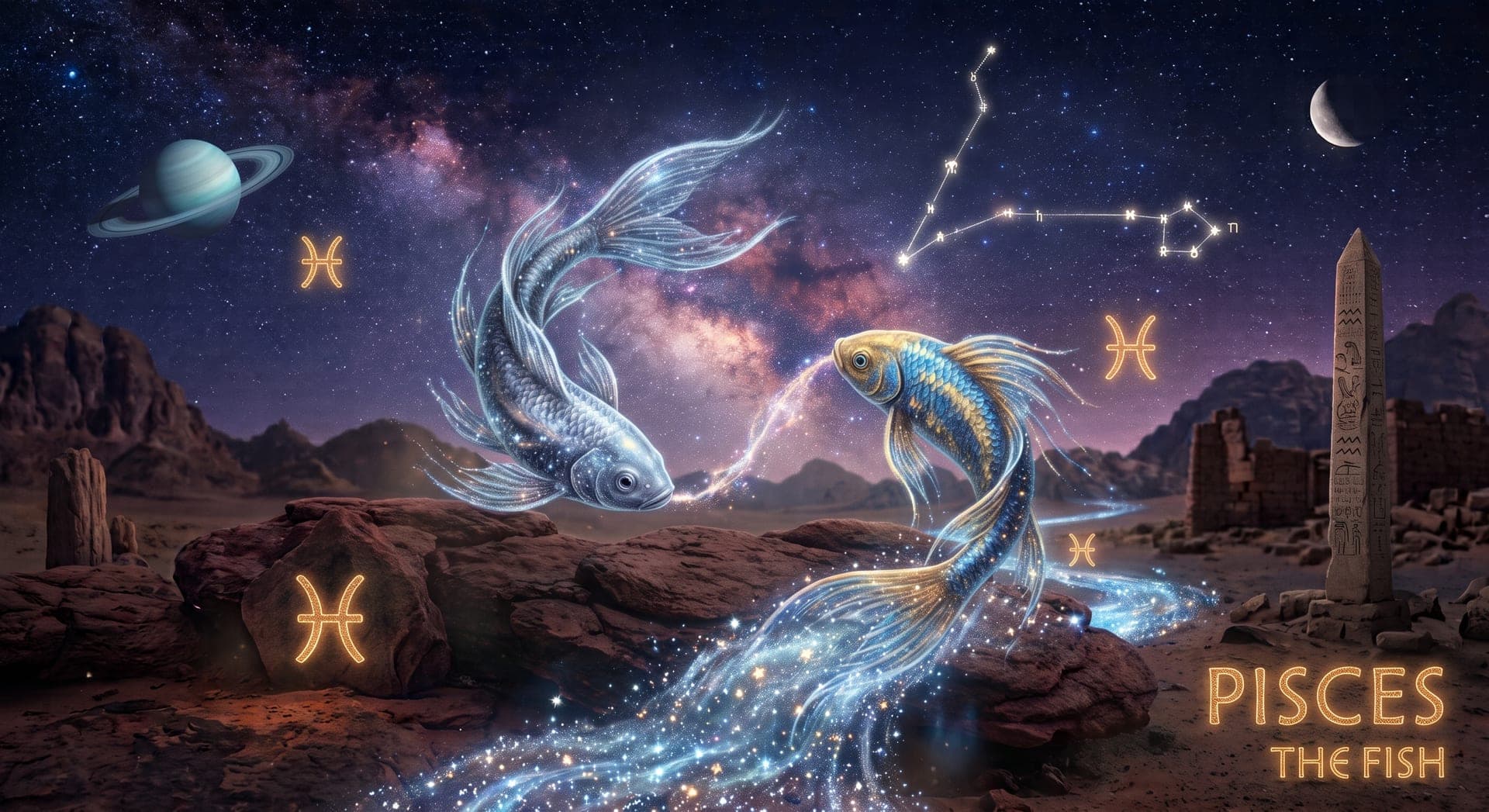
Pisces, the twelfth and final sign of the zodiac, spans February 19 to March 20 and is symbolized by two fish swimming in opposite directions, tied together by a cord, representing the tension between fantasy and reality, or the conscious and subconscious mind. Ruled by Neptune, the planet of dreams, intuition, and illusion, Pisces is widely regarded as the most emotionally sensitive and imaginative sign of the zodiac. As a Water sign, Pisces navigates the world primarily through feeling and empathy, often absorbing the moods of people around it as though they were its own. Its Mutable modality reflects a deep adaptability and fluidity, comfortable going with the flow rather than forcing rigid plans. People born under this sign are often drawn to art, music, and other creative or spiritual pursuits where their vivid imagination can take shape. Compassionate to a fault, Pisces individuals are frequently the ones quietly caring for others, sometimes at the expense of their own boundaries and needs.
Personality Traits
Strengths
- Deeply empathetic and compassionate
- Highly imaginative and artistic
- Intuitive and perceptive
- Selfless and generous
- Adaptable to change
Weaknesses
- Prone to escapism or avoidance
- Overly trusting, can be taken advantage of
- Difficulty setting boundaries
- Tends toward melancholy
- Indecisive
Compatible Signs
Fun Facts
- Pisces' symbol of two fish bound together swimming in opposite directions comes from a Greek myth in which Aphrodite and Eros transformed into fish and tied themselves together to escape the monster Typhon.
- As the twelfth and final sign of the zodiac, Pisces is often described as embodying traits of all the preceding signs, a kind of culmination of the zodiac wheel.
- Neptune, Pisces' modern ruling planet, is the Roman god of the sea, discovered in 1846 and named for its blue, oceanic appearance.
- Notable Pisces include Albert Einstein, Rihanna, Steve Jobs, and Kurt Cobain.
- Classical astrology assigns Jupiter as Pisces' ruler, before Neptune's discovery in the 19th century gave the sign its modern ruling planet.
Born on February 20
- 1745
Henry James Pye
English poet who served as Britain's first Poet Laureate under that formal title
- 1839
Benjamin Waugh
English social reformer who founded the National Society for the Prevention of Cruelty to Children
- 1844
Ludwig Boltzmann
Austrian physicist who advanced statistical mechanics
- 1867
Louise, Princess Royal
British royal, daughter of King Edward VII, who held the title Princess Royal
- 1925
Robert Altman
Acclaimed American film director
- 1926
Gillian Lynne
English dancer and choreographer celebrated for her work on the West End and Broadway productions of Cats and The Phantom of the Opera
- 1927
Sidney Poitier
First Black man to win the Academy Award for Best Actor
- 1940
Jimmy Greaves
English footballer regarded as one of the greatest goalscorers in the history of the English game
- 1951
Gordon Brown
Scottish politician who served as Chancellor of the Exchequer and later as Prime Minister of the United Kingdom
- 1967
Kurt Cobain
Nirvana frontman and grunge icon
- 1977
Stephon Marbury
NBA basketball star
- 1988
Rihanna
Grammy-winning singer and entrepreneur

On This Day in History
- 1472
The Orkney and Shetland Islands, pledged by Norway decades earlier as security for a royal dowry, are formally annexed to the Kingdom of Scotland.
The islands had been pledged in the late 1460s when Christian I of Denmark and Norway could not pay the agreed dowry for his daughter Margaret's marriage to King James III of Scotland. When the debt went unredeemed, the Scottish parliament acted to bring the Northern Isles permanently under the Scottish crown, ending nearly six centuries of Norse rule over the archipelago.
- 1547
Edward VI is crowned King of England at Westminster Abbey at age nine, beginning a brief reign dominated by regents.
Edward VI, the only surviving legitimate son of Henry VIII, became king at age nine, with real governing authority exercised first by his uncle and then by other regents throughout his brief six-year reign, during which England moved further toward Protestantism.
- 1547
Edward VI is crowned King of England and Ireland at Westminster Abbey, days after the death of his father, Henry VIII.
Only nine years old at his accession, Edward became England's first monarch to be raised as a Protestant from birth, and his brief reign saw the country pushed further toward Protestant reform under a series of regency councils. He died at fifteen in 1553, having never ruled in his own right, triggering the succession crisis that briefly put Lady Jane Grey on the throne.
- 1816
Gioachino Rossini's comic opera "The Barber of Seville" premieres in Rome, later becoming one of the most performed operas in the world.
Rossini reportedly composed the entire opera in under three weeks, and though its chaotic premiere was famously disrupted by hecklers and technical mishaps, "The Barber of Seville" quickly became one of the most beloved and frequently performed comic operas in the classical repertoire.
- 1824
Geologist William Buckland presents his description of Megalosaurus to the Geological Society of London, giving science its first formally named dinosaur genus.
Buckland based his account on a fossilised lower jawbone and other bones found in Oxfordshire quarries, correctly identifying the animal as an enormous extinct reptile, though the term 'dinosaur' itself would not be coined until nearly two decades later by Richard Owen. The find helped establish paleontology as a serious scientific discipline in early 19th-century Britain.
- 1872
The Metropolitan Museum of Art opens in New York City, growing into one of the largest and most visited art museums on Earth.
The Metropolitan Museum of Art opened with a modest initial collection before growing, through donations and acquisitions over the following century and a half, into one of the largest and most comprehensive art museums in the world, housing millions of works spanning five thousand years of human history.
- 1872
The Metropolitan Museum of Art opens to the public in New York City.
Founded a couple of years earlier by a group of businessmen, financiers, and artists who wanted to bring great art to the American public, the museum opened in a modest building before eventually moving to its present home on Fifth Avenue overlooking Central Park. It has since grown into one of the largest and most visited art museums in the world.
- 1877
Pyotr Ilyich Tchaikovsky's ballet Swan Lake receives its premiere at the Bolshoi Theatre in Moscow.
The initial production was poorly received, hampered by weak choreography and a company unused to Tchaikovsky's demanding score, and the ballet was largely dismissed by contemporary critics. Only after the composer's death, in a new staging by Marius Petipa and Lev Ivanov, did Swan Lake become one of the most beloved works in the classical ballet repertoire.
- 1933
Adolf Hitler secretly meets with German industrialists to secure funding for the Nazi Party's final election campaign before seizing dictatorial power.
Hitler's secret appeal to industrialists sought financial backing for the Nazi Party's final push before the March 1933 elections, framing the campaign as a decisive battle against Marxism. The funding helped the Nazis consolidate the political and financial support needed to establish a one-party dictatorship within weeks.
- 1933
The US Congress approves the Twenty-first Amendment, sending the repeal of nationwide Prohibition to the states for ratification.
Prohibition, in force since 1920 under the Eighteenth Amendment, had failed to eliminate alcohol consumption and instead fuelled organised crime and widespread lawbreaking. Amid the hardship of the Great Depression, public and political support for repeal grew rapidly, and the amendment was ratified within the year, making it the only constitutional amendment ever adopted specifically to undo an earlier one.
- 1939
Roughly 20,000 people attend a pro-Nazi rally at New York's Madison Square Garden, revealing the extent of American sympathizer movements before World War II.
The rally, organized by the German American Bund, drew a large crowd beneath a massive portrait of George Washington flanked by swastika banners, revealing the presence of organized pro-Nazi sentiment in the United States shortly before the country entered World War II against Germany.
- 1944
The Royal Air Force and US Army Air Forces launch 'Big Week,' a coordinated bombing campaign against German aircraft production.
The joint operation targeted factories manufacturing German fighter planes, aiming to cripple the Luftwaffe's ability to defend the Reich ahead of the planned Allied invasion of France. American bombers struck by day while RAF Bomber Command continued its night raids, and although industrial damage was mixed, the resulting air battles inflicted heavy losses on German fighter pilots that the Luftwaffe struggled to replace.
- 1962
John Glenn becomes the first American to orbit the Earth, completing three orbits aboard Friendship 7.
Glenn's orbital flight came at a critical moment in the Cold War space race, following earlier Soviet achievements, and made him an instant national hero. He later became a U.S. senator and, in 1998, returned to space at age 77 aboard the Space Shuttle, becoming the oldest person to fly in space at the time.
- 1962
John Glenn becomes the first American to orbit the Earth, completing three orbits aboard the Mercury spacecraft Friendship 7.
The flight came at the height of the Space Race, just under a year after Soviet cosmonaut Yuri Gagarin's pioneering orbital flight, and gave the American public a badly needed boost of confidence in the country's space program. Glenn returned home a national hero and later served as a US senator before returning to space in 1998 at age 77.
- 1986
The Soviet Union launches the Mir space station core module, which would remain in orbit for 15 years and host crews for a decade of that time.
Mir became a symbol of sustained human presence in orbit, hosting international crews including American astronauts during a period of post-Cold War cooperation, and provided crucial experience for the later construction and operation of the International Space Station before being deliberately deorbited in 2001.
- 1986
The Soviet Union launches the core module of the Mir space station into orbit.
Mir was designed as a modular station that could be expanded over time by docking additional sections launched separately, a departure from earlier single-piece Soviet stations. It remained continuously crewed for most of its fifteen years in orbit, hosting long-duration missions and later international crews including American astronauts, before being deliberately deorbited into the Pacific Ocean in 2001.
- 1991
Crowds in Tirana topple a giant statue of former Albanian dictator Enver Hoxha, symbolizing the collapse of communist rule in Albania.
The toppling of Hoxha's statue in Tirana symbolized the collapse of Albania's uniquely isolated and repressive form of Stalinist communism, which had cut the small Balkan nation off from most of the outside world for over four decades under his rule.
- 2003
A pyrotechnics display ignites a fire at The Station nightclub in Rhode Island, killing 100 people in one of the deadliest nightclub fires in U.S. history.
The Station nightclub fire, ignited by pyrotechnics used during a rock concert that quickly set flammable soundproofing foam ablaze, killed 100 people in one of the deadliest nightclub disasters in American history and led to stricter fire safety regulations for entertainment venues nationwide.
- 2014
Dozens of anti-government protesters are killed by snipers in Kyiv's Independence Square during Ukraine's Euromaidan uprising.
The sniper killings in Kyiv's Independence Square, during the final violent days of the Euromaidan protests against President Yanukovych, marked a bloody climax to months of demonstrations and directly preceded Yanukovych's ouster and flight from Ukraine days later.
- 2014
Dozens of protesters are shot and killed by snipers in Kyiv during the deadliest day of the Euromaidan uprising against Ukraine's government.
The killings marked the bloody climax of months of demonstrations that had begun after President Viktor Yanukovych abandoned a planned trade agreement with the European Union in favour of closer ties with Russia. Within a day of the shootings, Yanukovych fled the capital and was removed from office by parliament, setting off a chain of events that led to Russia's annexation of Crimea weeks later.