What’s Observed on February 21
Born on February 21: Pisces ♓
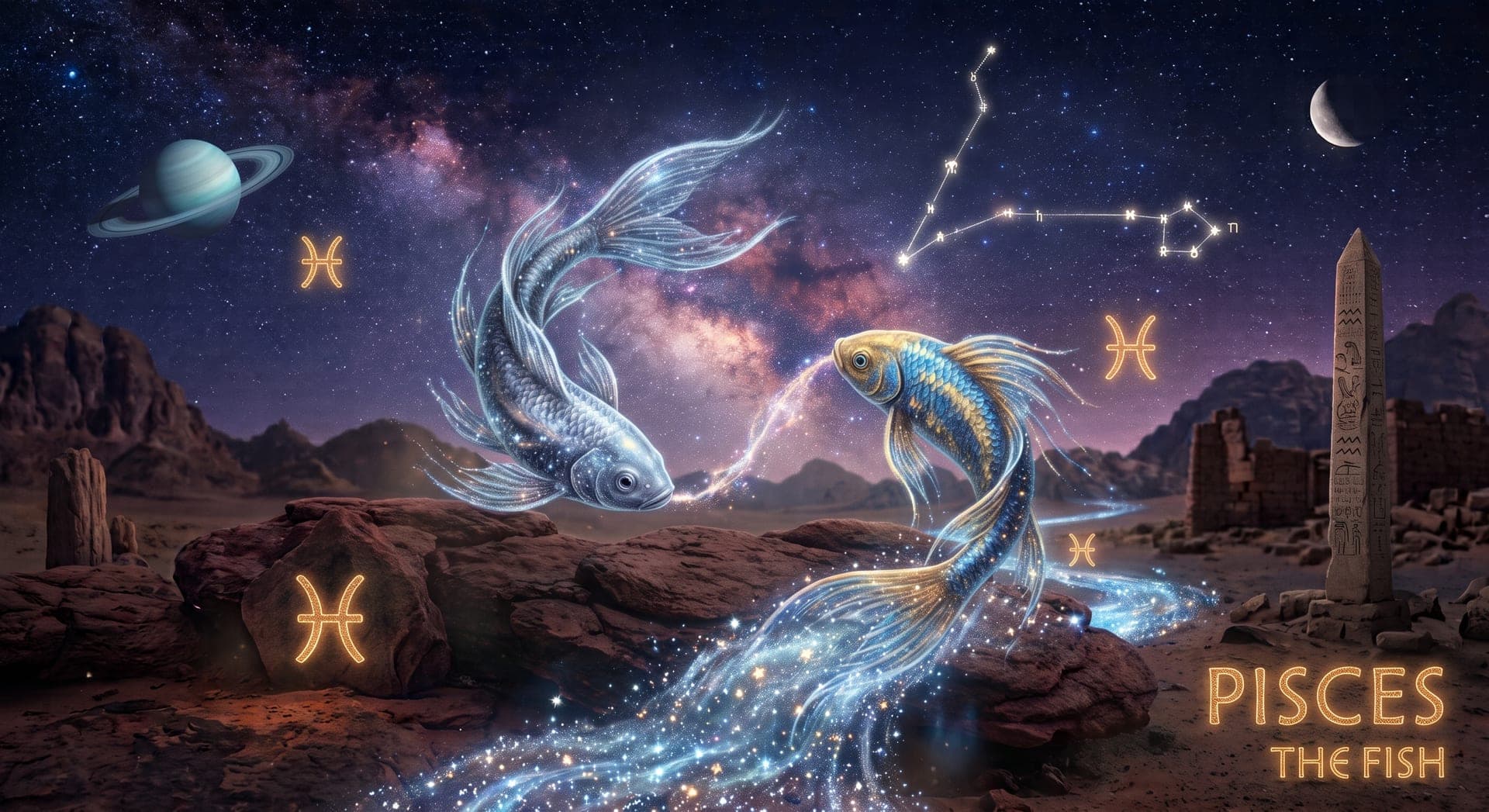
Pisces, the twelfth and final sign of the zodiac, spans February 19 to March 20 and is symbolized by two fish swimming in opposite directions, tied together by a cord, representing the tension between fantasy and reality, or the conscious and subconscious mind. Ruled by Neptune, the planet of dreams, intuition, and illusion, Pisces is widely regarded as the most emotionally sensitive and imaginative sign of the zodiac. As a Water sign, Pisces navigates the world primarily through feeling and empathy, often absorbing the moods of people around it as though they were its own. Its Mutable modality reflects a deep adaptability and fluidity, comfortable going with the flow rather than forcing rigid plans. People born under this sign are often drawn to art, music, and other creative or spiritual pursuits where their vivid imagination can take shape. Compassionate to a fault, Pisces individuals are frequently the ones quietly caring for others, sometimes at the expense of their own boundaries and needs.
Personality Traits
Strengths
- Deeply empathetic and compassionate
- Highly imaginative and artistic
- Intuitive and perceptive
- Selfless and generous
- Adaptable to change
Weaknesses
- Prone to escapism or avoidance
- Overly trusting, can be taken advantage of
- Difficulty setting boundaries
- Tends toward melancholy
- Indecisive
Compatible Signs
Fun Facts
- Pisces' symbol of two fish bound together swimming in opposite directions comes from a Greek myth in which Aphrodite and Eros transformed into fish and tied themselves together to escape the monster Typhon.
- As the twelfth and final sign of the zodiac, Pisces is often described as embodying traits of all the preceding signs, a kind of culmination of the zodiac wheel.
- Neptune, Pisces' modern ruling planet, is the Roman god of the sea, discovered in 1846 and named for its blue, oceanic appearance.
- Notable Pisces include Albert Einstein, Rihanna, Steve Jobs, and Kurt Cobain.
- Classical astrology assigns Jupiter as Pisces' ruler, before Neptune's discovery in the 19th century gave the sign its modern ruling planet.
Born on February 21
- 1788
Francis Ronalds
English scientist and inventor who built one of the earliest working electric telegraphs
- 1907
W. H. Auden
English-American poet regarded as one of the major literary voices of the 20th century
- 1910
Douglas Bader
English Royal Air Force fighter pilot who continued flying combat missions after losing both legs, becoming a celebrated wartime hero
- 1933
Nina Simone
Iconic singer-songwriter and pianist
- 1936
Barbara Jordan
Influential American lawyer and congresswoman
- 1943
David Geffen
Co-founder of DreamWorks and Geffen Records
- 1946
Alan Rickman
English actor known for his distinctive voice and roles including Severus Snape in the Harry Potter films
- 1955
Kelsey Grammer
Emmy-winning actor known for "Frasier"
- 1976
Michael McIntyre
English stand-up comedian known for his observational humour and top-rated television specials
- 1979
Jennifer Love Hewitt
American actress and producer
- 1979
Jordan Peele
Acclaimed director and filmmaker
- 1986
Charlotte Church
Welsh singer who rose to fame as a child classical vocalist before moving into pop music
- 1996
Sophie Turner
English actress best known for playing Sansa Stark in the television series Game of Thrones
On This Day in History
- 1613
Mikhail Romanov is elected Tsar of Russia by a national assembly, founding the Romanov dynasty.
His election ended the chaotic Time of Troubles, a period of civil war, famine, and foreign occupation that followed the extinction of the previous Rurikid dynasty. Mikhail, a teenager related to the old ruling line through his great-aunt, was seen as a compromise candidate acceptable to Russia's feuding noble factions. His descendants would rule Russia for the next three centuries, until the 1917 revolution.
- 1804
Engineer Richard Trevithick demonstrates the world's first self-propelled steam railway locomotive, hauling wagons along a tramway at the Penydarren ironworks in Wales.
Trevithick's high-pressure steam engine pulled ten tons of iron and around seventy men along nearly ten miles of horse-drawn tramway track, proving that a locomotive could move its own weight along rails. Though the fragile cast-iron rails of the day struggled under its weight, the demonstration is regarded as the birth of railway locomotion, decades before George Stephenson's more famous engines.
- 1848
Karl Marx and Friedrich Engels publish "The Communist Manifesto," a pamphlet that would go on to shape socialist and communist movements worldwide.
Written as a call to action for the international communist movement, "The Communist Manifesto" argued that history was driven by class struggle and predicted capitalism's eventual overthrow by the working class. Though it had little immediate impact, it became one of the most influential political documents in modern history.
- 1848
Karl Marx and Friedrich Engels publish The Communist Manifesto, a political pamphlet outlining their theory of class struggle and calling for workers to unite.
Commissioned by the Communist League, the pamphlet appeared just as revolutions were breaking out across Europe, though it had little immediate influence on those uprisings. Its stark analysis of capitalism and call to arms for the proletariat went on to become one of the most influential political texts in history, shaping socialist and communist movements worldwide over the following century and beyond.
- 1885
The newly completed Washington Monument is formally dedicated in the U.S. capital.
The Washington Monument's construction had been interrupted for over two decades due to funding shortages and the Civil War before finally being completed using different-colored marble, still visible today as a stripe partway up the obelisk, marking where construction had paused.
- 1916
The Battle of Verdun begins on the Western Front, becoming one of the longest and costliest battles of World War I.
The Battle of Verdun, launched by Germany with the explicit strategic goal of "bleeding France white," became a symbol of the war's brutal attritional stalemate, lasting nearly ten months and producing roughly 700,000 combined casualties for minimal territorial change.
- 1916
German forces launch a massive offensive against French positions at Verdun, opening one of the longest and costliest battles of World War I.
German commanders hoped to draw French forces into a battle of attrition that would 'bleed France white,' targeting Verdun for its symbolic and strategic importance rather than seeking a decisive breakthrough. The battle dragged on for nearly ten months, producing roughly 700,000 casualties on both sides combined and becoming a lasting symbol of the war's horrific human cost.
- 1925
The first issue of The New Yorker magazine is published.
Founded by editor Harold Ross and his wife Jane Grant, the magazine was originally conceived as a sophisticated humour weekly aimed at an urban readership, famously declaring it was 'not edited for the old lady in Dubuque.' It went on to become renowned for its long-form journalism, fiction, criticism, and cartoons, publishing many of the 20th century's most celebrated writers.
- 1947
Inventor Edwin Land publicly demonstrates the first instant camera, the Polaroid Land Camera, which could develop photos in under a minute.
Land's Polaroid camera allowed users to see a developed photograph within about a minute of taking it, a revolutionary convenience at a time when film typically required days of processing. The instant photography format remained popular for decades before digital cameras eventually eclipsed it.
- 1952
Student protests in support of the Bengali language erupt at the University of Dhaka, a movement later commemorated worldwide as International Mother Language Day.
Bengali-speaking students protested the imposition of Urdu as Pakistan's sole national language, and police gunfire on the demonstrators killed several students, an event that fueled Bengali nationalism and contributed to the eventual independence of Bangladesh two decades later. UNESCO later designated the date International Mother Language Day.
- 1952
The British government abolishes compulsory national identity cards, which had been in use since the start of the Second World War.
The cards had been introduced in 1939 as a wartime security measure but continued in peacetime, increasingly resented as police began using them for routine matters unrelated to national security. Their abolition followed a 1951 court case in which the Lord Chief Justice criticised their overuse, reflecting a broader postwar desire to roll back wartime restrictions on civil liberties.
- 1958
Artist Gerald Holtom designs the now-iconic peace symbol, originally created for the British nuclear disarmament movement.
Holtom designed the symbol, combining semaphore signals for the letters "N" and "D" (nuclear disarmament) within a circle, for a British anti-nuclear weapons march. Deliberately left unclaimed as intellectual property, the design spread globally and became the most widely recognized peace symbol in the world.
- 1958
British designer Gerald Holtom completes the design of the peace symbol, created for the campaign against nuclear weapons.
Holtom combined the semaphore signals for the letters 'N' and 'D,' standing for nuclear disarmament, into a single circular emblem for the Campaign for Nuclear Disarmament. It was first carried publicly at an Aldermaston march that Easter and went on to become one of the most widely recognised symbols of the 20th century, adopted far beyond its original anti-nuclear context.
- 1971
Representatives from dozens of countries sign the Convention on Psychotropic Substances in Vienna, establishing an international framework for controlling drugs such as amphetamines, barbiturates, and hallucinogens.
The treaty extended earlier international drug-control efforts, which had focused mainly on narcotics like opium and cocaine, to cover a newer generation of synthetic psychoactive substances that had proliferated since the 1950s. It set up a classification system and reporting requirements that still underpin much of international drug policy today.
- 1972
President Richard Nixon visits China, a historic trip that began the normalization of relations between the United States and the People's Republic of China.
Nixon's visit to China, arranged through secret diplomacy led by National Security Advisor Henry Kissinger, ended over two decades of diplomatic isolation between the two countries and set in motion the eventual normalization of formal U.S.-China relations, reshaping Cold War geopolitics.
- 1972
US President Richard Nixon arrives in Beijing, beginning a landmark week-long visit that opened diplomatic relations between the United States and the People's Republic of China.
The trip ended over two decades of Cold War isolation between the two countries and was engineered largely through secret diplomacy by National Security Advisor Henry Kissinger. Nixon's meetings with Chairman Mao Zedong and Premier Zhou Enlai produced the Shanghai Communiqué, a joint statement that laid the groundwork for full normalisation of relations later in the decade.
- 1973
Israeli fighter jets shoot down a Libyan airliner that strayed into contested airspace over the Sinai Peninsula, killing 108 people.
Libyan Arab Airlines Flight 114 strayed off course in poor visibility over the Sinai Peninsula, then under Israeli control following the 1967 war, and was shot down by Israeli fighter jets after failing to respond to signals, killing all but a handful of the 113 people aboard.
- 1975
Former White House aides H. R. Haldeman, John Ehrlichman, and John Mitchell are sentenced to prison for their roles in the Watergate scandal.
The three had been among President Nixon's closest advisers before being convicted of conspiracy, obstruction of justice, and perjury for their part in covering up the break-in at the Democratic National Committee's headquarters and the subsequent investigation. Their sentencing came about six months after Nixon's own resignation from the presidency, marking one of the final chapters of the Watergate affair.
- 1994
CIA officer Aldrich Ames is arrested for spying for the Soviet Union and Russia, one of the most damaging moles in CIA history.
Ames, a senior CIA counterintelligence officer, had sold the identities of numerous U.S. intelligence assets to the Soviet Union and later Russia in exchange for millions of dollars, leading to the deaths of at least ten agents. His arrest exposed one of the most damaging betrayals in CIA history.
- 2022
Russian President Vladimir Putin recognizes two breakaway regions of eastern Ukraine as independent states, days before launching a full-scale invasion.
Putin's recognition of the Luhansk and Donetsk separatist regions as independent states, granting Russia a pretext to deploy troops there, came just three days before he launched the full-scale invasion of Ukraine, marking the opening moves of Europe's largest war since World War II.