
What’s Observed on February 22
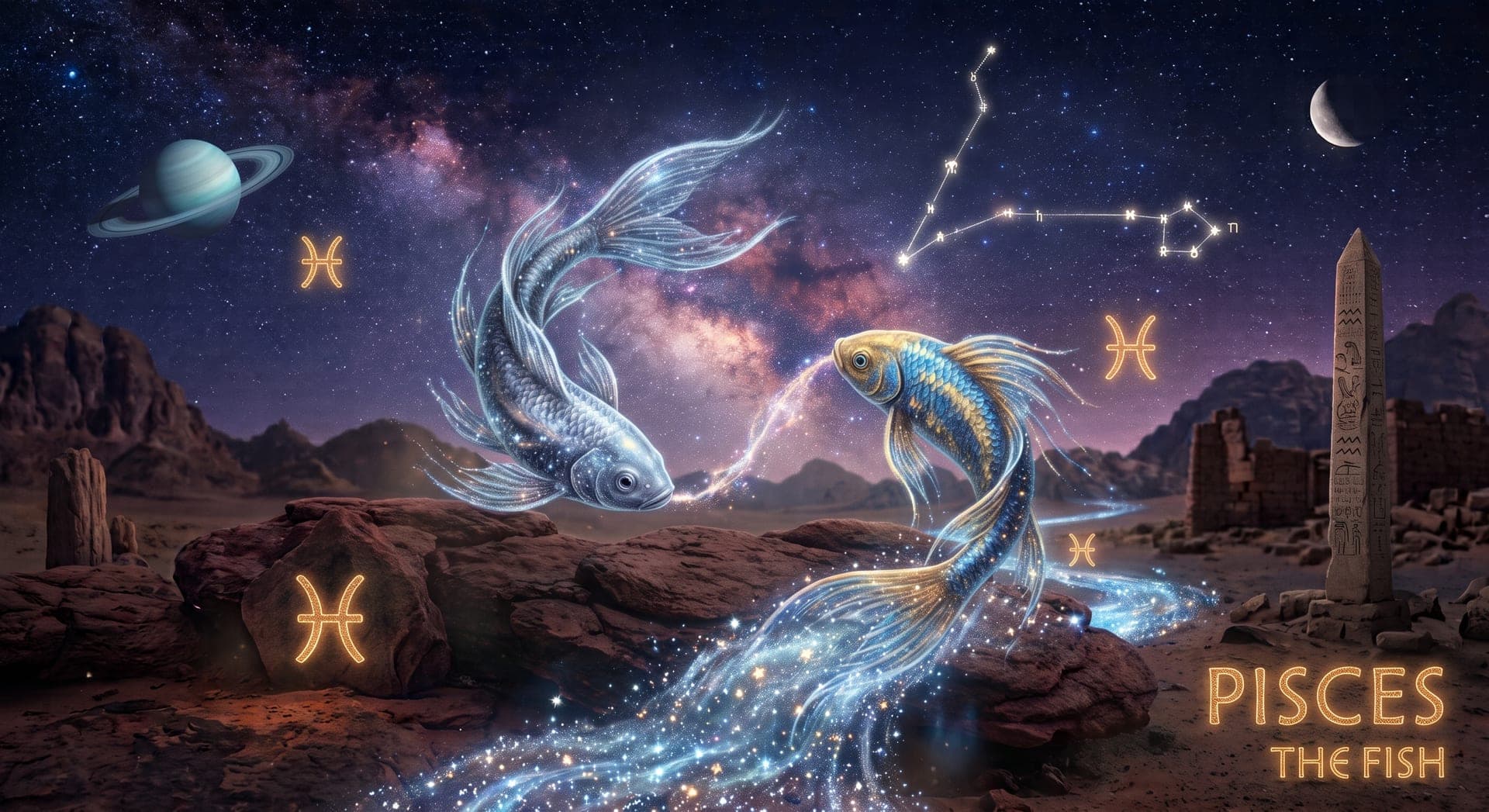
Born on February 22: Pisces ♓
Pisces, the twelfth and final sign of the zodiac, spans February 19 to March 20 and is symbolized by two fish swimming in opposite directions, tied together by a cord, representing the tension between fantasy and reality, or the conscious and subconscious mind. Ruled by Neptune, the planet of dreams, intuition, and illusion, Pisces is widely regarded as the most emotionally sensitive and imaginative sign of the zodiac. As a Water sign, Pisces navigates the world primarily through feeling and empathy, often absorbing the moods of people around it as though they were its own. Its Mutable modality reflects a deep adaptability and fluidity, comfortable going with the flow rather than forcing rigid plans. People born under this sign are often drawn to art, music, and other creative or spiritual pursuits where their vivid imagination can take shape. Compassionate to a fault, Pisces individuals are frequently the ones quietly caring for others, sometimes at the expense of their own boundaries and needs.
Personality Traits
Strengths
- Deeply empathetic and compassionate
- Highly imaginative and artistic
- Intuitive and perceptive
- Selfless and generous
- Adaptable to change
Weaknesses
- Prone to escapism or avoidance
- Overly trusting, can be taken advantage of
- Difficulty setting boundaries
- Tends toward melancholy
- Indecisive
Compatible Signs
Fun Facts
- Pisces' symbol of two fish bound together swimming in opposite directions comes from a Greek myth in which Aphrodite and Eros transformed into fish and tied themselves together to escape the monster Typhon.
- As the twelfth and final sign of the zodiac, Pisces is often described as embodying traits of all the preceding signs, a kind of culmination of the zodiac wheel.
- Neptune, Pisces' modern ruling planet, is the Roman god of the sea, discovered in 1846 and named for its blue, oceanic appearance.
- Notable Pisces include Albert Einstein, Rihanna, Steve Jobs, and Kurt Cobain.
- Classical astrology assigns Jupiter as Pisces' ruler, before Neptune's discovery in the 19th century gave the sign its modern ruling planet.
Born on February 22
- 1732
George Washington
First President of the United States
- 1857
Robert Baden-Powell
English army officer who founded the worldwide Scouting movement
- 1892
Edna St. Vincent Millay
Pulitzer Prize-winning American poet
- 1900
Luis Bunuel
Influential Spanish-Mexican film director
- 1908
John Mills
English actor whose long film career included leading roles in classic British war and drama films
- 1926
Kenneth Williams
English actor and comedian best remembered for his roles in the Carry On film series
- 1928
Bruce Forsyth
English television entertainer and long-running host of popular variety and game shows
- 1942
Christine Keeler
English model whose involvement in the Profumo affair became one of the defining political scandals of 1960s Britain
- 1949
Niki Lauda
Formula One world champion driver
- 1950
Julius Erving
Basketball Hall of Famer known as "Dr. J"
- 1950
Julie Walters
English actress known for roles in Educating Rita, the Harry Potter films, and Mamma Mia!
- 1962
Steve Irwin
Australian wildlife expert known as "The Crocodile Hunter"
- 1974
James Blunt
English singer-songwriter who found international success with the ballad 'You're Beautiful'
- 1975
Drew Barrymore
American actress and talk show host
On This Day in History
- 1371
Robert II is crowned King of Scots, becoming the first monarch of the House of Stewart (Stuart).
Robert, a grandson of Robert the Bruce through his mother, inherited the throne under a 1318 entail after the childless death of his uncle David II. His accession founded a dynasty that would rule Scotland, and later England as well, for more than three centuries, ending only with the death of Queen Anne in 1714.
- 1744
A British fleet clashes inconclusively with a combined French and Spanish fleet off Toulon during the War of the Austrian Succession, in a battle that later led to courts-martial of senior British commanders.
Confused signalling and poor coordination between the British van, centre, and rear divisions let the Franco-Spanish fleet escape largely intact, provoking outrage in Britain. Admiral Thomas Mathews and several subordinate officers were subsequently court-martialled, and the scandal prompted reforms to the Royal Navy's rigid fighting instructions, which had contributed to the fleet's poor performance.
- 1770
Eleven-year-old Christopher Seider is shot and killed in Boston by a customs employee firing into a crowd of colonists protesting British trade policy.
The shooting, by a loyalist customs informer named Ebenezer Richardson, inflamed already tense relations between Boston's residents and British colonial authorities in the run-up to the American Revolution. Seider's funeral drew a huge crowd organised by Samuel Adams, and the killing is often cited as a direct precursor to the more famous Boston Massacre less than two weeks later.
- 1797
A small French invasion force lands near Fishguard, Wales, the last time hostile foreign troops landed on British soil.
The small French force, intended as a diversionary landing to support a larger failed invasion of Ireland, surrendered within days after being confronted by local militia and, according to legend, mistaking Welsh women in traditional red cloaks for British soldiers. It remains the last hostile foreign landing on mainland Britain.
- 1797
A French invasion force lands near Fishguard on the Welsh coast, in what became the last foreign invasion of the British mainland.
The small force, made up largely of irregular troops, had been intended to support an Irish uprising but was diverted to Wales by poor winds. Disorganised and short on supplies, the invaders looted local farms before being confronted by hastily assembled British militia, yeomanry, and local volunteers. Heavily outnumbered and demoralised, the French surrendered two days later at Goodwick Sands.
- 1819
Spain agrees to sell Florida to the United States for five million dollars under the Adams-Onís Treaty.
The Adams-Onís Treaty resolved lingering border disputes between the United States and Spain, with Spain ceding Florida partly in exchange for the U.S. relinquishing claims to Texas. The purchase eliminated a persistent source of tension along the southeastern border and opened the territory to American settlement.
- 1848
Popular uprisings break out in Paris, sparking the French Revolution of 1848 and the collapse of the July Monarchy.
Popular anger over economic hardship and political repression under King Louis-Philippe erupted into street protests that escalated into revolution within days, forcing the king's abdication and the establishment of France's short-lived Second Republic, part of a wave of revolutions that swept across Europe that year.
- 1848
A popular uprising breaks out in Paris, beginning the French Revolution of 1848 that would topple King Louis Philippe within days.
Discontent over restricted suffrage, economic hardship, and political repression had been building for years, and a banned reform banquet in Paris provided the spark for street protests that escalated into open revolt. Louis Philippe abdicated just two days later, and France's Second Republic was proclaimed, part of a wider wave of revolutions that swept across Europe that year.
- 1904
Britain sells a weather station on Laurie Island in the South Orkney Islands to Argentina.
The station had been established by a Scottish Antarctic expedition a few years earlier, and its transfer to Argentina allowed continuous meteorological observations to continue under Argentine administration. Renamed Orcadas Base, it remains in operation today as the oldest continuously staffed research station in Antarctica, though British and Argentine sovereignty claims over the wider South Orkney Islands would later become a point of dispute.
- 1942
President Franklin D. Roosevelt orders General Douglas MacArthur to leave the besieged Philippines for Australia, a decision that saved MacArthur to lead the later Pacific counteroffensive.
MacArthur reluctantly obeyed Roosevelt's direct order to evacuate the besieged Philippines by PT boat and aircraft to Australia, famously vowing "I shall return." He fulfilled that promise nearly three years later, leading the campaign that liberated the islands from Japanese occupation.
- 1943
White Rose resistance members Sophie Scholl, Hans Scholl, and Christoph Probst are executed by the Nazi regime for distributing anti-war leaflets.
The three White Rose members were tried in a hastily convened Nazi "People's Court" and executed by guillotine just hours after their sentencing, a swift and brutal response intended to deter further resistance. Their courage in openly opposing the regime later made them celebrated symbols of German anti-Nazi resistance.
- 1972
The Official IRA detonates a car bomb at the headquarters of the British Army's 16th Parachute Brigade in Aldershot, England, killing seven people.
The bombing was carried out in retaliation for the Bloody Sunday killings in Derry three weeks earlier, but the device exploded near an officers' mess used mainly by support staff, killing five civilian cleaning and catering workers, a Catholic army chaplain, and a gardener rather than any paratroopers. The attack caused public revulsion and marked one of the deadliest acts of Troubles-related violence on English soil.
- 1979
Saint Lucia becomes an independent nation, ending its status as a British colony.
The Caribbean island had passed between French and British control multiple times during the colonial era before becoming a British Crown Colony in the early 19th century. Independence came as part of a broader wave of decolonisation across the British Caribbean, and Saint Lucia chose to remain within the Commonwealth, retaining the British monarch as its ceremonial head of state.
- 1980
In the "Miracle on Ice," the underdog U.S. Olympic hockey team defeats the heavily favored Soviet Union 4-3 at the Lake Placid Winter Games.
The underdog American college and amateur hockey players' victory over the dominant, professional-caliber Soviet team, during the height of Cold War tensions, is widely regarded as one of the greatest upsets in sports history and became a defining moment of American sporting patriotism, later dramatized in the film "Miracle."
- 1997
British scientists announce the successful cloning of an adult sheep named Dolly, the first mammal cloned from an adult cell.
Dolly, cloned from the mammary cell of an adult sheep by Scottish researchers, proved that a specialized adult cell could be reprogrammed to grow into a complete new organism, a discovery with profound implications for genetics, medicine, and ongoing ethical debates over cloning technology.
- 1997
Scientists at the Roslin Institute in Scotland announce the birth of Dolly the sheep, the first mammal successfully cloned from an adult somatic cell.
Dolly had actually been born the previous July, but her existence was kept quiet until the team, led by Ian Wilmut and Keith Campbell, could publish their findings. The breakthrough, achieved by transferring the nucleus of an adult mammary cell into an unfertilised egg, stunned the scientific world and reignited global debate over the ethics and future possibilities of cloning technology.
- 2006
A bombing severely damages the al-Askari Shrine in Samarra, Iraq, triggering a sharp escalation in sectarian violence.
The bombing of the al-Askari Shrine, one of Shia Islam's holiest sites, though it caused no direct casualties, triggered a devastating wave of retaliatory sectarian violence between Sunni and Shia militias across Iraq, pushing the country closer to full-scale civil war during the ongoing U.S. occupation.
- 2006
Armed robbers steal around 53 million pounds from a Securitas cash depot in Tonbridge, Kent, in what became Britain's largest cash robbery.
The gang, posing as police officers, kidnapped the depot manager and his family to force his cooperation before making off with the haul in a lorry. Despite the enormous sum stolen, much of the money was never recovered, and several members of the gang were later convicted and imprisoned for their roles in the elaborately planned heist.
- 2011
A powerful earthquake strikes Christchurch, New Zealand, killing 185 people in the country's second-deadliest natural disaster.
The Christchurch earthquake, though smaller in magnitude than an earlier 2010 quake near the city, struck much closer to the surface and directly beneath the urban center, causing far greater destruction and loss of life, and prompted a massive, years-long rebuilding effort.
- 2014
Ukraine's parliament votes to impeach President Viktor Yanukovych following months of Euromaidan protests, prompting his flight from the country.
Yanukovych's impeachment followed months of Euromaidan protests sparked by his rejection of a trade deal with the European Union in favor of closer ties with Russia. He fled to Russia as parliament voted him out, and Russia annexed Crimea from Ukraine within weeks of his ouster.