
What’s Observed on February 23
Born on February 23: Pisces ♓
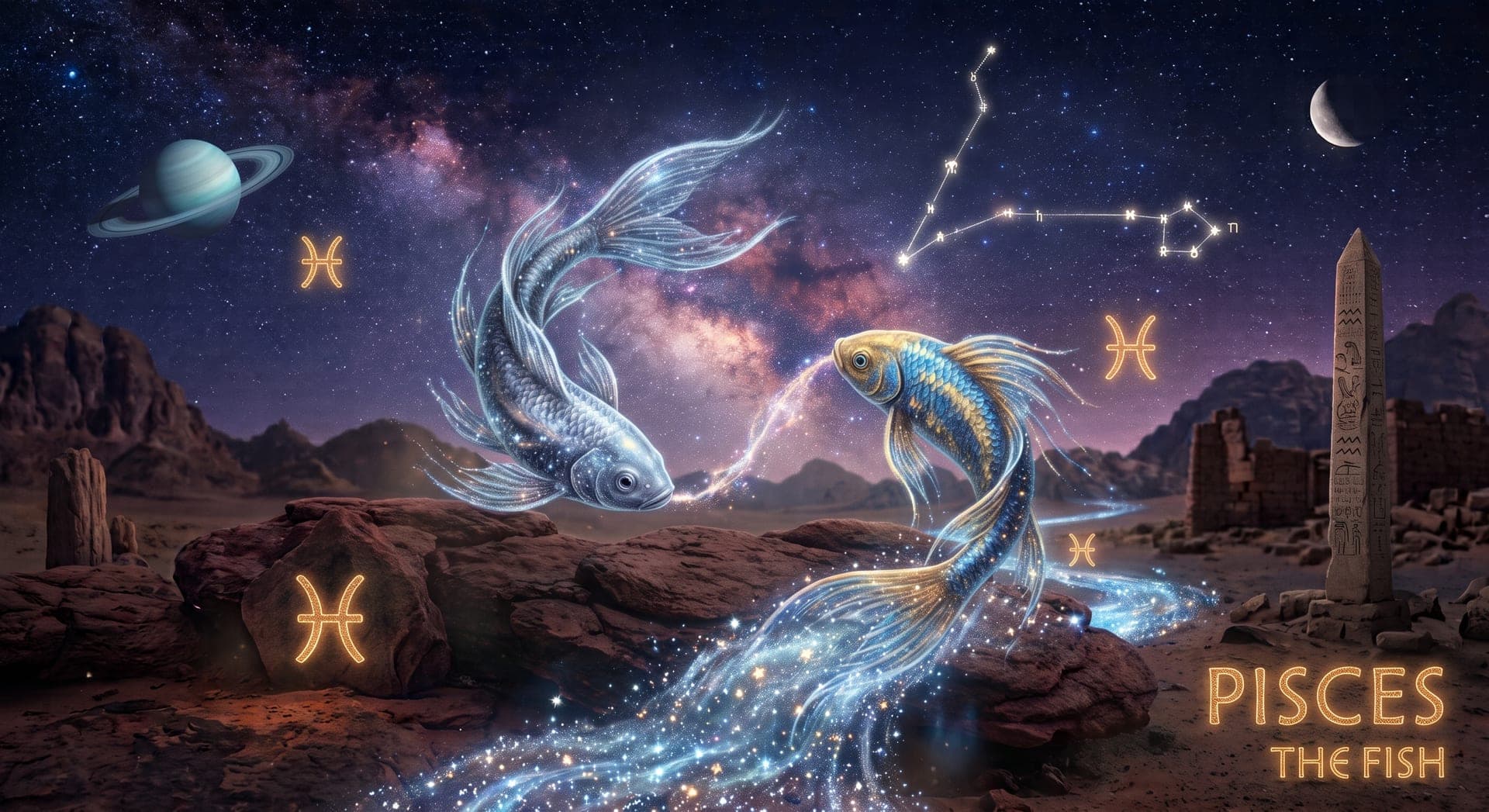
Pisces, the twelfth and final sign of the zodiac, spans February 19 to March 20 and is symbolized by two fish swimming in opposite directions, tied together by a cord, representing the tension between fantasy and reality, or the conscious and subconscious mind. Ruled by Neptune, the planet of dreams, intuition, and illusion, Pisces is widely regarded as the most emotionally sensitive and imaginative sign of the zodiac. As a Water sign, Pisces navigates the world primarily through feeling and empathy, often absorbing the moods of people around it as though they were its own. Its Mutable modality reflects a deep adaptability and fluidity, comfortable going with the flow rather than forcing rigid plans. People born under this sign are often drawn to art, music, and other creative or spiritual pursuits where their vivid imagination can take shape. Compassionate to a fault, Pisces individuals are frequently the ones quietly caring for others, sometimes at the expense of their own boundaries and needs.
Personality Traits
Strengths
- Deeply empathetic and compassionate
- Highly imaginative and artistic
- Intuitive and perceptive
- Selfless and generous
- Adaptable to change
Weaknesses
- Prone to escapism or avoidance
- Overly trusting, can be taken advantage of
- Difficulty setting boundaries
- Tends toward melancholy
- Indecisive
Compatible Signs
Fun Facts
- Pisces' symbol of two fish bound together swimming in opposite directions comes from a Greek myth in which Aphrodite and Eros transformed into fish and tied themselves together to escape the monster Typhon.
- As the twelfth and final sign of the zodiac, Pisces is often described as embodying traits of all the preceding signs, a kind of culmination of the zodiac wheel.
- Neptune, Pisces' modern ruling planet, is the Roman god of the sea, discovered in 1846 and named for its blue, oceanic appearance.
- Notable Pisces include Albert Einstein, Rihanna, Steve Jobs, and Kurt Cobain.
- Classical astrology assigns Jupiter as Pisces' ruler, before Neptune's discovery in the 19th century gave the sign its modern ruling planet.
Born on February 23
- 1633
Samuel Pepys
English diarist and naval administrator whose detailed diary offers a vivid firsthand account of Restoration-era London
- 1685
George Frideric Handel
Baroque composer of "Messiah"
- 1723
Richard Price
Welsh moral philosopher and dissenting minister whose writings on liberty influenced the American and French revolutions
- 1868
W. E. B. Du Bois
Influential sociologist and civil rights leader
- 1892
Kathleen Harrison
English character actress with a long career on stage and in British films
- 1944
Bernard Cornwell
English novelist best known for his Sharpe series of historical war novels
- 1958
David Sylvian
English musician and singer, formerly frontman of the band Japan, known for his atmospheric solo work
- 1965
Michael Dell
Founder of Dell Technologies
- 1976
Kelly Macdonald
Scottish actress known for roles in Trainspotting, No Country for Old Men, and Boardwalk Empire
- 1981
Gareth Barry
English footballer who made more Premier League appearances than almost any other player in the competition's history
- 1995
Andrew Wiggins
NBA player and Olympic gold medalist
- 1997
Jamal Murray
NBA basketball player
On This Day in History
- 532
Byzantine Emperor Justinian I lays the foundation stone for the Hagia Sophia in Constantinople, which would become one of the greatest architectural achievements of the ancient world.
Justinian's Hagia Sophia, built to replace an earlier church destroyed during the Nika riots, was completed in under six years and its massive central dome was considered an engineering marvel of the ancient world. It served for centuries as the world's largest cathedral before later becoming a mosque and now a museum-mosque in modern Istanbul.
- 1820
British authorities raid a hayloft in London's Cato Street and arrest a group of radicals plotting to assassinate the entire British cabinet.
The conspirators, led by Arthur Thistlewood, planned to murder government ministers at a dinner and use the chaos to spark a wider revolution, inspired by economic hardship and anger over the Peterloo Massacre the previous year. A government informer had infiltrated the group beforehand, allowing Bow Street Runners and soldiers to intercept the plotters. Five conspirators were later hanged for high treason.
- 1836
Mexican forces under Santa Anna begin the siege of the Alamo in San Antonio, Texas, a pivotal battle in the Texas Revolution.
The vastly outnumbered defenders of the Alamo mission, including figures like Davy Crockett and Jim Bowie, held out for thirteen days before being overwhelmed by Santa Anna's forces. Their defeat, though a military loss, became a galvanizing rallying cry, "Remember the Alamo," that helped Texas ultimately win its independence weeks later.
- 1836
Mexican forces under General Santa Anna begin their siege of the Alamo mission in San Antonio, Texas.
The small garrison of Texian defenders, including figures like Jim Bowie and Davy Crockett, held out for thirteen days against a vastly larger Mexican army before the mission was overrun and nearly all its defenders killed. The siege and subsequent battle became a rallying symbol for Texian forces, who invoked 'Remember the Alamo' during their decisive victory at San Jacinto weeks later.
- 1847
American forces under Zachary Taylor defeat a much larger Mexican army at the Battle of Buena Vista, boosting Taylor's political fortunes toward the presidency.
Taylor's outnumbered forces held their ground against a much larger Mexican army in rugged terrain, a defensive victory that, while not decisive to the war's outcome, boosted Taylor's national reputation and helped propel him to the U.S. presidency two years later.
- 1886
American chemist Charles Martin Hall successfully produces aluminium through an electrolytic process, making cheap mass production of the metal possible for the first time.
Hall developed the technique in a home laboratory using little more than batteries and household equipment, working out the same electrolytic process almost simultaneously with French chemist Paul Héroult. Before the breakthrough, aluminium had been rarer and more expensive than gold; the Hall-Héroult process, still used industrially today, made it cheap enough for everyday use within a generation.
- 1900
British forces launch their first attempt to storm Hart's Hill during the Second Boer War, part of the campaign to relieve the besieged town of Ladysmith.
The hill formed a key Boer defensive position blocking the British advance toward Ladysmith, and the initial assault was beaten back with heavy casualties amid difficult terrain and determined Boer resistance. British forces eventually secured the position after further hard fighting, and Ladysmith was relieved just days later, marking a turning point in Britain's fortunes in the war.
- 1909
The Silver Dart, built by the Aerial Experiment Association, makes the first powered aeroplane flight in Canada and across the British Empire.
The flight took place over the frozen surface of Bras d'Or Lake in Nova Scotia and was piloted by J. A. D. McCurdy, a member of a small aviation research group that had also included telephone inventor Alexander Graham Bell. The short hop demonstrated that heavier-than-air powered flight, achieved by the Wright brothers only a few years earlier, could be replicated elsewhere in the Empire.
- 1917
Mass demonstrations erupt in Petrograd over bread shortages, marking the beginning of the February Revolution that would topple the Russian tsar.
Women textile workers and other demonstrators in Petrograd, protesting bread shortages and wartime hardship, were soon joined by soldiers who refused orders to suppress them, rapidly escalating into a revolution that forced Tsar Nicholas II to abdicate within days, ending three centuries of Romanov rule.
- 1917
Mass demonstrations and strikes break out in Petrograd, marking the start of the February Revolution that would topple the Russian monarchy within days.
The protests began with women textile workers marking International Women's Day and demanding bread, quickly swelling into a general strike as soldiers garrisoned in the capital refused orders to fire on the crowds. Within a week Tsar Nicholas II abdicated, ending three centuries of Romanov rule and ushering in a provisional government that would itself be overthrown by the Bolsheviks later that year.
- 1927
Physicist Werner Heisenberg outlines his uncertainty principle in a letter to fellow physicist Wolfgang Pauli.
The principle holds that certain pairs of physical properties, such as a particle's position and momentum, cannot both be measured with perfect precision at the same time, a fundamental limit rather than merely a flaw in measuring instruments. It became one of the cornerstones of quantum mechanics, reshaping scientists' understanding of the fundamental nature of matter and observation.
- 1941
Chemist Glenn T. Seaborg and colleagues first produce and isolate plutonium, a discovery central to the later development of nuclear weapons.
Seaborg's team produced plutonium by bombarding uranium with particles in a cyclotron, a discovery kept secret during wartime due to its critical role in nuclear weapons development. Plutonium became the fissile material used in the first atomic bomb tested and the weapon dropped on Nagasaki.
- 1945
U.S. Marines raise the American flag atop Mount Suribachi during the Battle of Iwo Jima, producing one of the most famous photographs of World War II.
The flag-raising atop Mount Suribachi, captured in Joe Rosenthal's Pulitzer Prize-winning photograph, became one of the most reproduced images in history and later the basis for the U.S. Marine Corps War Memorial, even though the actual battle for Iwo Jima continued for weeks afterward.
- 1945
Combined Filipino and American forces liberate Manila from Japanese occupation after weeks of fierce urban fighting.
The liberation of Manila came after weeks of brutal urban combat in which retreating Japanese naval forces massacred tens of thousands of Filipino civilians, leaving much of the once-elegant "Pearl of the Orient" in ruins, among the most devastated Allied capital cities of the entire war.
- 1945
Royal Air Force bombers destroy much of the German city of Pforzheim in one of the most devastating air raids of World War II.
The raid concentrated an enormous weight of incendiary and high-explosive bombs on the town in under half an hour, igniting a firestorm that killed a large proportion of the city's population in a single night, proportionally one of the deadliest raids of the war relative to city size. Pforzheim, known for its jewellery and watchmaking industry, was left almost entirely in ruins.
- 1950
The United Kingdom holds a general election, in which Clement Attlee's Labour government is returned to power with a drastically reduced majority.
Labour had won a landslide in 1945 and used the intervening years to build the National Health Service and nationalise major industries, but by 1950 postwar austerity and rationing had eroded its popularity. The party clung to office with a majority of just a handful of seats, a result so precarious that it forced Attlee to call another election the following year, which Labour lost.
- 1981
Civil Guard officer Antonio Tejero leads an attempted coup, storming Spain's parliament and briefly holding lawmakers hostage before the plot collapsed.
Tejero's coup attempt, staged just years after Spain's transition to democracy following Franco's death, briefly held the entire parliament hostage at gunpoint before collapsing after King Juan Carlos I publicly denounced the plotters on television, a decisive moment that helped secure Spanish democracy.
- 1987
Astronomers observe Supernova 1987A in a nearby galaxy, the closest and most studied supernova visible from Earth in nearly four centuries.
Supernova 1987A, the explosive death of a massive star roughly 168,000 light-years away, was the closest and brightest supernova observed since the invention of the telescope, giving astronomers an unprecedented opportunity to study stellar death and the origins of heavy elements in real time.
- 2007
A Virgin Trains express derails near Grayrigg in Cumbria, England, after striking a faulty set of points, killing one passenger and injuring dozens more.
The Pendolino train was travelling at high speed when it hit the defective points and left the track, rolling down an embankment. Investigators found that a set of points had not been properly maintained, and the incident prompted Network Rail to overhaul its inspection procedures. Rail safety experts credited the train's crash-resistant design with preventing far greater loss of life.
- 2025
Germany holds a snap federal election following the collapse of the governing coalition the previous year.
The snap election followed the collapse of Germany's three-party coalition government the previous year over budget disagreements, reflecting a period of political fragmentation and economic uncertainty in Europe's largest economy.