What’s Observed on February 24
Born on February 24: Pisces ♓
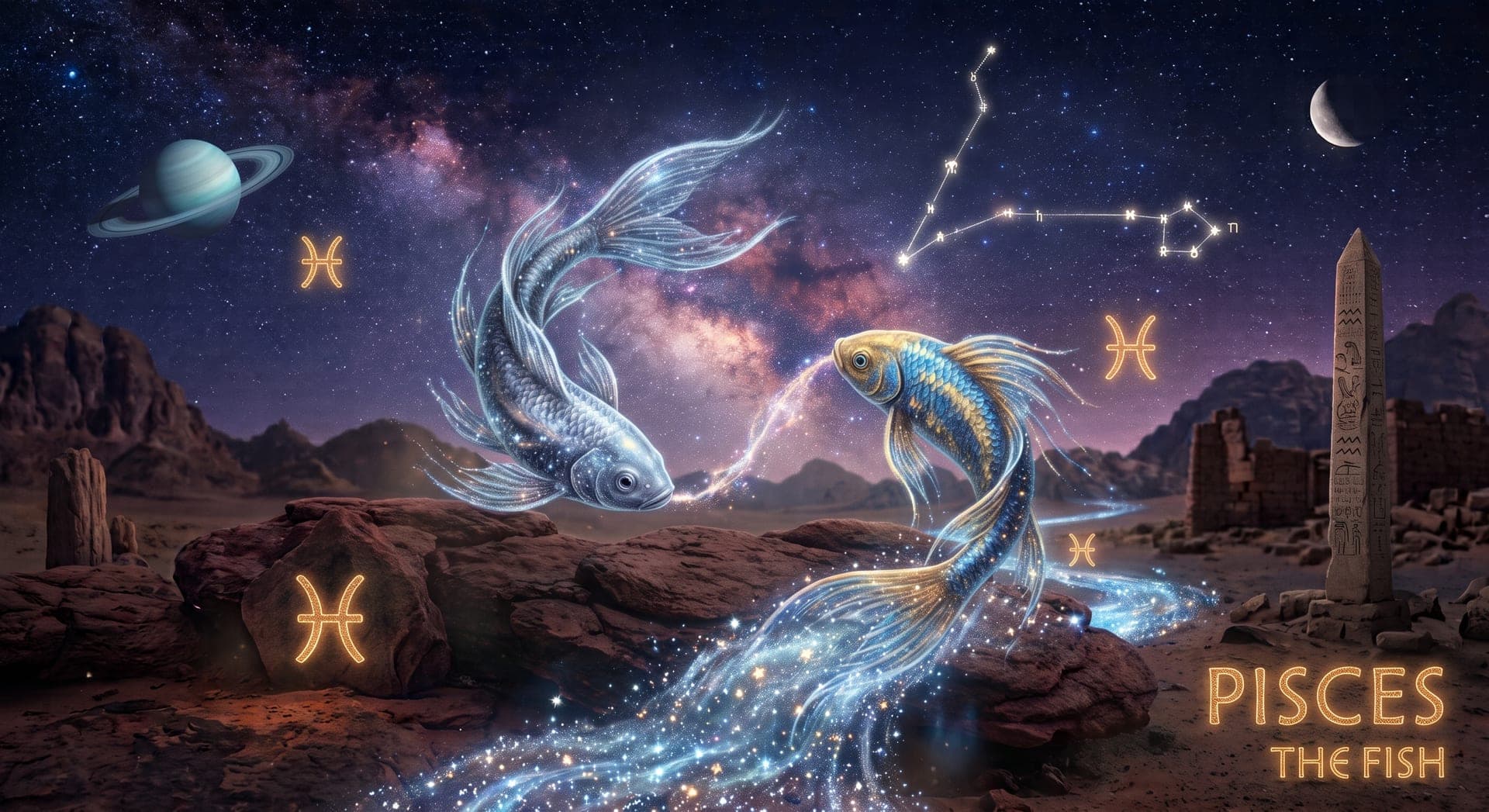
Pisces, the twelfth and final sign of the zodiac, spans February 19 to March 20 and is symbolized by two fish swimming in opposite directions, tied together by a cord, representing the tension between fantasy and reality, or the conscious and subconscious mind. Ruled by Neptune, the planet of dreams, intuition, and illusion, Pisces is widely regarded as the most emotionally sensitive and imaginative sign of the zodiac. As a Water sign, Pisces navigates the world primarily through feeling and empathy, often absorbing the moods of people around it as though they were its own. Its Mutable modality reflects a deep adaptability and fluidity, comfortable going with the flow rather than forcing rigid plans. People born under this sign are often drawn to art, music, and other creative or spiritual pursuits where their vivid imagination can take shape. Compassionate to a fault, Pisces individuals are frequently the ones quietly caring for others, sometimes at the expense of their own boundaries and needs.
Personality Traits
Strengths
- Deeply empathetic and compassionate
- Highly imaginative and artistic
- Intuitive and perceptive
- Selfless and generous
- Adaptable to change
Weaknesses
- Prone to escapism or avoidance
- Overly trusting, can be taken advantage of
- Difficulty setting boundaries
- Tends toward melancholy
- Indecisive
Compatible Signs
Fun Facts
- Pisces' symbol of two fish bound together swimming in opposite directions comes from a Greek myth in which Aphrodite and Eros transformed into fish and tied themselves together to escape the monster Typhon.
- As the twelfth and final sign of the zodiac, Pisces is often described as embodying traits of all the preceding signs, a kind of culmination of the zodiac wheel.
- Neptune, Pisces' modern ruling planet, is the Roman god of the sea, discovered in 1846 and named for its blue, oceanic appearance.
- Notable Pisces include Albert Einstein, Rihanna, Steve Jobs, and Kurt Cobain.
- Classical astrology assigns Jupiter as Pisces' ruler, before Neptune's discovery in the 19th century gave the sign its modern ruling planet.
Born on February 24
- 1743
Joseph Banks
English naturalist and botanist who sailed with Captain Cook and later shaped the Royal Botanic Gardens at Kew
- 1874
Honus Wagner
Legendary baseball shortstop
- 1922
Richard Hamilton
English artist widely regarded as a founding figure of the pop art movement
- 1931
Brian Close
English cricketer who became the youngest player ever to represent England in Test cricket at the time of his 1949 debut, aged 18
- 1938
Phil Knight
Co-founder of Nike, Inc.
- 1940
Denis Law
Scottish footballer and prolific striker for Manchester United, celebrated as one of Britain's greatest players
- 1942
Paul Jones
English singer and actor, formerly frontman of the band Manfred Mann
- 1948
Dennis Waterman
English actor known for television roles in The Sweeney and Minder
- 1950
George Thorogood
American rock and blues guitarist
- 1955
Steve Jobs
Co-founder of Apple and Pixar
- 1955
Alain Prost
Four-time Formula One world champion
- 1971
Gillian Flynn
Best-selling author of "Gone Girl"
- 1977
Floyd Mayweather Jr.
Undefeated professional boxing champion
- 1981
Lleyton Hewitt
Former world number one tennis player
- 1989
Daniel Kaluuya
English actor known for his performances in Get Out and Black Panther
On This Day in History
- 1303
Scottish forces defeat an invading English army at the Battle of Roslin during the Wars of Scottish Independence.
Led by John Comyn and Simon Fraser, a Scottish force ambushed and routed a larger English raiding party near Roslin, south of Edinburgh. The victory provided a morale boost for the Scottish resistance at a low point in the war, though it did little to change the war's overall trajectory, and English forces would continue campaigning in Scotland for years afterward.
- 1582
Pope Gregory XIII issues a papal bull introducing the Gregorian calendar, correcting the drift of the older Julian calendar and establishing the calendar system used by most of the world today.
Gregory's calendar reform corrected an accumulated ten-day drift in the older Julian calendar's approximation of the solar year, adjusting the leap year rules for greater long-term accuracy. Adoption spread gradually and unevenly across countries and religious lines over the following centuries, with some nations not switching until the 20th century.
- 1582
Pope Gregory XIII issues the papal bull Inter gravissimas, introducing the Gregorian calendar to correct accumulated errors in the older Julian calendar.
The reform dropped ten days from the calendar to realign the spring equinox with its traditional date and adjusted the system of leap years to keep the calendar more accurately synced with the solar year going forward. Catholic countries adopted the new calendar almost immediately, but Protestant and Orthodox nations, including Britain, held out for decades or even centuries before switching.
- 1803
The U.S. Supreme Court establishes the principle of judicial review in Marbury v. Madison, asserting its authority to strike down unconstitutional laws.
Chief Justice John Marshall's landmark opinion in Marbury v. Madison established that the Supreme Court has the authority to strike down laws it deems unconstitutional, a power not explicitly stated in the Constitution itself but that became a foundational pillar of the American system of checks and balances.
- 1803
The US Supreme Court rules in Marbury v. Madison, establishing the principle of judicial review over acts of Congress.
Chief Justice John Marshall's opinion held that the Court had the authority to strike down laws it found unconstitutional, a power not explicitly spelled out in the Constitution itself. The decision, born out of a dispute over a last-minute judicial appointment, fundamentally shaped the balance of power between America's branches of government and remains a foundational precedent in US constitutional law.
- 1809
The Theatre Royal, Drury Lane, in London burns to the ground in a devastating fire.
The theatre was owned by the playwright and politician Richard Brinsley Sheridan, who reportedly watched the blaze from a nearby coffee house with remarkable calm, remarking that a man could surely drink a glass of wine by his own fireside. The fire left Sheridan financially ruined, and the theatre was not rebuilt and reopened until 1812.
- 1809
British forces complete the capture of the French Caribbean colony of Martinique.
A Royal Navy squadron and army landing force overwhelmed the French garrison after a campaign of several weeks, part of Britain's broader effort to seize French and allied colonies in the Caribbean during the Napoleonic Wars. Martinique remained under British control for several years before being returned to France under the terms of a later peace settlement.
- 1813
The British sloop-of-war HMS Peacock is sunk by the American warship USS Hornet off the coast of British Guiana during the War of 1812.
The two ships exchanged fire for only about fifteen minutes before Peacock, badly damaged and taking on water, was forced to strike her colours and soon sank. The lopsided defeat was one of several single-ship actions in which American frigates and sloops outperformed their Royal Navy counterparts early in the war, briefly denting Britain's confidence in its naval supremacy.
- 1848
King Louis-Philippe of France abdicates amid revolutionary unrest, leading to the establishment of the French Second Republic.
Louis-Philippe's abdication, forced by the popular uprising of the French Revolution of 1848, ended the July Monarchy and led to the establishment of the Second Republic, with Napoleon's nephew Louis-Napoleon Bonaparte elected president later that year before eventually declaring himself emperor.
- 1917
British naval intelligence passes the decoded Zimmermann Telegram, a secret German proposal for a military alliance with Mexico against the United States, to the American government.
Codebreakers in Room 40 of the British Admiralty had intercepted and decrypted the telegram weeks earlier but delayed revealing it in order to protect the fact that Britain was reading German diplomatic codes. Its disclosure to Washington caused public outrage in the United States and helped shift American opinion decisively toward entering World War I within weeks.
- 1918
Estonia declares independence, briefly, before German occupation and later Soviet annexation would repeatedly interrupt its sovereignty over the following decades.
Estonia's declaration came amid a brief window of opportunity during the chaos of World War I and the Russian Revolution, though the country was almost immediately occupied by German forces and would face repeated foreign occupations before securing lasting independence in 1991.
- 1920
The German Workers' Party is reorganized and renamed the Nazi Party, unveiling its 25-point political program in Munich.
The renamed and reorganized Nazi Party unveiled its 25-point program, blending nationalist, antisemitic, and vaguely socialist economic proposals designed to appeal broadly to disaffected Germans amid the economic turmoil of the early Weimar Republic.
- 1920
Nancy Astor delivers her maiden speech in the House of Commons, becoming the first woman to address Parliament as a sitting Member of Parliament.
Astor, an American-born Conservative politician, had won a by-election for the Plymouth Sutton seat the previous December after her husband was elevated to the House of Lords. Her speech, delivered amid a largely hostile male chamber, addressed the licensing of alcohol, and she went on to serve as an MP for over two decades, championing causes such as temperance and welfare reform.
- 1920
The German Workers' Party unveils its 25-point program and renames itself the National Socialist German Workers' Party at a Munich beer hall meeting.
The gathering, addressed by a rising young speaker named Adolf Hitler, laid out a nationalist and antisemitic platform that combined elements of socialism with extreme German nationalism. The small fringe party would grow over the following decade into the movement that seized power in Germany in 1933, with catastrophic consequences for Europe and the world.
- 1949
Egypt and Israel sign an armistice agreement, formally ending major combat operations in the 1948 Arab-Israeli War.
The armistice agreements, negotiated separately between Israel and its Arab neighbors following the 1948 war that accompanied Israel's founding, established temporary ceasefire lines rather than permanent recognized borders, leaving core territorial and political disputes unresolved for decades to come.
- 1968
South Vietnamese and American forces recapture the imperial city of Hue from North Vietnamese and Viet Cong troops after weeks of fierce fighting during the Tet Offensive.
The recapture of Hue, following weeks of intense urban combat against North Vietnamese and Viet Cong forces who had seized the ancient imperial city during the Tet Offensive, came at a heavy cost and revealed the discovery of a mass grave from a massacre of civilians carried out by the occupying forces.
- 1991
The Gulf War's ground campaign begins as coalition forces cross into Iraq and Kuwait, quickly overwhelming Iraqi defenses.
The Gulf War's hundred-hour ground campaign swiftly overwhelmed Iraqi defenses, which had already been severely weakened by weeks of coalition air bombardment, liberating Kuwait and pushing Iraqi forces into a chaotic retreat before a ceasefire was declared just days later.
- 2008
Fidel Castro formally retires as President of Cuba after 32 years in power, handing control to his brother Raúl.
Castro's retirement, announced in a letter rather than a public address due to his declining health, ended nearly five decades of rule during which he survived numerous assassination attempts and U.S. hostility while remaining a defining, polarizing figure of the Cold War era.
- 2022
Russian President Vladimir Putin orders a full-scale invasion of Ukraine, launching the largest European conflict since World War II.
Putin's invasion, launched on multiple fronts including toward the capital Kyiv, aimed for a rapid takeover but met unexpectedly fierce Ukrainian resistance. The resulting war became the largest and deadliest conflict in Europe since World War II, triggering massive Western sanctions and a global realignment of security alliances.
- 2022
Russia launches a full-scale military invasion of Ukraine, opening the largest European war since World War II.
Russian forces attacked from multiple directions, including from Belarus, Russia, and Crimea, aiming for a rapid capture of Kyiv, but met fierce Ukrainian resistance that stalled the initial advance. The invasion triggered sweeping international sanctions against Russia, a massive refugee crisis, and sustained Western military support for Ukraine, reshaping European security policy for years afterward.