
What’s Observed on February 17
Born on February 17: Aquarius ♒
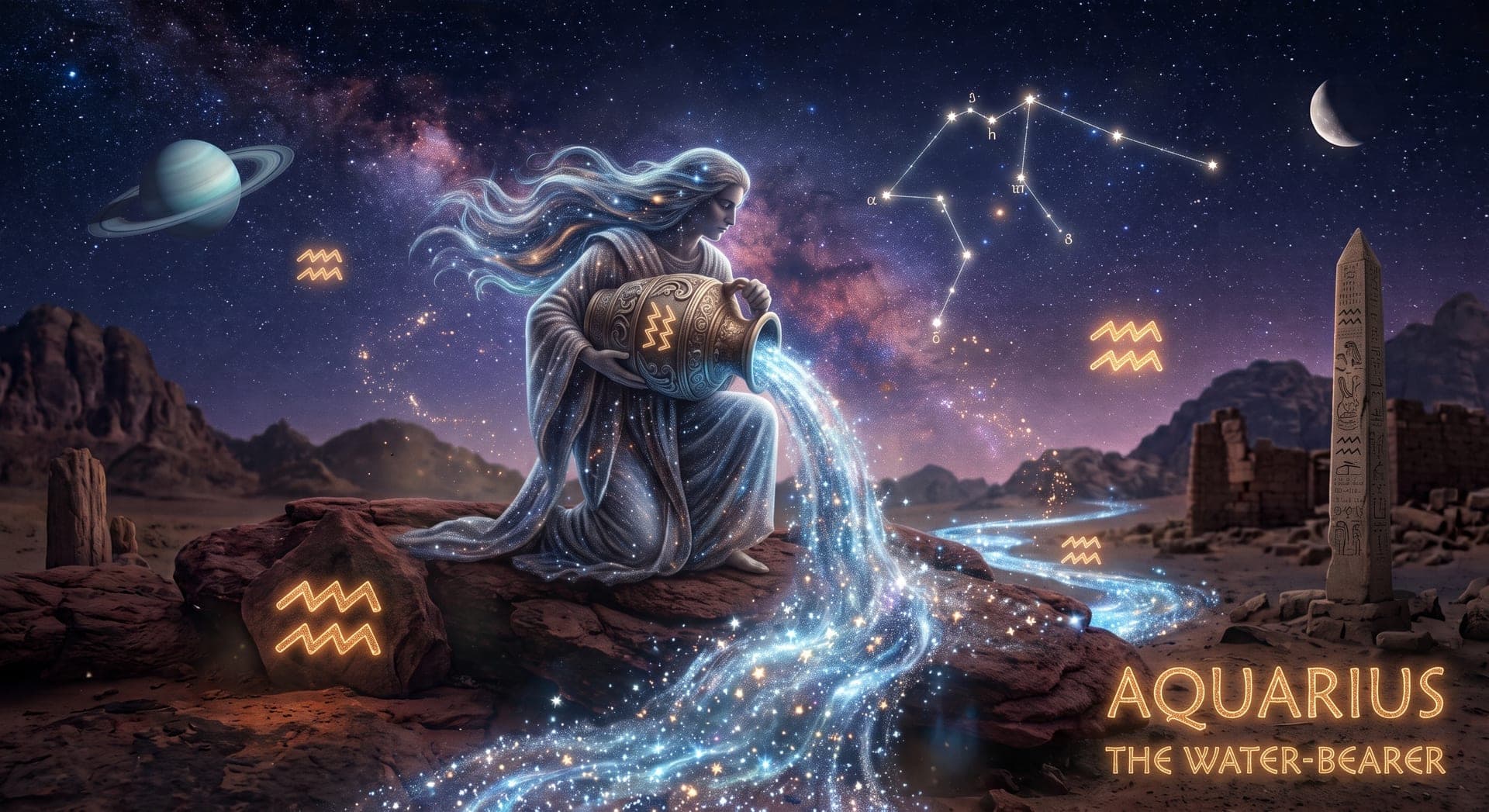
Aquarius, the eleventh sign of the zodiac, spans January 20 to February 18 and is symbolized by the water bearer, an image of someone pouring out knowledge and life-giving ideas to the world, despite Aquarius actually being an air sign rather than a water sign. Traditionally ruled by disciplined Saturn and, in modern astrology, by unpredictable Uranus, the planet of innovation and rebellion, Aquarius carries a distinctive blend of structure and originality. People born under this sign are often described as independent thinkers, forward-looking, and drawn to humanitarian causes, valuing the collective good over convention. As a Fixed sign, Aquarius can be famously stubborn once its mind is made up, even while championing change for everyone else. Intellectually curious and sometimes emotionally guarded, Aquarians tend to value friendship and community deeply, often serving as the visionary of their social circle, more comfortable debating ideas than discussing feelings.
Personality Traits
Strengths
- Original and forward-thinking
- Strong sense of fairness and justice
- Independent and self-sufficient
- Loyal to friends and causes alike
- Sees the bigger picture others miss
Weaknesses
- Can run from emotional expression
- Uncompromising once a position is fixed
- Prone to aloofness or detachment
- Sometimes contrarian just to stand apart
- Can prioritize ideas over people's feelings
Compatible Signs
Fun Facts
- Despite its watery name and imagery, Aquarius is classified as an air sign, grouped with Gemini and Libra as a sign of thought and communication rather than emotion.
- Aquarius has two ruling planets: Saturn in classical astrology, and Uranus, discovered in 1781, in the modern system most Western astrologers use today.
- The water bearer symbol traces back to Ganymede in Greek mythology, a cupbearer to the gods said to pour out a life-giving stream from the heavens.
- Notable Aquarians include Oprah Winfrey, Abraham Lincoln, Charles Darwin, Thomas Edison, and Bob Marley.
- Aquarius is one of the rarer signs to be represented by a person rather than an animal or object, alongside Gemini, Virgo, and Sagittarius's centaur half.
Born on February 17
- 1890
Ronald Fisher
English statistician and geneticist whose work laid much of the foundation for modern statistical science and evolutionary biology
- 1930
Ruth Rendell
English novelist celebrated for her psychological crime fiction, including the Inspector Wexford series
- 1934
Alan Bates
English actor known for stage and film roles including Women in Love and The Go-Between
- 1936
Jim Brown
NFL Hall of Fame running back and actor
- 1944
Karl Jenkins
Welsh composer and musician known for orchestral works such as Adiemus and The Armed Man
- 1954
Rene Russo
American actress and former model
- 1955
Mo Yan
Chinese novelist and Nobel Prize laureate
- 1957
Loreena McKennitt
Canadian Celtic musician and composer
- 1963
Michael Jordan
Widely regarded as the greatest basketball player of all time
- 1972
Billie Joe Armstrong
Green Day frontman
- 1978
Rory Kinnear
English actor known for stage work and film roles including the James Bond series
- 1981
Paris Hilton
Media personality and businesswoman
- 1989
Rebecca Adlington
English swimmer who won two gold medals in freestyle events at the 2008 Beijing Olympics
- 1991
Ed Sheeran
English singer-songwriter known for chart-topping albums including Divide and Equals
On This Day in History
- 1600
Philosopher and astronomer Giordano Bruno is burned at the stake in Rome for heresy, partly for supporting the Copernican view that the Earth orbits the Sun.
Bruno, a former Dominican friar and philosopher, was condemned by the Roman Inquisition for a range of heretical beliefs, including his defense of Copernican astronomy and speculation about an infinite universe with multiple worlds. His execution made him a lasting symbol of the conflict between scientific inquiry and religious orthodoxy.
- 1600
Italian philosopher Giordano Bruno is burned at the stake in Rome after being convicted of heresy by the Roman Inquisition.
Bruno had advanced controversial cosmological ideas, including the notion that the universe was infinite and contained countless worlds, alongside other theological positions the Church deemed heretical. His execution in the Campo de' Fiori made him a lasting symbol of the conflict between free philosophical inquiry and religious orthodoxy, and a statue was later erected on the site where he died.
- 1801
After a tied Electoral College vote, the U.S. House of Representatives elects Thomas Jefferson president over Aaron Burr.
The tied 1800 election between Jefferson and his own running mate, Aaron Burr, exposed a flaw in the original Constitution's electoral process, resolved only after 36 rounds of voting in the House. The crisis directly led to the Twelfth Amendment, which separated the voting for president and vice president.
- 1801
The U.S. House of Representatives resolves an electoral tie by electing Thomas Jefferson President and Aaron Burr Vice President.
Jefferson and Burr had unexpectedly finished tied in the Electoral College, throwing the contested 1800 election into the House, where it took 36 ballots over several days to break the deadlock. The crisis exposed a flaw in the original constitutional system for electing presidents and vice presidents, leading directly to the Twelfth Amendment, which separated the two votes going forward.
- 1854
The United Kingdom formally recognizes the independence of the Orange Free State, a Boer republic in southern Africa.
Under the Bloemfontein Convention, Britain relinquished its earlier claims of sovereignty over the region between the Orange and Vaal rivers, allowing Boer settlers there to establish a self-governing republic. The Orange Free State remained independent for nearly half a century until it was annexed by Britain during the Second Boer War at the turn of the twentieth century.
- 1863
A committee is founded in Geneva that would become the International Committee of the Red Cross, dedicated to protecting victims of armed conflict.
The Geneva committee, founded by Swiss businessman Henry Dunant after witnessing the horrific aftermath of the Battle of Solferino, established principles for neutral humanitarian aid to wounded soldiers regardless of allegiance. It grew into the International Committee of the Red Cross, a cornerstone of modern international humanitarian law.
- 1864
The Confederate submarine H. L. Hunley sinks the USS Housatonic, the first successful submarine attack on an enemy warship in history, though the Hunley itself was lost soon after.
The Hunley, a hand-cranked Confederate submarine, successfully sank the Union blockade ship Housatonic using a spar torpedo, but the primitive vessel and its crew of eight also sank shortly afterward for reasons still debated by historians. The wreck was located and raised over a century later.
- 1864
The Confederate submarine H. L. Hunley sinks the Union warship USS Housatonic off Charleston, South Carolina, becoming the first submarine in history to sink an enemy ship in combat.
The Hunley rammed a spar torpedo into the Housatonic's hull, sinking the ship in shallow water, but the submarine itself vanished afterward and its entire crew was lost along with it, in circumstances that remained mysterious for over a century. Its wreck was finally located in 1995 and raised in 2000, and it is now preserved as a landmark of naval history.
- 1865
Union troops burn much of Columbia, South Carolina, during General Sherman's campaign through the state.
Union General William Sherman's troops occupied and burned much of South Carolina's capital during his devastating March through the South, though responsibility for the fires, whether deliberate Union action, retreating Confederates, or accident, remains disputed by historians to this day.
- 1865
Union troops under General William Tecumseh Sherman occupy and burn much of Columbia, South Carolina, during the final months of the American Civil War.
Fires broke out across the city after Union forces entered, fueled by cotton bales set alight by retreating Confederates as well as by Union soldiers, and much of the city center was destroyed. The destruction of Columbia, the capital of the state where secession had begun, became one of the most bitterly remembered episodes of Sherman's march through the South.
- 1905
Grand Duke Sergei Alexandrovich, uncle of the Russian tsar, is assassinated by a revolutionary bomber in Moscow.
Grand Duke Sergei, the tsar's uncle and a widely unpopular figure known for his harsh policies as Moscow's governor-general, was killed by a bomb thrown by a revolutionary as part of the broader unrest of the 1905 Russian Revolution.
- 1949
Chaim Weizmann is sworn in as the first President of the newly established State of Israel.
Weizmann, a chemist and longtime Zionist leader who had lobbied for decades for a Jewish homeland, became the first president of Israel in a largely ceremonial role, with executive power resting with the prime minister, following the country's declaration of independence the previous year.
- 1959
The United States launches Vanguard 2, the first satellite designed to measure cloud cover and weather patterns from orbit.
Though its data proved of limited use due to a wobble in the satellite's spin, Vanguard 2 marked an early step toward the weather satellites that would later become essential tools for meteorology. It was launched as part of the broader Vanguard program, one of the United States' first efforts to develop orbital satellite capability during the early Space Race.
- 1978
The Provisional IRA detonates an incendiary bomb at the La Mon restaurant near Belfast, killing twelve people and seriously injuring dozens more.
The device, packed with a napalm-like mixture, exploded in the restaurant's function room where a social gathering was underway, engulfing the room in flames so intense that most victims could not be identified by sight. All twelve people killed were Protestant civilians, and the atrocity, one of the deadliest single incidents of the early Troubles, provoked widespread revulsion in both Northern Ireland and the Republic of Ireland.
- 1979
China launches a large-scale invasion of Vietnam, beginning the brief Sino-Vietnamese War.
The offensive came in response to Vietnam's invasion of Cambodia the previous year, which had overthrown China's ally, the Khmer Rouge. Chinese forces pushed into northern Vietnam and captured several provincial capitals before withdrawing after about a month, with both sides claiming victory in a costly conflict that strained Sino-Vietnamese relations for years afterward.
- 1996
The NEAR Shoemaker spacecraft launches on the first mission designed to orbit and eventually land on an asteroid.
NEAR Shoemaker's launch began a mission that would make it the first spacecraft to orbit and, in a bonus unplanned maneuver, land on an asteroid, providing scientists with unprecedented close-up data about the composition and structure of these small rocky bodies.
- 2008
Kosovo declares independence from Serbia, a move recognized by many Western nations but disputed by Serbia and Russia.
Kosovo's declaration followed years of conflict and international administration after NATO intervention ended a brutal Serbian crackdown on ethnic Albanians in the late 1990s. Its independence remains disputed by Serbia, Russia, and several other countries, leaving its international status unresolved.
- 2008
Kosovo unilaterally declares independence from Serbia.
The declaration came nearly a decade after NATO's intervention ended the Kosovo War and placed the territory under UN administration, with ethnic Albanians forming the overwhelming majority of its population. Kosovo's independence has since been recognized by more than a hundred countries, including the United Kingdom and the United States, but is still not recognized by Serbia, Russia, or several other states.
- 2011
Anti-government protests erupt in Libya against Muammar Gaddafi's regime, part of the wider Arab Spring uprisings sweeping the region.
Protests against Muammar Gaddafi's four-decade rule broke out in Benghazi and quickly spread, met with a violent government crackdown that triggered a civil war and eventual NATO intervention. Gaddafi was killed by rebel forces later that year, though Libya's subsequent political fragmentation has continued for years.
- 2011
Protests against Libyan leader Muammar Gaddafi's government break out in Benghazi, marking the start of the Libyan uprising and civil war.
The demonstrations, part of the wider wave of Arab Spring unrest sweeping the region, were met with a violent crackdown by government forces, which quickly escalated the protests into an armed rebellion. Within months, a NATO-backed intervention helped rebel forces topple Gaddafi's four-decade rule, though the country descended into prolonged instability in the years that followed.