What’s Observed on February 16
Born on February 16: Aquarius ♒
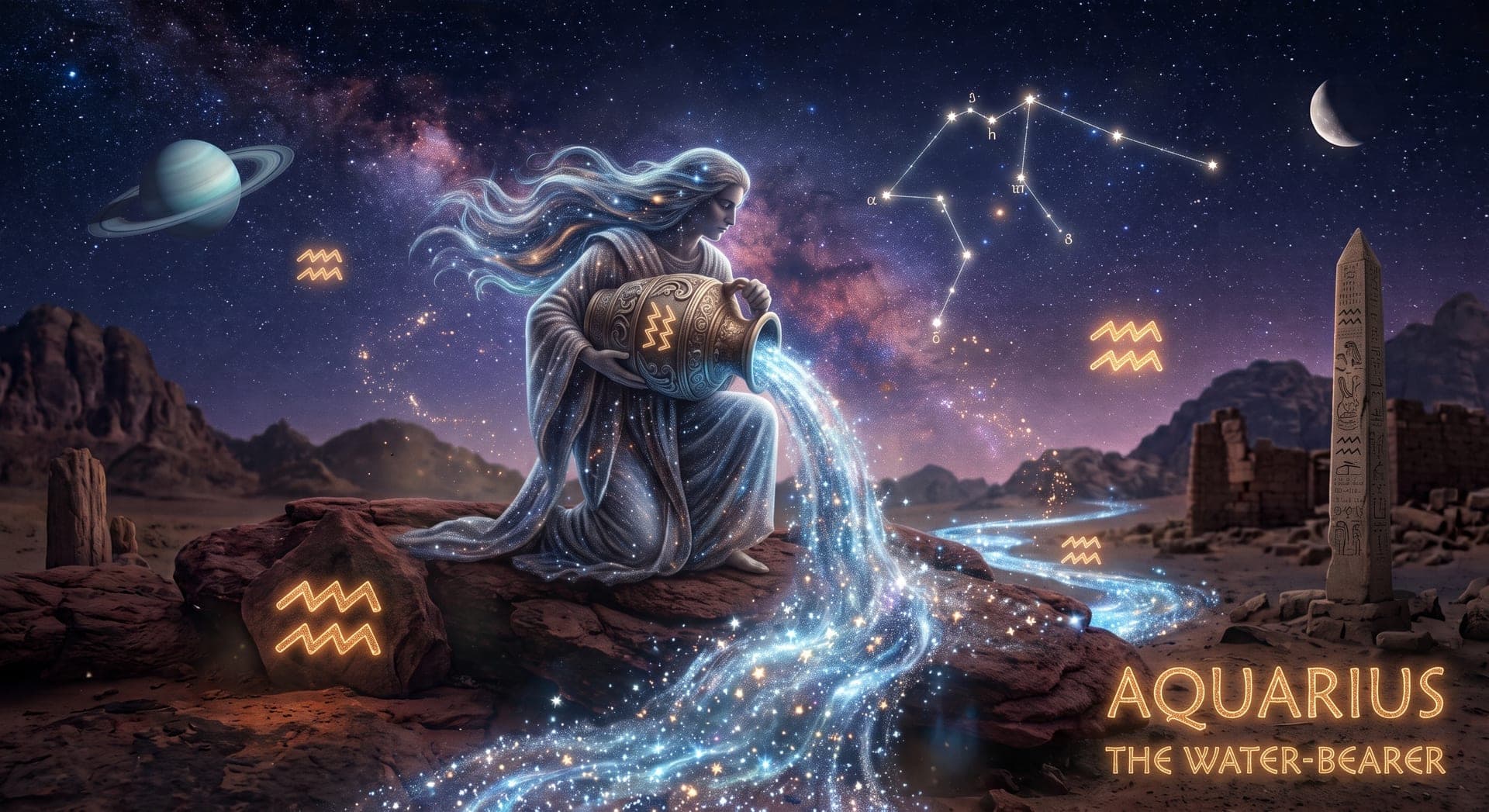
Aquarius, the eleventh sign of the zodiac, spans January 20 to February 18 and is symbolized by the water bearer, an image of someone pouring out knowledge and life-giving ideas to the world, despite Aquarius actually being an air sign rather than a water sign. Traditionally ruled by disciplined Saturn and, in modern astrology, by unpredictable Uranus, the planet of innovation and rebellion, Aquarius carries a distinctive blend of structure and originality. People born under this sign are often described as independent thinkers, forward-looking, and drawn to humanitarian causes, valuing the collective good over convention. As a Fixed sign, Aquarius can be famously stubborn once its mind is made up, even while championing change for everyone else. Intellectually curious and sometimes emotionally guarded, Aquarians tend to value friendship and community deeply, often serving as the visionary of their social circle, more comfortable debating ideas than discussing feelings.
Personality Traits
Strengths
- Original and forward-thinking
- Strong sense of fairness and justice
- Independent and self-sufficient
- Loyal to friends and causes alike
- Sees the bigger picture others miss
Weaknesses
- Can run from emotional expression
- Uncompromising once a position is fixed
- Prone to aloofness or detachment
- Sometimes contrarian just to stand apart
- Can prioritize ideas over people's feelings
Compatible Signs
Fun Facts
- Despite its watery name and imagery, Aquarius is classified as an air sign, grouped with Gemini and Libra as a sign of thought and communication rather than emotion.
- Aquarius has two ruling planets: Saturn in classical astrology, and Uranus, discovered in 1781, in the modern system most Western astrologers use today.
- The water bearer symbol traces back to Ganymede in Greek mythology, a cupbearer to the gods said to pour out a life-giving stream from the heavens.
- Notable Aquarians include Oprah Winfrey, Abraham Lincoln, Charles Darwin, Thomas Edison, and Bob Marley.
- Aquarius is one of the rarer signs to be represented by a person rather than an animal or object, alongside Gemini, Virgo, and Sagittarius's centaur half.
Born on February 16
- 1822
Francis Galton
English biologist and statistician who pioneered the study of human heredity and introduced statistical concepts such as regression and correlation
- 1876
G. M. Trevelyan
English historian celebrated for popular works on English social and political history, including English Social History
- 1877
Tom Crean
Irish-born Royal Navy seaman and Antarctic explorer celebrated for his endurance on the Discovery, Terra Nova, and Endurance expeditions
- 1903
Edgar Bergen
Pioneering American ventriloquist and radio performer
- 1909
Richard McDonald
Co-founder of the McDonald's restaurant chain
- 1927
June Brown
English actress best known for playing Dot Cotton in the soap opera EastEnders
- 1935
Sonny Bono
Singer and later U.S. congressman
- 1954
Iain Banks
Scottish author known for literary novels such as The Wasp Factory and for science fiction written as Iain M. Banks
- 1959
John McEnroe
Tennis champion and outspoken sportscaster
- 1961
Andy Taylor
English guitarist and songwriter who was a founding member of the band Duran Duran
- 1964
Christopher Eccleston
English actor known for playing the ninth incarnation of the Doctor in Doctor Who
- 1968
Warren Ellis
English writer known for graphic novels and comics including Transmetropolitan and Planetary
- 1974
Mahershala Ali
Two-time Academy Award-winning actor
- 1979
Valentino Rossi
Legendary MotoGP motorcycle racing champion
- 1989
Elizabeth Olsen
American actress known for Marvel films
- 1990
The Weeknd
Canadian singer-songwriter and producer
On This Day in History
- 1646
Parliamentarian forces defeat the last major Royalist field army at the Battle of Torrington in Devon, effectively ending the First English Civil War.
The battle, fought in and around the town of Torrington, saw fierce street fighting after a Royalist gunpowder store exploded in the town's church. The defeat scattered the remaining Royalist forces in the West Country, and King Charles I surrendered himself to the Scottish army a few months later, bringing the first phase of the English Civil War to a close.
- 1742
Spencer Compton, Earl of Wilmington, becomes Prime Minister of Great Britain following the resignation of Robert Walpole.
Wilmington's appointment came after Walpole, Britain's first and longest-serving prime minister, was forced from office following two decades in power. Wilmington's own tenure proved brief and largely ineffective, as he deferred heavily to other ministers, and he died in office just over a year later.
- 1796
British forces complete their conquest of Ceylon (present-day Sri Lanka) by capturing the Dutch-held port of Colombo.
The campaign came as Britain moved to seize Dutch colonial possessions after the Netherlands fell under French revolutionary control, denying France's ally a strategic base in the Indian Ocean. Ceylon became a British crown colony and remained under British rule for more than 150 years, until independence in 1948.
- 1862
Union General Ulysses S. Grant captures Fort Donelson, Tennessee, an early and important Union victory in the American Civil War.
Grant's capture of Fort Donelson, achieved after the fort's Confederate commanders fled and left a subordinate to negotiate, secured control of the Cumberland River and opened Tennessee to Union advance. Grant's demand for "unconditional surrender" gave rise to a popular nickname built on his initials.
- 1866
Spencer Compton Cavendish, later the 8th Duke of Devonshire, becomes British Secretary of State for War.
Cavendish, then known by his courtesy title Marquess of Hartington, went on to hold several senior cabinet posts across a long political career spanning both Liberal and Liberal Unionist governments. He was offered the premiership on more than one occasion but declined it, remaining an influential figure behind the scenes of British politics for decades.
- 1918
Lithuania's national council unanimously adopts the Act of Independence, formally declaring the country an independent state.
Lithuania's declaration came amid the chaos of World War I, as German occupying forces controlled the territory and Russia's own empire was collapsing into revolution. Lithuania's independence was repeatedly interrupted by Soviet and Nazi occupations over subsequent decades before being permanently restored in 1990.
- 1918
The Council of Lithuania unanimously adopts the Act of Independence, declaring Lithuania a sovereign state.
Signed by twenty members of the Council amid the upheaval of the First World War, the declaration asserted Lithuania's independence from both Russian and German control after more than a century under Russian imperial rule. The date is still celebrated annually in Lithuania as Restoration of the State Day.
- 1923
Archaeologist Howard Carter unseals the burial chamber of Pharaoh Tutankhamun, revealing the young king's largely intact treasures to the world.
Carter's discovery of Tutankhamun's tomb the previous year had already caused a sensation, but opening the inner burial chamber revealed the pharaoh's gilded shrines and eventually his intact sarcophagus, offering an unprecedented look at ancient Egyptian royal burial practices largely untouched by grave robbers.
- 1923
British archaeologist Howard Carter unseals the burial chamber of Tutankhamun in the Valley of the Kings, revealing the pharaoh's intact sarcophagus.
Carter had discovered the tomb's entrance months earlier, in November 1922, funded by the English aristocrat Lord Carnarvon, but it took several months of careful excavation to reach the burial chamber itself. The near-untouched tomb, filled with treasures, became one of the most significant archaeological finds of the twentieth century and sparked a wave of popular fascination with ancient Egypt across Britain and beyond.
- 1937
Chemist Wallace Carothers is granted a patent for nylon, the first fully synthetic fiber, which would transform the textile industry.
Carothers, a research chemist at DuPont, developed nylon as a synthetic silk substitute, and the material's strength and elasticity quickly made it commercially valuable for stockings and, later, countless industrial and military applications during World War II, including parachutes and rope.
- 1940
The British destroyer HMS Cossack boards the German tanker Altmark in Norwegian waters, freeing nearly 300 British merchant sailors held prisoner aboard.
The Altmark had been serving as a supply ship for the German raider Admiral Graf Spee and was carrying captured British sailors back to Germany when the Royal Navy tracked it down in a neutral Norwegian fjord. British boarders famously shouted 'The Navy's here!' as they stormed the ship, and the incident, though a breach of Norwegian neutrality, boosted British morale early in the war.
- 1945
American forces land on Corregidor Island in the Philippines, recapturing a strategic fortress lost to Japan earlier in World War II.
The recapture of Corregidor, a heavily fortified island guarding the entrance to Manila Bay, involved a dramatic combined airborne and amphibious assault against determined Japanese resistance. Its fall further secured the Philippines for Allied forces in the war's final year.
- 1959
Fidel Castro becomes Prime Minister of Cuba following the revolution that overthrew dictator Fulgencio Batista weeks earlier.
Castro assumed the premiership weeks after his rebel forces toppled the Batista dictatorship, initially promising democratic reforms before consolidating one-party communist rule and aligning Cuba closely with the Soviet Union, setting the stage for decades of Cold War tension with the United States.
- 1959
Fidel Castro becomes Prime Minister of Cuba following the overthrow of President Fulgencio Batista.
Castro's rise to power came weeks after his rebel forces swept into Havana at the start of the year, capping a guerrilla campaign that had begun in the Sierra Maestra mountains. His government soon nationalized industry and aligned with the Soviet Union, setting Cuba on a path toward decades of Communist rule and confrontation with the United States.
- 1962
The Great Sheffield Gale strikes northern England, damaging around 150,000 homes in Sheffield alone and killing nine people.
Winds reaching well over 100 miles per hour tore roofs from houses and brought down walls and chimneys across the city, in one of the most destructive storms to hit an English city in the twentieth century. The storm was part of a wider windstorm system that caused damage and casualties across northern Britain and continental Europe that week.
- 1968
The first 911 emergency telephone system in the United States goes into service in Haleyville, Alabama.
The Haleyville system replaced the previous practice of dialing a local operator or a specific seven-digit number for emergencies, a change enabled by a single dedicated three-digit number that could be remembered and dialed quickly. The 911 system gradually expanded nationwide over the following decades.
- 1983
The Ash Wednesday bushfires devastate southeastern Australia, killing 75 people and destroying thousands of homes.
The Ash Wednesday fires, fueled by extreme drought and high winds, devastated communities across Victoria and South Australia with little warning, becoming one of Australia's worst bushfire disasters at the time and prompting significant reforms to fire preparedness and land management.
- 1985
Hezbollah, the Lebanese Shia political and militant organization, is formally founded amid the Lebanese Civil War.
Hezbollah emerged from Lebanon's Shia Muslim community amid the chaos of the Lebanese Civil War and the Israeli occupation of southern Lebanon, receiving significant backing from Iran. It has since grown into a powerful political and military force in Lebanon and a key regional player backed by Iran.
- 2005
The Kyoto Protocol, the first major international treaty to set binding limits on greenhouse gas emissions, comes into legal force.
The Kyoto Protocol's entry into force, following Russia's ratification, obligated participating industrialized countries to reduce greenhouse gas emissions by specific targets. The United States never ratified the treaty, and its limited scope and eventual expiration led to later, broader agreements like the Paris Accord.
- 2005
The Kyoto Protocol, an international treaty committing signatory nations to reduce greenhouse gas emissions, enters into force following Russia's ratification.
Negotiated in 1997 as an extension of the UN Framework Convention on Climate Change, the protocol had needed ratification by enough countries to cover a sufficient share of global emissions before it could take legal effect. Russia's ratification in late 2004 finally cleared that threshold, though the treaty's impact was limited by the United States' decision not to ratify it.