
What’s Observed on February 15
Born on February 15: Aquarius ♒
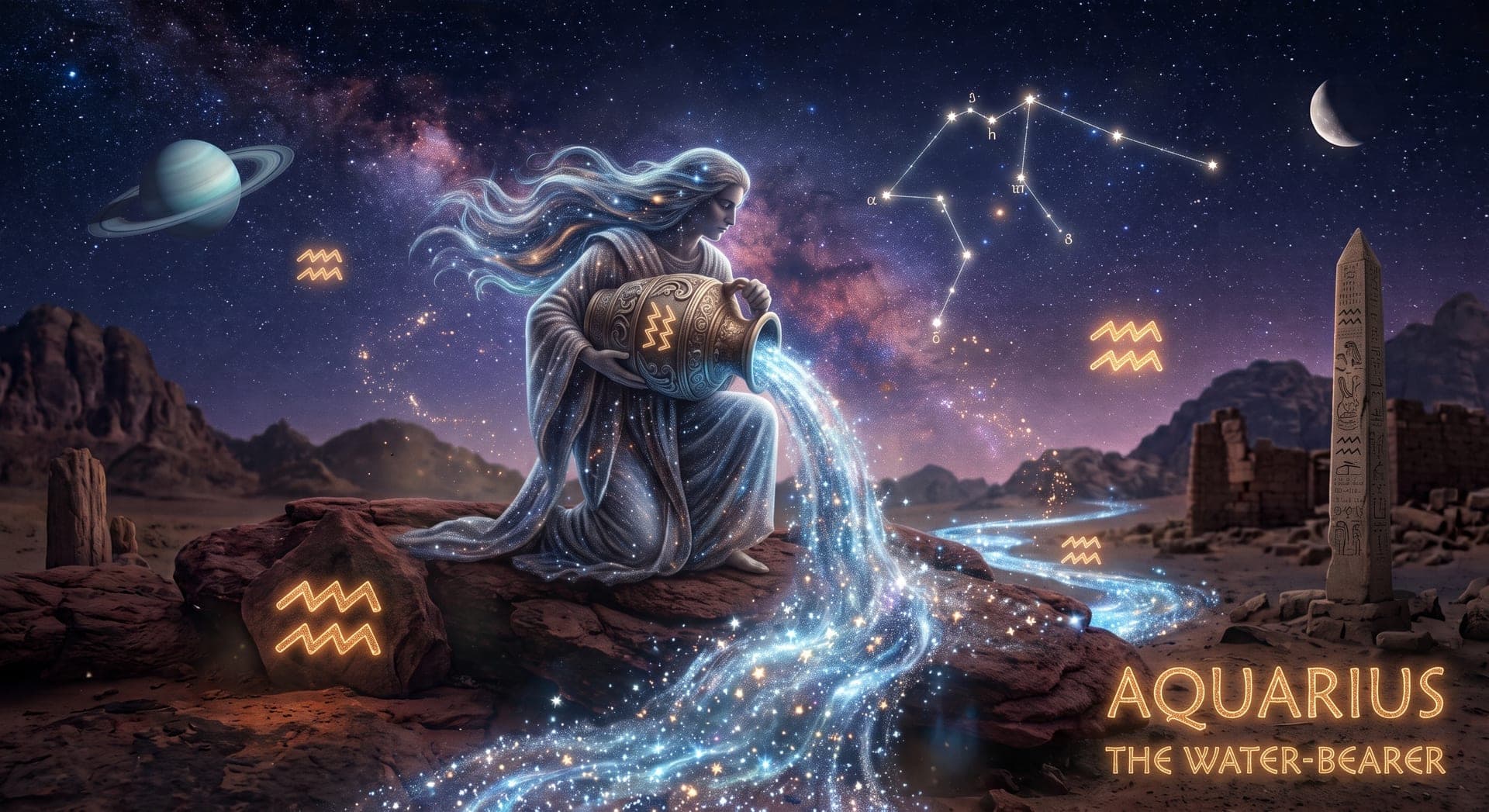
Aquarius, the eleventh sign of the zodiac, spans January 20 to February 18 and is symbolized by the water bearer, an image of someone pouring out knowledge and life-giving ideas to the world, despite Aquarius actually being an air sign rather than a water sign. Traditionally ruled by disciplined Saturn and, in modern astrology, by unpredictable Uranus, the planet of innovation and rebellion, Aquarius carries a distinctive blend of structure and originality. People born under this sign are often described as independent thinkers, forward-looking, and drawn to humanitarian causes, valuing the collective good over convention. As a Fixed sign, Aquarius can be famously stubborn once its mind is made up, even while championing change for everyone else. Intellectually curious and sometimes emotionally guarded, Aquarians tend to value friendship and community deeply, often serving as the visionary of their social circle, more comfortable debating ideas than discussing feelings.
Personality Traits
Strengths
- Original and forward-thinking
- Strong sense of fairness and justice
- Independent and self-sufficient
- Loyal to friends and causes alike
- Sees the bigger picture others miss
Weaknesses
- Can run from emotional expression
- Uncompromising once a position is fixed
- Prone to aloofness or detachment
- Sometimes contrarian just to stand apart
- Can prioritize ideas over people's feelings
Compatible Signs
Fun Facts
- Despite its watery name and imagery, Aquarius is classified as an air sign, grouped with Gemini and Libra as a sign of thought and communication rather than emotion.
- Aquarius has two ruling planets: Saturn in classical astrology, and Uranus, discovered in 1781, in the modern system most Western astrologers use today.
- The water bearer symbol traces back to Ganymede in Greek mythology, a cupbearer to the gods said to pour out a life-giving stream from the heavens.
- Notable Aquarians include Oprah Winfrey, Abraham Lincoln, Charles Darwin, Thomas Edison, and Bob Marley.
- Aquarius is one of the rarer signs to be represented by a person rather than an animal or object, alongside Gemini, Virgo, and Sagittarius's centaur half.
Born on February 15
- 1564
Galileo Galilei
Astronomer and physicist who championed the heliocentric model
- 1710
Louis XV
King of France
- 1748
Jeremy Bentham
English philosopher and jurist regarded as the founder of modern utilitarianism
- 1820
Susan B. Anthony
Pioneering American women's suffrage leader
- 1861
Alfred North Whitehead
English mathematician and philosopher who co-authored Principia Mathematica with Bertrand Russell
- 1874
Ernest Shackleton
Antarctic explorer known for his Endurance expedition
- 1883
Sax Rohmer
English author best known for creating the character Dr. Fu Manchu
- 1905
Harold Arlen
Composer of classic American songs including "Over the Rainbow"
- 1929
Graham Hill
English racing driver who won two Formula One World Championships and remains the only driver to win motorsport's Triple Crown
- 1931
Claire Bloom
English actress known for her stage work and films including Limelight and The Spy Who Came in from the Cold
- 1946
Clare Short
English politician who served as Secretary of State for International Development and resigned over the Iraq War
- 1951
Jane Seymour
English-American actress
- 1964
Chris Farley
American comedian and "Saturday Night Live" star
- 1972
Jaromir Jagr
Czech ice hockey legend
- 1998
George Russell
English racing driver who competes in Formula One for the Mercedes team

On This Day in History
- 1214
King John of England lands with his army at La Rochelle to begin a campaign to reclaim the Angevin lands in France.
The expedition formed part of John's attempt to recover territories in Poitou and Anjou lost earlier in his reign, in coordination with allies attacking from the north. The campaign ultimately failed after his allies were defeated at the Battle of Bouvines later that year, a setback that weakened John's position at home and contributed to the baronial revolt that produced Magna Carta the following year.
- 1493
Christopher Columbus writes a letter describing his discoveries in the New World while sailing back to Spain, one of the first written accounts of the Americas to reach Europe.
Columbus's letter, describing the peoples, geography, and resources of the lands he had encountered, was quickly printed and circulated across Europe, becoming one of the first widely read accounts of the New World and helping spark the age of European exploration and colonization that followed.
- 1764
French fur traders establish the settlement of St. Louis in Spanish Louisiana, which would grow into a major American gateway city.
French fur trader Pierre Laclède and his associates established the trading post at a strategic location along the Mississippi River, naming it for King Louis IX of France. St. Louis grew into a major hub for westward American expansion and later earned the nickname "Gateway to the West."
- 1798
French troops invade Rome and proclaim the Roman Republic, forcing Pope Pius VI into exile.
French revolutionary forces occupied Rome and deposed the pope's temporal authority, establishing a short-lived republic modeled on France's own revolutionary government. The Roman Republic collapsed within a year as opposing forces restored papal rule, though it foreshadowed the eventual end of the Papal States decades later.
- 1898
The battleship USS Maine explodes in Havana harbor, killing over 250 sailors and helping spark the Spanish-American War.
The Maine's explosion, whose cause remains debated among historians, killed most of its crew and was quickly blamed on Spain by the sensationalist "yellow journalism" of American newspapers, under the rallying cry "Remember the Maine." Public outrage helped push the United States into war with Spain just months later.
- 1898
The American battleship USS Maine explodes and sinks in Havana harbor, killing most of its crew and helping push the United States toward war with Spain.
The cause of the explosion was never conclusively determined, but American newspapers and public opinion quickly blamed Spain, adopting the rallying cry 'Remember the Maine.' The incident became a catalyst for the Spanish-American War declared two months later, a conflict that ended Spanish colonial rule in Cuba, Puerto Rico, and the Philippines.
- 1942
Singapore falls to Japanese forces in the largest surrender of British-led troops in history, a major blow to British colonial prestige.
The fall of Singapore, a British fortress long considered impregnable, came after Japanese forces advanced rapidly down the Malay Peninsula and overwhelmed the city's defenses, which had been designed primarily to repel a naval attack rather than an assault from the landward side.
- 1942
British Lieutenant-General Arthur Percival surrenders Singapore to Japanese forces, in what Winston Churchill called the worst disaster in British military history.
Roughly 80,000 British, Indian, and Australian troops became prisoners of war after Japanese forces, though outnumbered, advanced rapidly down the Malay Peninsula and forced the surrender of the supposedly impregnable fortress city. The fall of Singapore shattered British prestige in Asia and is remembered as one of the most significant defeats suffered by the British Empire during the Second World War.
- 1946
ENIAC, the first general-purpose electronic computer, is formally dedicated, ushering in the modern computing era.
Built to calculate artillery firing tables for the U.S. Army, ENIAC filled an entire room and used thousands of vacuum tubes, yet was far faster than any calculating device before it. Its dedication marked a foundational moment in the development of general-purpose electronic computing.
- 1946
ENIAC, the first general-purpose electronic digital computer, is formally dedicated at the University of Pennsylvania.
Built for the U.S. Army to calculate artillery firing tables, ENIAC filled a large room with thousands of vacuum tubes and could perform calculations far faster than any previous machine. Though soon superseded by more advanced designs, it is widely regarded as a foundational step in the development of modern computing.
- 1952
King George VI of the United Kingdom is buried at St George's Chapel, Windsor Castle, following his death earlier in the month.
The funeral came two weeks after George VI died in his sleep at Sandringham, having reigned since 1936 and led Britain through the Second World War. His daughter Elizabeth II, who had been in Kenya when she learned of her father's death, succeeded him and would go on to become the longest-reigning monarch in British history.
- 1965
Canada adopts its red maple leaf flag, replacing the Canadian Red Ensign after a fierce national debate over the design.
Canada's flag debate, dubbed the "Great Flag Debate," pitted supporters of the traditional Red Ensign, which featured the Union Jack, against advocates of a new, uniquely Canadian symbol. The maple leaf design, chosen after months of parliamentary wrangling, became a powerful and now-iconic symbol of Canadian national identity.
- 1971
The United Kingdom switches to a decimal currency system on "Decimal Day," abandoning the centuries-old pounds, shillings, and pence system.
"Decimal Day" replaced Britain's centuries-old system of 12 pence to a shilling and 20 shillings to a pound with a simpler 100 pence to a pound. The changeover required an extensive public education campaign and new coinage, and remains a shared cultural memory for older generations who grew up under the old system.
- 1971
The United Kingdom and Ireland complete the switch to decimal currency on 'Decimal Day,' replacing the old system of pounds, shillings, and pence.
Under the new system, the pound was divided into 100 new pence instead of the old 240 pence, ending centuries of a currency structure that many found confusing, particularly for international trade and calculation. The changeover had been planned for years, with new coins introduced gradually beforehand, and required extensive public education campaigns to ease the transition.
- 1982
The semi-submersible drilling rig Ocean Ranger sinks in a severe storm off the coast of Newfoundland, killing all 84 workers aboard.
The rig, then the largest of its kind in the world, capsized after huge waves damaged its ballast control system, and no one survived the failed evacuation into the freezing seas. The disaster, one of the worst in offshore oil industry history, led to sweeping reforms in safety regulations and evacuation procedures for offshore platforms in Canadian and international waters.
- 2001
The first working draft of the complete human genome sequence is published, a landmark moment in genetics and medicine.
The publication of the draft human genome sequence, the product of a massive international scientific collaboration, mapped the vast majority of human genetic code for the first time. It opened new frontiers in medical research, genetic disease diagnosis, and personalized medicine that continue to expand today.
- 2001
The first draft sequence of the human genome is published in the journal Nature by the publicly funded Human Genome Project.
The milestone came after more than a decade of international collaboration among laboratories, including the UK's Wellcome Trust Sanger Institute, which sequenced the largest single portion of the genome of any contributor. Published alongside a rival draft from the private company Celera Genomics, the achievement opened the door to a new era of genetic medicine and research.
- 2003
Coordinated protests across more than 600 cities worldwide oppose the looming U.S.-led invasion of Iraq, in what is considered the largest single-day protest event in history.
Held just weeks before the U.S.-led invasion of Iraq began, the coordinated protests spanned cities across six continents, reflecting widespread global opposition to the war despite the eventual invasion proceeding regardless. Organizers and researchers have cited it as the largest globally coordinated protest event in recorded history.
- 2003
Millions of people take part in coordinated protests against the impending invasion of Iraq in cities across the world, in what are believed to be the largest coordinated demonstrations in history.
Organizers estimated that between six and thirty million people marched in roughly 600 cities worldwide, from London and Rome to New York and Sydney, in a single coordinated day of action. Despite the scale of opposition, the United States and its allies, including the United Kingdom, proceeded with the invasion of Iraq the following month.
- 2013
A meteor explodes in the atmosphere over Chelyabinsk, Russia, releasing a shock wave that injures around 1,500 people.
The meteor, estimated at around 20 meters across before it broke apart, entered the atmosphere at high speed and exploded roughly 30 kilometers above the ground with a force many times greater than the Hiroshima bomb. The resulting shock wave shattered windows and damaged buildings across the region, and the event became one of the most closely documented meteor airbursts in history thanks to widespread dashcam footage.