
What’s Observed on February 14
Born on February 14: Aquarius ♒
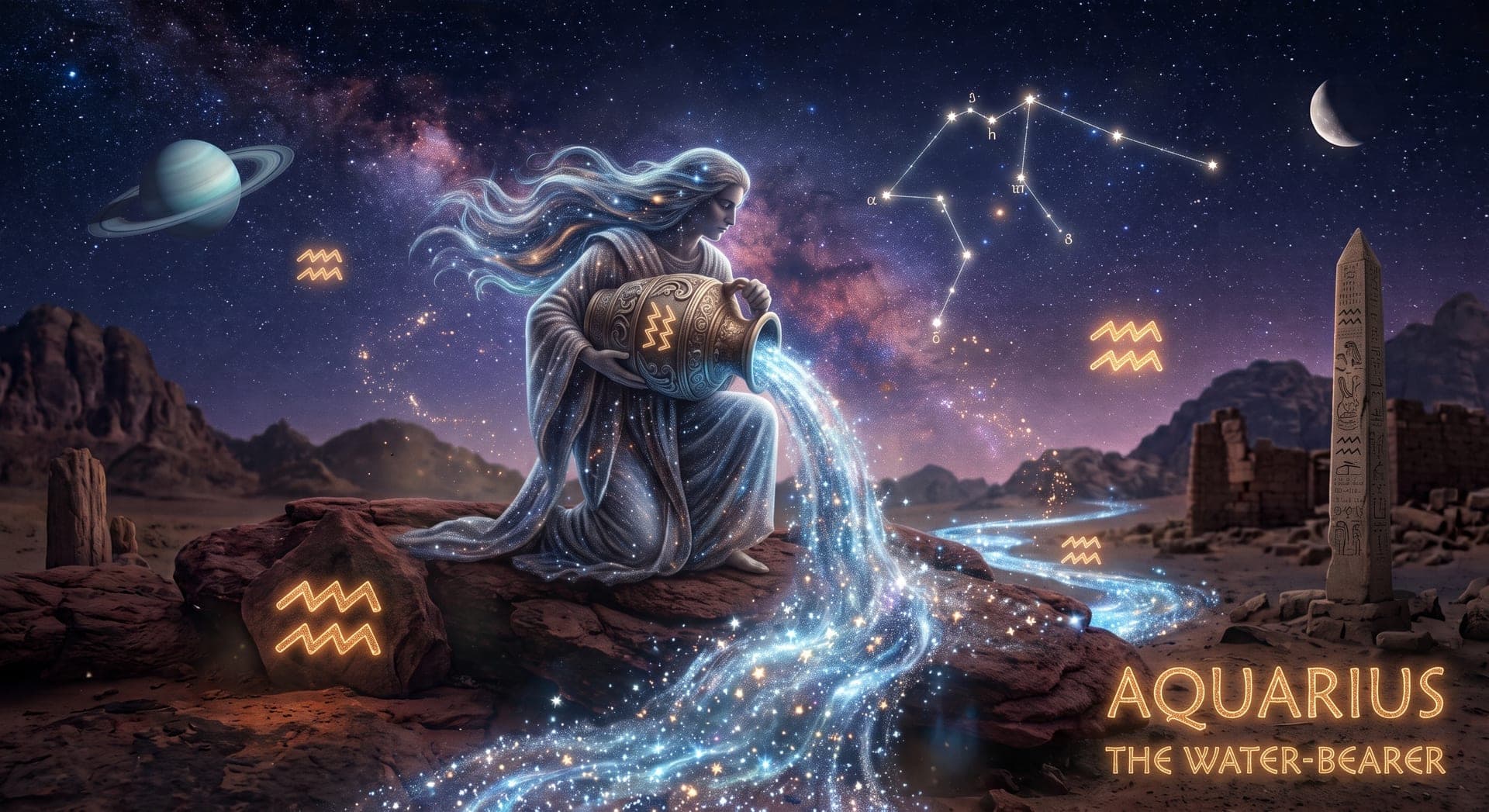
Aquarius, the eleventh sign of the zodiac, spans January 20 to February 18 and is symbolized by the water bearer, an image of someone pouring out knowledge and life-giving ideas to the world, despite Aquarius actually being an air sign rather than a water sign. Traditionally ruled by disciplined Saturn and, in modern astrology, by unpredictable Uranus, the planet of innovation and rebellion, Aquarius carries a distinctive blend of structure and originality. People born under this sign are often described as independent thinkers, forward-looking, and drawn to humanitarian causes, valuing the collective good over convention. As a Fixed sign, Aquarius can be famously stubborn once its mind is made up, even while championing change for everyone else. Intellectually curious and sometimes emotionally guarded, Aquarians tend to value friendship and community deeply, often serving as the visionary of their social circle, more comfortable debating ideas than discussing feelings.
Personality Traits
Strengths
- Original and forward-thinking
- Strong sense of fairness and justice
- Independent and self-sufficient
- Loyal to friends and causes alike
- Sees the bigger picture others miss
Weaknesses
- Can run from emotional expression
- Uncompromising once a position is fixed
- Prone to aloofness or detachment
- Sometimes contrarian just to stand apart
- Can prioritize ideas over people's feelings
Compatible Signs
Fun Facts
- Despite its watery name and imagery, Aquarius is classified as an air sign, grouped with Gemini and Libra as a sign of thought and communication rather than emotion.
- Aquarius has two ruling planets: Saturn in classical astrology, and Uranus, discovered in 1781, in the modern system most Western astrologers use today.
- The water bearer symbol traces back to Ganymede in Greek mythology, a cupbearer to the gods said to pour out a life-giving stream from the heavens.
- Notable Aquarians include Oprah Winfrey, Abraham Lincoln, Charles Darwin, Thomas Edison, and Bob Marley.
- Aquarius is one of the rarer signs to be represented by a person rather than an animal or object, alongside Gemini, Virgo, and Sagittarius's centaur half.
Born on February 14
- 1614
John Wilkins
English clergyman and natural philosopher who co-founded the Royal Society and served as its first secretary
- 1869
Charles Thomson Rees Wilson
Scottish physicist who won the Nobel Prize for inventing the cloud chamber used to detect subatomic particles
- 1883
George Washington Gale Ferris Jr.
Engineer who invented the Ferris wheel
- 1890
Nina Hamnett
Welsh painter and writer prominent in the bohemian art circles of London and Paris in the early twentieth century
- 1894
Jack Benny
Pioneering American comedian and radio star
- 1898
Bill Tilman
English mountaineer and explorer known for pioneering Himalayan climbing expeditions and long ocean voyages later in life
- 1942
Michael Bloomberg
Businessman and former Mayor of New York City
- 1944
Carl Bernstein
Journalist who helped uncover the Watergate scandal
- 1944
Alan Parker
English film director and screenwriter known for films including Midnight Express, Fame, and The Commitments
- 1946
Gregory Hines
American dancer, actor, and singer
- 1951
Kevin Keegan
English footballer and manager who twice won the Ballon d'Or and later managed England's national team
- 1967
Mark Rutte
Longtime Prime Minister of the Netherlands
- 1970
Simon Pegg
English actor and screenwriter known for Shaun of the Dead, Hot Fuzz, and the Mission: Impossible film series
- 1987
Edinson Cavani
Uruguayan international footballer

On This Day in History
- 1613
Princess Elizabeth, daughter of King James I of England, marries Frederick V, Elector Palatine, in a lavish ceremony at Whitehall Palace in London.
The wedding was one of the most celebrated events of the Jacobean court, marked by masques, fireworks, and festivities. Known afterward as the 'Winter Queen' following Frederick's brief and disastrous reign in Bohemia, Elizabeth became an ancestor of Britain's House of Hanover, and through it of every British monarch since George I.
- 1779
British explorer James Cook is killed in a confrontation with Native Hawaiians at Kealakekua Bay during his third Pacific voyage.
Cook, who had made three landmark voyages of Pacific exploration, was killed during a violent confrontation that erupted after he attempted to take a Hawaiian chief hostage in retaliation for a stolen boat. His death marked a dramatic end to one of history's most consequential eras of European Pacific exploration.
- 1797
The British Royal Navy defeats a larger Spanish fleet at the Battle of Cape St. Vincent, boosting British naval dominance during the Napoleonic Wars.
The British victory, led by Admiral John Jervis with Horatio Nelson playing a decisive role, prevented a planned combination of Spanish and French fleets and boosted British morale during a difficult period of the wars against revolutionary France. Nelson's bold tactics in the battle helped launch his legendary naval career.
- 1797
The British Royal Navy under Admiral Sir John Jervis defeats a larger Spanish fleet at the Battle of Cape St Vincent off the coast of Portugal.
Heavily outnumbered, Jervis's fleet exploited a gap in the Spanish line, and Commodore Horatio Nelson broke from formation on his own initiative to prevent enemy ships from escaping, capturing two Spanish vessels in the process. The victory boosted British morale during the French Revolutionary Wars and launched Nelson toward the fame that would culminate at Trafalgar eight years later.
- 1852
The Hospital for Sick Children opens on Great Ormond Street in London, the first hospital in the English-speaking world dedicated solely to treating children.
Founded by physician Charles West with just ten beds, the hospital grew into one of the world's leading centers for pediatric medicine and research. It later gained an unusual benefactor in author J. M. Barrie, who gifted the hospital the copyright to Peter Pan in 1929, providing it with royalty income that continues to support its work.
- 1876
Alexander Graham Bell files a patent application for the telephone just hours before a rival inventor, Elisha Gray, files a similar claim.
Bell and Gray filed remarkably similar patent applications for the telephone on the same day, triggering decades of legal disputes over priority. Bell's patent was ultimately upheld, and the invention transformed long-distance communication, eventually giving rise to the vast telecommunications industry.
- 1900
British forces under General Sir Redvers Buller begin the Battle of the Tugela Heights in an effort to break the Boer siege of Ladysmith during the Second Boer War.
The multi-day battle involved repeated assaults on entrenched Boer positions along the Tugela River in Natal, part of a broader British campaign to relieve the besieged garrison town. British forces eventually broke through, and Ladysmith was relieved later that month, marking a turning point after a string of earlier defeats in the war.
- 1929
Gunmen linked to Al Capone kill seven rival gang members in Chicago in the notorious Saint Valentine's Day Massacre.
The massacre, in which Al Capone's organization allegedly targeted rival bootlegger George "Bugs" Moran's gang, saw gunmen dressed as police officers line up and shoot seven men in a Chicago garage. Though no one was ever convicted, the shocking violence helped turn public opinion against Capone and organized crime during Prohibition.
- 1929
Seven men associated with a Chicago gang are shot dead in a garage on the city's North Side in what becomes known as the Saint Valentine's Day Massacre.
The killings, widely attributed to Al Capone's South Side gang targeting rivals led by George 'Bugs' Moran, saw gunmen dressed as police officers line up their victims before opening fire with machine guns. Though no one was ever convicted, the massacre shocked the American public and intensified pressure on authorities to crack down on organized crime during Prohibition.
- 1939
Nazi Germany launches the battleship Bismarck, which would go on to become one of the most feared warships of World War II before its sinking in 1941.
The Bismarck, one of the largest and most heavily armored battleships ever built, became a symbol of German naval power before being sunk by the Royal Navy in a dramatic pursuit in May 1941 after sinking the British battlecruiser HMS Hood.
- 1944
A British Royal Navy submarine torpedoes and sinks a German-controlled former Italian submarine in the Strait of Malacca.
Following Italy's surrender in 1943, several former Italian submarines operating in Axis-controlled waters of the Indian Ocean came under German control, continuing to run supplies between Europe and Japanese-held territory in the Far East. British submarines patrolling the Strait of Malacca targeted this valuable long-range shipping route, and the sinking removed one of these vessels from Axis service late in the war.
- 1945
Allied bombers continue a third night of raids on Dresden, part of a firebombing campaign that killed an estimated 25,000 people.
Allied bombers continued their assault on Dresden over multiple nights, compounding a firestorm so intense it consumed oxygen and generated hurricane-force winds. The bombing's devastating human toll and disputed military necessity have made it one of the most scrutinized Allied actions of World War II.
- 1945
Royal Air Force and United States Army Air Forces bombers continue the destructive bombing campaign against Dresden into a second day.
The firebombing of Dresden that began the previous night continued into 14 February with American Eighth Air Force bombers striking the already burning city in daylight, aiming at rail yards but adding to the devastation from the RAF's earlier incendiary raids. The multi-day attack ranks as one of the most destructive bombing campaigns of the war and remains a focal point of debate over the ethics of area bombing.
- 1946
The Bank of England is nationalized, bringing Britain's central bank under full state ownership for the first time.
The Bank had operated since 1694 as a privately owned institution serving as the government's banker, but the postwar Labour government under Clement Attlee brought it into public ownership as part of a broader program of nationalizing key industries. It continued to set monetary policy on the government's behalf until being granted operational independence over interest rates in 1997.
- 1989
Iranian leader Ayatollah Khomeini issues a fatwa calling for the death of author Salman Rushdie over his novel "The Satanic Verses."
Khomeini's fatwa condemned Rushdie's novel "The Satanic Verses" as blasphemous and called for his death, forcing the British author into hiding under police protection for years. The edict strained diplomatic relations between Iran and Western nations and raised enduring debates about free expression and religious sensitivity.
- 1990
NASA's Voyager 1 spacecraft, from nearly four billion miles away, captures the photograph of Earth later known as the "Pale Blue Dot."
Voyager 1, at the suggestion of astronomer Carl Sagan, turned its camera back toward the inner solar system from beyond Neptune's orbit to capture Earth as a tiny point of light. Sagan later used the image in his writings to reflect on humanity's small place in the vastness of the cosmos.
- 1990
Voyager 1 captures a photograph of Earth from about 6 billion kilometers away, later known as the 'Pale Blue Dot' image.
The image was taken at the suggestion of astronomer Carl Sagan as Voyager 1 turned its camera back toward the inner solar system before its instruments were powered down to conserve energy. In the photograph Earth appears as a tiny point of light less than a pixel across, an image Sagan later used to reflect on humanity's small place in the cosmos.
- 2005
YouTube is launched by a group of former PayPal employees, growing within a few years into the world's dominant video-sharing platform.
YouTube began as a simple video-sharing site created by three former PayPal employees working out of a garage. Google acquired the company for $1.65 billion just over a year later, and it has since grown into the world's dominant video platform, reshaping media, entertainment, and online culture.
- 2005
The video-sharing website YouTube is launched by three former PayPal employees.
Founded by Chad Hurley, Steve Chen, and Jawed Karim, the site began as a way to easily share home videos online and grew rapidly, hosting its first upload, a clip titled 'Me at the zoo,' within months of launch. Google acquired YouTube for stock worth about $1.65 billion in late 2006, and it went on to become one of the most visited websites in the world.
- 2018
Jacob Zuma resigns as President of South Africa amid mounting corruption allegations and pressure from his own party.
Zuma's resignation came after years of corruption scandals, including allegations of improper ties to a wealthy business family, that eroded support even within his own African National Congress party. His deputy, Cyril Ramaphosa, succeeded him as president.