What’s Observed on December 9
Born on December 9: Sagittarius ♐
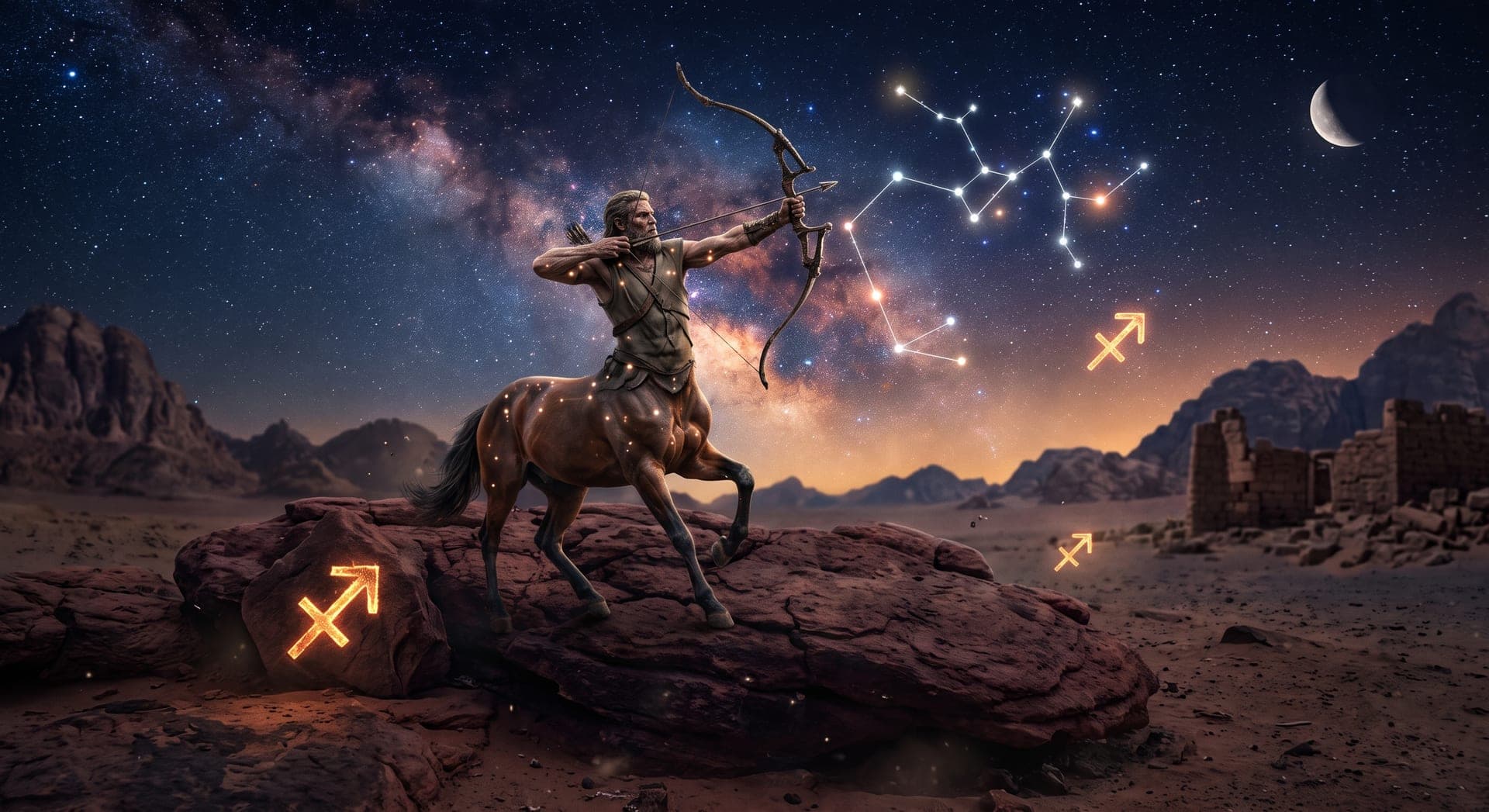
Sagittarius, the ninth sign of the zodiac, spans November 22 to December 21 and is symbolized by the archer, typically depicted as a centaur drawing a bow, representing a restless pursuit of knowledge, adventure, and far-off horizons. Ruled by Jupiter, the largest planet in the solar system and a symbol of growth, luck, and abundance, Sagittarius is widely regarded as one of the most optimistic and freedom-loving signs of the zodiac. As a Fire sign, Sagittarius approaches life with enthusiasm and a genuine hunger for new experiences, whether through literal travel or intellectual and philosophical exploration. Its Mutable modality reflects a deep aversion to routine and confinement, always looking toward the next adventure rather than settling into fixed patterns. People born under this sign are often drawn to travel, higher education, philosophy, or any pursuit that broadens their horizons and understanding of the world. Sagittarius's honesty and optimism make it excellent company, though its blunt directness and restless need for freedom can sometimes come across as tactless or noncommittal to those seeking more stability.
Personality Traits
Strengths
- Adventurous and open to new experiences
- Optimistic and enthusiastic
- Honest and direct
- Philosophical and broad-minded
- Generous and good-humored
Weaknesses
- Tactlessly blunt
- Impatient with routine
- Prone to overpromising
- Restless and commitment-averse
- Careless with details
Compatible Signs
Fun Facts
- Sagittarius's symbol, a centaur drawing a bow and arrow, connects to the Greek myth of Chiron, a wise and scholarly centaur unlike the more unruly members of his kind.
- Jupiter, Sagittarius' ruling planet, is the largest planet in the solar system, reflecting the sign's association with expansion, abundance, and big-picture thinking.
- Sagittarius is one of two zodiac signs, along with Capricorn, represented by a hybrid creature combining human and animal features.
- Notable Sagittarians include Taylor Swift, Walt Disney, Winston Churchill, and Jimi Hendrix.
- Sagittarius season spans the lead-up to the winter solstice, a period historically associated with travel, feasting, and philosophical reflection in many cultures.
Born on December 9
- 1608
John Milton
English poet and polemicist best known for the epic poem Paradise Lost, and among the most influential writers in the English language.
- 1617
Richard Lovelace
English Cavalier poet of the 17th century, remembered for lyric poems such as 'To Althea, from Prison' and 'To Lucasta, Going to the Wars.'
- 1667
William Whiston
English mathematician, historian, and theologian who succeeded Isaac Newton as Lucasian Professor at Cambridge and produced the standard English translation of Josephus.
- 1813
Thomas Andrews
Irish chemist and physicist who discovered the critical point of gases while working in Belfast, foundational to the modern understanding of the liquid-to-gas transition.
- 1868
Fritz Haber
German chemist and Nobel Prize laureate
- 1906
Grace Hopper
American computer scientist and Navy rear admiral who helped develop COBOL
- 1916
Kirk Douglas
American actor and film producer
- 1929
Bob Hawke
23rd Prime Minister of Australia
- 1934
Judi Dench
English actress celebrated for her stage work with the Royal Shakespeare Company and for film roles including M in the James Bond series, one of Britain's most honored performers.
- 1950
Joan Armatrading
Singer-songwriter and guitarist, born in Saint Kitts and raised in Birmingham, who became one of Britain's most acclaimed folk and blues artists.
- 1957
Donny Osmond
American singer and entertainer
- 1960
Caroline Lucas
English politician who became the Green Party's first-ever elected Member of Parliament in the UK, representing Brighton Pavilion from 2010.
- 1968
Kurt Angle
American Olympic wrestler and professional wrestler

On This Day in History
- 1531
Juan Diego reportedly experiences an apparition of the Virgin of Guadalupe at Tepeyac near Mexico City.
According to Catholic tradition, the Virgin of Guadalupe appeared to the Indigenous convert Juan Diego on a hill outside Mexico City, leaving her image miraculously imprinted on his cloak, which is still displayed and venerated at the Basilica of Our Lady of Guadalupe today. The apparition became central to Mexican Catholic identity and remains one of the most significant Marian devotions in the Americas.
- 1688
Williamite forces defeat Jacobite troops at the Battle of Reading, hastening King James II's flight from England.
The Battle of Reading, a relatively minor skirmish during the Glorious Revolution, nonetheless proved strategically significant as it convinced King James II that his cause was lost, prompting his subsequent flight from England. William of Orange's largely bloodless assumption of the English throne that followed fundamentally reshaped the balance of power between the British monarchy and Parliament.
- 1775
American revolutionary forces win the Battle of Great Bridge, ending British royal control of Virginia.
The Battle of Great Bridge saw Virginia patriot militia decisively defeat forces loyal to the colony's last royal governor, Lord Dunmore, effectively ending British royal authority in Virginia early in the Revolutionary War. The victory forced Dunmore to flee to a British warship, and the battle is sometimes called "the Bunker Hill of the South" for its significance in the region.
- 1775
American Patriot militia defeat British troops and Loyalists at the Battle of Great Bridge in Virginia.
Fought near Norfolk, the battle broke the last significant British military resistance in the colony and forced Royal Governor Lord Dunmore to abandon Virginia for the safety of Royal Navy ships offshore. Sometimes nicknamed the 'Second Bunker Hill,' the Patriot victory effectively ended royal government in Virginia a full six months before the Declaration of Independence was signed.
- 1856
British expeditionary forces capture the Persian port city of Bushehr during the Anglo-Persian War.
The assault opened Britain's brief war with Persia, triggered by the Shah's occupation of Herat in violation of an earlier treaty. A joint Royal Navy and East India Company force landed near Bushehr and took the city after brief resistance, part of Britain's broader effort to protect its interests in Afghanistan and the approaches to India.
- 1868
London installs the world's first traffic signals outside Parliament, using illuminated semaphore arms.
London's first traffic signal, installed near the Houses of Parliament to manage the increasingly chaotic mix of horse-drawn carriages and pedestrians, used gas-lit semaphore arms rather than the electric lights familiar today. The experimental device was removed after only a few weeks when a gas leak caused an explosion that injured the police officer operating it.
- 1868
The world's first traffic signal is installed outside the Palace of Westminster in London.
Designed by railway engineer John Peake Knight and modeled on railway signaling, the gas-lit device used revolving arms and red and green lights to direct horse-drawn traffic near the Houses of Parliament. It was manually operated by a police constable and worked for about three weeks before a gas leak caused it to explode, injuring the officer and delaying wider adoption of traffic signals for decades.
- 1905
France enacts legislation formally separating religious institutions from state authority.
France's 1905 law formally separated church and state, ending the government's official recognition and funding of religious institutions while guaranteeing freedom of religious practice. The legislation, known as laïcité, established a strict secularism that remains a defining and sometimes contentious feature of French public life and governance to this day.
- 1917
British forces under Field Marshal Edmund Allenby capture Jerusalem from Ottoman control.
Field Marshal Allenby's capture of Jerusalem during World War I ended four centuries of continuous Ottoman rule over the city, and Allenby notably chose to enter on foot out of respect for the city's religious significance rather than riding in as a conqueror. The British capture of Jerusalem carried enormous symbolic and strategic weight, boosting Allied morale during a difficult period of the war.
- 1917
British and Commonwealth forces under Field Marshal Edmund Allenby capture Jerusalem from the Ottoman Empire.
The city's Ottoman governor surrendered after weeks of fighting during the Sinai and Palestine Campaign of the First World War, ending four centuries of Ottoman control. The capture was a major propaganda victory for Britain and paved the way for Allenby's formal, symbolically humble entry into the city on foot two days later.
- 1940
British and Indian troops launch a surprise offensive against Italian forces at Sidi Barrani in Egypt.
The assault, part of Operation Compass, was the opening move of the Western Desert Campaign in the Second World War. A heavily outnumbered British and Commonwealth force routed the Italian Tenth Army, capturing tens of thousands of prisoners and reversing Italy's earlier advance into Egypt, marking Britain's first major land victory of the war.
- 1960
The soap opera Coronation Street debuts in Britain, eventually becoming the world's longest-running television soap opera.
Coronation Street's debut on British commercial television introduced viewers to a fictional working-class street in Manchester, initially conceived with modest expectations but rapidly becoming a cultural institution. Its continuous decades-long run has made it not only Britain's longest-running soap opera but the longest-running television soap opera in the world.
- 1960
The first episode of Coronation Street is broadcast on British television.
Created by Tony Warren and set on a fictional cobbled street in Salford, the ITV soap opera was initially expected to run for only a few months. It went on to become the world's longest-running television soap opera still in production, chronicling working-class life in the north of England for generations of British viewers.
- 1961
Tanganyika becomes independent from Britain, with Julius Nyerere as its first prime minister.
The former British-administered UN trust territory in East Africa gained self-rule after a largely peaceful transition. Tanganyika became a republic within the Commonwealth in 1962, and in 1964 it merged with Zanzibar to form the United Republic of Tanzania, marking one of the smoother chapters of Britain's postwar decolonization in Africa.
- 1968
Douglas Engelbart publicly demonstrates revolutionary computing technologies including the computer mouse and graphical interface.
Douglas Engelbart's presentation, later nicknamed "The Mother of All Demos," introduced audiences to computing concepts that seemed like science fiction at the time, including hypertext linking, video conferencing, and collaborative real-time document editing, alongside the debut of the computer mouse itself. The demonstration profoundly influenced the subsequent development of personal computing and remains one of the most significant events in computing history.
- 1968
Douglas Engelbart publicly debuts the computer mouse, hypertext, and a graphical interface.
At a computer conference in San Francisco, Engelbart and his team demonstrated technologies decades ahead of their time, including video conferencing, word processing, and collaborative real-time editing. Later nicknamed 'the Mother of All Demos,' the ninety-minute presentation is regarded as one of the most influential events in the history of computing.
- 1973
British and Irish authorities sign the Sunningdale Agreement, aiming to establish power-sharing in Northern Ireland.
Negotiated by UK Prime Minister Edward Heath and Irish Taoiseach Liam Cosgrave alongside Northern Irish parties, the agreement created a short-lived power-sharing executive and a cross-border Council of Ireland. Unionist opposition and the Ulster Workers' Council strike brought it down within five months, but it is widely seen as a forerunner to the 1998 Good Friday Agreement.
- 1979
A commission certifies that smallpox has been eradicated worldwide, the first disease driven to extinction.
The declaration followed a decade-long global vaccination campaign coordinated by the World Health Organization following the last naturally occurring case in Somalia in 1977. The eradication of smallpox, a disease that had killed hundreds of millions of people, remains one of public health's greatest achievements and the only human disease eliminated through vaccination.
- 1987
Palestinians launch the First Intifada uprising in the Gaza Strip and West Bank.
The First Intifada emerged as a largely spontaneous, grassroots uprising among Palestinians in the occupied territories, involving widespread civil disobedience, strikes, and stone-throwing protests against Israeli military occupation. The sustained unrest, which continued for years, significantly reshaped the political dynamics of the Israeli-Palestinian conflict and contributed to the eventual Oslo peace process.
- 2017
Australia legalizes same-sex marriage, becoming the 26th nation to do so.
Australia's legalization of same-sex marriage followed a national postal survey in which a majority of participating Australians voted in favor, prompting Parliament to swiftly pass the enabling legislation. The vote made Australia the 26th country to legalize same-sex marriage nationally, following years of sustained advocacy and several earlier failed legislative attempts.
- 2019
A volcanic eruption on New Zealand's Whakaari/White Island kills 22 people.
The eruption of Whakaari, also known as White Island, occurred without significant warning while a tour group was visiting the active volcano, a popular but inherently risky tourist destination. The disaster prompted renewed scrutiny of safety regulations for tourism at active volcanic sites and led to criminal charges against several companies involved in operating the tours.