What’s Observed on December 19
Born on December 19: Sagittarius ♐
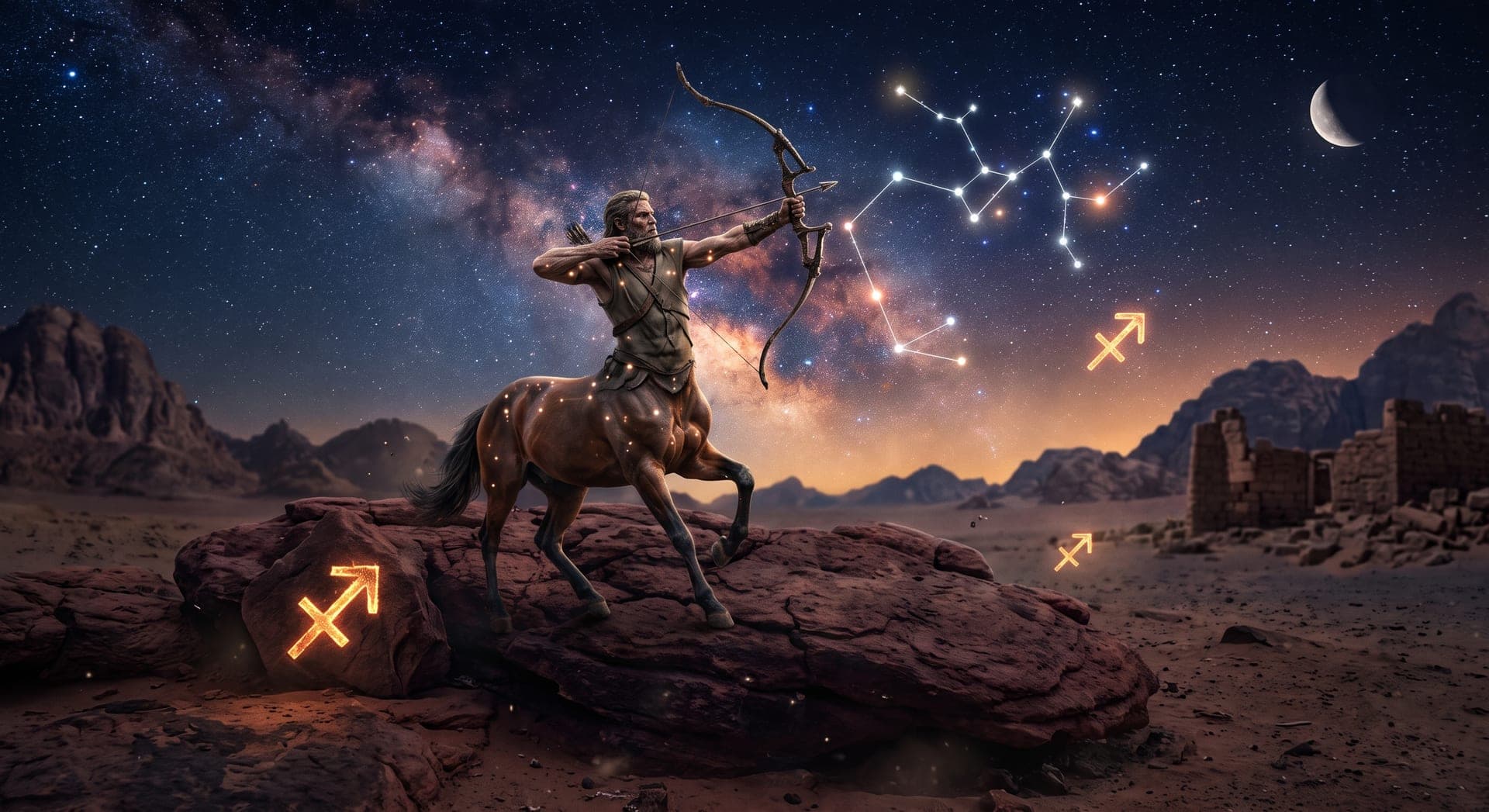
Sagittarius, the ninth sign of the zodiac, spans November 22 to December 21 and is symbolized by the archer, typically depicted as a centaur drawing a bow, representing a restless pursuit of knowledge, adventure, and far-off horizons. Ruled by Jupiter, the largest planet in the solar system and a symbol of growth, luck, and abundance, Sagittarius is widely regarded as one of the most optimistic and freedom-loving signs of the zodiac. As a Fire sign, Sagittarius approaches life with enthusiasm and a genuine hunger for new experiences, whether through literal travel or intellectual and philosophical exploration. Its Mutable modality reflects a deep aversion to routine and confinement, always looking toward the next adventure rather than settling into fixed patterns. People born under this sign are often drawn to travel, higher education, philosophy, or any pursuit that broadens their horizons and understanding of the world. Sagittarius's honesty and optimism make it excellent company, though its blunt directness and restless need for freedom can sometimes come across as tactless or noncommittal to those seeking more stability.
Personality Traits
Strengths
- Adventurous and open to new experiences
- Optimistic and enthusiastic
- Honest and direct
- Philosophical and broad-minded
- Generous and good-humored
Weaknesses
- Tactlessly blunt
- Impatient with routine
- Prone to overpromising
- Restless and commitment-averse
- Careless with details
Compatible Signs
Fun Facts
- Sagittarius's symbol, a centaur drawing a bow and arrow, connects to the Greek myth of Chiron, a wise and scholarly centaur unlike the more unruly members of his kind.
- Jupiter, Sagittarius' ruling planet, is the largest planet in the solar system, reflecting the sign's association with expansion, abundance, and big-picture thinking.
- Sagittarius is one of two zodiac signs, along with Capricorn, represented by a hybrid creature combining human and animal features.
- Notable Sagittarians include Taylor Swift, Walt Disney, Winston Churchill, and Jimi Hendrix.
- Sagittarius season spans the lead-up to the winter solstice, a period historically associated with travel, feasting, and philosophical reflection in many cultures.
Born on December 19
- 1699
William Bowyer
English printer known as 'the learned printer' for his scholarly command of Greek and Latin, who printed works for the Royal Society and many leading authors of his day.
- 1861
Italo Svevo
Italian novelist and playwright
- 1875
Carter G. Woodson
American historian who founded Black History Month
- 1902
Ralph Richardson
English actor regarded as one of the great figures of 20th-century British theatre and film, celebrated for his stage work and films including The Fallen Idol.
- 1906
Leonid Brezhnev
Soviet leader and General Secretary of the Communist Party
- 1915
Édith Piaf
French singer known for "La Vie en Rose"
- 1916
Roy Ward Baker
English film director best known for A Night to Remember, the acclaimed 1958 dramatisation of the sinking of the Titanic.
- 1934
Al Kaline
American Major League Baseball player
- 1944
Alvin Lee
English guitarist and frontman of Ten Years After, whose blistering performance of 'I'm Going Home' at the 1969 Woodstock festival made him a guitar-hero icon.
- 1958
Steven Isserlis
English cellist and author regarded as one of the world's leading classical cellists, known for his scholarship on the instrument's repertoire as well as his performances.
- 1958
Limahl
English pop singer who found fame as the frontman of Kajagoogoo before a solo career that produced the hit 'Never Ending Story.'
- 1963
Jennifer Beals
American actress
- 1980
Jake Gyllenhaal
American actor
- 1985
Gary Cahill
English footballer who won the Premier League and Champions League with Chelsea and represented England at multiple major tournaments.
On This Day in History
- 1154
Henry II is crowned King of England at Westminster Abbey, beginning the Plantagenet dynasty.
Henry II's coronation established the Plantagenet dynasty in England, which would rule for over three centuries and include figures such as Richard the Lionheart, King John, and Edward III. His extensive continental holdings, inherited and acquired through marriage, created what historians term the Angevin Empire, stretching from Scotland's border to the Pyrenees.
- 1154
Henry II was crowned King of England at Westminster Abbey.
The coronation established the Plantagenet dynasty and ended the long civil war known as the Anarchy that had convulsed England since the death of Henry I. As Duke of Normandy and Count of Anjou as well as king, Henry ruled over a vast territory stretching from the Scottish border to the Pyrenees, later called the Angevin Empire, one of the largest realms in medieval Europe.
- 1562
The Battle of Dreux takes place during the French Wars of Religion between Catholic and Huguenot forces.
The Battle of Dreux marked the first major military engagement of the French Wars of Religion, a series of brutal conflicts between Catholic and Protestant Huguenot factions that would devastate France for decades. Though tactically inconclusive, with heavy casualties and captured commanders on both sides, the battle set a violent precedent for the religious warfare that followed.
- 1606
Three ships carrying English settlers departed for Virginia, leading to the founding of Jamestown.
The Susan Constant, Godspeed and Discovery sailed under the Virginia Company's charter, carrying just over a hundred colonists. After a rough Atlantic crossing they reached Chesapeake Bay in the spring of 1607 and founded Jamestown, the first permanent English settlement in North America. It became the seed of England's, and later Britain's, extensive colonial presence in the New World.
- 1688
Williamite forces defeated James II's troops at the Battle of Reading, prompting the king to flee England.
The skirmish, a rare clash of arms during the largely bloodless Glorious Revolution, cleared the way for William of Orange's advance on London. Within days James II's authority had effectively collapsed, and he soon abandoned the throne to his daughter Mary and her husband William, who were jointly crowned monarchs. The episode entrenched the principle of parliamentary supremacy over the crown, reshaping the British constitution for centuries to come.
- 1777
George Washington's Continental Army enters winter quarters at Valley Forge, Pennsylvania.
Washington's army's arrival at Valley Forge for winter quarters marked the beginning of a brutal season of cold, disease, and severe supply shortages that killed roughly a quarter of the encamped soldiers. Despite the hardship, the winter also saw crucial military training and reorganization under Baron von Steuben that transformed the Continental Army into a more disciplined, effective fighting force.
- 1783
William Pitt the Younger becomes Britain's youngest Prime Minister at age 24.
William Pitt the Younger's appointment as Prime Minister at just 24 years old, still the youngest in British history, came during a period of political crisis following the loss of the American colonies. His subsequent lengthy tenure would prove remarkably successful, guiding Britain through significant financial reforms and the early years of the Napoleonic Wars.
- 1783
William Pitt the Younger became Prime Minister of Great Britain at the age of 24, the youngest in history.
Appointed by George III after the collapse of the Fox-North coalition, Pitt faced a hostile House of Commons but won a decisive general election victory the following year. He went on to serve nearly two decades as prime minister across two terms, steering Britain through war with revolutionary France and remaining the youngest person ever to hold the office.
- 1929
The Indian National Congress issues the Purna Swaraj declaration, formally demanding complete independence from Britain.
The Purna Swaraj, or "complete independence," declaration marked a significant escalation in the Indian independence movement's demands, moving beyond earlier calls for dominion status within the British Empire toward full sovereignty. The declaration, adopted under Jawaharlal Nehru's leadership, set January 26th as an annual Independence Day observance, a date India would later adopt for its actual constitution.
- 1932
The BBC launched the Empire Service, the forerunner of today's BBC World Service.
Broadcasting in English to audiences across the British Empire on shortwave radio, the service aimed to connect Britons overseas with news and culture from home. Founding director John Reith admitted the early programmes would be 'neither very interesting nor very good.' The service expanded dramatically during the Second World War and evolved into the BBC World Service, now broadcasting worldwide in dozens of languages.
- 1941
Italian navy divers used limpet mines to badly damage the British battleships HMS Valiant and HMS Queen Elizabeth in Alexandria harbour.
Frogmen of the Italian Decima Flottiglia MAS rode manned torpedoes into the heavily defended harbour and attached explosive charges to the hulls of both battleships, disabling them for months. The raid was one of the most daring special-operations successes of the war, temporarily crippling Britain's Mediterranean battle fleet, though the Royal Navy managed to conceal the extent of the damage from the Axis for some time.
- 1945
British fascist John Amery was executed for treason after broadcasting Nazi propaganda during the war.
The son of senior Conservative minister Leo Amery, John Amery had travelled to Germany, urged British prisoners of war to join an anti-Soviet legion, and made radio broadcasts on behalf of the Nazi regime. He pleaded guilty at his trial and was hanged at Wandsworth Prison at the age of 33, one of the last people executed for treason in Britain.
- 1956
Physician John Bodkin Adams was arrested in connection with the suspicious deaths of more than 160 of his patients.
The Irish-born Eastbourne doctor had been named in the wills of numerous elderly patients he treated, prompting a lengthy police investigation into whether he had euthanised or poisoned them for financial gain. Adams was tried for murder in 1957 and acquitted, in a case that became one of Britain's most sensational and controversial criminal trials, later credited with shaping subsequent debate over euthanasia.
- 1972
Apollo 17 splashes down in the Pacific Ocean, concluding the final crewed lunar mission.
Apollo 17's splashdown in the Pacific Ocean concluded the Apollo program's final crewed lunar mission, bringing to a close an extraordinary era of human space exploration that had achieved six successful Moon landings within just over three years. No human has traveled beyond low Earth orbit since this mission's conclusion.
- 1981
All eight crew of the Penlee lifeboat died attempting to rescue the stricken coaster Union Star off the Cornish coast.
The lifeboat Solomon Browne launched into hurricane-force seas near Mousehole to save the crew of the disabled Union Star, which was being driven onto rocks. After repeatedly battling alongside the coaster to take people off, contact with the lifeboat was lost; all eight lifeboatmen died alongside the eight aboard the coaster. The disaster remains one of the RNLI's greatest losses and a defining tragedy in British maritime history.
- 1984
China and Britain sign the Sino-British Joint Declaration, setting the terms for Hong Kong's eventual handover.
The Sino-British Joint Declaration established the framework for Hong Kong's 1997 transfer from British colonial rule to Chinese sovereignty, guaranteeing the territory's existing capitalist economic system and civil liberties would remain unchanged for fifty years under a "one country, two systems" arrangement. The agreement's terms have become a subject of significant controversy in subsequent decades.
- 1984
Britain and China signed the Sino-British Joint Declaration, agreeing that Hong Kong would return to Chinese sovereignty in 1997.
Prime Minister Margaret Thatcher and Chinese Premier Zhao Ziyang signed the agreement in Beijing, ending years of negotiation over the future of the British colony. Under the 'one country, two systems' framework, Hong Kong's capitalist economy and way of life were to remain unchanged for fifty years after the handover. The declaration set the terms for Britain's largest and last major decolonisation, completed on 1 July 1997.
- 2016
A truck attack at a Berlin Christmas market kills twelve people and injures dozens more.
The Berlin Christmas market attack, in which a truck was deliberately driven into crowds at a popular holiday market, was later claimed by the Islamic State and became one of the deadliest terrorist attacks in modern German history. The attack prompted increased security measures at public gatherings across Europe during subsequent holiday seasons.