What’s Observed on December 18
Born on December 18: Sagittarius ♐
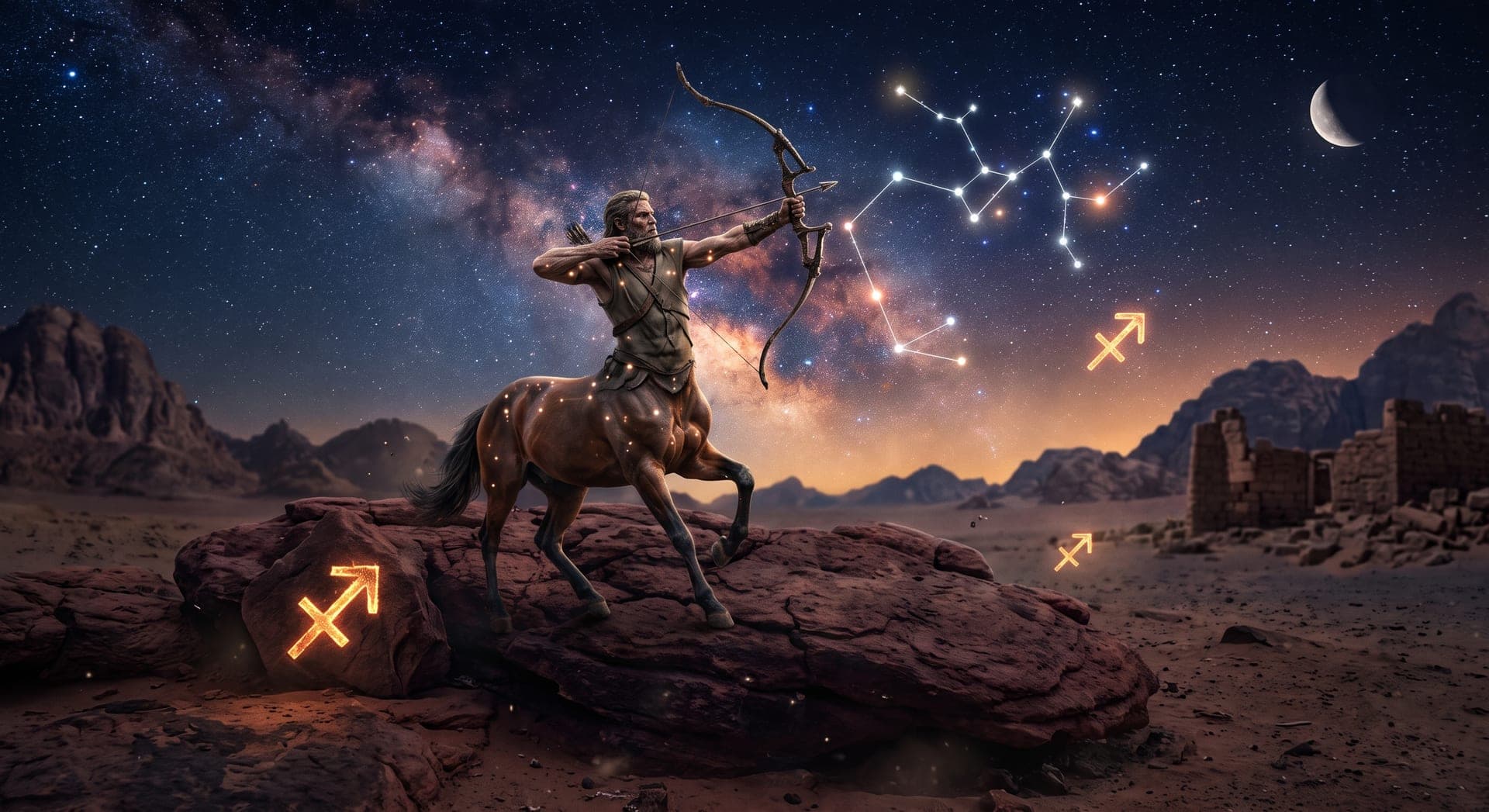
Sagittarius, the ninth sign of the zodiac, spans November 22 to December 21 and is symbolized by the archer, typically depicted as a centaur drawing a bow, representing a restless pursuit of knowledge, adventure, and far-off horizons. Ruled by Jupiter, the largest planet in the solar system and a symbol of growth, luck, and abundance, Sagittarius is widely regarded as one of the most optimistic and freedom-loving signs of the zodiac. As a Fire sign, Sagittarius approaches life with enthusiasm and a genuine hunger for new experiences, whether through literal travel or intellectual and philosophical exploration. Its Mutable modality reflects a deep aversion to routine and confinement, always looking toward the next adventure rather than settling into fixed patterns. People born under this sign are often drawn to travel, higher education, philosophy, or any pursuit that broadens their horizons and understanding of the world. Sagittarius's honesty and optimism make it excellent company, though its blunt directness and restless need for freedom can sometimes come across as tactless or noncommittal to those seeking more stability.
Personality Traits
Strengths
- Adventurous and open to new experiences
- Optimistic and enthusiastic
- Honest and direct
- Philosophical and broad-minded
- Generous and good-humored
Weaknesses
- Tactlessly blunt
- Impatient with routine
- Prone to overpromising
- Restless and commitment-averse
- Careless with details
Compatible Signs
Fun Facts
- Sagittarius's symbol, a centaur drawing a bow and arrow, connects to the Greek myth of Chiron, a wise and scholarly centaur unlike the more unruly members of his kind.
- Jupiter, Sagittarius' ruling planet, is the largest planet in the solar system, reflecting the sign's association with expansion, abundance, and big-picture thinking.
- Sagittarius is one of two zodiac signs, along with Capricorn, represented by a hybrid creature combining human and animal features.
- Notable Sagittarians include Taylor Swift, Walt Disney, Winston Churchill, and Jimi Hendrix.
- Sagittarius season spans the lead-up to the winter solstice, a period historically associated with travel, feasting, and philosophical reflection in many cultures.
Born on December 18
- 1662
James Douglas, 2nd Duke of Queensberry
Scottish statesman who, as Lord High Commissioner to the Scottish Parliament, steered through the 1707 Act of Union that created the united Kingdom of Great Britain, earning him the nickname 'the Union Duke.'
- 1707
Charles Wesley
English clergyman and hymn writer who, with his brother John, co-founded the Methodist movement and wrote thousands of hymns including 'Hark! The Herald Angels Sing.'
- 1870
Saki (H. H. Munro)
British writer, born Hector Hugh Munro, celebrated for sharp, darkly witty short stories such as 'The Open Window'; he was killed in action in the First World War.
- 1878
Joseph Stalin
Soviet leader who ruled the USSR for over two decades
- 1879
Paul Klee
Swiss-German painter
- 1886
Ty Cobb
American Major League Baseball player
- 1888
Gladys Cooper
English stage and film actress whose career spanned Edwardian musical theatre to Hollywood, earning three Academy Award nominations later in life.
- 1908
Celia Johnson
English actress best remembered for her performance as Laura Jesson in David Lean's Brief Encounter, one of British cinema's most acclaimed films.
- 1916
Betty Grable
American actress and dancer
- 1938
Chas Chandler
English bassist with The Animals who went on to manage and shape the early career of Jimi Hendrix, playing a pivotal role in bringing him to Britain.
- 1943
Keith Richards
English guitarist and co-founder of the Rolling Stones, celebrated as one of rock music's most influential riff-writers and songwriters.
- 1946
Steven Spielberg
American film director and producer
- 1963
Brad Pitt
American actor and producer
- 1964
"Stone Cold" Steve Austin
American professional wrestler
- 2001
Billie Eilish
American singer-songwriter

On This Day in History
- 1271
Kublai Khan formally establishes the Yuan dynasty, marking the beginning of Mongol rule over China.
Kublai Khan's establishment of the Yuan dynasty represented a deliberate effort to legitimize Mongol rule over China by adopting a traditional Chinese dynastic name and governing structure, rather than ruling purely as foreign conquerors. His subsequent reign would see the completion of the Mongol conquest of China and significant expansion of trade and cultural exchange along routes including the Silk Road.
- 1655
The Whitehall Conference concludes that no English law prevents Jews from returning to England after centuries of expulsion.
The Whitehall Conference, convened by Oliver Cromwell to consider formally readmitting Jews to England after their expulsion nearly 400 years earlier, ultimately reached no formal legal resolution but effectively allowed Jewish resettlement to proceed informally. This unofficial toleration gradually solidified into accepted practice, allowing a Jewish community to reestablish itself in England for the first time in centuries.
- 1655
The Whitehall Conference concluded that no law barred Jews from resettling in England.
Convened by Oliver Cromwell to consider Menasseh ben Israel's petition, the conference of judges, merchants and clergy could not agree on a formal readmission policy, but found no legal barrier remained from the 1290 Edict of Expulsion. The ambiguous ruling effectively opened the way for Jewish resettlement in England after more than three and a half centuries of official exclusion.
- 1777
The United States marks its first national Thanksgiving following the American victory at the Battle of Saratoga.
The first American Thanksgiving proclaimed by the Continental Congress celebrated the pivotal American victory at the Battle of Saratoga, which had convinced France to formally recognize American independence and provide crucial military support. This early observance, distinct from the modern annual holiday established decades later, reflected the young nation's practice of declaring thanksgiving for specific significant events.
- 1787
New Jersey ratifies the U.S. Constitution, becoming the third state to do so.
New Jersey's ratification of the Constitution came swiftly and with little internal opposition, reflecting the state's economic interests in supporting a stronger federal government capable of regulating interstate commerce. As the third state to ratify, New Jersey helped build early momentum toward the nine-state threshold required for the Constitution to take effect.
- 1865
Secretary of State William Seward announces the adoption of the Thirteenth Amendment, abolishing slavery nationwide.
Secretary of State Seward's announcement formally certified that the required three-quarters of states had ratified the Thirteenth Amendment, permanently abolishing slavery throughout the United States. The amendment represented the culmination of the abolitionist movement's decades-long struggle and fulfilled the promise begun with Lincoln's wartime Emancipation Proclamation two years earlier.
- 1865
US Secretary of State William Seward proclaimed the ratification of the Thirteenth Amendment, abolishing slavery throughout the United States.
The amendment's ratification, completed when Georgia became the 27th state to approve it, formally ended chattel slavery across the country less than a year after the Confederacy's defeat in the Civil War. It built on the wartime Emancipation Proclamation, which had freed enslaved people only in Confederate territory, extending abolition nationwide and reshaping the constitutional foundation of American citizenship.
- 1892
Tchaikovsky's ballet "The Nutcracker" premieres in Saint Petersburg, Russia.
Tchaikovsky's ballet "The Nutcracker," based on a story by E.T.A. Hoffmann, received a mixed critical reception at its premiere despite the composer's now-iconic score. The ballet's popularity grew enormously over subsequent decades, particularly in the United States, where it became an essential annual holiday tradition for countless dance companies and audiences.
- 1892
Tchaikovsky's ballet The Nutcracker received its premiere at the Mariinsky Theatre in Saint Petersburg.
The two-act ballet, based on E.T.A. Hoffmann's story and choreographed by Lev Ivanov after Marius Petipa fell ill, received a mixed critical reception at its first performance. Despite the lukewarm debut, the score became one of Tchaikovsky's most beloved works, and the ballet grew into a worldwide Christmas tradition performed by companies every winter season.
- 1898
Gaston de Chasseloup-Laubat set the first officially recognized land speed record, reaching 39.245 mph in an electric car.
Driving a Jeantaud electric vehicle over a measured course near Achères, France, the French count clocked 63.159 km/h, a speed that seems modest today but represented the fastest a human had ever travelled on land under controlled, timed conditions. His record kicked off a fierce rivalry with fellow pioneer Camille Jenatzy, launching land speed racing as a sport.
- 1916
The Battle of Verdun concludes after French forces push German troops back during World War I.
The Battle of Verdun, one of the longest and costliest battles of World War I, inflicted staggering casualties on both French and German forces over nearly ten months of grinding attritional warfare centered on a symbolically significant French fortress city. The battle's enormous human cost made it a lasting symbol of the war's futility and horror in French national memory.
- 1939
RAF bombers clashed with German fighters over the Heligoland Bight in the first major air battle of the Second World War.
A formation of RAF Wellington bombers attempted a daylight raid on German warships near Wilhelmshaven, but was intercepted by Luftwaffe fighters, which shot down more than half the attacking force. The heavy losses forced RAF Bomber Command to abandon unescorted daylight bombing raids over Germany and shift toward night operations for the remainder of the war.
- 1958
Project SCORE launches as the world's first communications satellite, broadcasting a recorded message from President Eisenhower.
Project SCORE, launched hastily as a Cold War propaganda demonstration ahead of a planned Soviet announcement, became the first satellite to relay a communications signal from space, broadcasting a recorded Christmas message from President Eisenhower to the world below. Though short-lived, the mission proved the basic feasibility of satellite communications that would later revolutionize global telecommunications.
- 1958
The United States launched Project SCORE, the world's first communications satellite.
Broadcasting a recorded Christmas message from President Dwight D. Eisenhower, SCORE relayed the first voice transmission from space, demonstrating that satellites could receive, store and retransmit signals. Though it operated for only a few weeks before its batteries failed, the mission proved the basic concept behind the communications satellites that would later carry telephone calls and television broadcasts around the globe.
- 1972
President Nixon launched Operation Linebacker II, an intensive bombing campaign against North Vietnam.
Ordered after peace talks with North Vietnam collapsed, the campaign sent American B-52 bombers against Hanoi and Haiphong over eleven days, becoming known as the 'Christmas bombings.' It was the largest heavy bomber strike since the Second World War and drew international criticism for its intensity. The pressure contributed to North Vietnam's return to the negotiating table, leading to the Paris Peace Accords weeks later.
- 2015
Kellingley Colliery in North Yorkshire closed as the last deep coal mine in Great Britain.
The closure of the Yorkshire pit, once one of Europe's largest, brought centuries of British deep coal mining to an end. At its peak the industry had employed over a million miners and powered the nation's factories, railways and homes. Kellingley's shutdown, following the earlier decline of the coalfields after the 1984-85 miners' strike, marked a symbolic close to a defining chapter of Britain's industrial history.
- 2019
The U.S. House of Representatives impeaches President Donald Trump for the first time.
The House of Representatives' impeachment of President Trump centered on charges of abuse of power and obstruction of Congress related to his dealings with Ukraine, making him just the third U.S. president in history to be impeached. The Senate would subsequently acquit him on both charges the following February, largely along party lines.
- 2019
The US House of Representatives voted to impeach President Donald Trump for the first time.
Representatives approved two articles of impeachment, abuse of power and obstruction of Congress, stemming from Trump's dealings with Ukraine over investigations into a political rival. The vote made Trump only the third US president to be impeached. The Senate acquitted him on both charges the following February, largely along party lines.
- 2022
Argentina defeats France in the FIFA World Cup final on penalty kicks after a dramatic 3-3 draw.
Argentina's dramatic World Cup final victory over France, featuring a hat-trick from French striker Kylian Mbappé and a legendary performance from Argentina's Lionel Messi, is widely regarded as one of the greatest matches in World Cup history. The win delivered Argentina's third World Cup title and provided Messi with the one major trophy that had eluded his storied career.
- 2022
Argentina won the FIFA World Cup final, beating defending champions France on penalties after a dramatic 3-3 draw.
Lionel Messi scored twice and set up another as Argentina built a two-goal lead, only for Kylian Mbappé's hat-trick to force extra time and then penalties at Lusail Stadium in Qatar. Argentina prevailed 4-2 in the shootout, securing Messi's first World Cup title in what many regarded as the greatest World Cup final ever played.