
What’s Observed on December 17
Born on December 17: Sagittarius ♐
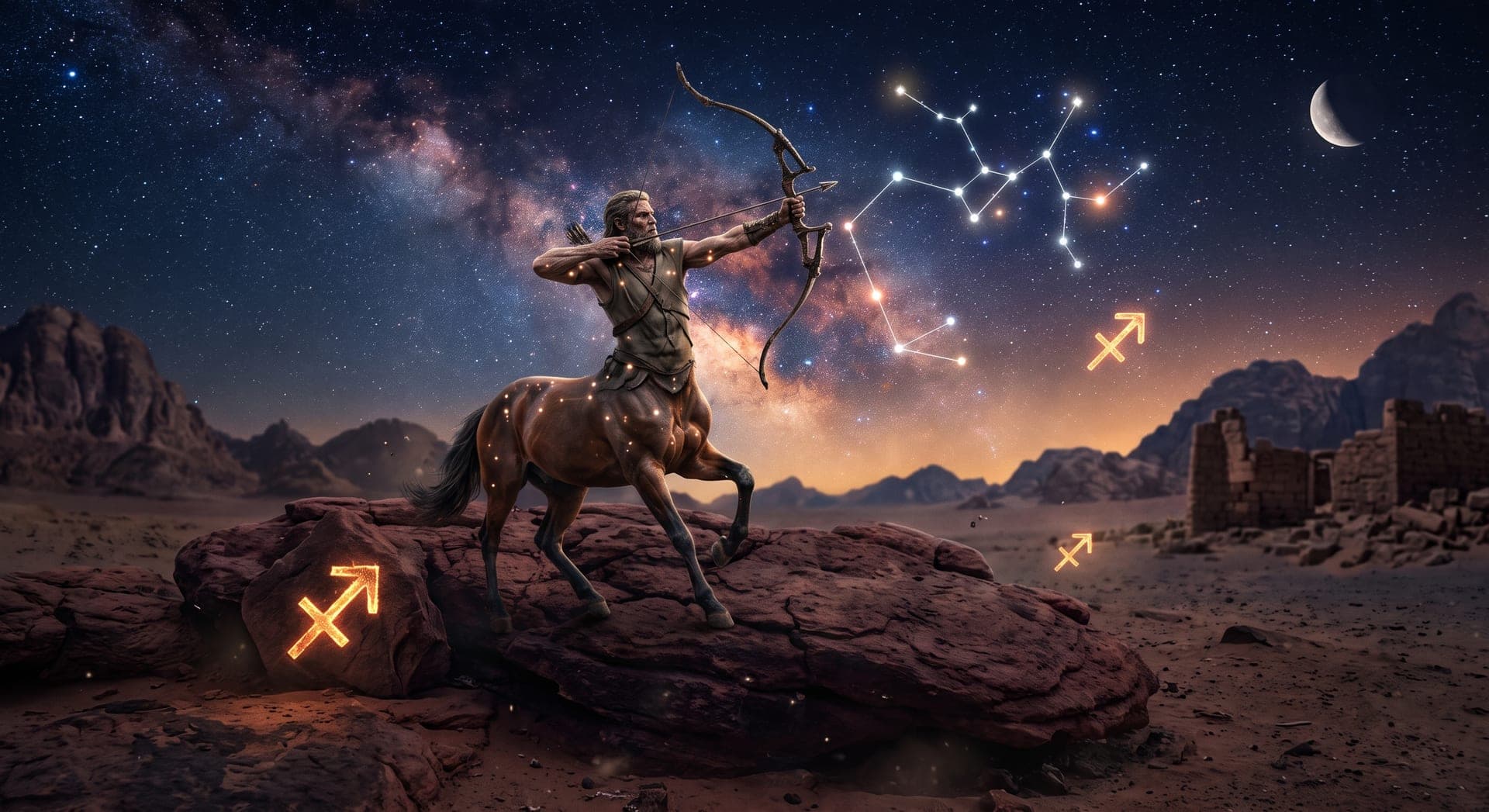
Sagittarius, the ninth sign of the zodiac, spans November 22 to December 21 and is symbolized by the archer, typically depicted as a centaur drawing a bow, representing a restless pursuit of knowledge, adventure, and far-off horizons. Ruled by Jupiter, the largest planet in the solar system and a symbol of growth, luck, and abundance, Sagittarius is widely regarded as one of the most optimistic and freedom-loving signs of the zodiac. As a Fire sign, Sagittarius approaches life with enthusiasm and a genuine hunger for new experiences, whether through literal travel or intellectual and philosophical exploration. Its Mutable modality reflects a deep aversion to routine and confinement, always looking toward the next adventure rather than settling into fixed patterns. People born under this sign are often drawn to travel, higher education, philosophy, or any pursuit that broadens their horizons and understanding of the world. Sagittarius's honesty and optimism make it excellent company, though its blunt directness and restless need for freedom can sometimes come across as tactless or noncommittal to those seeking more stability.
Personality Traits
Strengths
- Adventurous and open to new experiences
- Optimistic and enthusiastic
- Honest and direct
- Philosophical and broad-minded
- Generous and good-humored
Weaknesses
- Tactlessly blunt
- Impatient with routine
- Prone to overpromising
- Restless and commitment-averse
- Careless with details
Compatible Signs
Fun Facts
- Sagittarius's symbol, a centaur drawing a bow and arrow, connects to the Greek myth of Chiron, a wise and scholarly centaur unlike the more unruly members of his kind.
- Jupiter, Sagittarius' ruling planet, is the largest planet in the solar system, reflecting the sign's association with expansion, abundance, and big-picture thinking.
- Sagittarius is one of two zodiac signs, along with Capricorn, represented by a hybrid creature combining human and animal features.
- Notable Sagittarians include Taylor Swift, Walt Disney, Winston Churchill, and Jimi Hendrix.
- Sagittarius season spans the lead-up to the winter solstice, a period historically associated with travel, feasting, and philosophical reflection in many cultures.
Born on December 17
- 1778
Humphry Davy
English chemist known for isolating several chemical elements
- 1873
Ford Madox Ford
English novelist and critic celebrated for The Good Soldier and the Parade's End tetralogy, and for founding influential literary journals that championed modernist writing.
- 1874
William Lyon Mackenzie King
10th Prime Minister of Canada
- 1884
Alison Uttley
English author beloved for the Little Grey Rabbit series and the classic children's fantasy A Traveller in Time.
- 1894
Arthur Fiedler
American orchestra conductor
- 1905
Simo Häyhä
Finnish sniper known for his service in the Winter War
- 1916
Penelope Fitzgerald
English novelist who won the Booker Prize for Offshore and was celebrated late in life for spare, precisely observed fiction such as The Blue Flower.
- 1934
Ray Wilson
English footballer who played left-back in England's 1966 World Cup-winning team, regarded as one of the finest defenders of his generation.
- 1936
Pope Francis
Head of the Catholic Church
- 1936
Tommy Steele
English singer and actor often called Britain's first rock and roll star, who topped the charts with 'Singing the Blues' before becoming a stage and film favourite.
- 1956
Dominic Lawson
English journalist and author who edited The Spectator and The Sunday Telegraph, known for incisive political commentary.
- 1973
Paula Radcliffe
English long-distance runner and three-time London Marathon champion whose 2003 marathon world record stood for sixteen years.
- 1974
Sarah Paulson
American actress
- 1975
Milla Jovovich
Ukrainian-American actress and model
- 1978
Manny Pacquiao
Filipino boxer and politician
On This Day in History
- 497 BCE
The first Saturnalia festival is celebrated in ancient Rome, honoring the god Saturn with feasting and gift-giving.
Saturnalia was one of ancient Rome's most popular festivals, involving feasting, gift-giving, and a temporary suspension of ordinary social norms in which enslaved people were permitted certain privileges and role reversals occurred between social classes. Many scholars believe elements of Saturnalia's traditions, including gift-giving and midwinter feasting, later influenced Christian Christmas customs as Christianity spread through the Roman Empire.
- 1538
Pope Paul III excommunicates King Henry VIII of England over his break from the Catholic Church.
Pope Paul III's excommunication of Henry VIII followed years of escalating conflict after the English king broke from Rome to establish the Church of England, primarily driven by his desire to annul his marriage to Catherine of Aragon. The excommunication formalized the religious schism that would permanently separate England from Catholic Church authority.
- 1538
Pope Paul III formally excommunicated King Henry VIII, cutting him off from the Catholic Church.
The bull followed years of tension after Henry's break with Rome, culminating in his campaign against Catholic shrines in England, including the destruction of Thomas Becket's shrine at Canterbury. Long threatened but repeatedly delayed for diplomatic reasons, the excommunication formalized the religious schism that had begun with Henry's split from papal authority and the creation of the Church of England.
- 1665
The first published account of a blood transfusion appeared in the Royal Society's Philosophical Transactions.
English physician Richard Lower described his transfusion experiments in a letter to fellow scientist Robert Boyle, printed in the Royal Society's journal. Lower had spent the year successfully transfusing blood between dogs, laying early groundwork for the science of transfusion medicine. The publication marked one of the Royal Society's first notable contributions to what became a cornerstone of modern medicine.
- 1718
Great Britain declared war on Spain as part of the War of the Quadruple Alliance.
The declaration followed Spanish attempts under chief minister Cardinal Alberoni to reclaim territories in Italy lost after the War of the Spanish Succession. Britain joined France, Austria and the Dutch Republic in the Quadruple Alliance to check Spanish ambitions in the Mediterranean. The resulting war, fought largely at sea and in Sicily, ended in Spanish defeat by 1720.
- 1777
France formally recognizes American independence during the Revolutionary War.
France's formal recognition of American independence, secured largely through the diplomatic efforts of Benjamin Franklin following the American victory at Saratoga, marked a decisive turning point in the Revolutionary War. French military and financial support that followed proved essential to the eventual American victory, transforming what had been a colonial rebellion into a broader international conflict against Britain.
- 1903
The Wright brothers achieve the first controlled, powered, heavier-than-air flight at Kitty Hawk, North Carolina.
The Wright brothers' historic flight, piloted by Orville while Wilbur ran alongside steadying the wing, covered just 120 feet and lasted twelve seconds, yet represented the first time in history a heavier-than-air machine had achieved sustained, controlled flight under its own power. Their subsequent flights that same day extended the distance considerably, with the final flight covering 852 feet.
- 1903
The Wright brothers made the first controlled, powered flight in a heavier-than-air aircraft at Kitty Hawk, North Carolina.
Orville Wright piloted the Wright Flyer for 12 seconds over a distance of 120 feet, with his brother Wilbur running alongside. The brothers made three more flights that day, the longest covering 852 feet in 59 seconds. Their success, achieved after years of gliding experiments and wind-tunnel testing, launched the age of powered aviation and transformed transport and warfare within a generation.
- 1927
Indian revolutionary Rajendra Lahiri was hanged in Gonda jail, executed two days ahead of schedule.
Lahiri had been convicted for his part in the 1925 Kakori conspiracy, a train robbery organised by Hindustan Republican Association revolutionaries to fund the fight against British colonial rule in India. Authorities moved his execution date forward, reportedly to avoid public demonstrations. His death, alongside fellow conspirators executed the same week, made him one of the era's most memorialised martyrs of the Indian independence movement.
- 1928
Indian revolutionaries assassinated British police officer John Saunders in Lahore in a case of mistaken identity.
Bhagat Singh, Sukhdev Thapar and Shivaram Rajguru had set out to kill senior officer James Scott, whom they blamed for the fatal police beating of independence leader Lala Lajpat Rai weeks earlier, but shot Assistant Superintendent Saunders instead. The killing became one of the most famous acts of the Indian independence movement against British rule; all three assassins were later captured and executed in 1931.
- 1938
Chemist Otto Hahn discovers nuclear fission of uranium, laying groundwork for both nuclear energy and weapons.
Otto Hahn's discovery of nuclear fission, achieved through experiments bombarding uranium with neutrons, revealed that atomic nuclei could be split apart, releasing tremendous energy in the process. His colleague Lise Meitner, who had fled Nazi Germany due to her Jewish heritage, provided the crucial theoretical explanation for the phenomenon, though she was controversially excluded from the Nobel Prize later awarded for the discovery.
- 1938
German chemist Otto Hahn discovered nuclear fission, splitting the uranium atom for the first time.
Working with Fritz Strassmann in Berlin, Hahn found that bombarding uranium with neutrons produced lighter elements, a result that physicist Lise Meitner and her nephew Otto Frisch soon interpreted as the splitting, or fission, of the atomic nucleus. The discovery revealed the vast energy locked inside atoms and became the scientific foundation for both nuclear power and the atomic bomb developed during the Second World War.
- 1939
The German pocket battleship Admiral Graf Spee was scuttled outside Montevideo after a running battle with Royal Navy cruisers.
Cornered off South America by HMS Exeter, Ajax and Achilles in the Battle of the River Plate days earlier, the damaged Graf Spee took refuge in neutral Montevideo. Rather than face the pursuing British squadron in open water, Captain Hans Langsdorff had the ship scuttled in the estuary. It was one of the Royal Navy's first major victories of the Second World War, won without sinking the enemy in direct combat.
- 1944
The Malmedy massacre occurs during the Battle of the Bulge, as German troops kill unarmed American prisoners of war.
The Malmedy massacre saw German SS troops execute roughly 84 captured American soldiers in a field during the opening days of the Battle of the Bulge, one of the most notorious war crimes committed against American forces in the European theater. News of the massacre spread quickly among American troops, hardening their resolve during the remainder of the campaign.
- 1967
Australian Prime Minister Harold Holt disappears while swimming and is presumed drowned.
Harold Holt's disappearance while swimming in rough surf off the Victorian coast, with his body never recovered despite an extensive search, left Australia's sitting prime minister officially declared dead by presumed drowning. His sudden, unexplained disappearance spawned numerous conspiracy theories over the following decades, none of which have been substantiated.
- 1983
A Provisional IRA car bomb exploded outside Harrods department store in London, killing six people.
The bomb detonated on one of the busiest shopping days before Christmas, killing three police officers and three civilians and injuring dozens more. The IRA later claimed the attack had not been sanctioned by its leadership. The bombing remains one of the most notorious acts of Troubles-related violence carried out on English soil, and it hardened public revulsion against attacks on civilian targets.
- 1989
The animated series "The Simpsons" premieres with the episode "Simpsons Roasting on an Open Fire."
The Simpsons' debut episode introduced the dysfunctional but ultimately loving Simpson family to television audiences, initially as a Christmas special before the show transitioned to its regular weekly format the following month. It would go on to become the longest-running scripted primetime television series in American history, still in production decades later.
- 1996
Members of the Túpac Amaru Revolutionary Movement seize the Japanese embassy in Lima, Peru.
The Túpac Amaru Revolutionary Movement's seizure of the Japanese ambassador's residence in Lima, taking hundreds of hostages during a diplomatic reception, initiated a tense four-month standoff that ended when Peruvian special forces stormed the building in a dramatic rescue operation. The crisis drew significant international attention to Peru's ongoing internal conflict.
- 2003
The Soham murder trial concluded at London's Old Bailey with the conviction of school caretaker Ian Huntley.
Huntley was found guilty of murdering ten-year-olds Holly Wells and Jessica Chapman, whose disappearance from Soham, Cambridgeshire, in August 2002 had gripped Britain for weeks before their bodies were found. His girlfriend, Maxine Carr, was convicted of perverting the course of justice for providing him a false alibi. The case prompted major reforms to vetting checks for people working with children in Britain.
- 2010
Mohamed Bouazizi's self-immolation in Tunisia catalyzes the Tunisian Revolution and the broader Arab Spring.
Mohamed Bouazizi, a Tunisian street vendor who set himself on fire after officials confiscated his produce cart and allegedly humiliated him, became an unintended catalyst for widespread protests against corruption and authoritarian rule. His act of desperation sparked the Tunisian Revolution, which toppled the country's longtime president and ignited the broader wave of uprisings known as the Arab Spring.